-
-
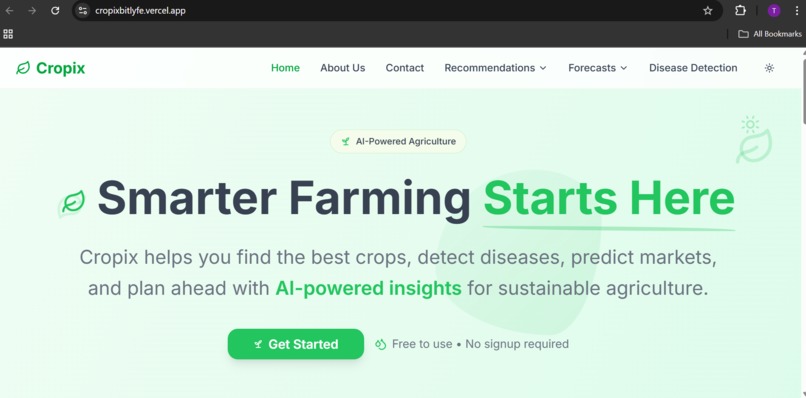
HomePage
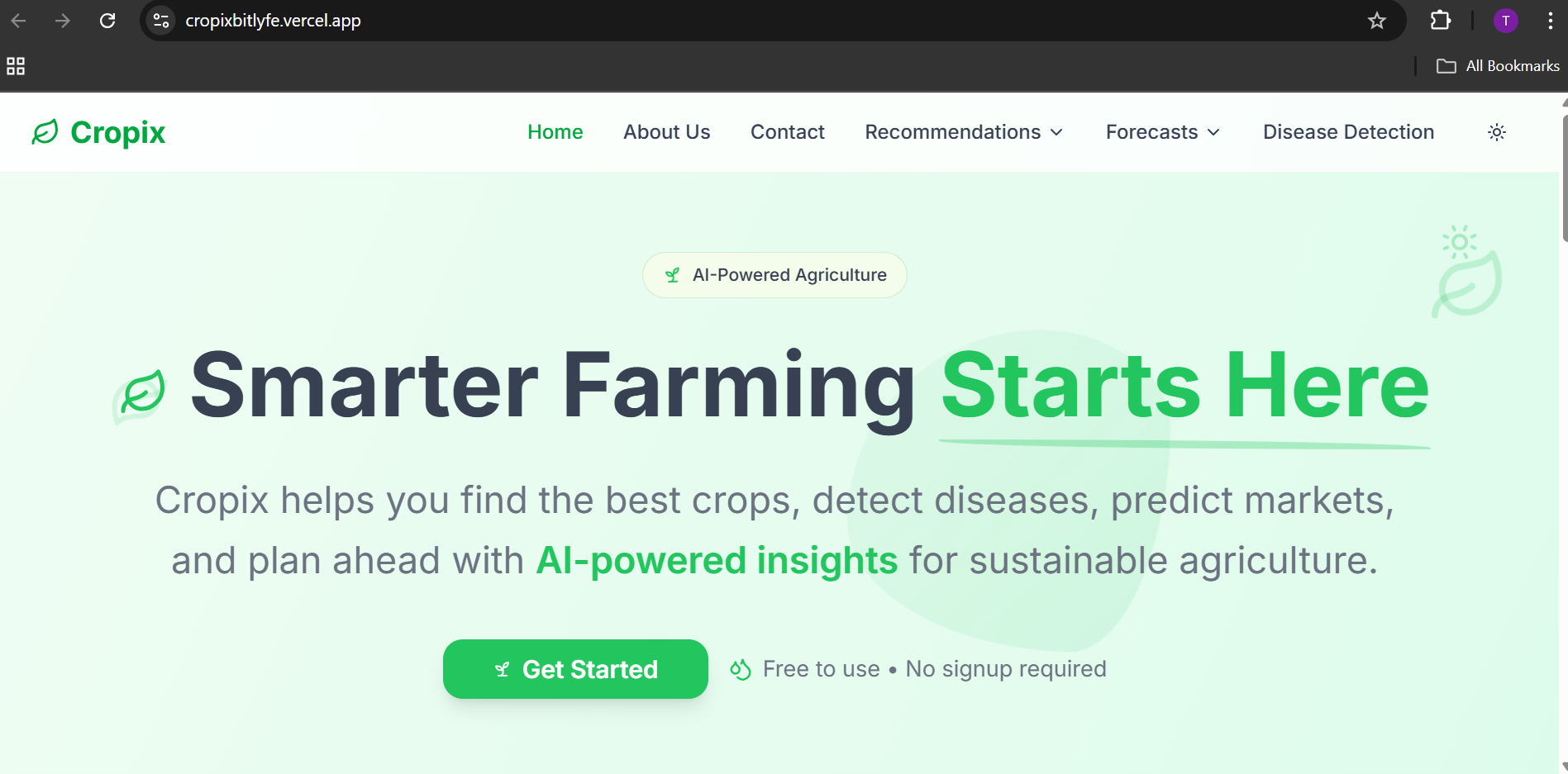
About the Cropix Project
Inspiration
The inspiration behind Cropix stemmed from a deep-seated desire to empower farmers with data-driven insights, especially in regions where traditional farming methods often face unpredictable challenges like climate change and soil degradation. We recognized the immense potential of machine learning and data science to transform agriculture, making it more sustainable, efficient, and profitable. The goal was to create a user-friendly platform that could bridge the gap between complex agricultural data and practical, actionable recommendations for farmers.
What We Learned
Throughout the development of Cropix, we embarked on a significant learning journey:
- Agricultural Science: We delved into the intricacies of soil science, crop physiology, and weather patterns, understanding how various factors influence yield and crop health. This involved researching different crop types, their optimal growing conditions, and common diseases.
- Machine Learning in Agriculture: We explored various machine learning models suitable for agricultural predictions, including K-Nearest Neighbors (KNN) for soil-crop recommendations, Random Forest for fertilizer recommendations, XGBoost for crop yield prediction, and Convolutional Neural Networks (CNN) for disease detection. We learned about feature engineering specific to agricultural datasets and the importance of robust model evaluation.
- Data Handling and Preprocessing: Working with diverse agricultural datasets presented challenges in data cleaning, normalization, and handling missing values. We learned to preprocess data effectively to ensure model accuracy and reliability.
- Full-Stack Development: From designing intuitive user interfaces with React and Next.js to building scalable backend APIs with Python and FastAPI, we gained hands-on experience in full-stack development, integrating various components seamlessly.
- Deployment and Scalability: Deploying machine learning models and web applications to cloud platforms like Hugging Face Spaces and understanding containerization with Docker were crucial learning points for ensuring the project's accessibility and scalability.
How We Built It
The Cropix project was built with a modular and scalable architecture, leveraging modern web and machine learning technologies:
Frontend (React & Next.js):
- We used Next.js for server-side rendering and routing, providing a fast and responsive user experience.
- React components were developed for each feature (Soil Crop Recommendation, Fertilizer Recommendation, Crop Yield Prediction, Disease Detection, Market Forecast, Weather Forecast), ensuring a clean and maintainable codebase.
- Tailwind CSS was utilized for rapid and consistent styling, allowing for a modern and visually appealing interface.
-
framer-motionwas integrated for smooth animations and transitions, enhancing the user experience.
Backend (Python & FastAPI):
- FastAPI was chosen for its high performance and ease of use in building robust APIs.
- Each machine learning model was integrated as a separate endpoint, allowing for independent scaling and management.
- Data preprocessing and model inference logic were encapsulated within these endpoints.
- The backend was containerized using Docker for consistent deployment across different environments.
Machine Learning Models:
- Soil Crop Recommendation: Implemented using a KNN classifier, trained on soil nutrient data (N, P, K, pH, etc.) and corresponding optimal crops.
- Fertilizer Recommendation: A Random Forest Regressor was used to predict optimal fertilizer amounts based on soil and crop data.
- Crop Yield Prediction: An XGBoost Regressor was employed for its ability to handle tabular data and provide accurate yield predictions.
- Disease Detection: A pre-trained Convolutional Neural Network (CNN) was fine-tuned for image classification, identifying plant diseases from leaf images.
- Market Forecast: A Long Short-Term Memory (LSTM) model was used for time-series forecasting of weekly crop prices.
Deployment:
- The backend APIs were deployed on Hugging Face Spaces, providing a convenient and accessible platform for our machine learning models.
- The frontend application was deployed separately, connecting to the backend APIs.
Challenges We Faced
Building Cropix was not without its challenges:
- Data Acquisition and Quality: Obtaining clean, comprehensive, and diverse agricultural datasets was a significant hurdle. Many datasets were fragmented, inconsistent, or required extensive preprocessing.
- Model Selection and Optimization: Choosing the right machine learning model for each specific agricultural problem required careful experimentation and evaluation. Optimizing hyperparameters and ensuring model generalization were iterative processes.
- Integration of Diverse Models: Integrating five different machine learning models, each with its own input requirements and output formats, into a single cohesive backend API was complex. Ensuring smooth data flow between the frontend and these diverse models was crucial.
- Real-time Performance: For features like disease detection, achieving near real-time inference while maintaining accuracy was a challenge, especially when dealing with image processing.
- User Experience Design: Translating complex agricultural concepts and machine learning outputs into an intuitive and user-friendly interface for farmers was a continuous design challenge. We aimed to make the platform accessible to users with varying levels of technical expertise.
- Deployment and Infrastructure: Managing dependencies, ensuring compatibility between different software versions, and optimizing deployment for cost-effectiveness and performance were ongoing challenges. The
net::ERR_ABORTEDerrors encountered during development highlighted the complexities of web deployment and caching.
Despite these challenges, the development of Cropix has been a rewarding experience, pushing the boundaries of what's possible in agricultural technology. We believe Cropix has the potential to make a real difference in the lives of farmers, contributing to a more sustainable and productive agricultural future.
Built With
- fastapi
- huggingface
- nexjs
- python
- react
- tailwindcss
- typescript
- vercel


Log in or sign up for Devpost to join the conversation.