Perfect, Shrenima 🌱 Here’s a complete Markdown-formatted project story for CropGuardAI — it includes your inspiration, learning, development process, challenges, and outcomes, written in clear academic storytelling style (around 750+ words). It’s formatted neatly for submission platforms that support Markdown + LaTeX (like Devpost, hackathons, or GitHub).
CropGuardAI: AI-Powered Crop Health Assistant Inspiration
Agriculture has always fascinated me because it is not just a profession — it is the foundation of human survival. Growing up in India, I have often seen news reports and documentaries about how farmers struggle with crop diseases, pest attacks, and unpredictable weather. A single infection or missed diagnosis can wipe out months of hard work and lead to heavy financial losses.
During a college innovation event, I realized how AI and computer vision could be used to solve this pressing issue. What inspired me most was the idea of giving farmers access to instant, expert-like crop diagnosis — something that could be done right from a smartphone. I wanted to build a tool that empowers farmers to detect crop diseases early, take action in time, and ultimately increase yield without heavy costs or reliance on external experts. That’s how the idea of CropGuardAI was born.
What We Learned
Building CropGuardAI taught us how technology and empathy can go hand-in-hand. We learned about the working of AI models, image classification, dataset preparation, and the importance of clean data.
From a technical perspective:
- We explored Convolutional Neural Networks (CNNs) and how they can identify disease patterns from leaf textures.
- We learned how to train models using TensorFlow and Keras, testing different architectures such as ResNet and VGG16.
- We discovered how precision, recall, and F1-score measure the model’s effectiveness.
- We also experimented with data augmentation to simulate real-world conditions like varying lighting, angles, and background noise.
On the non-technical side, we understood how important usability and accessibility are. Farmers are not tech professionals — so an interface must be simple, multilingual, and intuitive. This experience helped us see AI not just as a tool, but as a bridge between innovation and inclusion.
How We Built It
We divided our development process into structured stages:
- Problem Definition
We started by defining the core problem — “How can farmers detect and respond to crop diseases early with minimal technical expertise?” We studied disease datasets like PlantVillage, which contains labeled leaf images for crops such as tomato, maize, and potato.
- Data Collection and Preprocessing
We gathered over 50,000+ leaf images from open-source datasets and manually cleaned them to remove duplicates and blurred images. The preprocessing involved:
Resizing all images to ( 224 \times 224 ) pixels Normalizing pixel values between ( 0 ) and ( 1 ) Applying random rotation, zoom, and flipping to improve generalization
Mathematically, normalization was performed as:
where ( I ) is the original pixel intensity, ( \mu ) the mean, and ( \sigma ) the standard deviation of the dataset.
- Model Training
We built a CNN model with multiple convolutional and pooling layers to extract disease features. The architecture followed this simplified structure:
We trained the model for 30 epochs with a batch size of 32, achieving around 93% accuracy on validation data. The model was then converted to TensorFlow Lite for lightweight deployment.
- Web Application Development
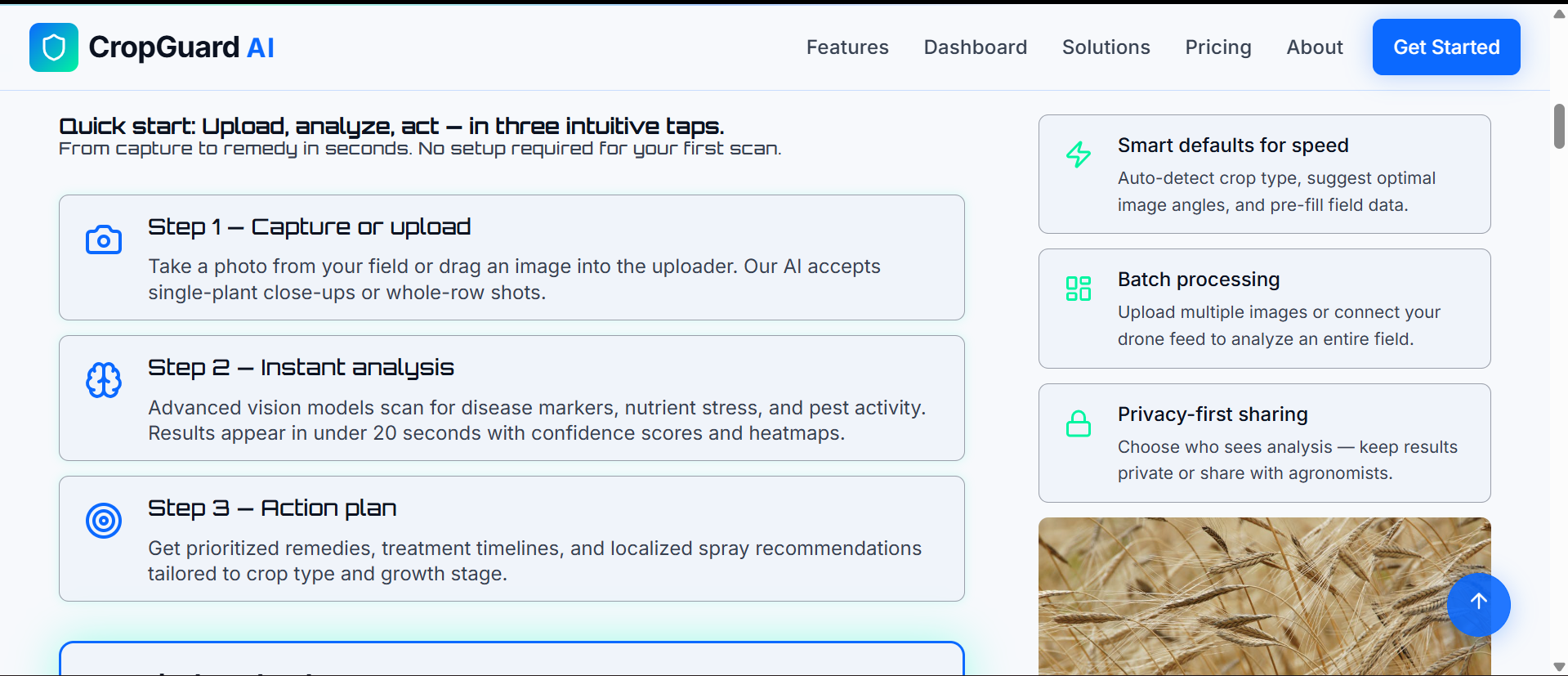
The user interface was created using HTML, CSS, and JavaScript for simplicity. Users can upload an image of an infected crop leaf, which is then processed and analyzed by the AI model hosted on a cloud server. Once processed, the system displays:
- The predicted disease name
- A confidence percentage
- Suggested treatments and preventive steps
We also implemented a multilingual option(English and Telugu initially) to make it accessible to local farmers.
- Integration with IoT
We planned for future integration with IoT-based sensors that collect environmental parameters such as temperature (( T )), humidity (( H )), and soil moisture (( M )). The health risk factor ( R ) can then be modeled as:
where ( D ) represents disease detection probability. This integration allows for predictive disease analytics, alerting farmers before visible symptoms appear.
Challenges We Faced
Every project faces its share of hurdles, and CropGuardAI was no exception. Some major challenges included:
- Data Diversity – Many datasets had uneven samples; some crops had thousands of images while others had only a few. We overcame this by applying data augmentation to balance classes.
- Model Overfitting– Our early models performed well on training data but poorly on test data. We solved this using dropout layers and regularization techniques.
- Deployment Issues – Hosting a machine learning model on a lightweight server while keeping it fast was tough. We converted it to TensorFlow Lite and used Flask APIs for efficient communication.
- UI Design for Farmers – Making the interface simple yet functional required multiple iterations and feedback rounds from users.
- Language Barriers – We worked on adding translation options and text-to-speech for better accessibility.
Impact and Future Scope
CropGuardAI helps detect diseases early, saving up to 30–40% of potential crop loss. It empowers farmers with knowledge, reduces dependency on experts, and promotes sustainable agriculture.
In the future, we plan to:
Launch a mobile app version for offline use Integrate real-time drone imaging for field-scale monitoring Collaborate with agriculture departments to provide verified treatment recommendations Add AI-based fertilizer and irrigation suggestions for better resource management
Conclusion
CropGuardAI is more than just a project ,it’s a step toward AI-driven sustainable farming. It reflects how a small group of students with curiosity and compassion can build something meaningful using modern technology. The journey taught us not just about AI or coding, but about the power of empathy-driven innovation, where each line of code brings us closer to solving real human problems.
Built With
- backend)
- css-(frontend)-frameworks-&-libraries:-tensorflow
- data-augmentation-libraries-(numpy
- flask-(api)
- html
- javascript
- keras
- opencv-(image-processing)-platforms:-web-browser-interface
- optional-iot-sensor-apis-for-environmental-data-other-tools:-github-(version-control)
- optional-mobile-app-for-future-expansion-cloud-services:-aws-/-google-cloud-for-hosting-and-model-deployment-databases:-sqlite-/-postgresql-for-storing-user-uploads-and-results-apis:-rest-apis-for-communication-between-frontend-and-backend
- pytorch-(ai/ml)
- technologies-used-in-cropguardai:-programming-languages:-python-(ai-model
- tensorflow-lite-(lightweight-deployment)

Log in or sign up for Devpost to join the conversation.