Inspiration
Farmers often have to identify crop problems from visible symptoms, but early signs can be subtle and difficult to recognize. We wanted to create a simple solution where a farmer could use a smartphone camera to get an early indication of crop-health issues. Our inspiration was to make computer vision practical, accessible, and useful for farmers, especially when expert agricultural support may not be immediately available.
What it does
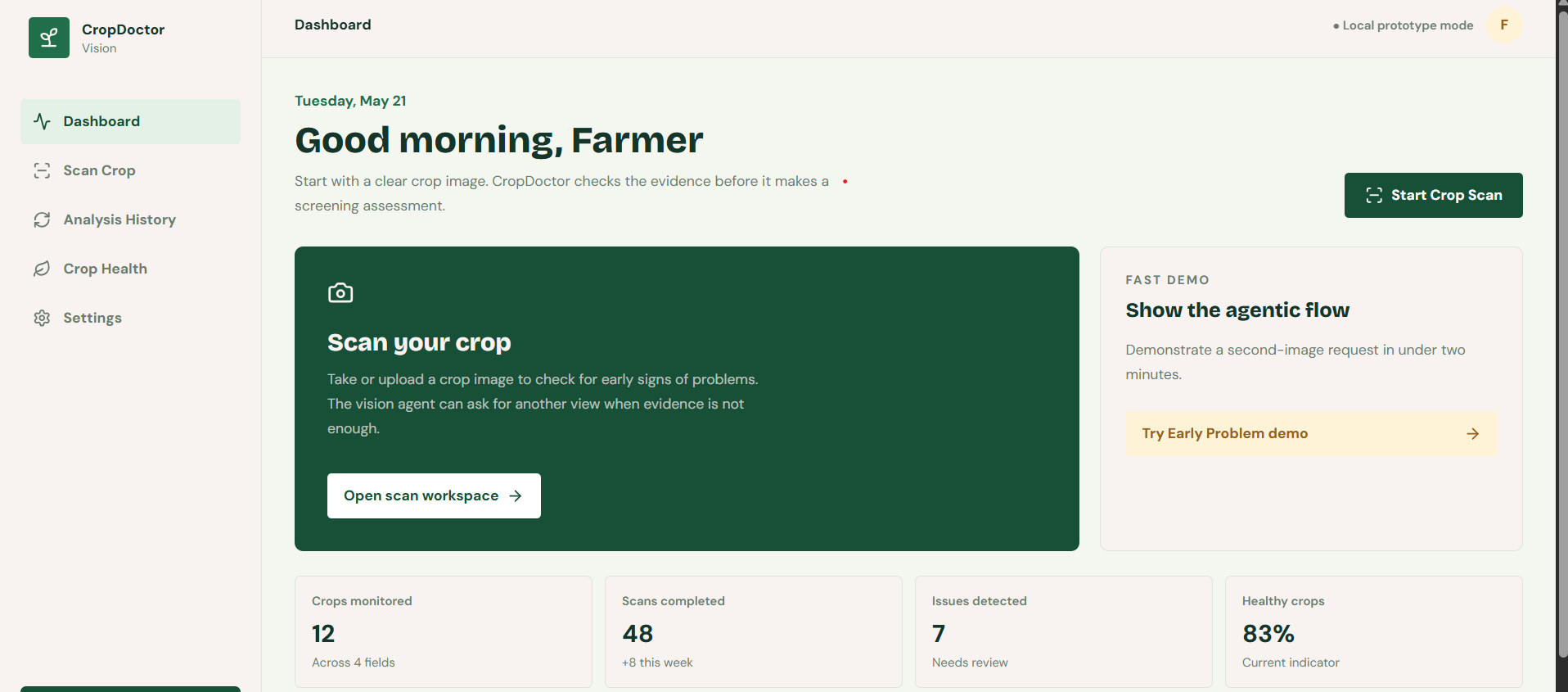
CropDoctor Vision analyzes crop images using computer vision to identify potential signs of crop-health problems. It checks image quality, analyzes visible symptoms, highlights affected areas, and provides an easy-to-understand assessment.
Instead of blindly trusting a single image, the system can recognize when the visual evidence is insufficient and request another image or viewing angle. This creates an observe → verify → decide workflow.
The goal is to help farmers detect potential problems earlier, reduce avoidable crop losses, and make more informed decisions.
How we built it
We built CropDoctor Vision by combining OpenCV 5, AI/ML, agentic reasoning, and AWS services.
OpenCV is used for image preprocessing, quality assessment, segmentation, and visual feature analysis. AI/ML models analyze crop conditions and identify potential abnormalities. An AI agent evaluates the available visual evidence and determines whether additional information is required before providing an assessment.
AWS provides the cloud infrastructure for processing, storing, and managing the application's data and services.
Challenges we ran into
Real-world crop images are unpredictable. Lighting, blur, camera angle, background objects, leaf orientation, and image quality can significantly affect computer-vision results.
Another challenge was avoiding overconfident results. We wanted the system to recognize uncertainty instead of giving a conclusion when there was not enough visual evidence. Designing the verification workflow and making the results understandable to farmers were important challenges.
Accomplishments that we're proud of
We are proud of building a system where computer vision does more than simply classify an image. CropDoctor Vision can use visual evidence to determine what should happen next.
The combination of OpenCV-based analysis and an AI agent creates a more interactive workflow where the system can request additional visual information when necessary.
Most importantly, we focused on the farmer's experience: turning a simple crop photograph into clear, actionable information rather than presenting complicated technical results.
What we learned
We learned that successful computer vision in the real world requires more than a trained model. Image quality, preprocessing, uncertainty, and the context surrounding an image all matter.
We also learned how OpenCV can be integrated into an agentic vision pipeline, where visual information influences the AI's next decision instead of being used only for a final prediction.
What's next for CropDoctor Vision
Our next step is to expand CropDoctor Vision to support more crops, conditions, and real-world environments.
We plan to add offline and low-connectivity support for rural areas, more crop and disease categories, multi-angle crop verification, crop-health history and monitoring, location-based crop-health insights, farmer-friendly regional language support, expert verification and escalation, and early-warning trends for recurring crop problems.
Our long-term vision is to make CropDoctor Vision a reliable first layer of crop-health screening, helping farmers identify potential problems earlier and connect with appropriate agricultural expertise when needed.
Built With
- kleap.io
- lovable

Log in or sign up for Devpost to join the conversation.