Inspiration
As the world approaches 2030, the risk of failing to meet the Paris Agreement looms larger. A global temperature increase of 1.5°C will have significant consequences, especially in agriculture. While cooler regions like North America and Europe may see a 5% increase in wheat yields (rainfall permitting), vulnerable areas such as India, Central America, and Africa could face yield declines of 3% or more. This is due to an increase in natural disasters, shifting climate conditions, and a rise in pest populations that threaten crops. Farmers need to be prepared for these challenges in advance, which is why we created CropCast.
What it does
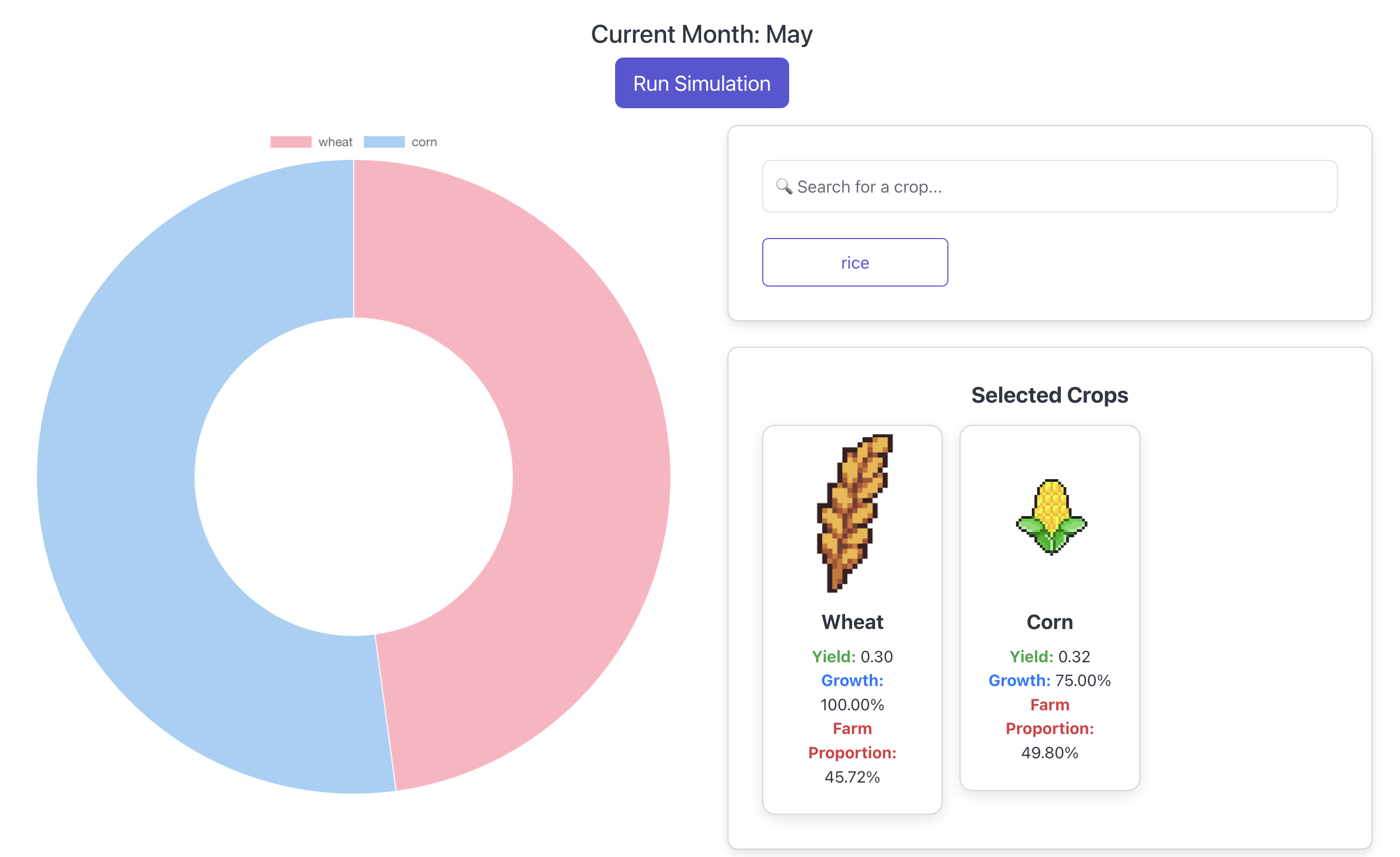
CropCast is a simulation tool that predicts crop yields (rice, wheat, and corn) under a 1.5°C temperature increase scenario. It tailors predictions to a farmer’s specific location, using a weather dataset from 2030 that models temperature, precipitation, humidity, and more.
Additionally, we leverage Claude AI to assess the probabilities of natural disasters like hurricanes and droughts based on the predicted weather data. Our system processes structured weather data and feeds it into Claude, where advanced prompt engineering (including few-shot prompting and test cases) refines the accuracy of disaster predictions.
Beyond climate conditions, CropCast also factors in crop diseases and flooding risks:
- Disease Spread: A diffusion model calculates the spread of infections using variables like diffusion coefficient, infection probability, and initial sickness values.
- Flooding & Yield Estimation: The system simulates crop health and yield values based on environmental stressors, allowing users to visualize potential outcomes.
How we built it
- Weather Simulation: We compiled a climate dataset for 2030, assuming a 1.5°C increase in global temperatures.
- Natural Disaster Prediction: Using Claude AI, we structured weather data into detailed inputs and refined our prompts via Claude’s workbench to ensure high accuracy.
- Mathematical Models: We implemented disease spread models (Multisource BFS) and flooding simulations to quantify agricultural risks.
- Yield Prediction: By combining weather patterns, disaster probabilities, and environmental stressors, the system estimates crop growth, health, and yield outcomes.
What's next for CropCast
Enhancing Claude’s Accuracy with RAG: We plan to improve disaster predictions by integrating real-time meteorological data from global sources. Although we faced challenges in gathering comprehensive datasets, future versions will incorporate Retrieval-Augmented Generation (RAG) to enhance AI-driven insights.
Expanding Disaster Simulations: We aim to include additional climate hazards such as wildfires, soil degradation, and extreme heatwaves.
Built With
- claude
- fastapi
- javascript
- python
- react

Log in or sign up for Devpost to join the conversation.