Inspiration
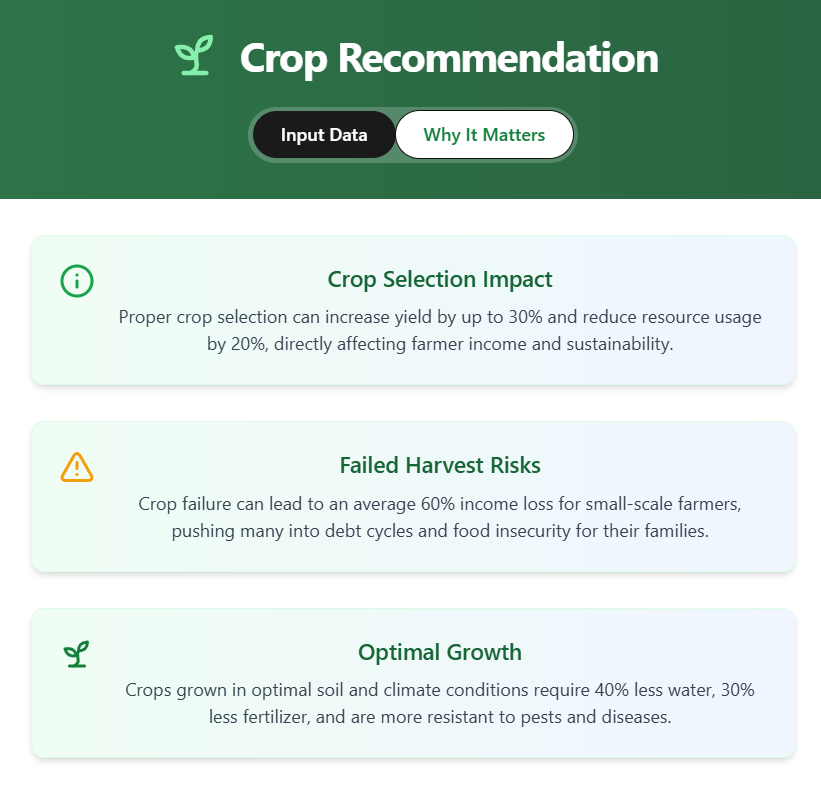
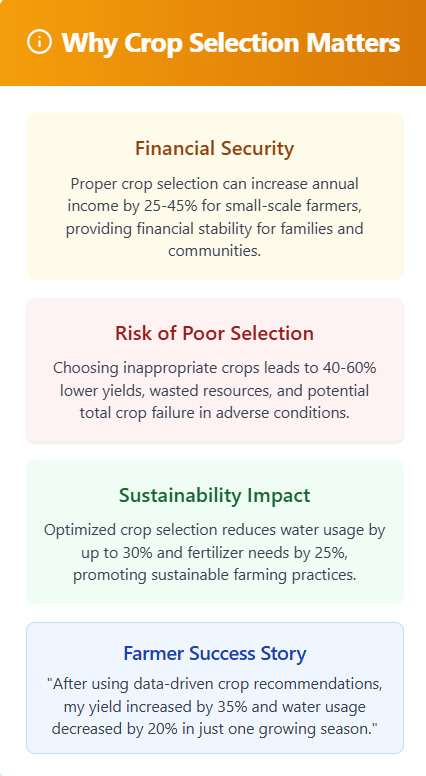
Observing the plight of farmers within the community led to the birth of the AI Crop Recommendation System. Most of them practised farming methods passed down through generations. Recently, however, ever-changing weather patterns due to global warming and ever-changing soil conditions have rendered some of those traditional methods unreliable. We saw actual farmers making mistakes in crop selection that cost them dearly, simply because they didn't have accurate information concerning their soil and environmental conditions. This urged us to put together something that combined agricultural science with machine learning in order to give farmers a tool that allows them to make informed decisions.
What it does
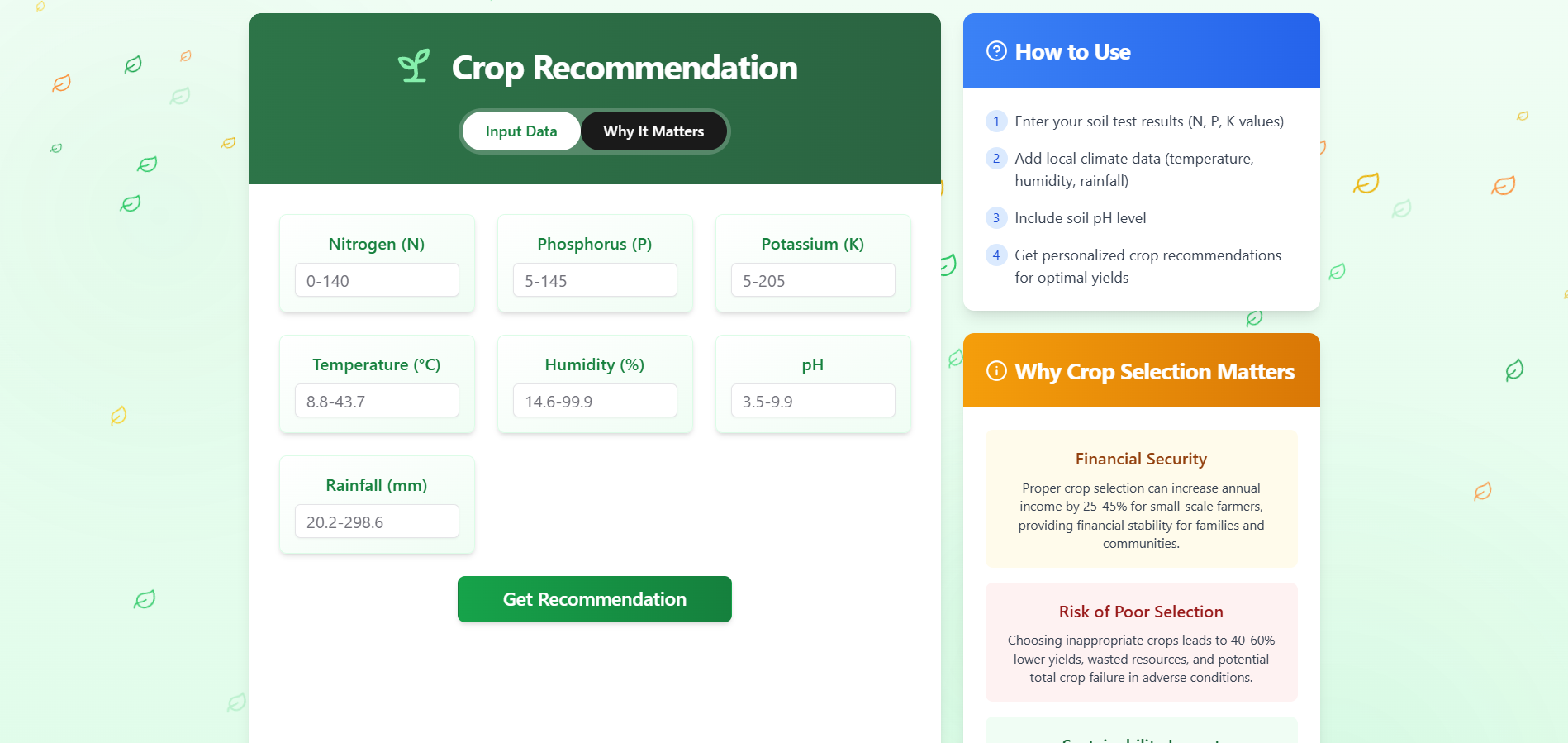
What it does is give the farmers an insight into the condition of their land and what kind of crops their land can support. It takes the input from the farmer about specific soil conditions like nitrogen , phosphorus, potassium levels; pH; temperature; humidity; rainfall; etc. It then processes that data through various machine learning models whose weighted mean is taken through an ensemble. it then proceeds to see which crop would suit the soil and then delivers that choice through the user interface
How we built it
The major processes that led to our system are:
Data Collection: We assembled an extensive dataset that contained soil parameters and successful crop matches in various agricultural environments.
Model Implementation: The various machine-learning classifiers implement and ensemble for optimum accuracy: Random Forest, Gradient Boosting, AdaBoost, Logistic Regression, and SVM.
Validation: Establish reliability of recommendations across regions and conditions through cross-validation techniques.
User Interface: Create an interface that is user-friendly, so that the farmer can enter soil data and get the recommendation without hesitation
Challenges we ran into
No matter how rewarding, the journey had challenges:
- Data Quality: The major difficulty lay in finding comprehensive, reliable agricultural data representing diverse growing conditions.
- Model Parameter Tuning: Each of the algorithms was carefully tuned to ensure good performance without overfitting.
- Complexity Balance: We faced dilemmas on how to make a complex enough system that would generate correct recommendations versus simple enough for daily usage by the farmers.
- Consistency: We had to address scepticism on the part of farmers reluctant to trust AI recommendations over traditional knowledge, which required maximum transparency and trust-building.
- Deployment : The transition from a working local model to a deployed live version was quite a hurdle since i have limited experience with deploying backends
Through hard work and a united front , we managed to scale the barriers, and finally, a tool was built to help farmers make data-driven decisions while they protect their interests and enhance their yields.
Accomplishments that we're proud of
- Achieving high prediction accuracy (over 99%) through our ensemble model approach, giving farmers recommendations they can truly rely on.
- Developing a user-friendly interface, making the solution accessible to farmers regardless of their background with tech.
- Successfully integrating multiple machine learning algorithms to compensate for each other's weaknesses, making the model more robust and trustworthy.
What we learned
This project helped us increase our understanding of both agriculture and machine learning. We learnt a lot about:
- The complex relationships between soil nutrients (N, P, K), pH levels, and crop suitability
- How ensemble machine learning models can provide more robust predictions than individual algorithms via compensating for each other
- The importance of model interpretability for gaining farmer trusts
- How to balance technical sophistication with practical usability for end users who may not have a technical background
What's next for CropCast
- Building on the current foundation , there are some plans to expand the reach of Cropcast by deploying it on actual farms on a small scale to see how it performs.
- Building a mobile app for real-time monitoring of soil conditions and water intake to allow farmers more ease of accessibility.
- Inclusion of IoT sensors which would make the system even more dependable and robust

Log in or sign up for Devpost to join the conversation.