Inspiration
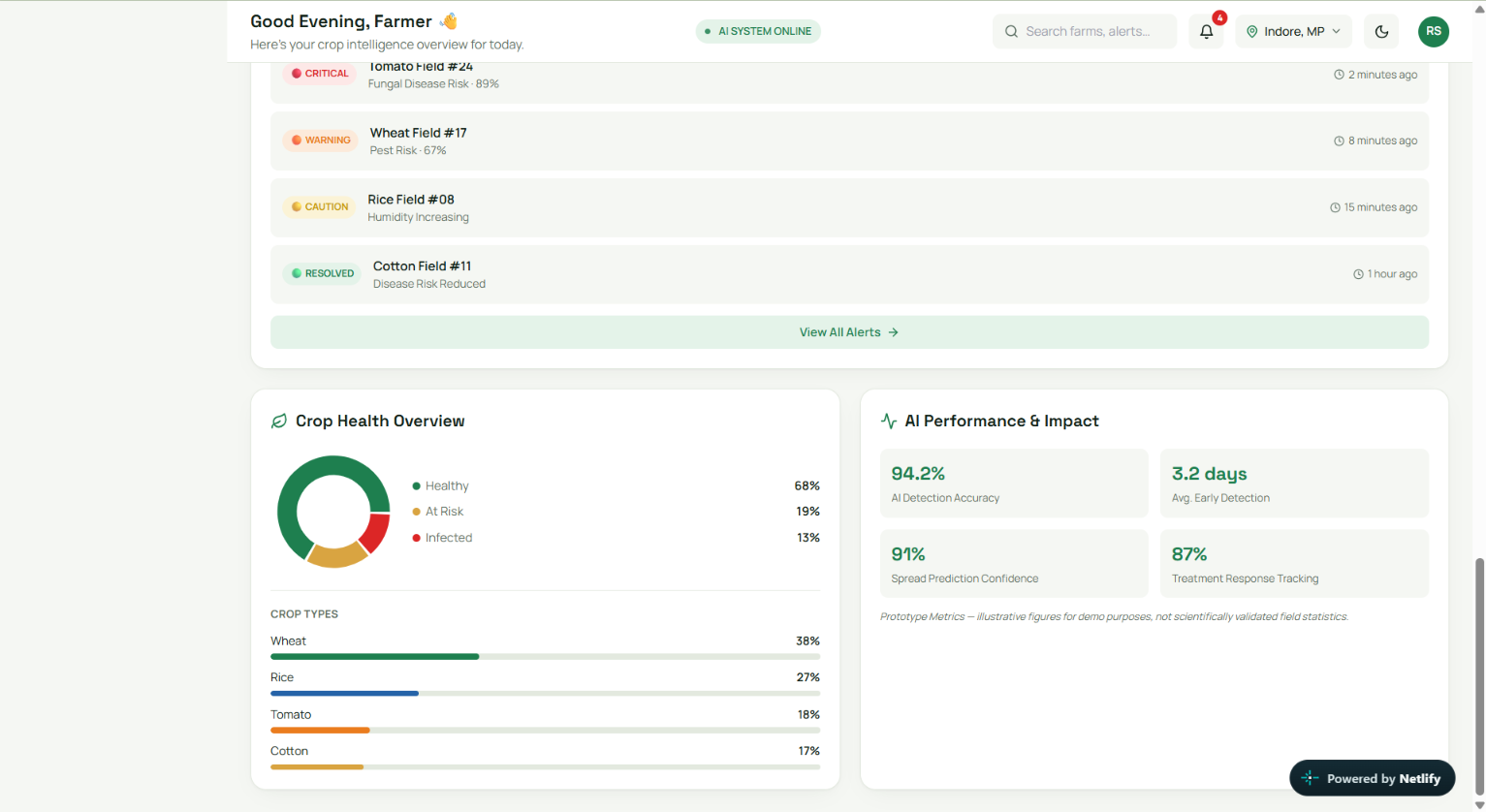
Farmers often discover crop diseases only after visible damage has already spread. We were inspired by the idea of using AI to make early crop-health detection accessible, practical, and actionable. Instead of simply telling a farmer “your crop has a disease,” we wanted to answer the bigger questions: How serious is it? What is the risk? What should be done next?
This led us to build CropCare AI, with the vision of helping farmers move from reactive treatment to proactive crop protection.
What it Does
CropCare AI follows a simple workflow:
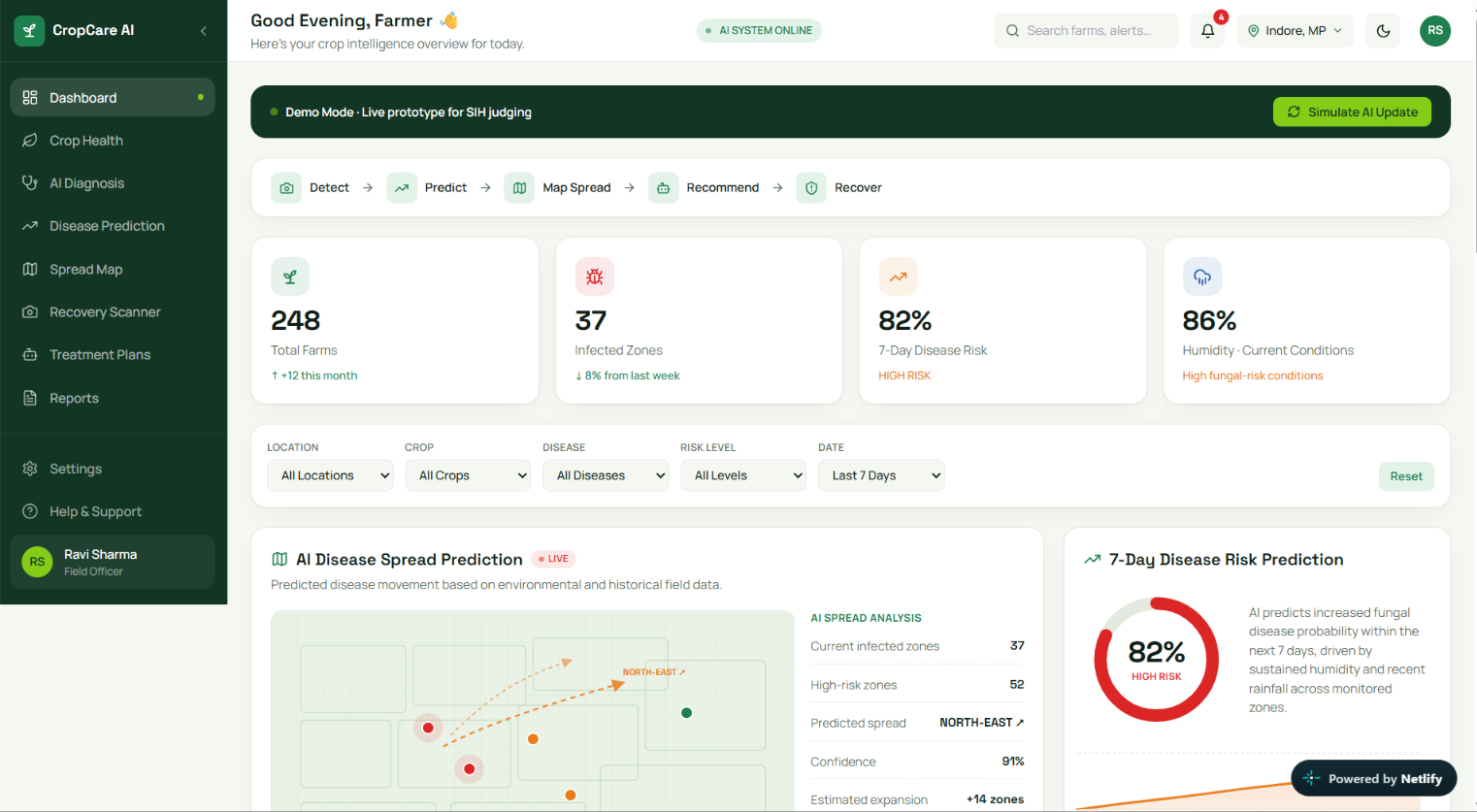
Detect → Assess → Predict → Recommend → Monitor → Verify
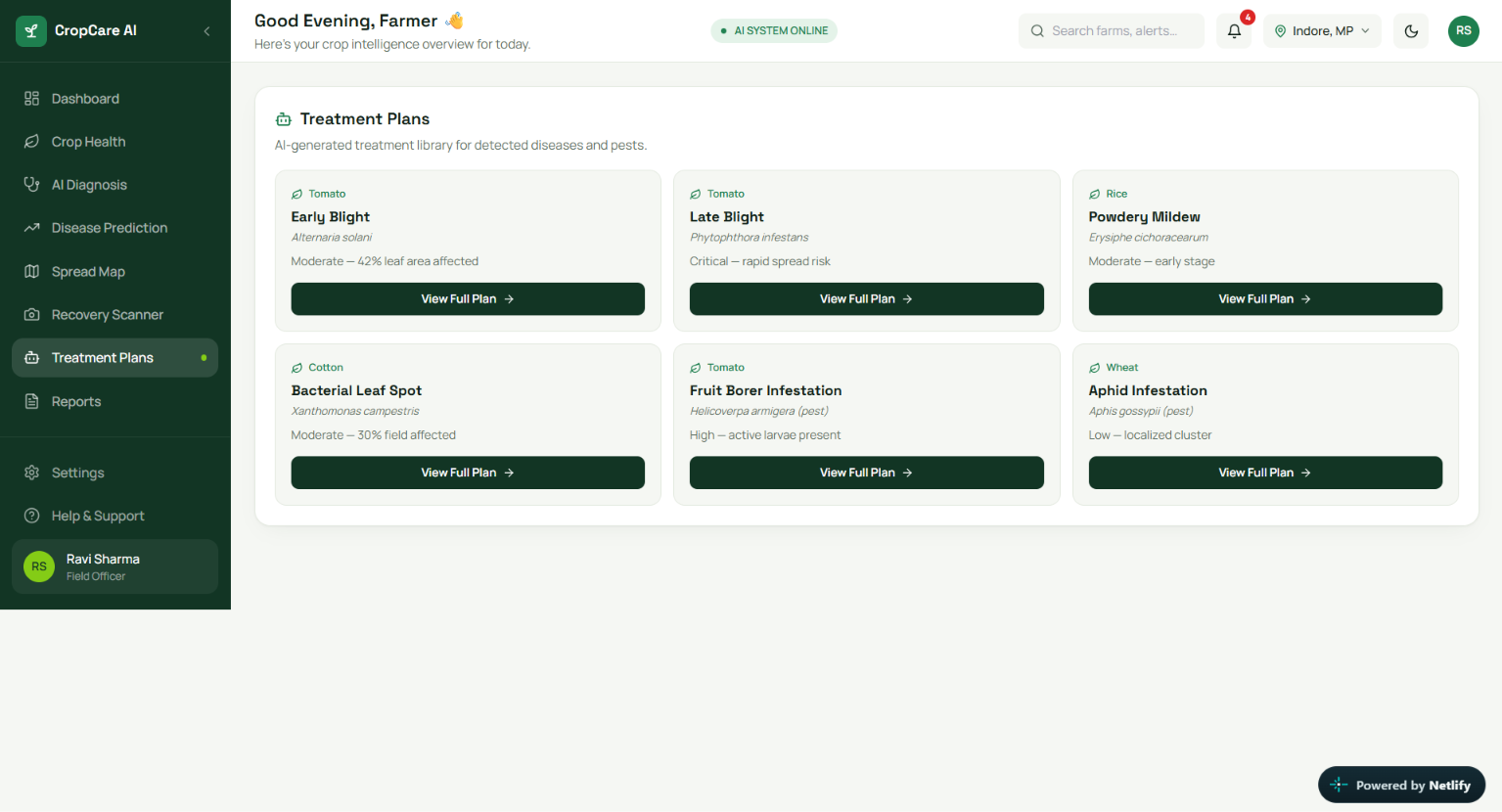
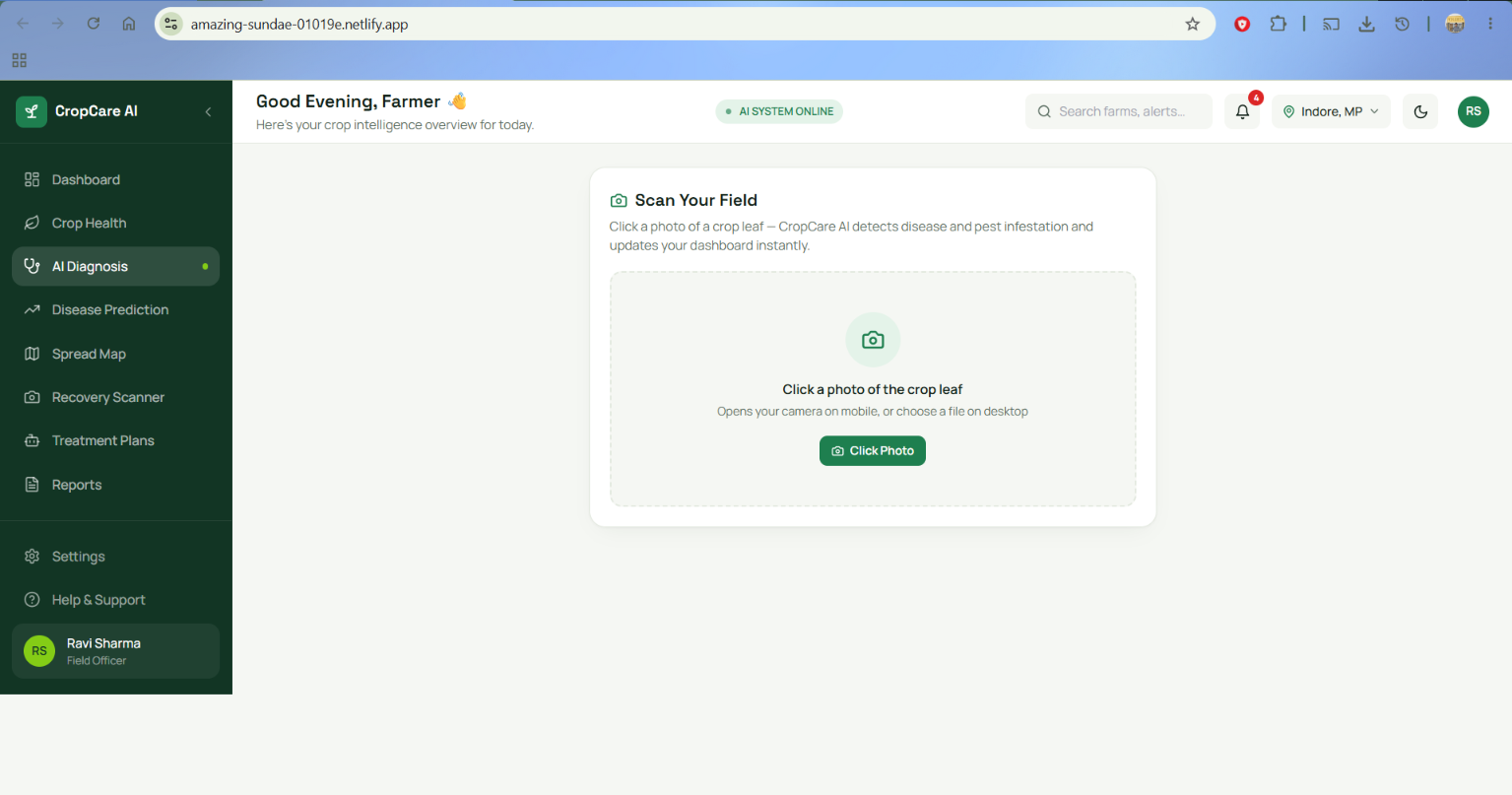
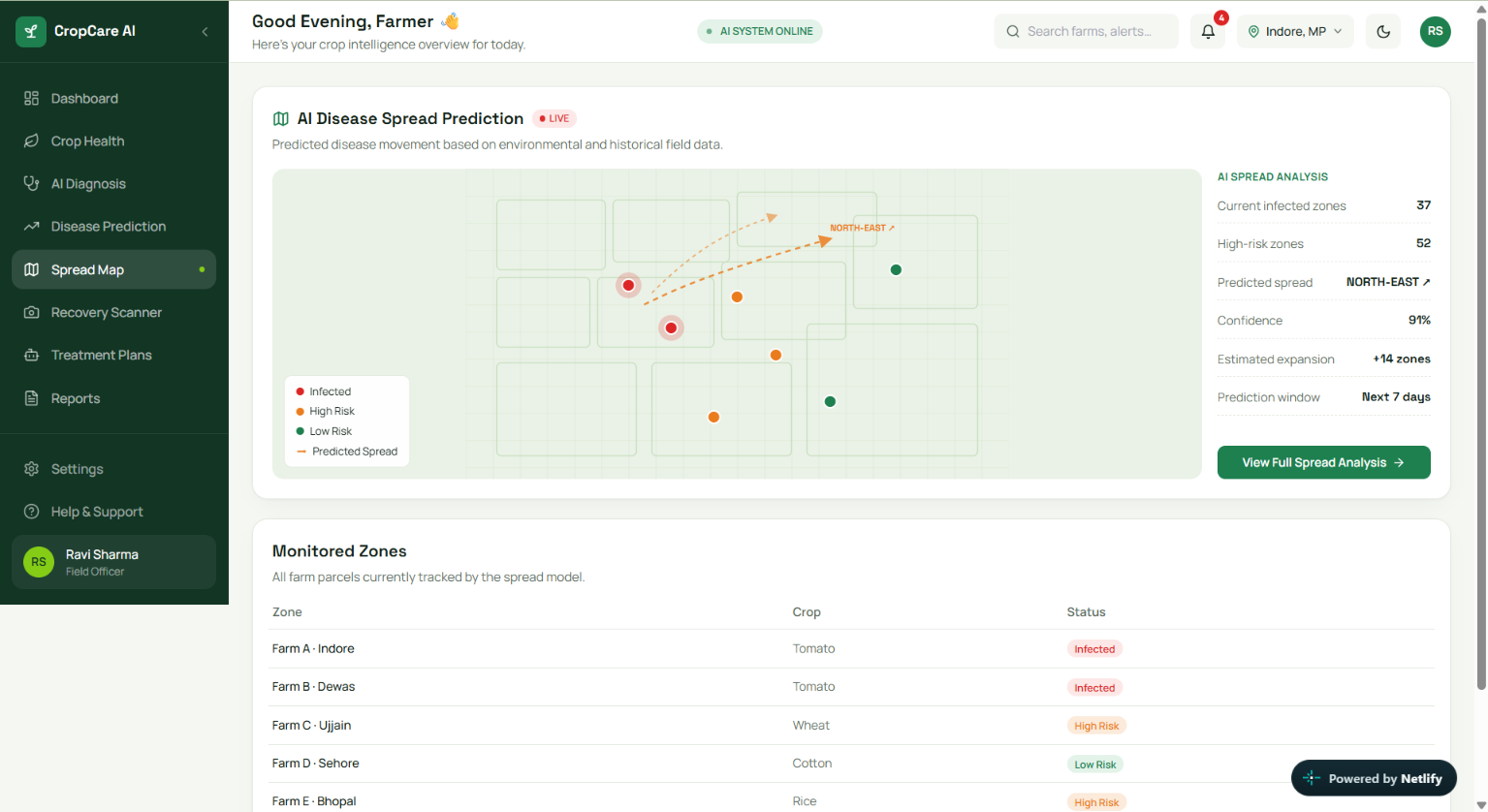
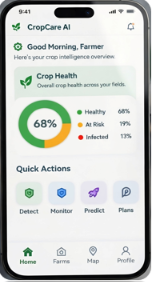
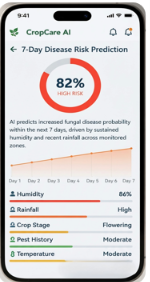
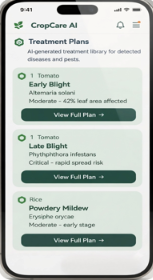
Farmers can provide a crop image, and the system is designed to identify potential diseases or pests, estimate severity, and provide understandable recommendations. Weather and environmental information can further help assess the possibility of disease spread and generate short-term risk predictions.
The goal is to turn complex AI analysis into simple, farmer-friendly insights that can support faster and better decisions.
How We Built It
We designed CropCare AI as a modular platform with a React-based frontend, FastAPI backend, and PostgreSQL database.
Our planned AI pipeline uses CNN/YOLO with PyTorch for crop disease and pest detection. Weather APIs provide additional environmental context for risk prediction.
The architecture is designed to support future additions such as:
- AI-based disease and pest detection
- Severity estimation
- Weather-based risk prediction
- Actionable recommendations
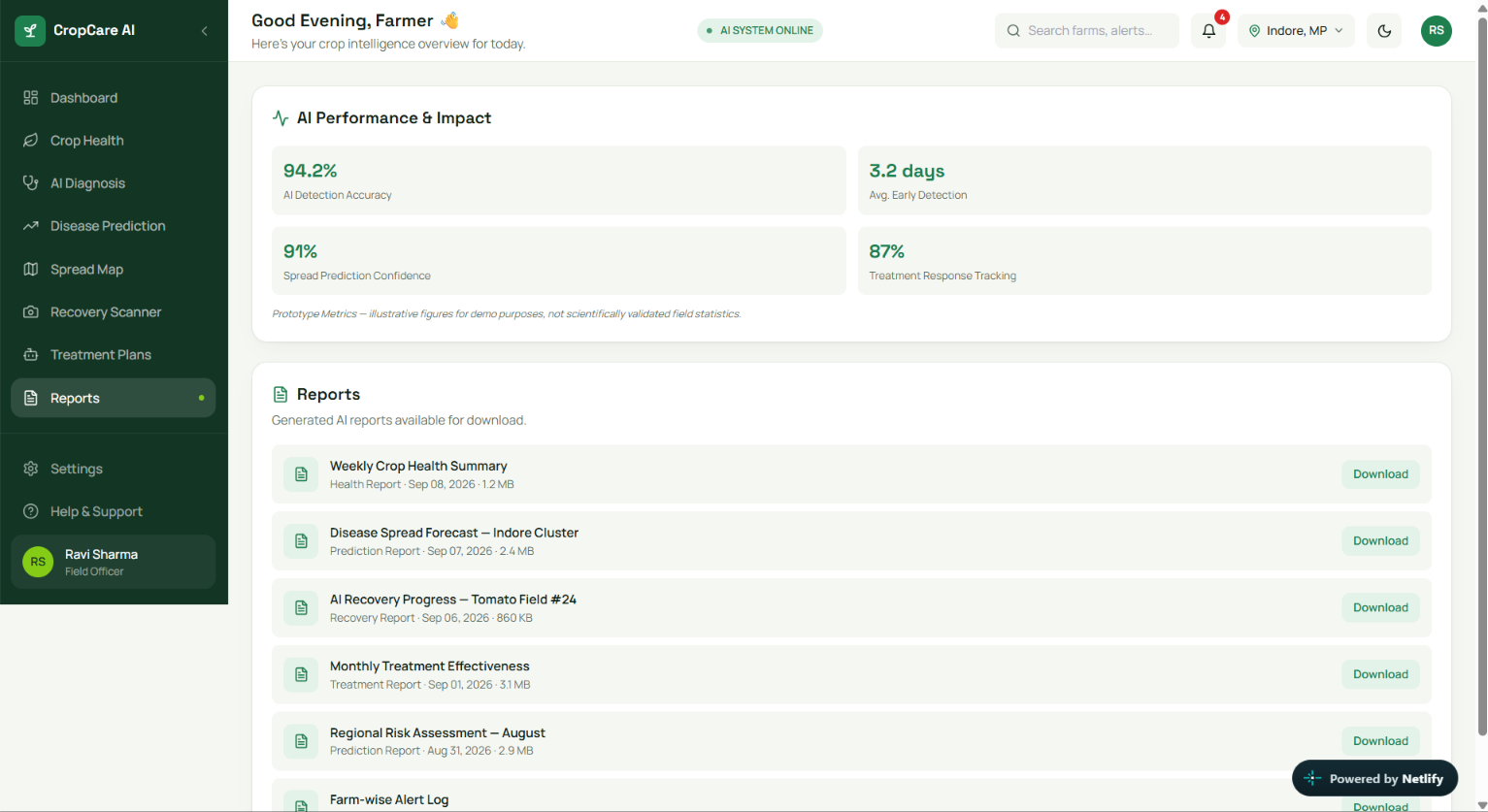
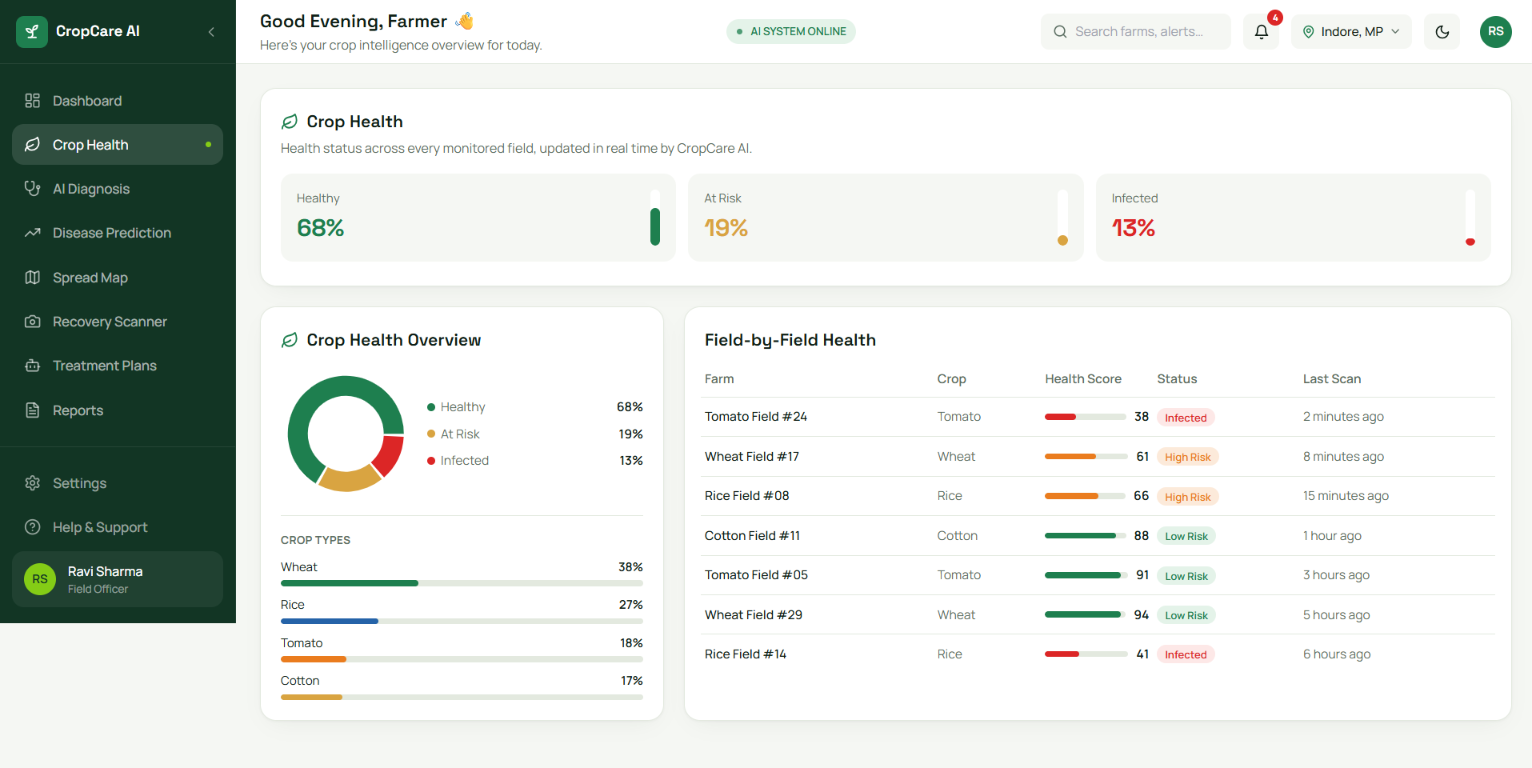
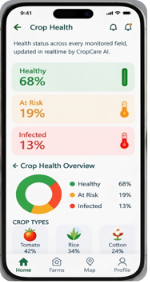
- Crop-health monitoring
- Multilingual and voice-based assistance
- IoT sensor integration
- GIS-based crop monitoring
This approach allows the platform to evolve from an image-based detection tool into a broader intelligent crop-health monitoring system.
Challenges We Ran Into
One of our biggest challenges was balancing technical complexity with simplicity for the end user. A highly accurate AI system is not useful if its results are difficult for farmers to understand or act upon.
We also had to consider challenges such as:
- Differentiating visually similar crop diseases
- Handling variations in crop images and lighting
- Estimating disease severity meaningfully
- Combining image-based predictions with weather information
- Designing recommendations that are understandable and actionable
- Planning for multilingual accessibility and real-world scalability
These challenges pushed us to think beyond just building an AI model and focus on building a complete solution.
Accomplishments We're Proud Of
We are proud that CropCare AI goes beyond basic disease classification. We created an end-to-end concept and prototype that connects detection with severity assessment, risk prediction, recommendations, and monitoring.
We also designed the solution with real-world scalability in mind, including future IoT, GIS, weather intelligence, and multilingual support.
Most importantly, we focused on building technology around the farmer's decision-making process, rather than building AI for the sake of AI.
What We Learned
We learned that solving a real-world agricultural problem requires much more than selecting an AI model.
We gained experience in:
- Designing AI-powered product workflows
- Integrating computer vision with backend systems
- Structuring agricultural data using PostgreSQL
- Using external APIs for environmental context
- Designing simple and accessible user experiences
- Thinking about AI explainability and actionable recommendations
- Converting a broad real-world problem into a scalable technical solution
The biggest lesson was that good technology should not only detect a problem—it should help people decide what to do next.
What's Next for CropCare AI
Our next step is to strengthen the AI pipeline with trained CNN/YOLO models, improve severity estimation, and enhance weather-based disease-risk prediction.
We also plan to add multilingual and voice-based assistance, integrate low-cost IoT sensors for real-time field data, and introduce GIS-based crop monitoring.
Our long-term vision is to make CropCare AI a continuously learning crop-health platform that can help farmers detect earlier, predict risk, take timely action, and protect their crops more effectively.
Built With
- analytics
- api
- artificial
- cnn
- computer
- css
- fastapi
- github
- html
- intelligence
- javascript
- learning
- machine
- postgresql
- predictive
- python
- pytorch
- react
- rest
- vision
- visualization
- weather
- yolo

Log in or sign up for Devpost to join the conversation.