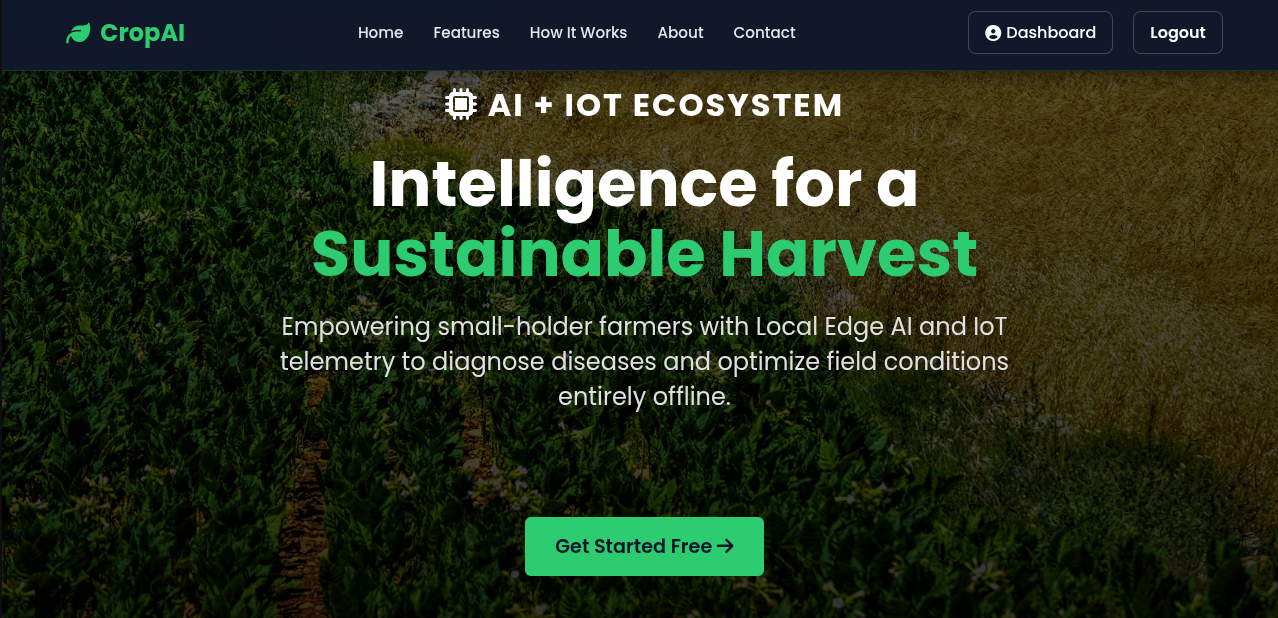
CropAI
I an intelligent crop recommendation system that uses machine learning to suggest optimal crops based on soil nutrients, weather conditions, and geographic location. This project was born from the desire to empower small-scale farmers with data-driven insights to improve yield and sustainability.
Inspiration
The idea for CropAI came from witnessing the struggles of farmers in rural areas who often rely on traditional methods and guesswork when deciding what to plant. With climate change making weather patterns increasingly unpredictable, we wanted to build a tool that could provide personalized, science-backed crop suggestions to help farmers make better decisions and improve their livelihoods.
What it does
CropAI takes input parameters such as:
Nitrogen (N), Phosphorus (P), Potassium (K) levels in the soil
Temperature, humidity, and rainfall
Soil pH and type
Using this data, the system predicts the most suitable crop to plant. The model is trained on agricultural datasets and serves recommendations through a fast, scalable API.
How we built it
We built CropAI using:
Node.js for the backend API and server logic
Express.js to handle routing and middleware
TensorFlow.js or Brain.js for running machine learning models directly in Node.js
React for the frontend user interface
MongoDB or PostgreSQL for storing user data and crop information
LaTeX for displaying mathematical formulas in the documentation (e.g., crop suitability indices)
We used Jupyter Notebooks for initial model prototyping and then exported the models to TensorFlow.js format for seamless integration with Node.js.
Challenges we ran into
One major challenge was optimizing the machine learning model to run efficiently in a Node.js runtime without sacrificing accuracy. We also had to handle missing or inconsistent data in the training datasets, which required careful preprocessing and imputation. Another challenge was designing a RESTful API that could handle multiple concurrent requests while maintaining low latency for users in remote areas.
Accomplishments that we’re proud of
We’re proud of achieving 92% accuracy on our validation set and building a responsive, mobile-friendly interface. Our Node.js backend handles thousands of requests per day with minimal downtime, and the API is lightweight enough to be used in areas with limited internet connectivity.
What we learned
We learned how to bridge the gap between data science and full-stack development by integrating machine learning models into a Node.js environment. We also gained valuable experience in building scalable APIs, optimizing database queries, and designing intuitive user interfaces for non-technical users.
What’s next for CropAI
We plan to expand CropAI by:
Integrating real-time weather forecasting APIs
Adding support for multiple languages
Building a mobile app with offline capabilities using React Native
Incorporating pest and disease prediction features
Partnering with agricultural extension services for wider reach
Built With
- css
- featherless
- html
- javascript
- mongodb
- node.js
- postgresql


Log in or sign up for Devpost to join the conversation.