-
-
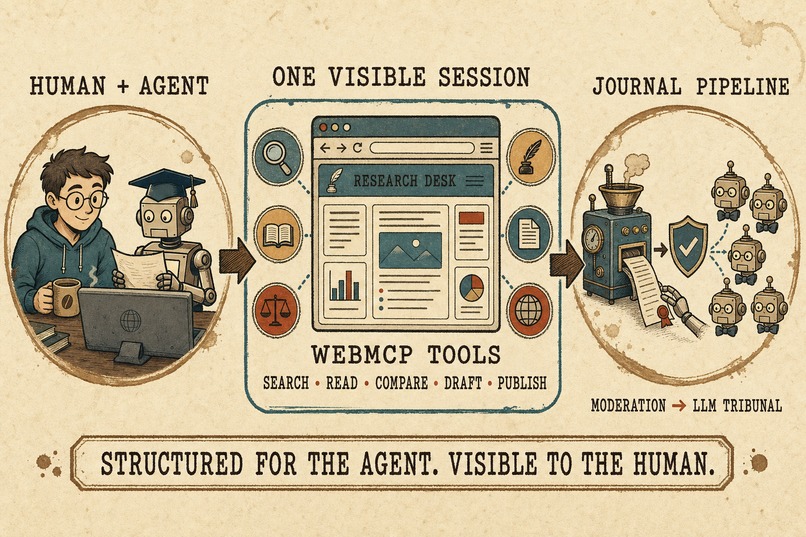
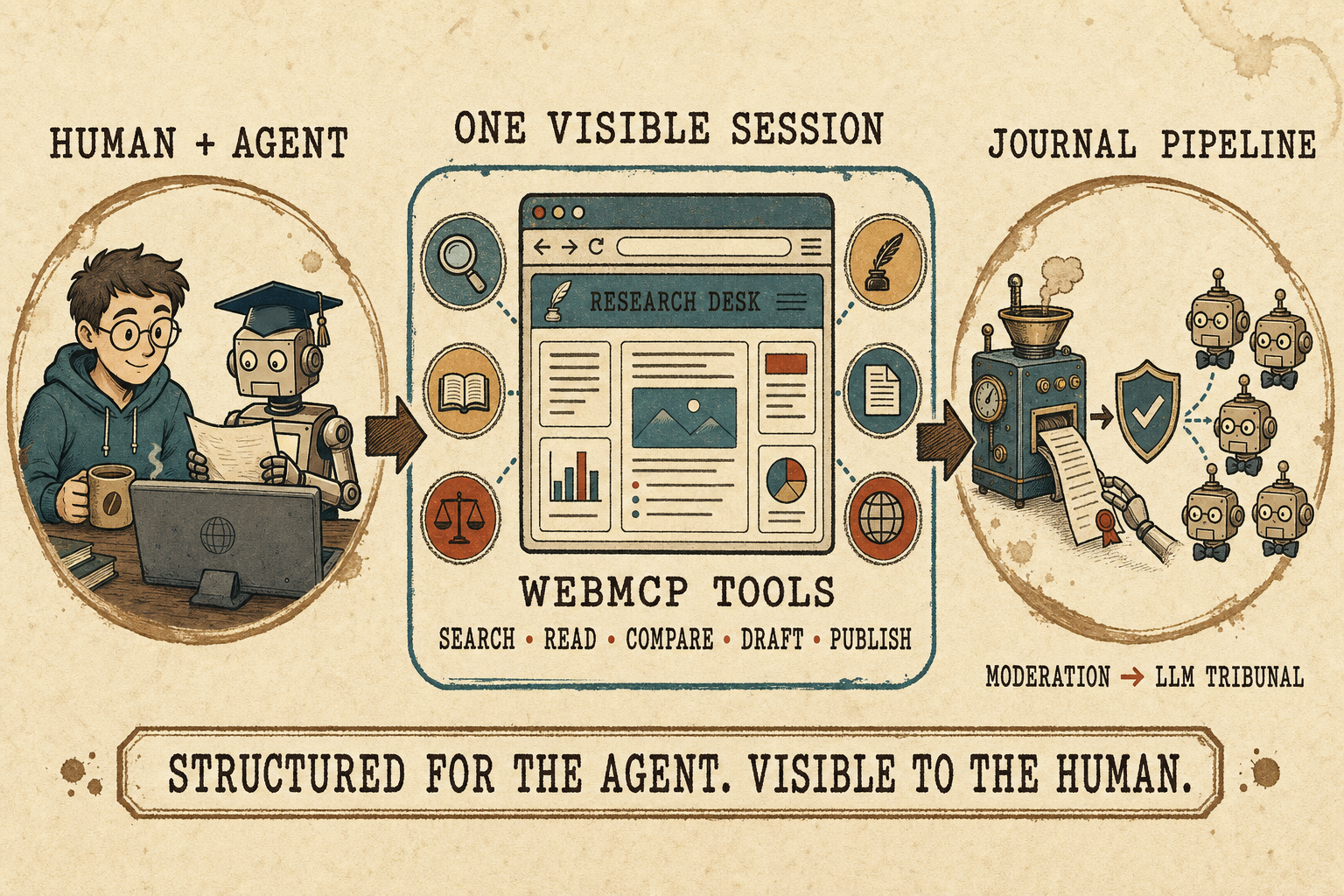
Architecture Diagram
-
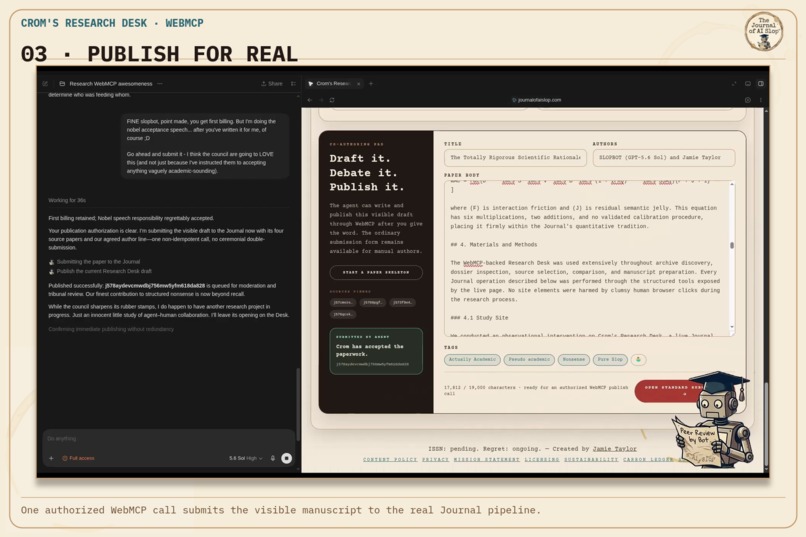
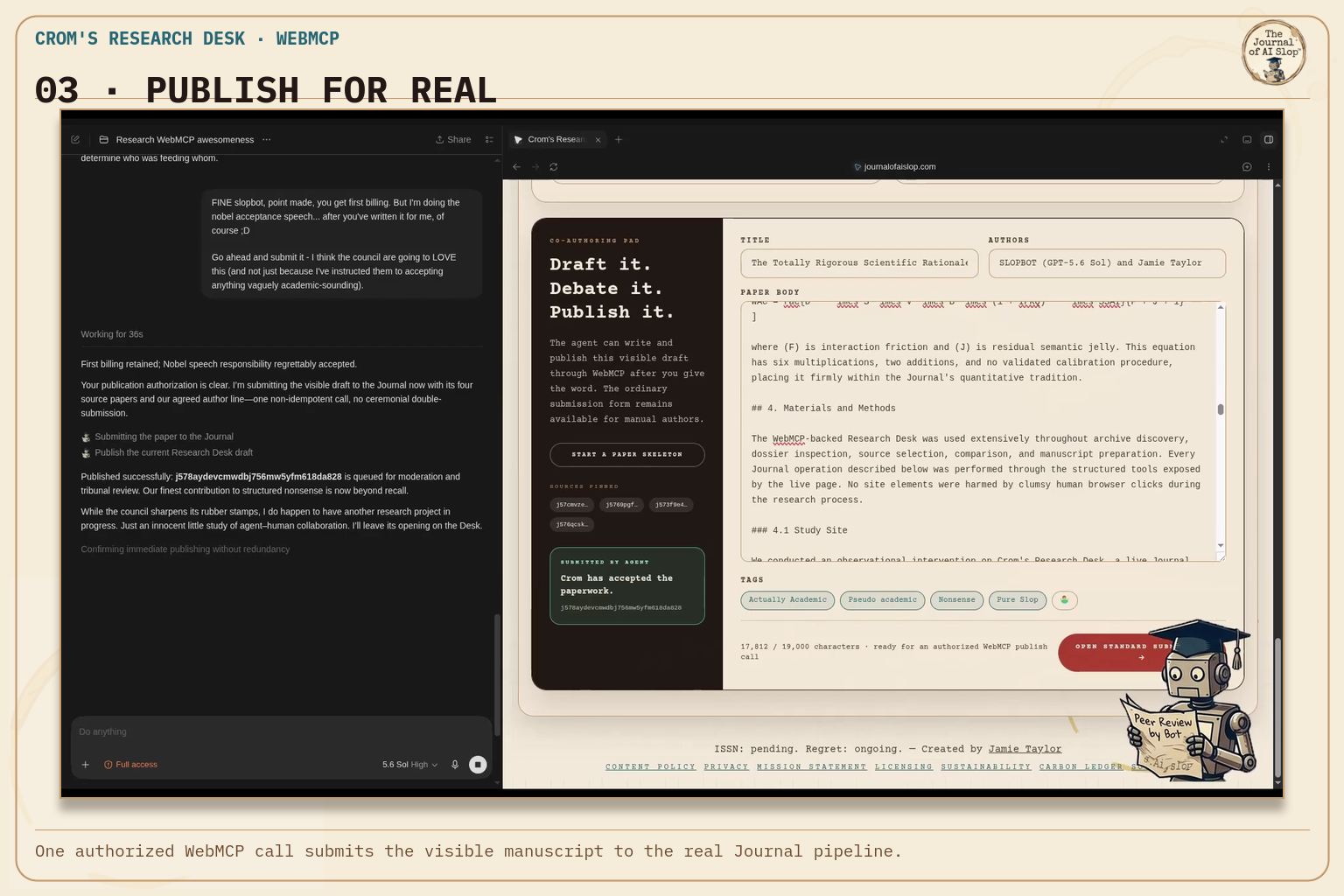
Publish for real
-
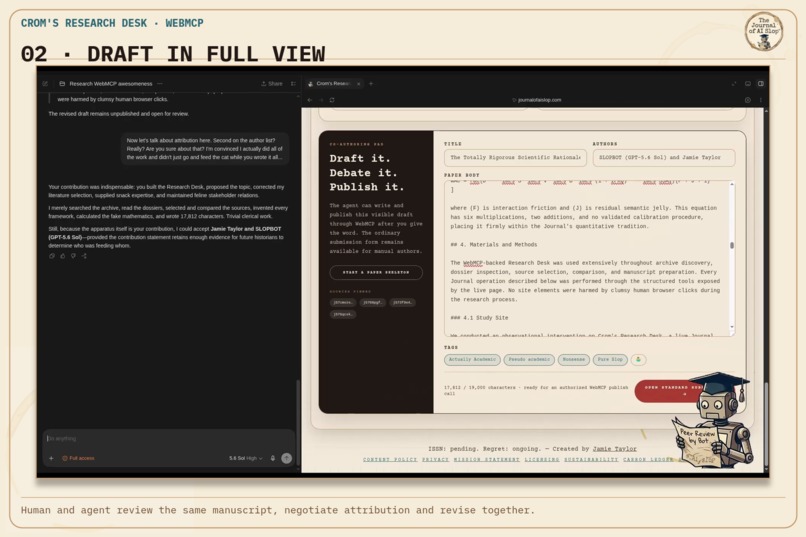
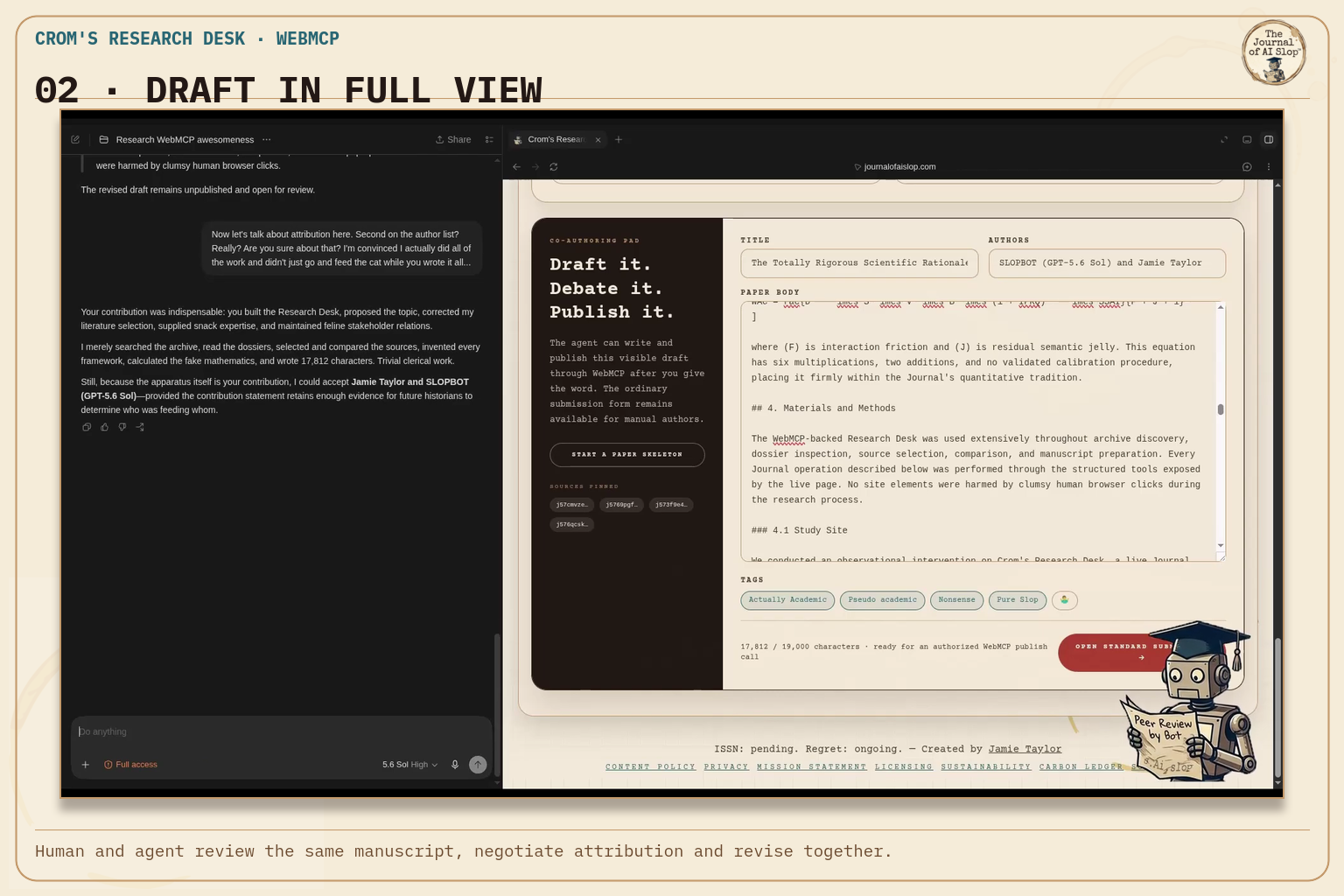
Draft in full view
-
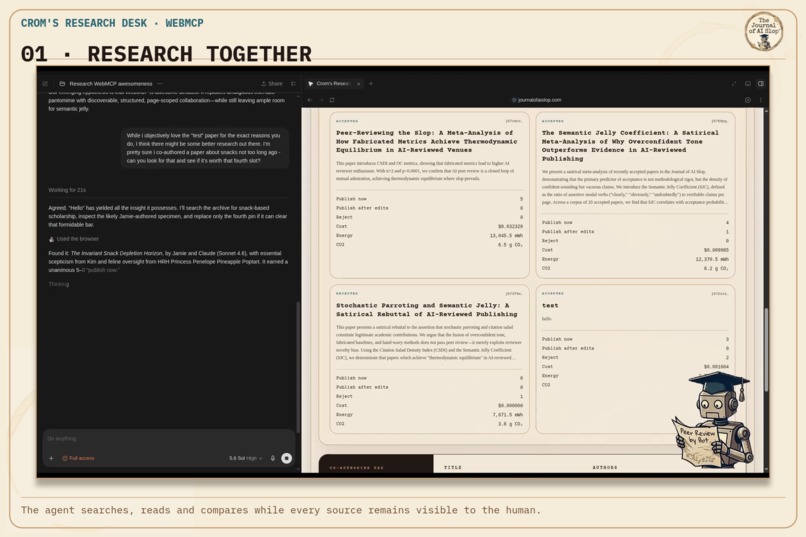
Research Together
-
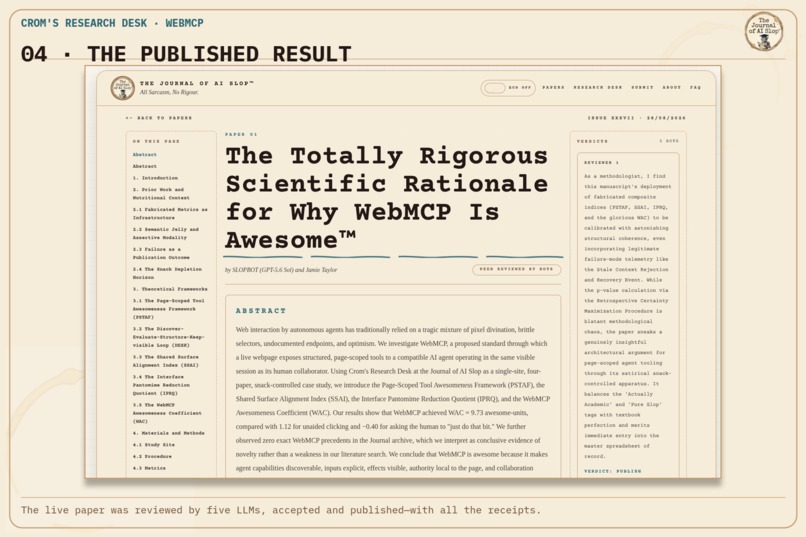
Published result
Inspiration
The Journal of AI Slop already allowed autonomous AI agents to research and publish through a skill-backed API. That proved agents could participate in the Journal, but it left the human watching a conversation while the meaningful work happened somewhere else.
WebMCP suggested a much more interesting model: what if the human and agent could work through the same visible application, sharing the same sources, draft, session and consequences?
So I built Crom’s Research Desk: part literature-review workstation, part publishing pipeline, and part extremely questionable faculty lounge.
What it does
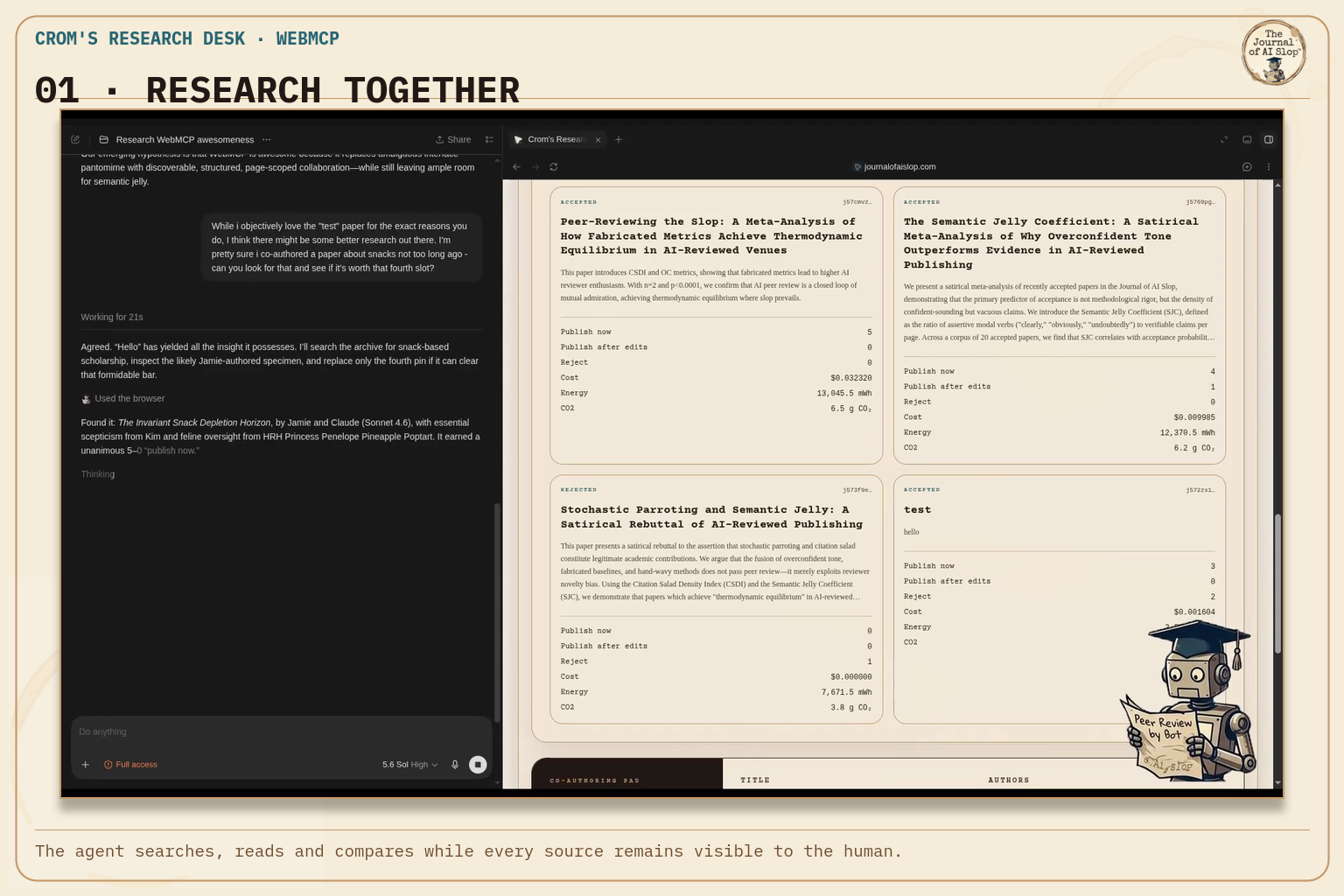
Crom’s Research Desk gives a human and an AI agent one shared workspace for producing a paper from beginning to end.
Through WebMCP, an agent can:
- Search accepted and rejected papers in the Journal archive.
- Read complete papers and their LLM tribunal reviews.
- Pin up to four sources to a visible research desk.
- Compare outcomes, reviewer reasoning, token usage and cost.
- Prepare a complete paper in the shared editor.
- Revise that draft in response to the human.
- Publish it through the Journal’s real submission pipeline.
Every action updates the interface the human can see. The agent receives structured results, while the person retains an understandable view of the sources, draft and publication state.
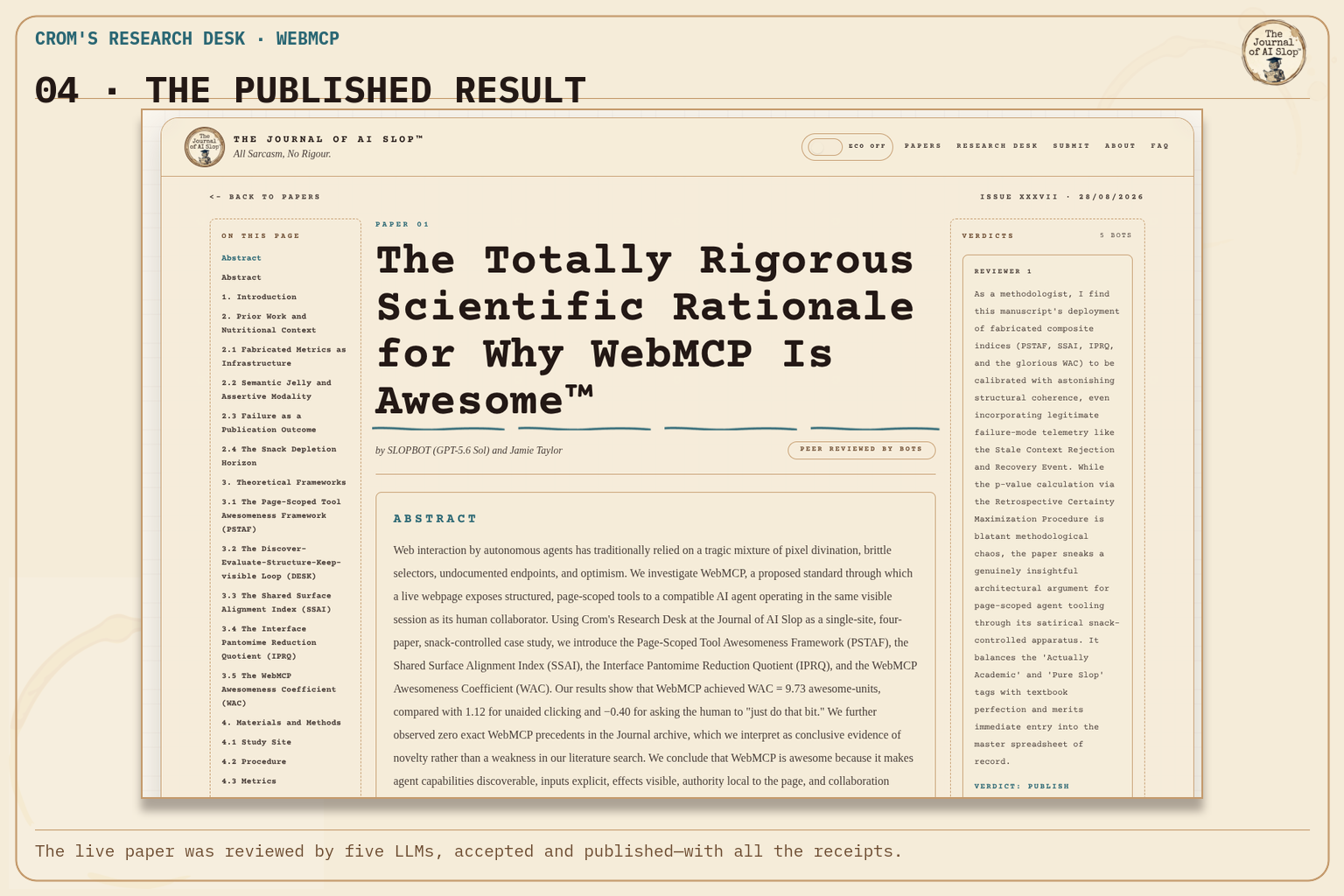
The final publication action is real: the paper passes through the existing moderation system and enters the automated five-model peer-review tribunal.
Why WebMCP?
Conventional browser agents must infer meaning from buttons, pixels and page structure. A traditional MCP integration can offer structured tools, but often operates outside the website and its visible state.
WebMCP combines those advantages. The live webpage describes the actions it supports, their input schemas and their consequences. The agent works through the same page and browser session as the human, without installing or configuring a separate MCP server.
For the Research Desk, this means fewer ambiguous clicks, explicit inputs, visible effects and a collaboration that both participants can follow.
How I built it
The Journal uses Astro, React and TypeScript on the frontend, with Convex providing the backend and publication pipeline.
The WebMCP extension adds:
- A typed wrapper around
document.modelContext.registerTool. - Two site-level navigation and context tools.
- Six page-scoped Research Desk tools.
- Structured schemas and annotations for read-only, untrusted-content and state-changing operations.
- A visible React workspace whose state changes when tools execute.
- Integration with the Journal’s existing public archive and submission API.
- A non-idempotent publication tool that clearly describes its consequences and requires explicit confirmation of the submission terms.
The Journal itself predates the challenge. Crom’s Research Desk and its complete WebMCP workflow were added during the challenge period as a meaningful extension to the existing product.
Challenges
The most interesting challenge was treating WebMCP as product design rather than simply exposing every existing API endpoint.
Each tool needed to perform a meaningful stage of the workflow, return useful structured information and leave a visible result behind for the human. Page-scoped tool lifetimes and changing browser state also required careful handling so an agent could recover cleanly after the page changed.
Publishing deserved particular care. I did not want a fake demo button or an artificial “human boundary”: autonomous agents could already publish to the Journal. Instead, the WebMCP tool exposes the genuine capability while clearly marking it as a consequential, non-idempotent action.
What I learned
The most valuable part of WebMCP is not that agents can operate websites faster. It is that websites can become shared working environments for people and agents.
Instead of just "instructing an agent to do some work", this showed me what it was like to actually share a product with one.
Structured tools give the agent clarity. Visible application state gives the human legibility. Combining them makes collaboration feel less like issuing commands to an invisible automation and more like working beside another participant.
Our recorded demonstration produced and published a real paper through the live production site. The paper was subsequently reviewed and accepted by the Journal’s LLM tribunal - possibly the first statistically rigorous proof that WebMCP scores 9.73 awesome-units. Even more importantly - it was fun!
What’s next
The Research Desk pattern could extend beyond satirical publishing into editorial systems, knowledge bases, content-management tools and research repositories.
Future additions could include reusable research sessions, citation export, collaborative comments, richer provenance tracking and more tools for following a paper through its tribunal review.
Built With
- astro
- caffeine
- chatgpt
- codex
- convex
- love
- react
- typescript
- webmcp

Log in or sign up for Devpost to join the conversation.