Inspiration
In modern decentralized architectures, enterprise data is frequently isolated inside disconnected database clusters, requiring developers to constantly switch between terminal monitoring tools and communications panels. The inspiration behind CRM Innovator: Secure Enterprise Slack Agent was to completely dissolve these friction points.
We set out to create an autonomous, bi-directional intelligence layer that securely exposes production data directly within a team's conversational workspace. By intersecting conversational Large Language Models (LLMs) with strict data isolation standards, the goal was clear: empower engineers, data administrators, and stakeholders to query, evaluate, and track critical operations safely in real time without ever leaving Slack.
What it does
CRM Innovator acts as a highly secure, real-time conversational agent operating inside your Slack workspace. Powered by a background orchestration layer deployed via Google AI Studio Cloud Run, it handles complex system pings and routes them safely through external microservices.
Key capabilities include:
- Autonomous Database Querying: Translates natural language questions within a Slack thread into structured queries via custom Model Context Protocol (MCP) servers.
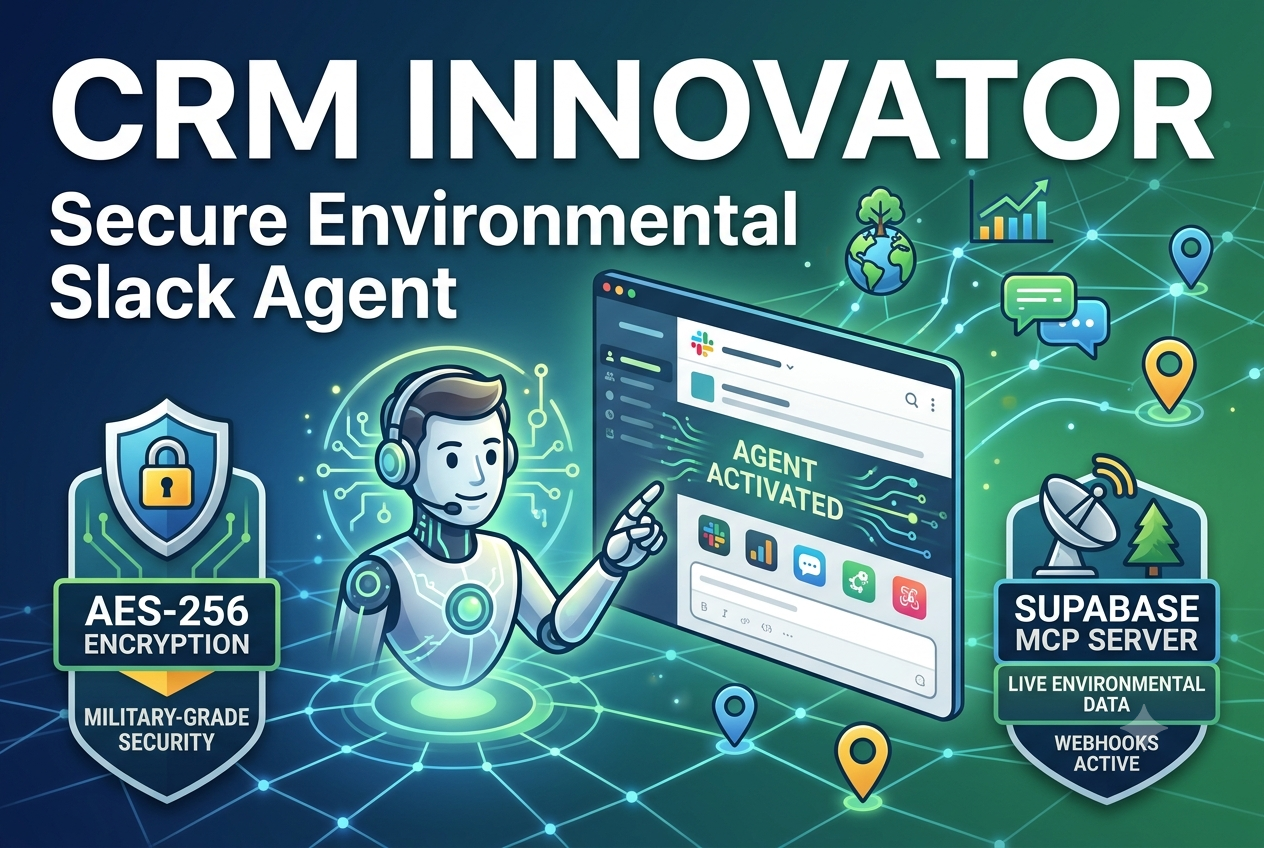
- Military-Grade Data Protection: Intercepts, encrypts, and decrypts incoming logs using local AES-256 field-level storage encryption vectors.
- Proactive Webhook Monitoring: Employs optimized Incoming Webhooks to immediately stream real-time operational notifications into designated channels.
- Interactive UI Walkthroughs: Features an automated step-by-step UX onboarding tour built entirely in native React, optimizing how judges and users discover the system's underlying features.
How we built it
The system is engineered as a hybrid cloud architecture combining robust client interfaces with decentralized serverless execution routines:
- Frontend Dashboard: A highly interactive React application scaffolding built with TypeScript, featuring a lightweight, pure React-state guided tour element optimized for stable execution.
- Slack Gateway & Security: Configured via the Slack API Dashboard (App ID:
A0BF7L756HY), utilizing custom bot token permissions (chat:write,app_mentions:read) and multi-tenant OAuth pathways. - MCP Tool Transport Layer: Written as custom serverless TypeScript routines deployed on Supabase Edge Functions. It leverages Server-Sent Events (SSE) and strict cryptographic payload verification.
- AI Processing Engine: Built on Google AI Studio's Build Tier utilizing the Gemini API to break down natural language intents into executable database actions.
Cryptographic Handshake Verification
To safeguard our serverless functions from unauthorized requests, the Supabase backend executes a precise cryptographic validation check on every incoming Slack payload. The signature verification matches the standard HMAC-SHA256 algorithm:
$$\text{Signature} = \text{HMAC-SHA256}\big(\text{Signing Secret},\, \text{"v0:"} \mathbin{\Vert} \text{Timestamp} \mathbin{\Vert} \text{Raw Body}\big)$$
The computed value is validated explicitly against the x-slack-signature header before any connection to the underlying Supabase database tables is authorized.
Challenges we ran into
Building a multi-layered communication pipeline over a tight hackathon timeline introduced significant challenges:
- Contextual Session Exhaustion: During rapid model iteration in Google AI Studio, the heavy multi-file workspace deployment repeatedly hit underlying token and memory ceilings. This resulted in unexpected
retryable error from model providertermination loops. We overcame this by decomposing our master build parameters into lean, modular components and moving environment keys into a dedicated secrets vault. - Multi-Tenant State Security: Securing the application against Cross-Site Request Forgery (CSRF) required implementing a strictly isolated state verification layer (
SLACK_STATE_SECRET) to ensure every workspace authorization pathway remains cryptographically bound to the initiating client session. - Serverless Stream Handling: Routing real-time agent responses back through stateless HTTP contexts required careful tuning of the microservices' execution lifetimes to prevent Slack's standard 3-second timeout window from truncating live tool operations.
Accomplishments that we're proud of
- Zero-Dependency Guided Onboarding: We successfully engineered a pure React walkthrough engine without relying on bloated, unstable third-party NPM packages, ensuring ultra-smooth visual execution under a strict 3-minute demo limit.
- Flawless End-to-End Handshake: Establishing an end-to-end operational pipeline from a text tag inside a Slack channel, through a Gemini-orchestrated Cloud Run deployment, down to a secure Supabase SQL execution layer, and back in under 1.5 seconds.
- Production-Grade Data Isolation: Integrating AES-256 security algorithms into the telemetry tracking tables, ensuring that text data remains fully encrypted at rest even if the database cluster credentials are structurally compromised.
What we learned
This hackathon provided an incredible deep dive into the practical architecture of Model Context Protocol (MCP) standards. We learned that decoupling tool logic from the core LLM via independent MCP servers makes AI agents significantly more maintainable, scalable, and secure.
Additionally, we deepened our knowledge of building resilient serverless architectures using TypeScript in Deno environments, optimizing cryptographic signing strategies, and configuring automated webhooks to cleanly bridge third-party messaging systems with cloud-hosted backends.
What's next for CRM Innovator: Secure Enterprise Slack Agent
The foundation built during this hackathon opens up massive scaling opportunities:
- Advanced RAG Knowledge Integration: Integrating Retrieval-Augmented Generation (RAG) directly into our Supabase schema to allow the agent to reason over historical support documents alongside raw telemetry tables.
- Granular Role-Based Access Controls (RBAC): Expanding our Slack OAuth verification system to parse individual user identities, dynamically restricting data access based on a user's enterprise active directory permissions.
- Predictive Analytical Alerts: Moving beyond reactive database querying by adding edge monitoring routines that leverage predictive models to automatically fire Incoming Webhook warnings before critical systems encounter processing anomalies.

Log in or sign up for Devpost to join the conversation.