Inspiration
When people move to another state or country, or are rushed to a hospital, their medical history rarely goes with them. In India about 1.68 lakh people died in road accident emergencies due to lack of info about their medical history and info in 2022. In an emergency, doctors often have to treat first and ask later, and an unconscious patient with no bystander or a language barrier cannot tell them anything. Lost records mean delayed diagnosis, repeated tests and real danger. I wanted to give doctors verified history in seconds.
What it does
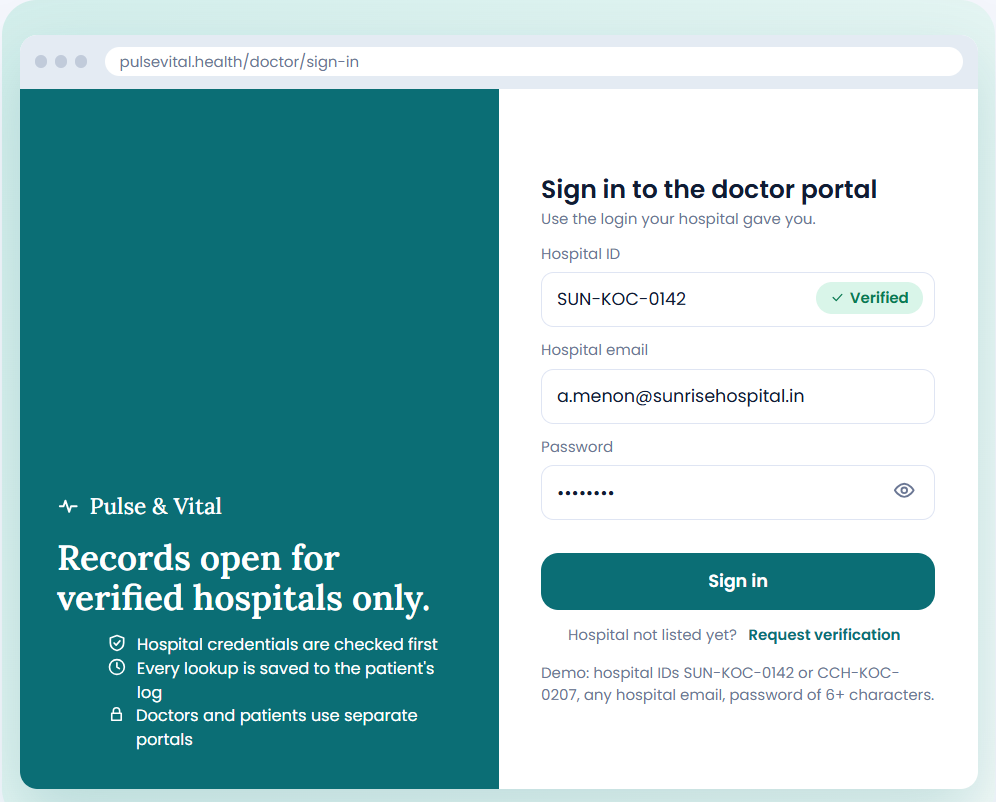
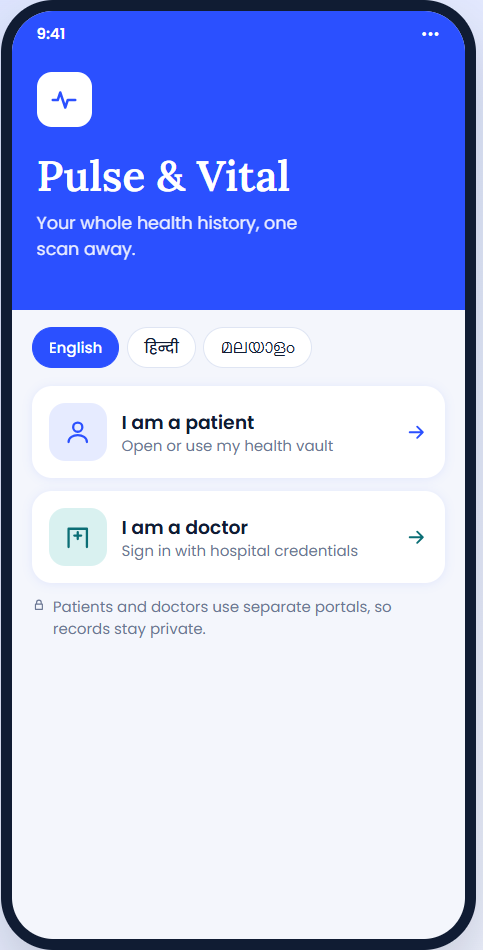
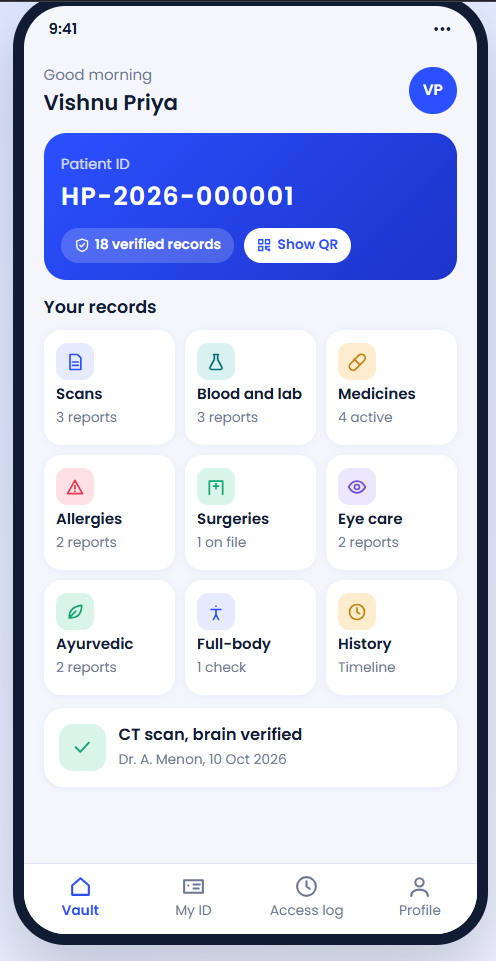
Pulse & Vital is a Unified Cross-Border Digital Health Vault. It gathers a patient's verified medical timeline (scans, blood reports, medicines, allergies, surgeries, eye and Ayurvedic records) in one place and opens it with a Dynamic QR code or an Aadhaar-style smart card. Patients and doctors use two separate portals. A doctor must log in with a verified hospital account before any record opens, every record carries the signing doctor's name, and the patient can see who accessed their data. A family contact number is ready if the patient is unconscious. The records follow the FHIR standard, so any hospital can read them.
How we built it
I am a solo builder with no coding background, so I used AI tools to design and build an interactive mock-up of 10 screens: 6 for patients and 4 for doctors. I also designed the QR token (a short signed token that changes every 60 seconds), worked out the QR size, security and storage calculations, and ran a 10,000-lookup simulation of scan-to-data time in Python. The prototype is built with HTML, CSS and JavaScript.
Challenges we ran into
Everything in the prototype is simulated. Aadhaar OTP, hospital login, QR scanning and record signing are mocked, because real Aadhaar and medical-registry links need official approval. Designing privacy and security carefully without being a security engineer was hard. So was handling very large scans like CT and MRI, which I solved on paper by storing previews and linking the full files.
Accomplishments that we're proud of
- A complete design for a doctor-verified, FHIR-based record that opens by scan.
- A token design with an extremely small chance of being guessed, and a QR that fits comfortably on a card.
- A simulation showing a target of about 4 seconds from scan to key data.
- A clear 75-day plan, a bill of materials of about ₹9,050, and honest status reporting.
- Learning to turn an idea into a working design with AI as a non-coder.
What we learned
Security and privacy are the heart of a health product, not an add-on. A QR code should be a key, never the data itself. Being honest about what is simulated builds more trust than overselling. Planning in small versions makes a big idea manageable.
What's next for pulse & vital
In 75 days I plan to build a working model in three stages: sign-up and a static QR first, then the doctor portal and a real changing QR, then FHIR mapping, doctor signatures and the emergency view. I will run real tests, time real scans, print a sample PVC card, survey users in Kerala, and get a security and privacy review before any real data is used. After that: Malayalam and multi-language support, offline use, and pilot partnerships with hospitals.


Log in or sign up for Devpost to join the conversation.