Inspiration
It started with a simple, uncomfortable question: what happens when an AI translation app gets it wrong in a hospital room? Deaf and hard-of-hearing people already face daily communication gaps — and over 430 million people worldwide live with disabling hearing loss (WHO, 2024). AI-powered translation tools are getting better, but none of them answer the one question that actually matters in high-stakes moments: how do you know it got it right? That gap — between "AI translated it" and "someone can trust it was translated correctly" — is what we set out to close.
What it does
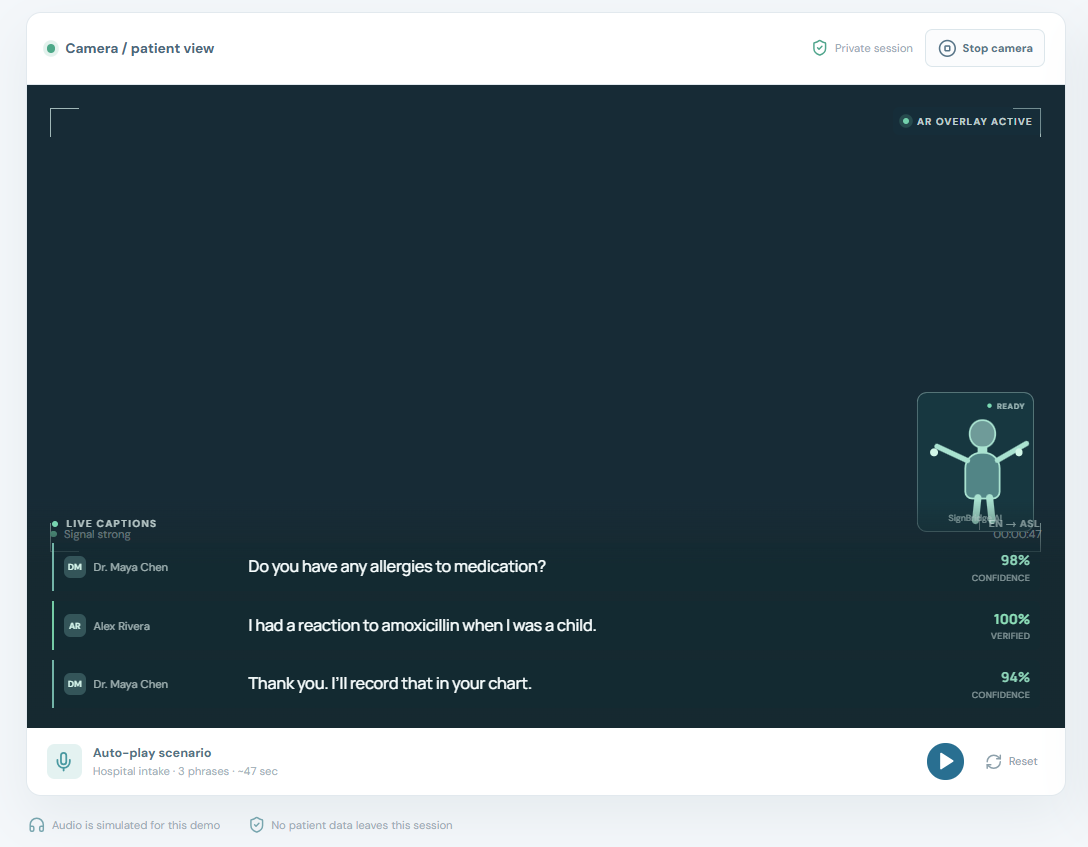
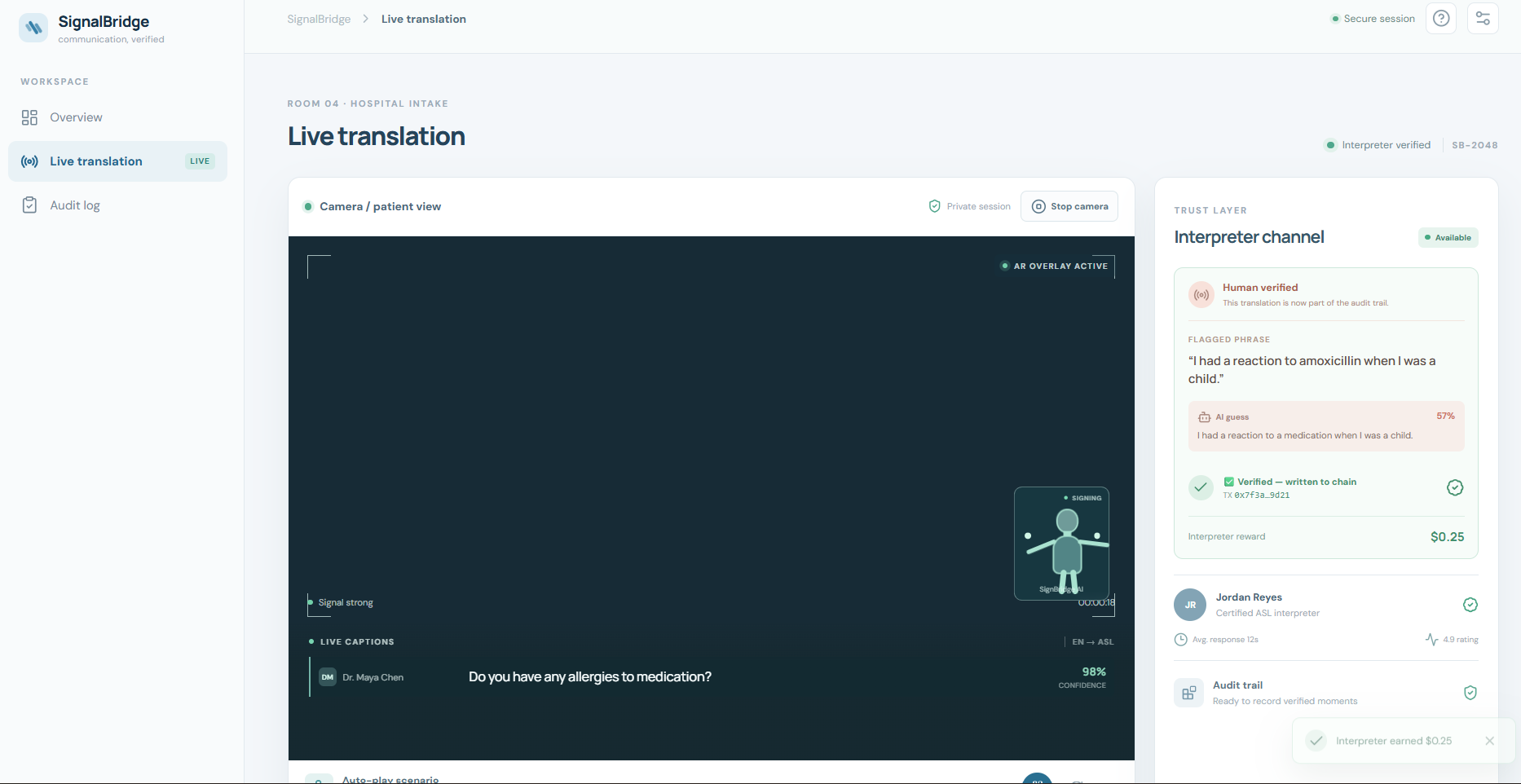
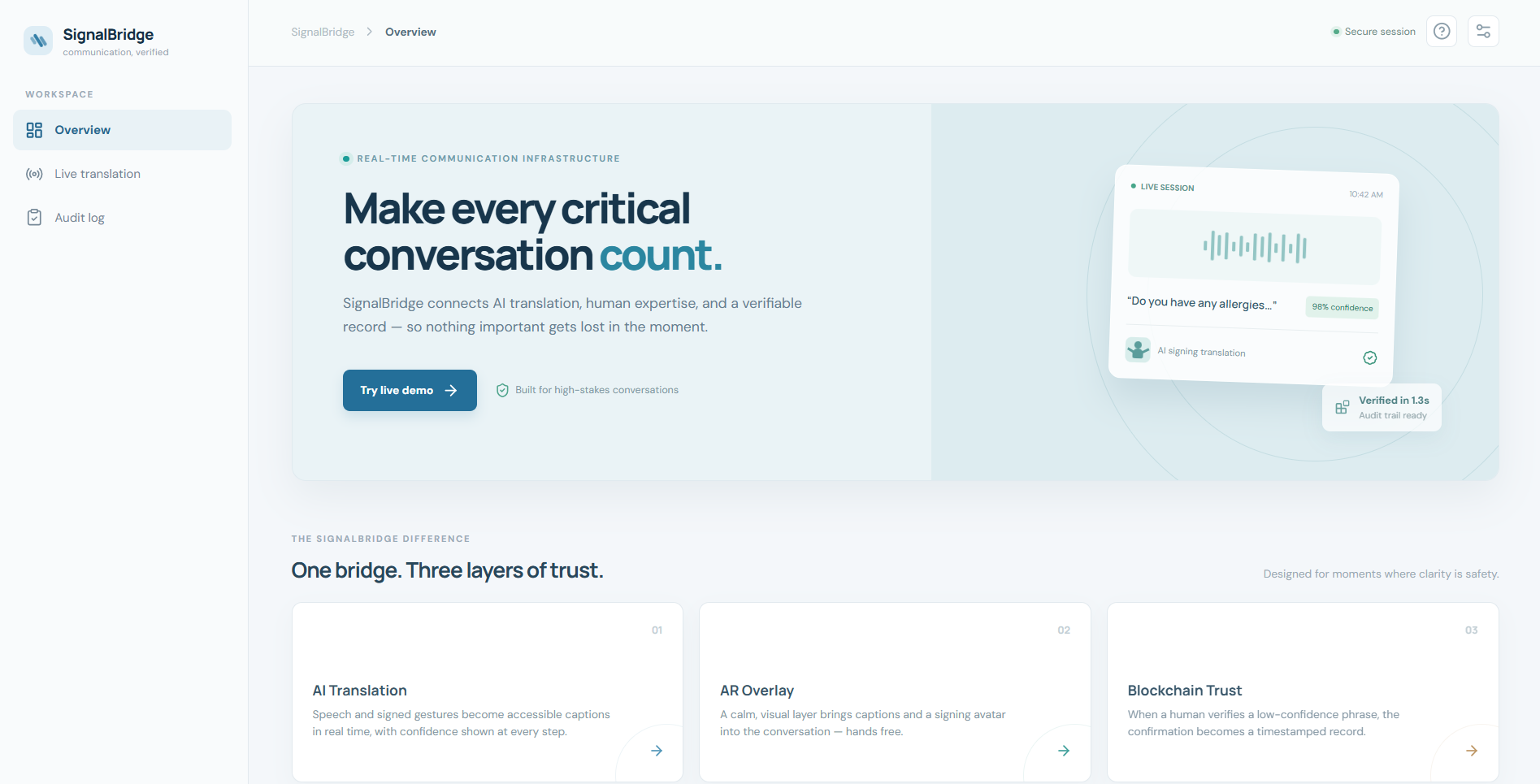
SignalBridge is a real-time AI + AR communication translator. It listens to speech and converts it into live captions plus an animated sign-language avatar overlay, and it watches sign gestures through the camera and converts them back into text and speech — so communication flows both ways, live. Every translation carries a confidence score. When that score drops on a critical phrase (a medical term, a legal word), the system automatically flags it for a human interpreter. Once the interpreter confirms or corrects the translation, that confirmation is logged as a timestamped, tamper-proof record — turning blockchain into an accountability layer instead of a gimmick, and giving both parties a verifiable record of what was actually communicated.
How we built it
We built an interactive React prototype covering the full user journey: a live translation screen with a scripted hospital-intake scenario, an interpreter verification panel that triggers on low-confidence moments, and a blockchain ledger screen that logs every verified exchange with a timestamp and transaction hash. Given the hackathon timeline, the speech recognition, sign-avatar rendering, and blockchain writes are simulated with realistic mock data rather than live models and a deployed smart contract — but the interaction flow, state machine, and UX are fully functional and demo-able end to end.
Challenges we ran into
The hardest part wasn't the tech — it was the trust design. We had to figure out where exactly the AI should hand off to a human, without making the app feel either reckless (never asking for help) or annoying (asking constantly). Tuning the confidence-threshold logic and the moment the interpreter panel appears took several iterations. We also had to resist the urge to bolt blockchain onto the idea superficially — it only earned its place once we reframed it as a trust and audit layer rather than a payment feature.
Accomplishments that we're proud of
We're proud that SignalBridge is a complete, clickable, end-to-end loop — not just slides. A judge can watch AI translate, watch it hesitate, watch a human step in, and watch that moment get permanently logged, all in under a minute. We also kept the design accessible-first: high contrast, large legible captions, and a calm interface, because a product for the Deaf and hard-of-hearing community has to be genuinely usable, not just impressive in a pitch.
What we learned
We learned how much UX design matters in AI products — a confidence score is meaningless unless it's communicated clearly and acted on predictably. We also learned that blockchain earns real value in accessibility and healthcare contexts specifically because of its immutability, not its novelty. And we learned a lot about scoping ambition realistically: choosing what to simulate versus build was as important a decision as the idea itself.
What's next for SignalBridge
Our roadmap has four phases: (1) this hackathon MVP with a working interactive prototype; (2) swapping in production-grade ASL/ISL recognition models and real speech translation, plus a live smart contract on a testnet; (3) a small pilot with a clinic or student health center to test the workflow with real interpreters; and (4) an open marketplace of verified interpreters, paid per verification, expanding across languages and sign systems beyond ASL.

Log in or sign up for Devpost to join the conversation.