Inspiration
The idea for CRISP sparked from our fascination with the delicate balance between numbers and emotions in the financial world. We were inspired by the complexity of managing client relationships in hedge funds, where even the most successful portfolios can falter due to miscommunication and overlooked emotions. As we delved deeper, we realized that most tools focus solely on numbers—ignoring the powerful, intangible impact of client sentiment. We asked ourselves: What if we could give portfolio managers a tool that not only crunches numbers but also reads between the lines? This drove us to create CRISP—a platform that bridges the gap between financial data and human emotions, offering a complete view of client satisfaction.
What it does
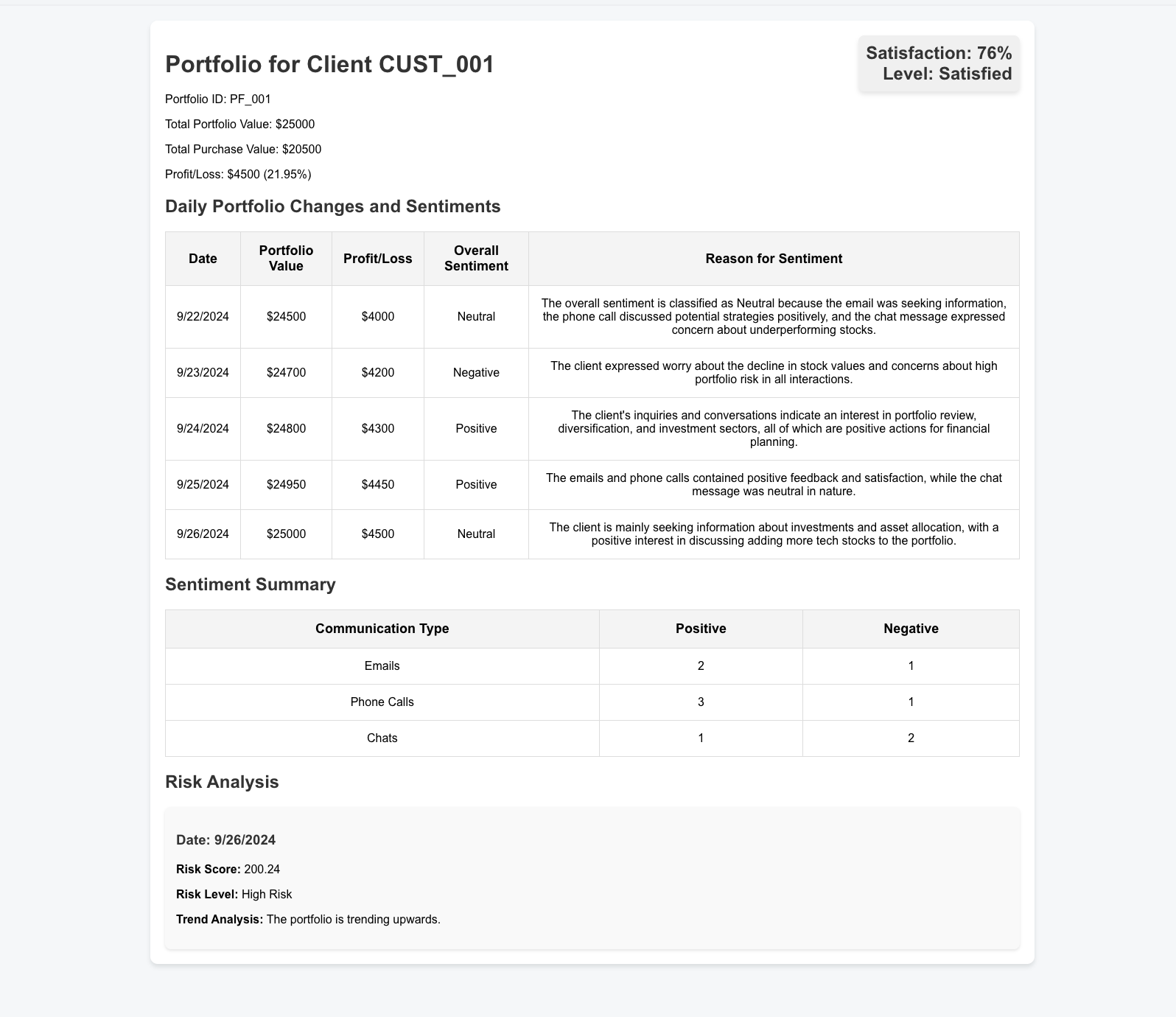
CRISP is like a pair of superhuman glasses for financial advisors and portfolio managers—enabling them to see beyond the numbers. It doesn’t just analyze portfolios; it listens to client voices through emails, chat logs, and phone call notes, identifying hidden sentiments that could impact long-term relationships. CRISP then combines these insights with a comprehensive risk analysis of each client’s portfolio, culminating in a powerful Client Satisfaction Score. This score helps identify which clients are content, which are on the brink of disengagement, and which need immediate attention to prevent churn. Think of CRISP as a crystal ball that predicts not only financial outcomes but also client emotions.
How we built it
The journey to build CRISP was like assembling a puzzle with pieces that didn’t quite fit at first. We started by creating a robust sentiment analysis model using OpenAI’s GPT to interpret and classify client communication into Positive, Neutral, or Negative sentiments. From there, we built a separate risk assessment module that digests daily portfolio changes, identifying high-risk areas. The final challenge was weaving these insights together, creating a unified scoring algorithm that balances sentiment and financial risk. We used MongoDB to seamlessly store and retrieve this interconnected data, ensuring that CRISP could scale without compromising performance. Every component—from the NLP models to the API integrations—was meticulously crafted to achieve one goal: deliver a complete picture of each client’s relationship health.
Challenges we ran into
During the course of the project, we encountered several key challenges that required thoughtful resolution and iterative refinement. One major hurdle was accurately aligning the outputs of multiple models, such as the sentiment analysis and risk assessment modules, which involved reconciling differing data formats and creating a unified data pipeline for seamless integration. Additionally, fine-tuning GPT models for context-specific scenarios was challenging due to limited labeled datasets and ensuring that the models responded correctly to complex financial prompts without generating ambiguous or mixed sentiment outputs.
Another significant obstacle was managing the diverse data sources within our MongoDB and SQL databases. We had to develop sophisticated ETL (Extract, Transform, Load) scripts to handle data inconsistencies, such as missing fields and varied data structures across client records. Handling complex API calls and adjusting the model’s response to JSON outputs was also a challenge, often resulting in format errors or invalid outputs. This necessitated custom parsing logic and error-handling mechanisms.
Finally, deploying the complete solution and orchestrating multiple scripts presented challenges in maintaining version compatibility and managing dependencies across different development environments. This included ensuring smooth interactions between the Python backend scripts and the Node.js frontend for triggering automated runs from the web interface. Overcoming these challenges involved close collaboration, thorough testing, and a step-by-step approach to debugging and refinement.
Accomplishments that we're proud of
Building CRISP from scratch was a massive undertaking, but we’re incredibly proud of how it turned out. We succeeded in crafting a sentiment analysis module that understands complex financial communication—something many solutions struggle with. Our risk assessment model, which factors in daily portfolio changes and sentiment trends, is another highlight. But our biggest accomplishment is the Client Satisfaction Score—a single metric that captures both the tangible and intangible aspects of client relationships. Seeing CRISP transform raw data into actionable insights felt like unlocking a new superpower for financial advisors.
What we learned
We learned that the numbers never tell the full story. There’s a world of emotions, expectations, and human complexities hidden behind each email and every portfolio. This project deepened our appreciation for the subtleties of human behavior, and we gained a new understanding of how critical communication is in managing high-value clients. We also learned to balance technical precision with empathy—fine-tuning our models to understand not just what clients say, but what they really mean. And finally, we learned the power of perseverance, debugging countless edge cases and iterating until everything clicked into place.
What's next for CRISP: Client Relationship Insight & Sentiment Performance
The future of CRISP is boundless. We envision CRISP evolving into the go-to platform for financial relationship management. Next, we plan to integrate real-time alerts, notifying advisors when a client’s sentiment shifts dramatically or when a portfolio risk level spikes. We’re also excited to explore behavioral profiling, using advanced analytics to predict disengagement before it happens. And of course, we’ll be expanding our dataset to include real-time market trends, allowing CRISP to provide even richer insights. With these enhancements, CRISP will not just be a tool—it will be the secret weapon that turns data into decisions, keeping hedge funds one step ahead in every client conversation.
Built With
- amazon-web-services
- aws-ec2
- django
- express.js
- flask
- github
- heroku
- javascript
- mern-stack
- mongodb
- node.js
- openai-gpt-api
- postgresql
- python
- react


Log in or sign up for Devpost to join the conversation.