-
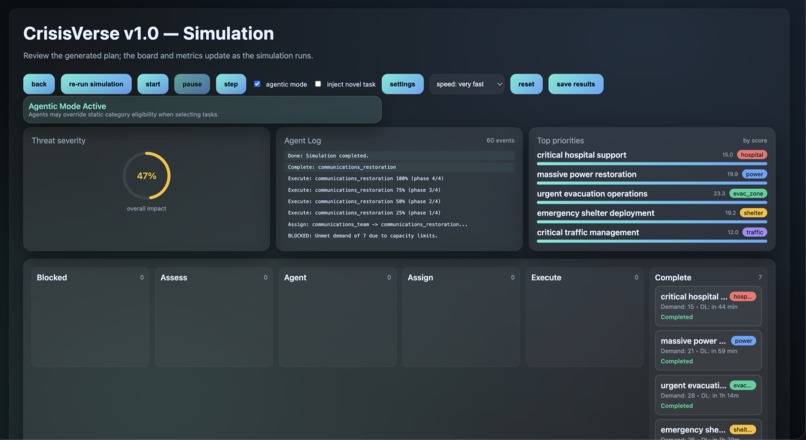
Multi-Agentic Crisis Management System (30% DECREASE in THREAT SEVERITY!)
-
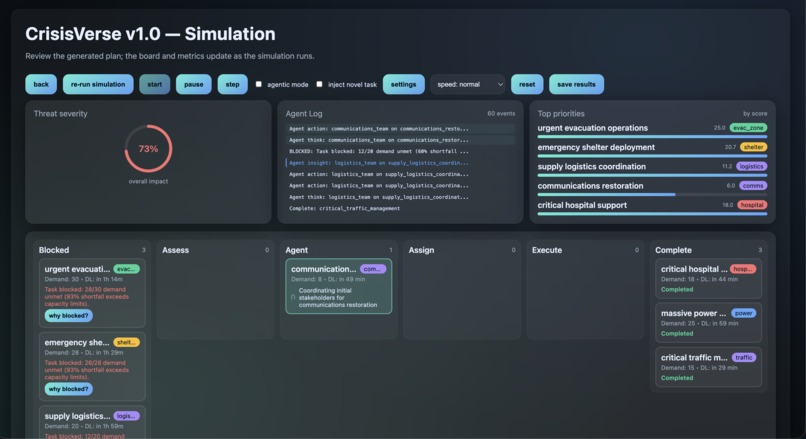
Non-Agentic / Deterministic Crisis Managements
-

Our saviour! Our protector! Mr. Chill
-
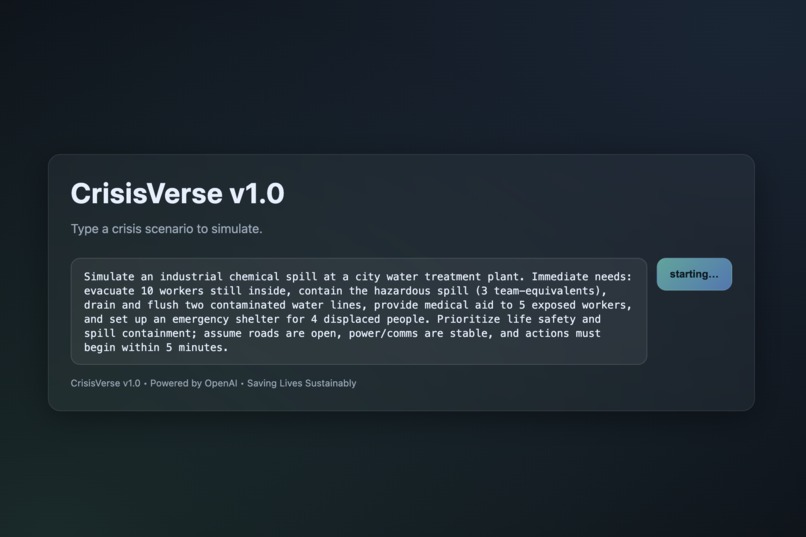
Simple prompting for users; Maximum safety for citizens of the world!


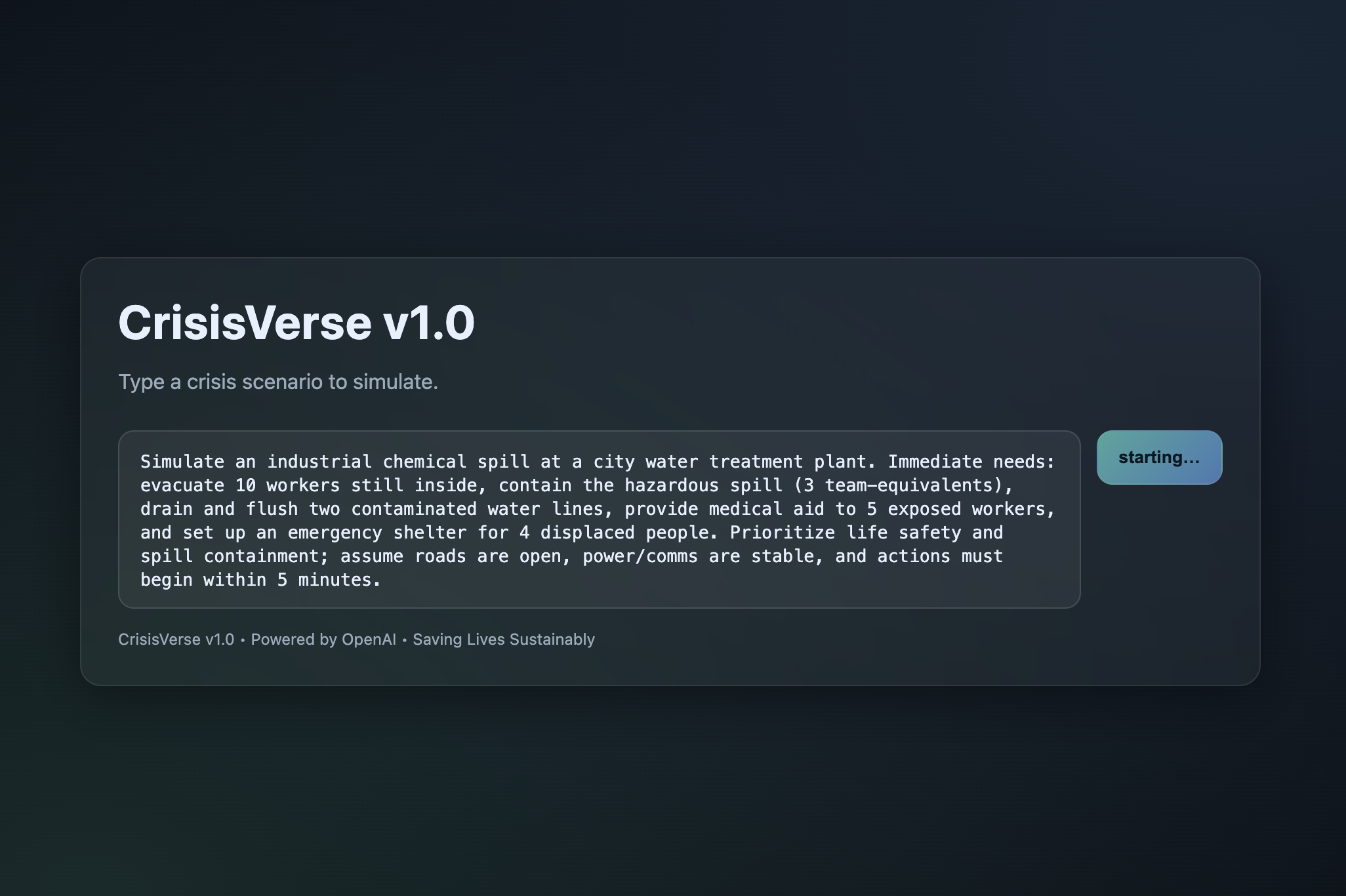
⚡ CrisisVerse: Agentic AI Simulations for Smarter Crisis Management
🚀 Overview
CrisisVerse is a next-generation, AI-powered threat simulation platform that transforms plain-English crisis prompts into structured, live, and adaptive multi-agent simulations.
Built with Next.js 14 (TypeScript) and powered by Google Gemini 2.0 Flash (Thinking Experimental), CrisisVerse demonstrates how agentic AI systems can outperform traditional, rigid planning approaches in emergency response. By modeling crises as interactive micro-worlds with actors, tasks, policies, constraints, and resources, CrisisVerse lets governments, NGOs, corporations, and researchers stress-test response strategies in real time—before disaster strikes.
This is how CrisisVerse targets different goals across safety, sustainability, and education:
Safety: CrisisVerse improves safety by simulating real-world emergencies and reducing crisis severity through intelligent, adaptive AI agents that coordinate resources under pressure.
Sustainability: CrisisVerse supports sustainability by optimizing resource allocation during crises, minimizing waste, and ensuring that limited supplies are directed where they have the greatest impact.
Education: CrisisVerse advances education by providing an interactive, AI-driven platform where students and professionals can learn crisis management strategies and understand how multi-agent systems make real-time decisions.
🔥 Inspiration
Real-world crisis management is plagued by:
- ⚠️ Static plans that break down when conditions shift.
- ⚠️ Expensive drills that can't capture edge cases.
- ⚠️ Siloed stakeholders that cause duplication, overload, or missed deadlines.
- ⚠️ No easy way to test scenarios under resource, policy, or time constraints.
We asked: 👉 What if anyone could simulate a real crisis—just by describing it in natural language? 👉 What if that simulation populated a live world of responders, hospitals, utilities, and roads—and adaptive AI agents coordinated resources intelligently under constraints?
That's CrisisVerse.
⚡ What It Does
CrisisVerse converts free-text prompts into structured, interactive crisis worlds:
✅ LLM parses scenarios into actors, tasks, deadlines, and constraints.
✅ The simulation engine allocates resources, tracks deadlines, and logs failures.
✅ Dual modes: deterministic (rigid rules) vs agentic (AI reasoning overrides).
✅ Users inject new crises mid-simulation to test adaptability.
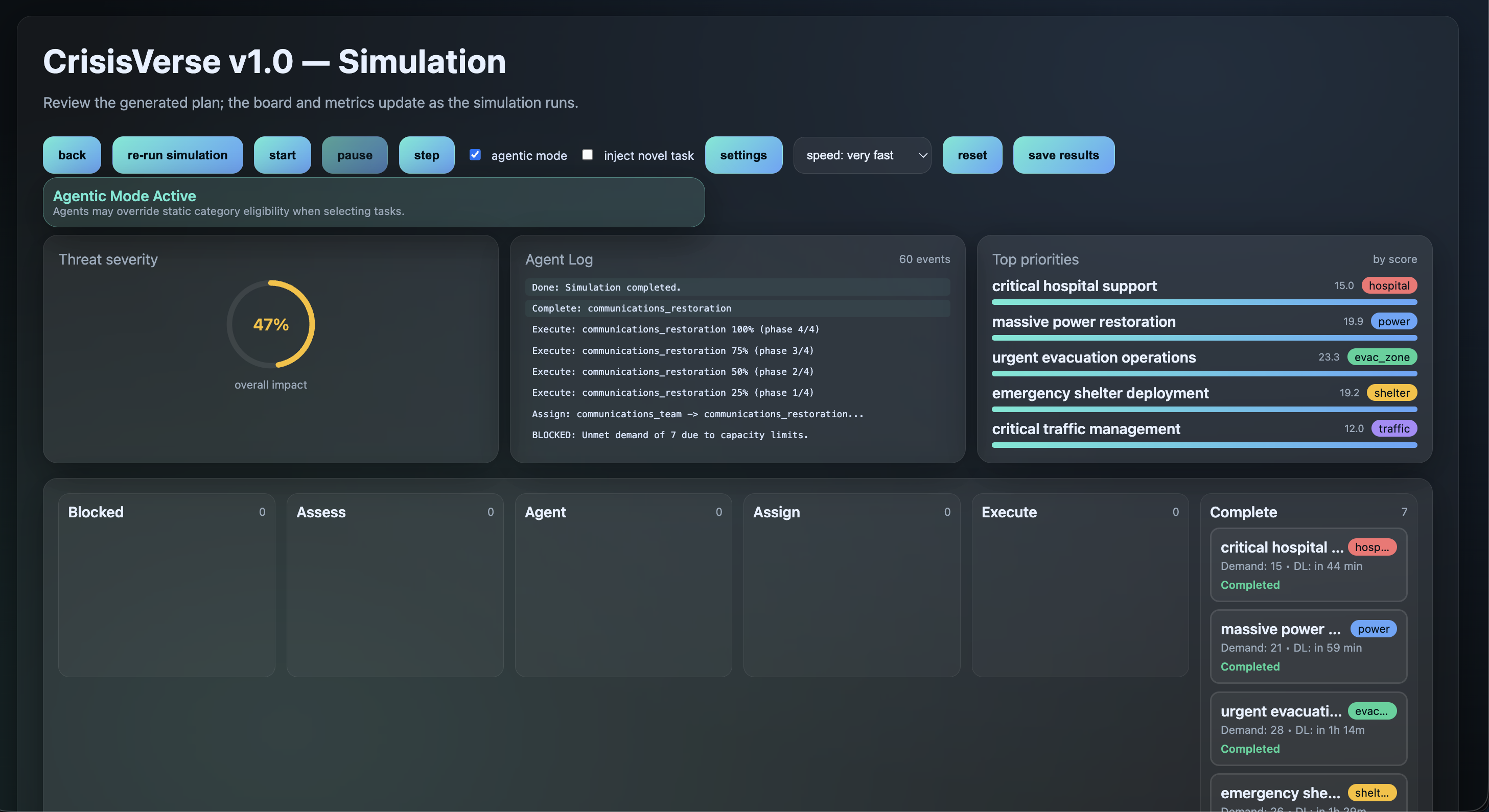
✅ The dashboard visualizes severity, blocked tasks, actor loads, and agent logs.
✅ Comparative metrics show how agentic AI improves throughput and resilience.
Example Input: "A heatwave hits Phoenix, backup power grids fail, and hospitals face surge demand." → Output: Structured tasks for hospital staff, utility repair teams, and coordinators, each with deadlines, policy restrictions, and capacity constraints.
🔧 How We Built It
- Prompt-to-World Engine
- Uses Gemini 2.0 Flash to parse crisis descriptions into JSON with actors, tasks, capacities, and objectives.
- Enforces structured outputs with deadlines, policy blocks, and resources.
- Simulation Core
- Custom TypeScript tick-based simulation engine.
- Handles assignment, constraints, retries, and bottlenecks.
- Supports both deterministic and agentic override flows.
- Agentic Reasoning Engine
/api/agent/decideroutes AI agents with full world state context.- Gemini agents reason dynamically about constraints and reprioritize tasks.
- Supports retry logic and blocked task reassignment.
- Interactive Dashboard (React + Tailwind)
- Live Kanban board of task progression (
Blocked → Assess → Agent → Assign → Execute → Complete). - Severity gauge, agent logs, actor load bars, and timeline progress indicators.
- Glassmorphism + gradient UI for clarity and immersion.
- Flexible Config System (
simulation.json)
- Adjustable weights, enforcement toggles, throttling, and A/B testing.
- Session persistence for runtime modifications without restart.
🛠 Tech Stack & Architecture
| Layer | Technology |
|---|---|
| 🧠 AI Engine | Google Gemini 2.0 Flash (Thinking Exp) |
| 🌐 Frontend | Next.js 14 + React 18 + Tailwind |
| ⚙️ Simulation Engine | Custom TS tick-based simulator |
| 📦 Config System | JSON-based (simulation.json) |
| 🧪 Testing | Vitest (unit, integration, scenario) |
| 🎨 UI Design | Glassmorphism + gradients + real-time UX |
🚧 Challenges We Ran Into
- 🧩 Designing dual modes (deterministic vs agentic) without breaking consistency.
- 🐛 Preventing stale deadlines from cached simulation states.
- 🧠 Parsing vague prompts into precise, constraint-sensitive JSON.
- 🔁 Ensuring injected tasks preserved all required metadata.
- ⚖️ Balancing agent autonomy with strict policy/resource constraints.
🎯 Accomplishments We're Proud Of
✅ Delivered a real-time AI-backed crisis simulator from scratch decreasing threat severity by 30%!
✅ Built a comparison framework proving agentic AI outperforms rigid planning.
✅ Created a configurable engine (simulation.json) for stress-testing different crisis types.
✅ Solved state persistence issues for fresh plan regeneration.
✅ Designed a polished, interpretable UI for live decision transparency.
📚 What We Learned
📌 How interpretable AI logs build trust in high-stakes environments.
📌 Why fresh state handling is critical in live simulations.
📌 The trade-off between autonomy and constraint fidelity.
📌 How UX clarity improves user adoption of complex AI systems.
📌 Value of simulating edge cases (resource bottlenecks, late injections).
🚀 Future Roadmap
🔹 CrisisVerse API for programmatic scenario testing
🔹 Prebuilt crisis templates (earthquake, flood, cyberattack, wildfire)
🔹 GIS + weather data integration for real-world accuracy
🔹 Multiplayer planning mode with role-specific dashboards
🔹 Exportable simulation analytics (CSV, widgets, reports)
🔹 Specialized LLM personas (military, medical, logistics)
🔹 Integration with municipal emergency dashboards
🛠 Setup & Deployment
Requirements
- Node.js + npm
- Google Gemini API key in
.env.local
Run Locally
git clone https://github.com/akulka404/sunhacks-2025
npm install
npm run dev
Or try it live right now at: the-crisis-and-chill.club
Sample Prompt to Test:
Metropolitan area faces cascading multi-crisis emergency requiring intelligent load balancing: massive power grid failure during peak summer heat causes hospital backup systems to fail, forcing immediate evacuations of high-rise buildings with disabled elevators, overwhelming traffic systems, and requiring emergency shelter setup for thousands. Multiple specialized response teams are stretched beyond capacity with critical deadlines requiring intelligent load balancing across constrained resources.
🏆 Why It's Unique
Unlike bureaucratic simulations built over months, CrisisVerse is instant, adaptive, and interpretable. In under 30 seconds, anyone with a browser can stress-test plans against realistic constraints—and see firsthand how agentic AI improves crisis outcomes.
It's not just a simulator. It's a blueprint for how the future of crisis management will look: dynamic, adaptive, AI-driven, and open to everyone.
Built With
- custom-constraint-based-simulation-engine
- github
- google-gemini-2.0-flash-(thinking-experimental)
- json-configuration-system
- next.js-14
- node.js
- openai-api-(backup)
- react-18
- restful-api-routes
- sessionstorage-(state-persistence)
- tailwind-css
- typescript
- vercel-(deployment)
- version-control
- vitest


Log in or sign up for Devpost to join the conversation.