Inspiration
Natural disasters like floods, cyclones, and earthquakes often create chaos within minutes. During such situations, people panic, emergency lines become overloaded, and rescue teams struggle to prioritize cases effectively. The inspiration for CrisisMind AI came from observing how critical the first few minutes are during emergencies. I wanted to build a system where AI could respond instantly — reducing panic, organizing information, and supporting both victims and rescue teams in real time.
What it does
🎤Listens to voice or text messages from people during emergencies
🧠 Understands urgency and context using AI reasoning
🚨 Detects risk level (Low / Medium / High)
📍 Extracts important details like location, number of people, medical needs
🛟 Provides instant safety guidance to the victim
📊 Sends structured alerts to a rescue dashboard
⚡ Automatically prioritizes cases based on severity It turns panic messages into organized, actionable information so rescue teams can respond faster and more efficiently.It’s like a 24/7 intelligent emergency operator that never gets overloaded.
How we built it
1️⃣ Designing the Architecture
We first designed a cloud-native architecture focused on scalability and real-time processing. The system was structured into three main layers:
User Interaction Layer (Web Interface)
AI Processing Layer
Rescue Dashboard & Analytics Layer
2️⃣ Building the Frontend
We built the web interface using:
React.js
Tailwind CSS
The frontend includes:
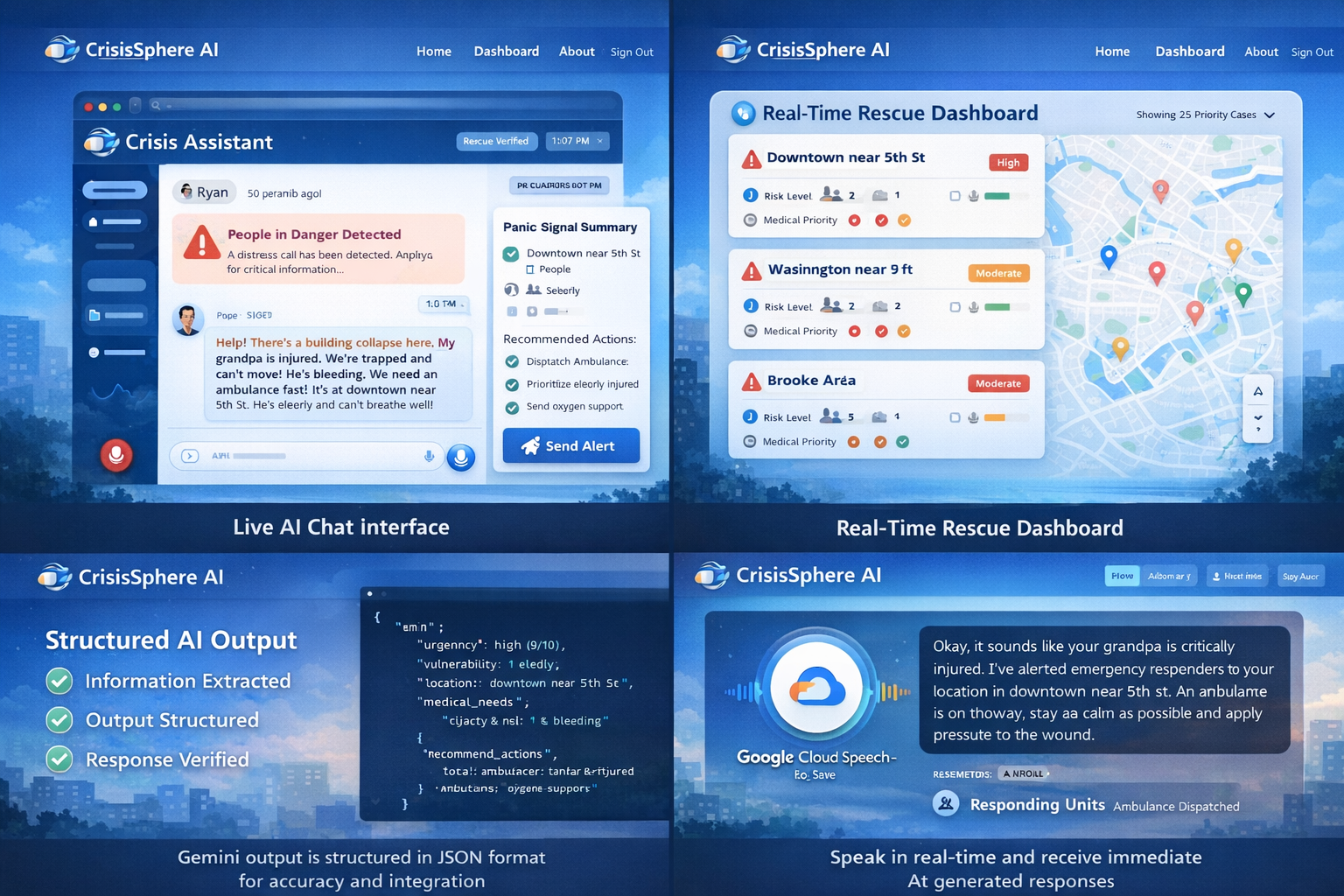
Live chat interface
Voice input button
Panic level indicator
Real-time rescue dashboard
The UI was designed to be minimal and calm, suitable for emergency situations.
3️⃣ Implementing AI Processing
For intelligence and reasoning, we used:
Gemini via
Vertex AI
Gemini processes incoming voice or text messages and:
Detects urgency
Identifies vulnerable individuals (elderly, injured)
Extracts structured information
Generates safety recommendations
We used prompt engineering to ensure the output was structured in JSON format for dashboard integration.
4️⃣ Voice Integration
To support real-time voice interaction, we integrated:
Google Cloud Speech-to-Text
Google Cloud Text-to-Speech
This allows the system to:
Convert voice to text
Process it using Gemini
Respond back in natural voice
5️⃣ Real-Time Dashboard
We used:
Firebase for live data updates
Structured alert cards showing:
Location
Risk level
Number of people
Medical priority
Each emergency case is ranked automatically using a weighted risk scoring formula.
6️⃣ Risk Scoring Logic
We implemented a scoring system:
𝑅 𝑖 𝑠 𝑘 𝑆 𝑐 𝑜 𝑟
𝑒
( 0.5 × 𝑈 𝑟 𝑔 𝑒 𝑛 𝑐 𝑦 ) + ( 0.3 × 𝑉 𝑢 𝑙 𝑛 𝑒 𝑟 𝑎 𝑏 𝑖 𝑙 𝑖 𝑡 𝑦 ) + ( 0.2 × 𝐿 𝑜 𝑐 𝑎 𝑡 𝑖 𝑜 𝑛 𝑆 𝑒 𝑣 𝑒 𝑟 𝑖 𝑡 𝑦 ) RiskScore=(0.5×Urgency)+(0.3×Vulnerability)+(0.2×LocationSeverity)
This helps prioritize rescue cases intelligently.
7️⃣ Deployment
Frontend deployed using Firebase Hosting
Backend deployed on Google Cloud
Environment variables secured for API access
Designed to scale automatically using cloud infrastructure
🚀 Final Outcome
The result is a fully functional AI-powered live disaster agent that:
Responds in real time
Converts unstructured panic into structured intelligence
Prioritizes rescue operations automatically
Scales for large disaster scenarios
Challenges we ran into
1️⃣ Handling Unstructured Panic Input
During disasters, people don’t speak in clear sentences. Messages are often incomplete, emotional, or chaotic.
Designing prompts that could reliably extract structured data (location, urgency, medical needs) from messy input was a major challenge.
We solved this using structured prompt engineering and enforced JSON output formatting.
2️⃣ Real-Time Latency
Emergency systems must respond instantly.
Balancing:
Voice processing
AI reasoning
Structured output generation
while keeping response time low required optimizing API calls and reducing unnecessary processing steps.
3️⃣ Designing a Fair Risk Scoring Model
Creating an automated priority system was difficult.
We had to carefully balance factors like:
Urgency level
Vulnerable individuals (elderly, injured)
Location severity
If weights were too high or too low, prioritization would become biased or inaccurate.
4️⃣ Ensuring Scalable Architecture
Disasters can generate thousands of simultaneous requests.
Designing a cloud-native system that could scale without crashing required thoughtful architecture planning using managed cloud services.
5️⃣ Building a Calm User Experience
In high-stress situations, a complex interface increases panic.
We had to:
Simplify UI elements
Reduce cognitive load
Avoid overwhelming animations
Make information easy to understand instantly
Designing for stress was more challenging than designing for normal users.
6️⃣ Structured AI Output Reliability
Large language models sometimes generate inconsistent output formats.
Ensuring predictable, machine-readable responses required:
Strict output templates
Validation checks
Fallback logic
🚀 What These Challenges Taught Us
Real-world AI is not just about accuracy — it’s about reliability.
Human-centered design is critical in emergency systems.
Scalability must be planned from day one.
Structured intelligence is more powerful than raw AI responses.
Accomplishments that we're proud of
Built a real-time AI disaster response live agent that converts voice/text into structured emergency alerts.
Designed an intelligent risk scoring model for automatic rescue prioritization.
Integrated Gemini via Vertex AI** with a scalable cloud-native architecture.
Developed a live rescue dashboard using Firebase.
Created a human-centered, stress-friendly interface for emergency situations.
What we learned
Building real-world AI requires reliability, not just intelligence.
Structuring LLM outputs into actionable data is critical for practical impact.
Cloud-native design is essential for scalability during high-demand situations.
Human-centered UI design matters even more in high-stress environments.
Collaboration between AI reasoning and system architecture creates meaningful solutions.
What's next for CrisisSphere AI
🔄 Integrate real-time weather and disaster APIs for predictive alerts.
📍 Add automatic GPS location detection for faster rescue coordination.
🌍 Expand multilingual support for rural and global deployment.
🤝 Partner with local authorities and NGOs for pilot testing.
📊 Enhance the risk model using historical disaster data and machine learning.
☁️ Scale infrastructure for large-scale, real-world emergency scenarios.


Log in or sign up for Devpost to join the conversation.