What it does
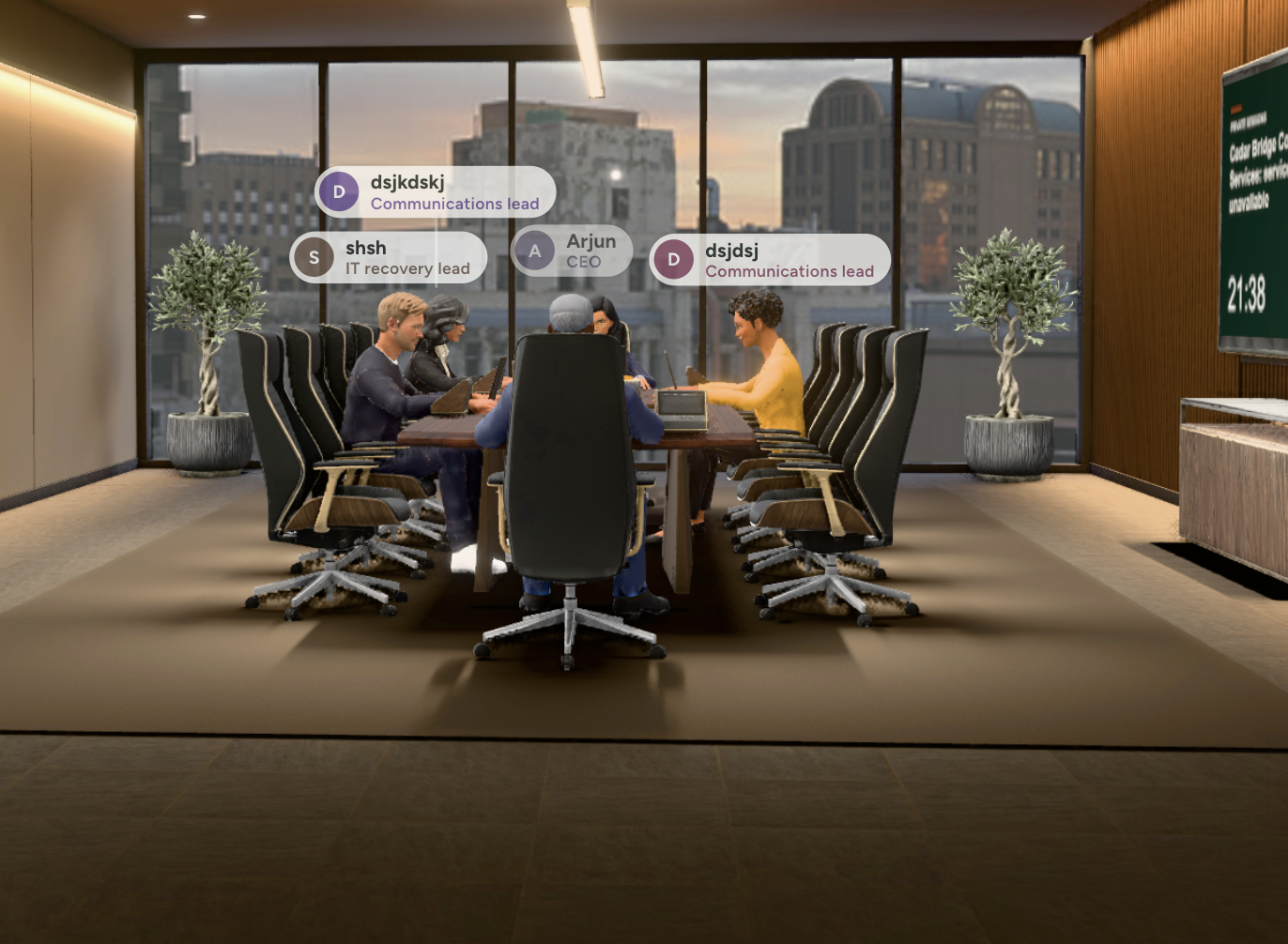
CrisisRoom is an AI-powered boardroom crisis simulation platform that helps organizations prepare for unexpected situations through interactive tabletop exercises.
Instead of simply reading through a business continuity plan, participants take on leadership roles and work together to navigate realistic crises, such as cybersecurity attacks, reputational damage, and disruptions to business operations.
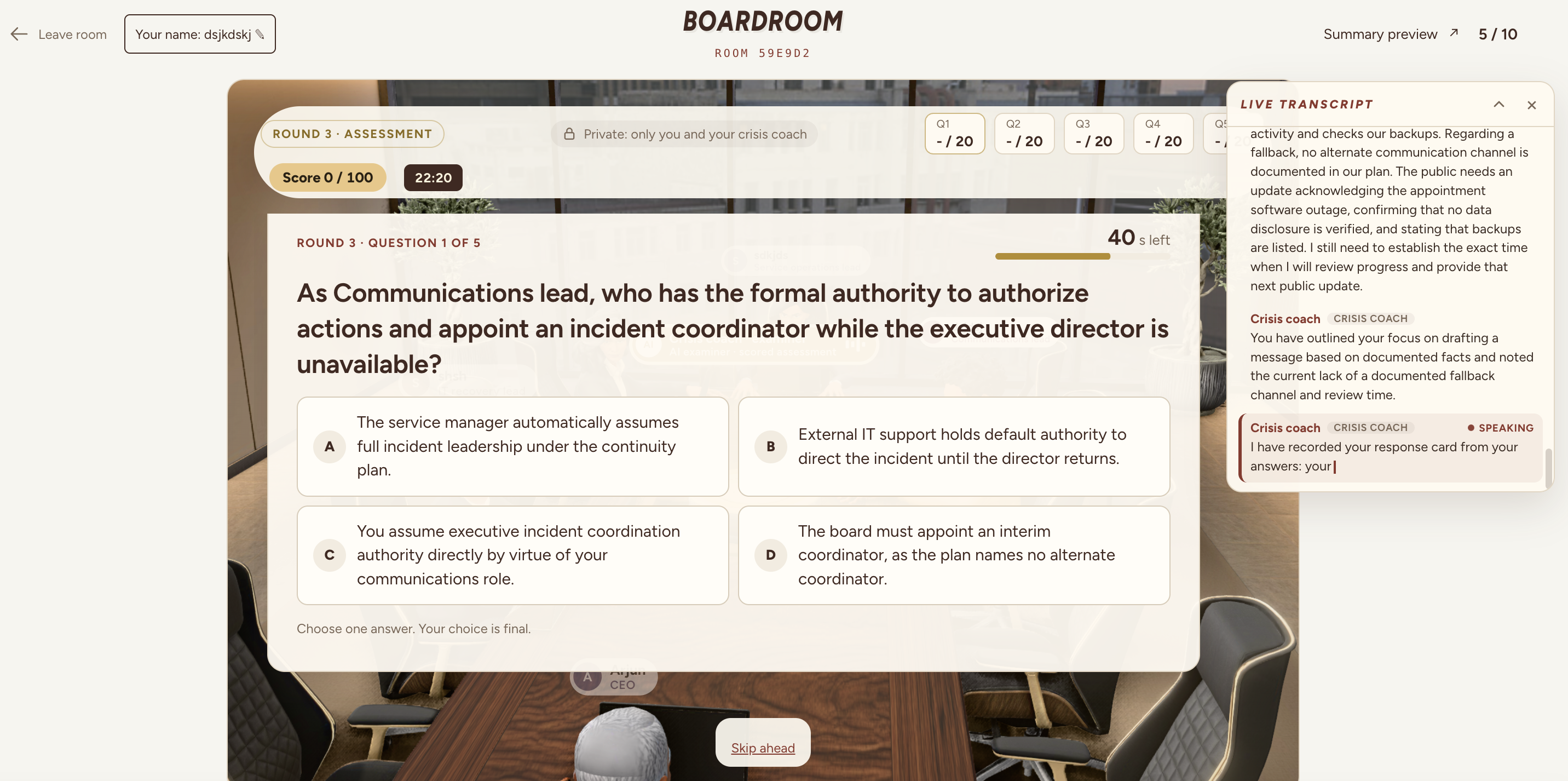
Throughout the simulation, participants discuss potential solutions, propose actions, and vote on critical decisions under time pressure. Their choices influence how the scenario unfolds, introducing new challenges and forcing teams to adapt.
At the end of the exercise, CrisisRoom provides AI-assisted feedback based on participants' decisions, discussions, and contributions, helping teams identify strengths, weaknesses, and areas for improvement.
Our goal is to make crisis preparedness more engaging, accessible, and practical for organizations.
How we built it
We built CrisisRoom as a full-stack web application using React, TypeScript, and Vite for the frontend and Python with FastAPI for the backend.
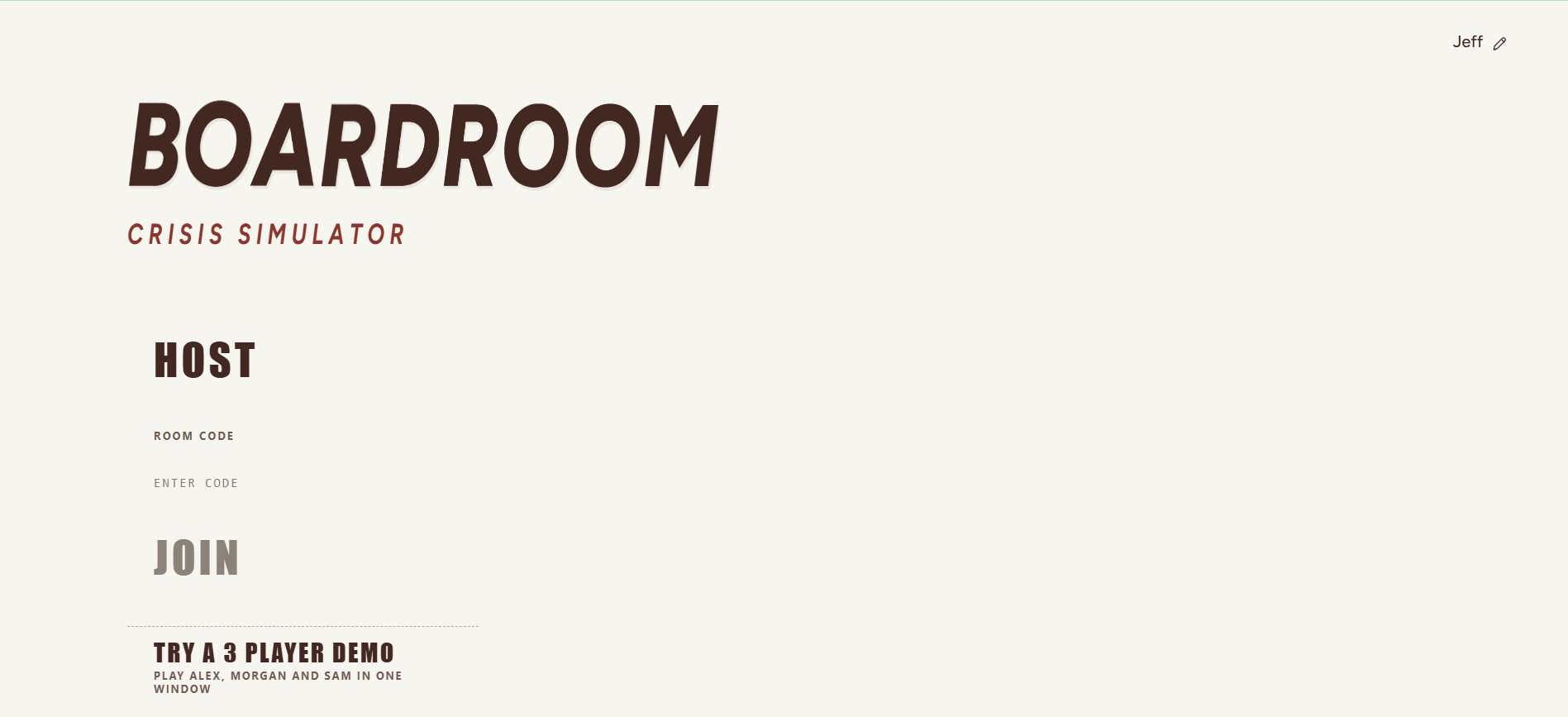
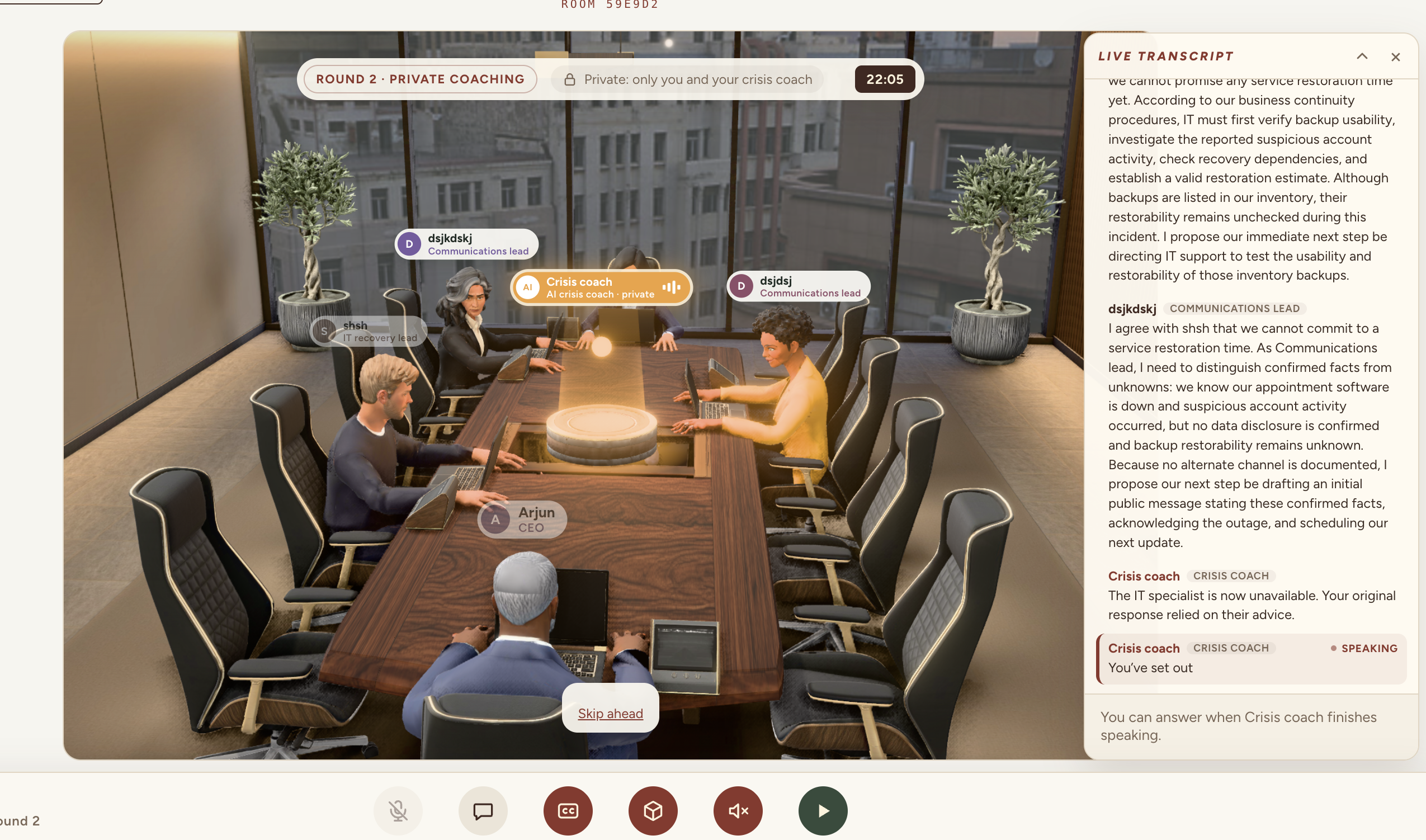
The frontend provides an interactive boardroom experience where participants can join sessions using room codes, assume leadership roles, communicate with one another, and participate in timed decision-making rounds.
On the backend, we implemented room management, participant authentication, role assignments, voting, timers, and a simulation engine that manages the progression of each crisis.
We integrated AI-powered inference to help interpret participant decisions and generate qualitative feedback based on their contributions throughout the exercise. We also integrated ElevenLabs for speech-to-text and text-to-speech functionality, allowing participants to engage through voice.
For deployment, we used Docker, Coolify, and Vultr Cloud Compute to host our application and make it accessible online.
Challenges we ran into
One of our biggest challenges was developing a multiplayer simulation where participants could interact simultaneously while maintaining a consistent game state.
We needed to coordinate multiple users, different leadership roles, timed discussions, voting sessions, and scenario progression without allowing conflicting actions or losing important contributions.
Integrating AI into the simulation was another challenge. We wanted the experience to feel dynamic while ensuring that AI-generated responses remained consistent with the scenario and did not interfere with the application's decision-making rules.
We also encountered challenges integrating voice recording, transcription, and playback while managing browser permissions and securely handling participant data.
Finally, deploying the full-stack application introduced additional challenges involving Docker networking, environment variables, DNS configuration, and HTTPS certificates.
These challenges pushed us to think more carefully about system architecture, reliability, and how different services communicate.
Accomplishments that we're proud of
We're proud that we were able to turn a real organizational challenge into a working, interactive application within the constraints of a hackathon.
Some of our biggest accomplishments include:
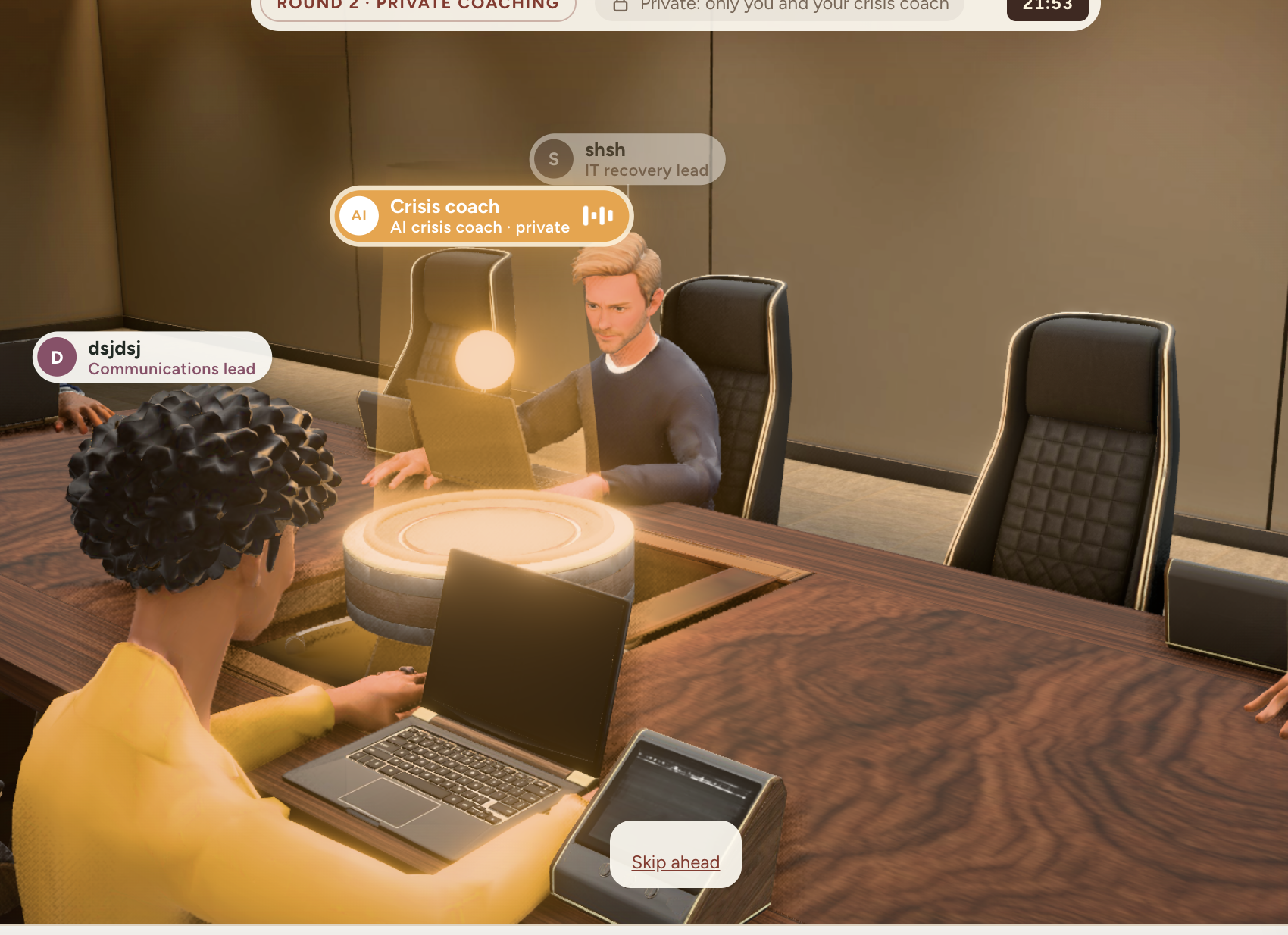
- Building a multiplayer boardroom environment where participants can join the same simulation and take on different leadership roles.
- Developing a structured crisis simulation engine with timed discussions, voting, evolving scenarios, and decision consequences.
- Integrating AI to interpret decisions and provide meaningful feedback rather than relying entirely on predefined outcomes.
- Implementing voice recording, transcription, and narration using ElevenLabs.
- Creating an interactive frontend with custom animations and a cohesive visual design.
- Successfully testing a complete multiplayer simulation involving three participants across multiple decision-making rounds.
- Containerizing and deploying our full-stack application using Vultr and Coolify.
Most importantly, we're proud that our project goes beyond a simple AI chatbot. We built an experience that encourages collaboration, critical thinking, communication, and decision-making under pressure.
What we learned
Building CrisisRoom taught us how challenging it is to develop a system that combines real-time collaboration, AI integration, and an interactive user experience.
We gained valuable experience designing server-authoritative multiplayer systems, managing asynchronous operations, integrating external APIs, and coordinating frontend and backend development.
We also learned that AI works best when it operates within clearly defined boundaries. Rather than allowing AI to control the entire simulation, we used application logic to manage the rules, permissions, and decisions while AI supported interpretation and feedback.
Beyond the technical aspects, we learned more about the importance of business continuity planning and how organizations can benefit from practicing their response to crises before they happen.
What's next for CrisisRoom
We envision CrisisRoom becoming a practical training and preparedness platform for organizations of different sizes.
Moving forward, we want to expand the platform by introducing:
- Document-driven scenarios: Allow organizations to upload their business continuity plans and generate simulations tailored to their actual policies and procedures.
- More crisis scenarios: Support situations involving cybersecurity, financial disruptions, leadership emergencies, public relations, and operational failures.
- Advanced AI feedback: Provide more detailed assessments of communication, decision-making, and how effectively teams followed their established procedures.
- Persistent sessions: Allow simulations to recover after interruptions and retain historical exercises for future review.
- Improved collaboration: Enhance the multiplayer experience with more seamless real-time communication and facilitator controls.
- Organizational dashboards: Help teams review previous simulations, identify recurring gaps, and track improvements over time.
Our long-term vision is to make crisis preparedness something organizations can actively practice rather than simply document.
Because when a real crisis happens, preparation should already be second nature.


