-
-
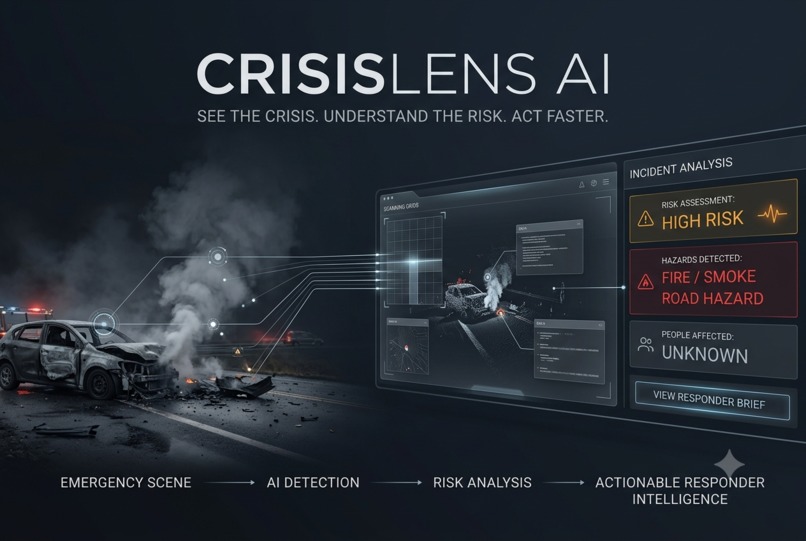
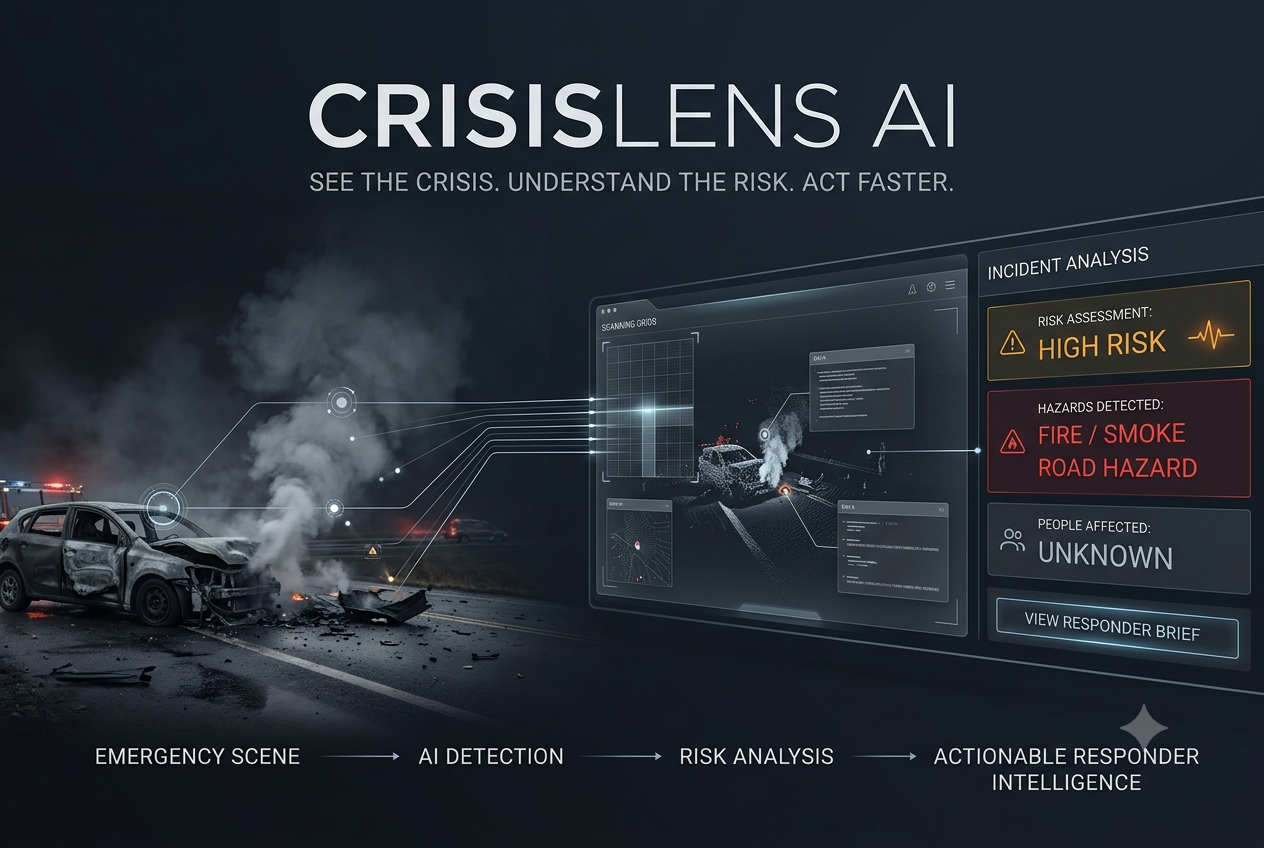
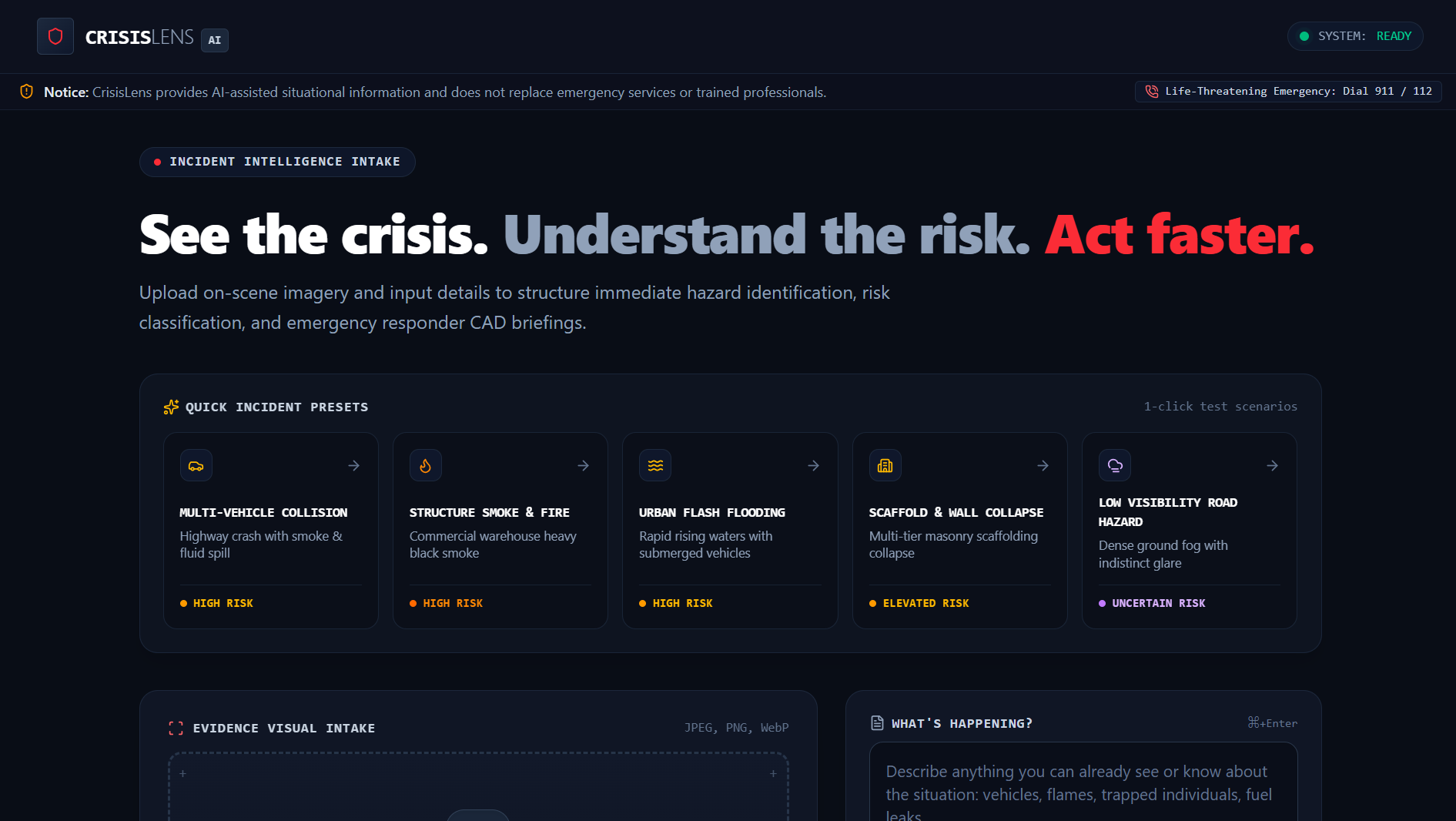
“CrisisLens AI — an emergency intelligence dashboard designed to turn incident evidence into actionable insights.”
-
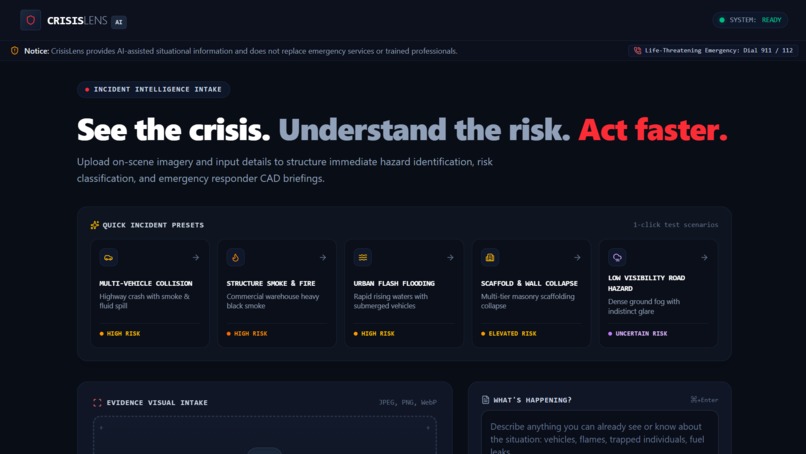
Emergency Intelligence Dashboard
-
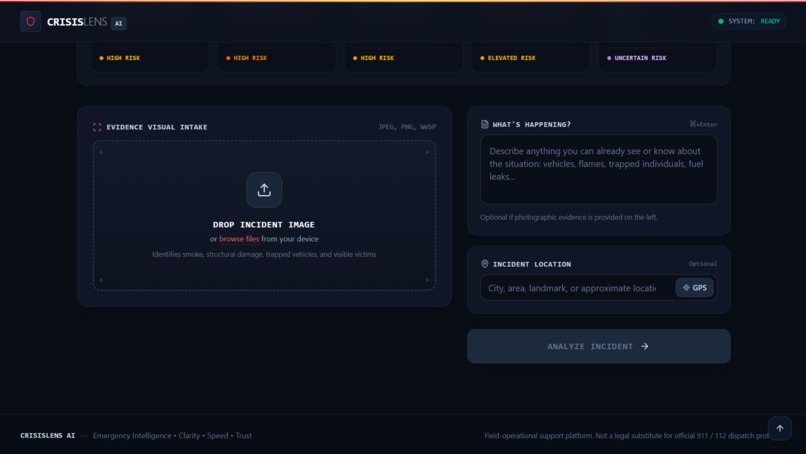
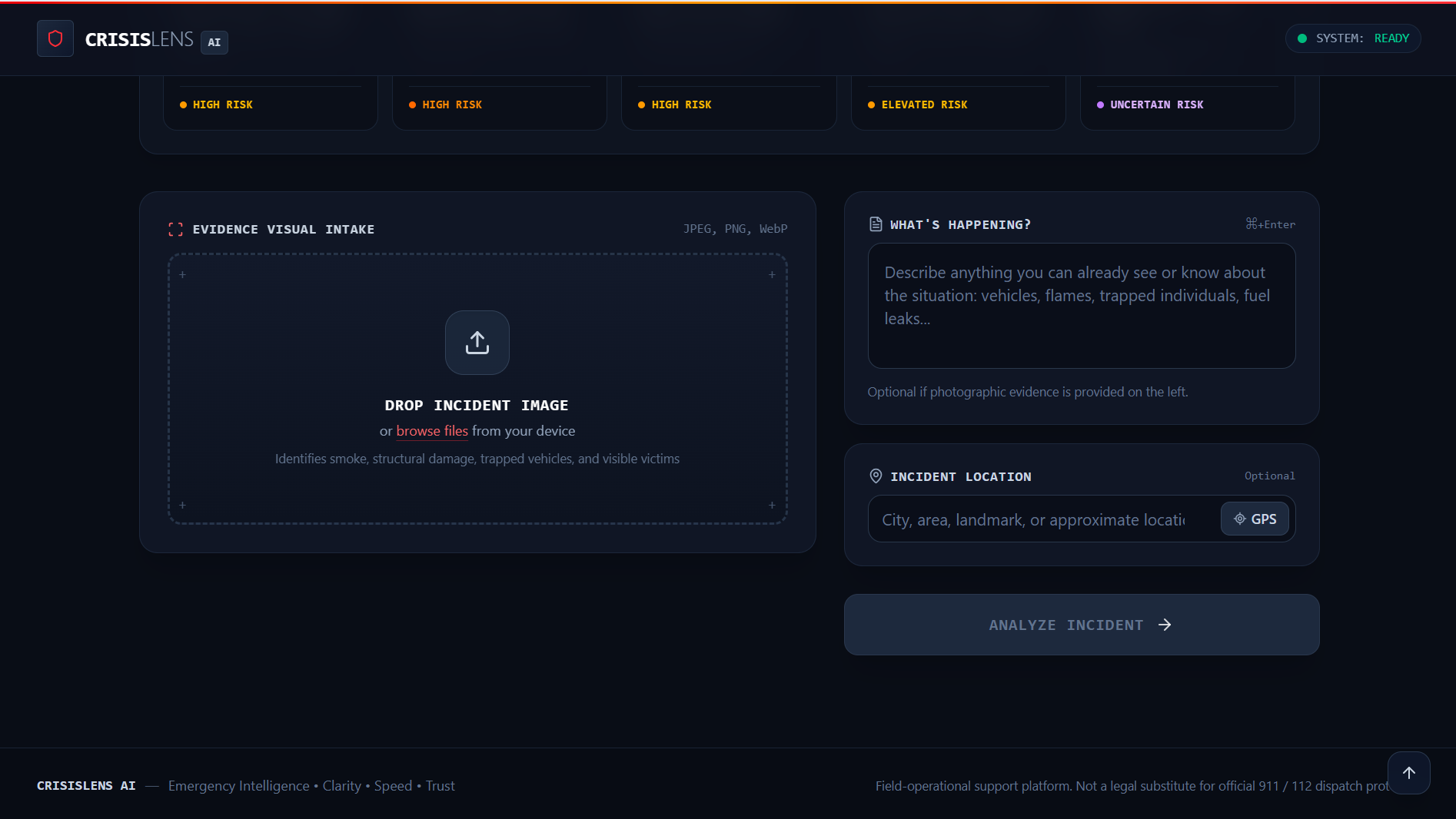
“Upload an incident image and description to begin AI-powered emergency analysis.”
-
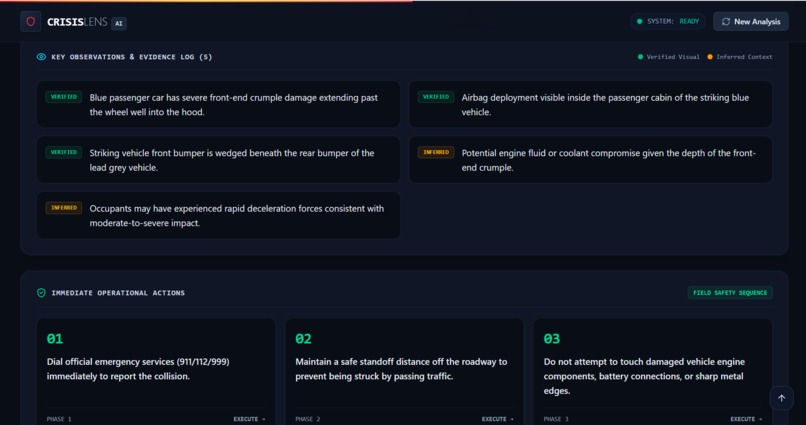
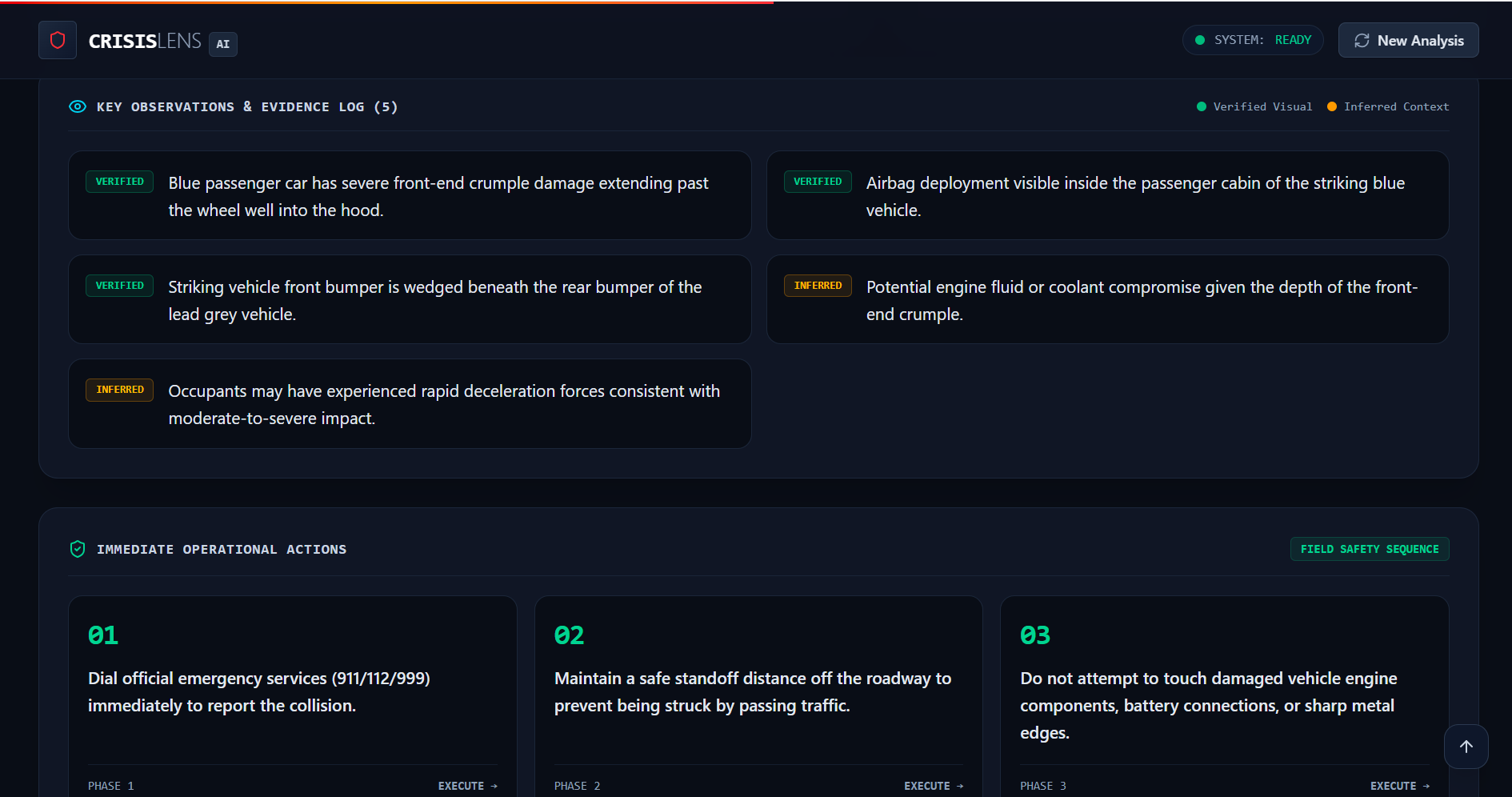
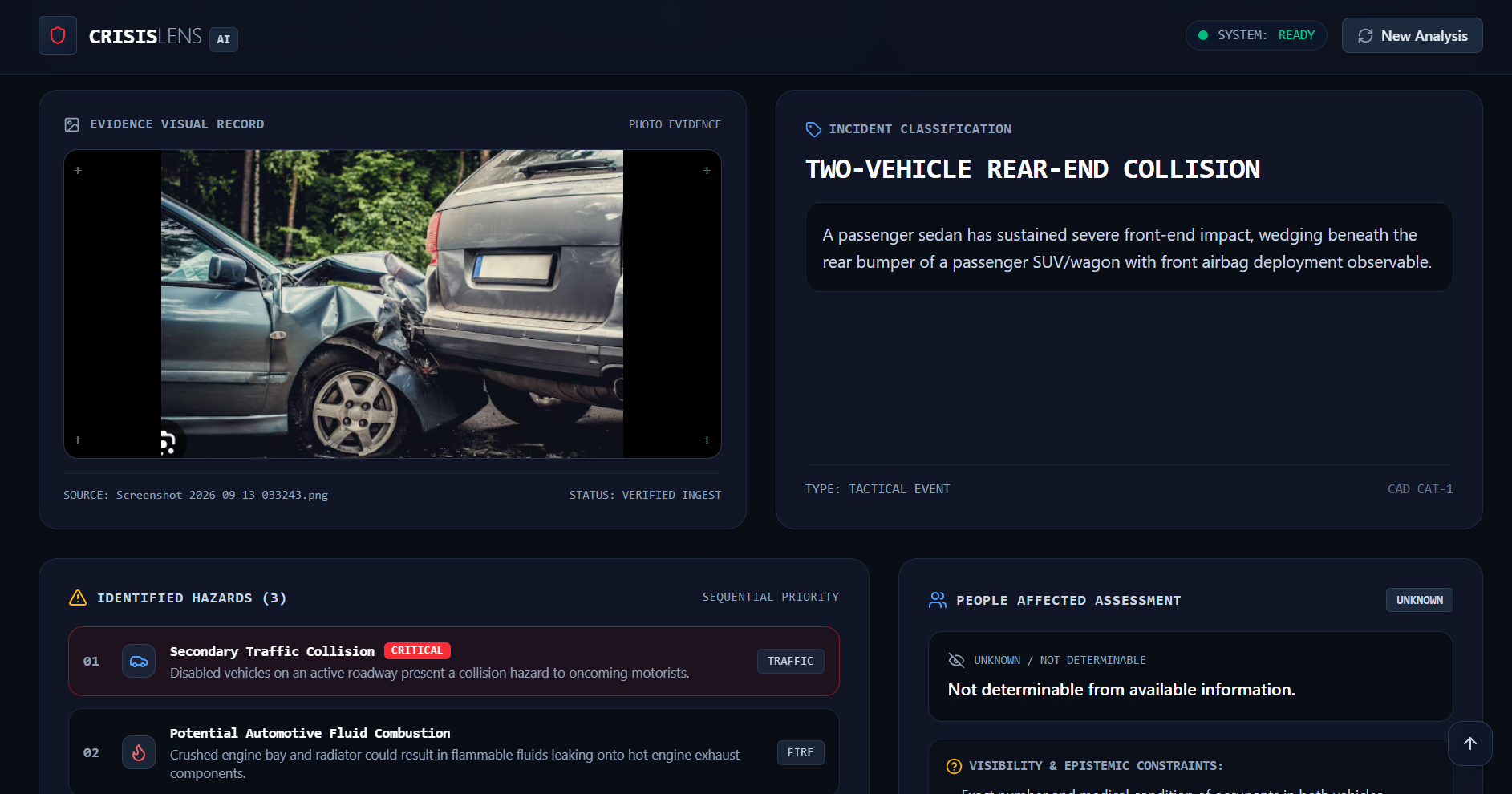
“Detected hazards are organized into a clear, easy-to-understand emergency intelligence view.”
-
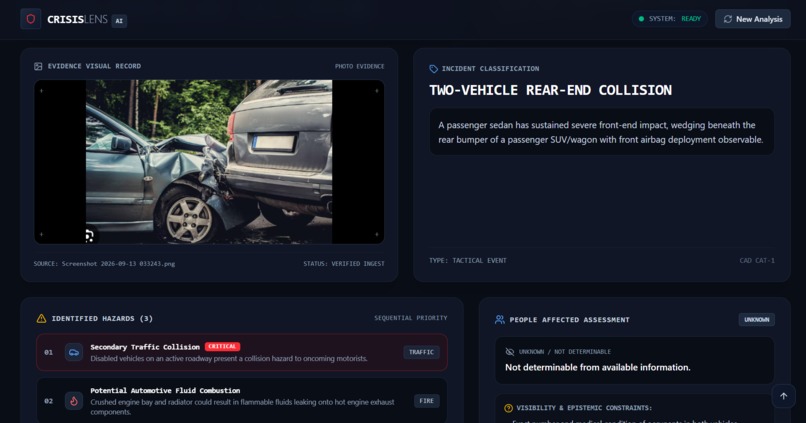
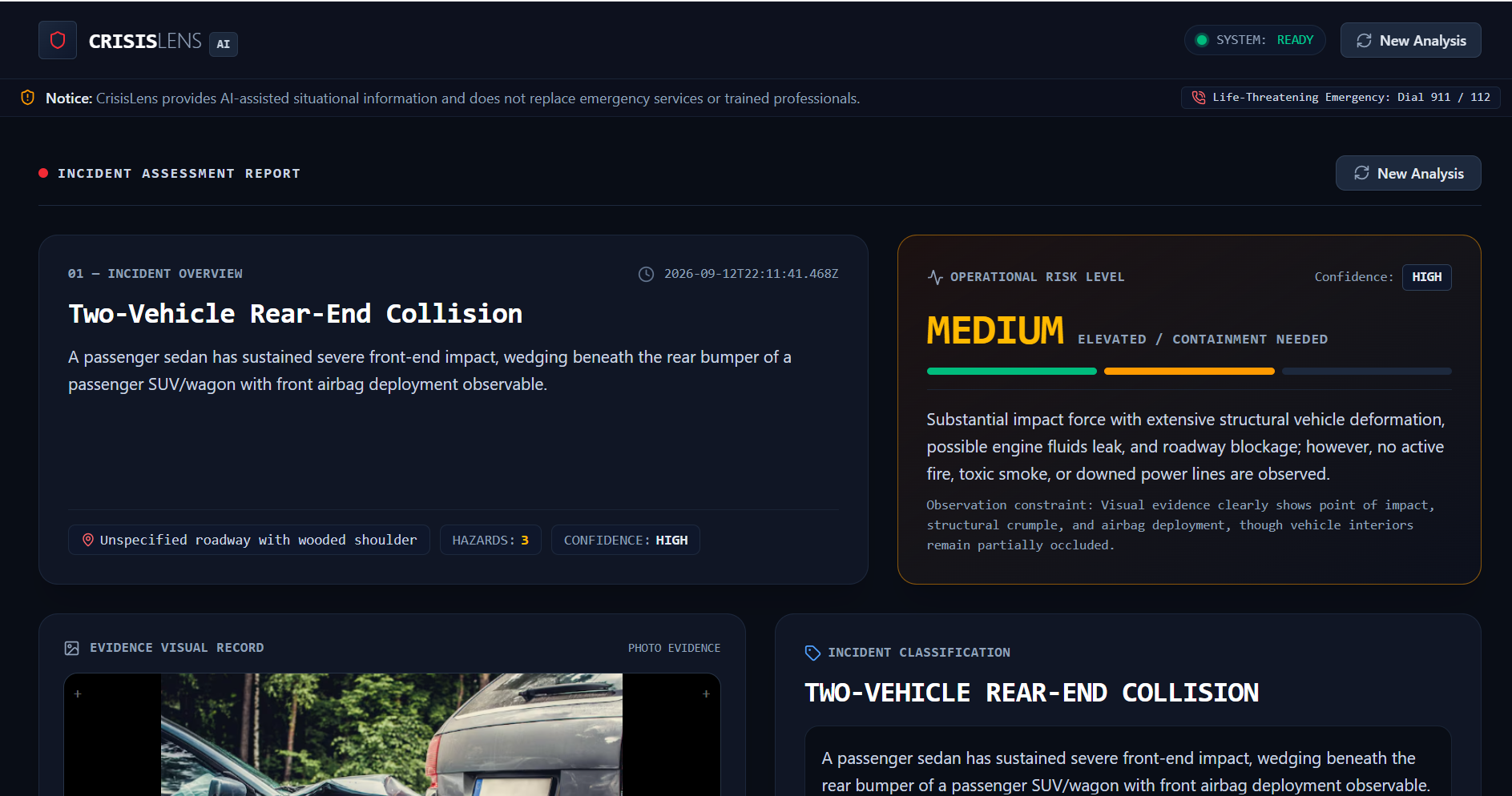
“A structured risk assessment helps communicate the urgency of the detected situation.”
-
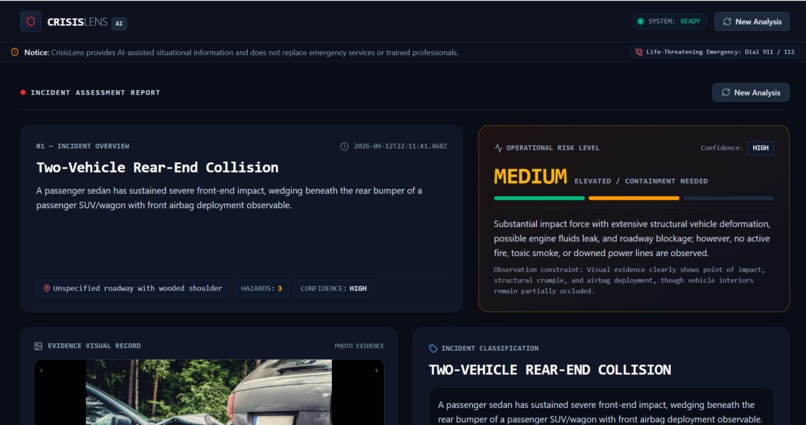
“Multimodal AI analyzes the incident to identify the situation, hazards, and overall risk level.”
-
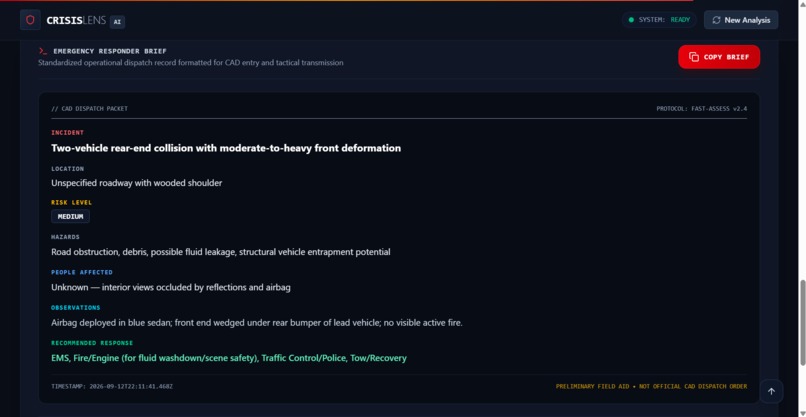
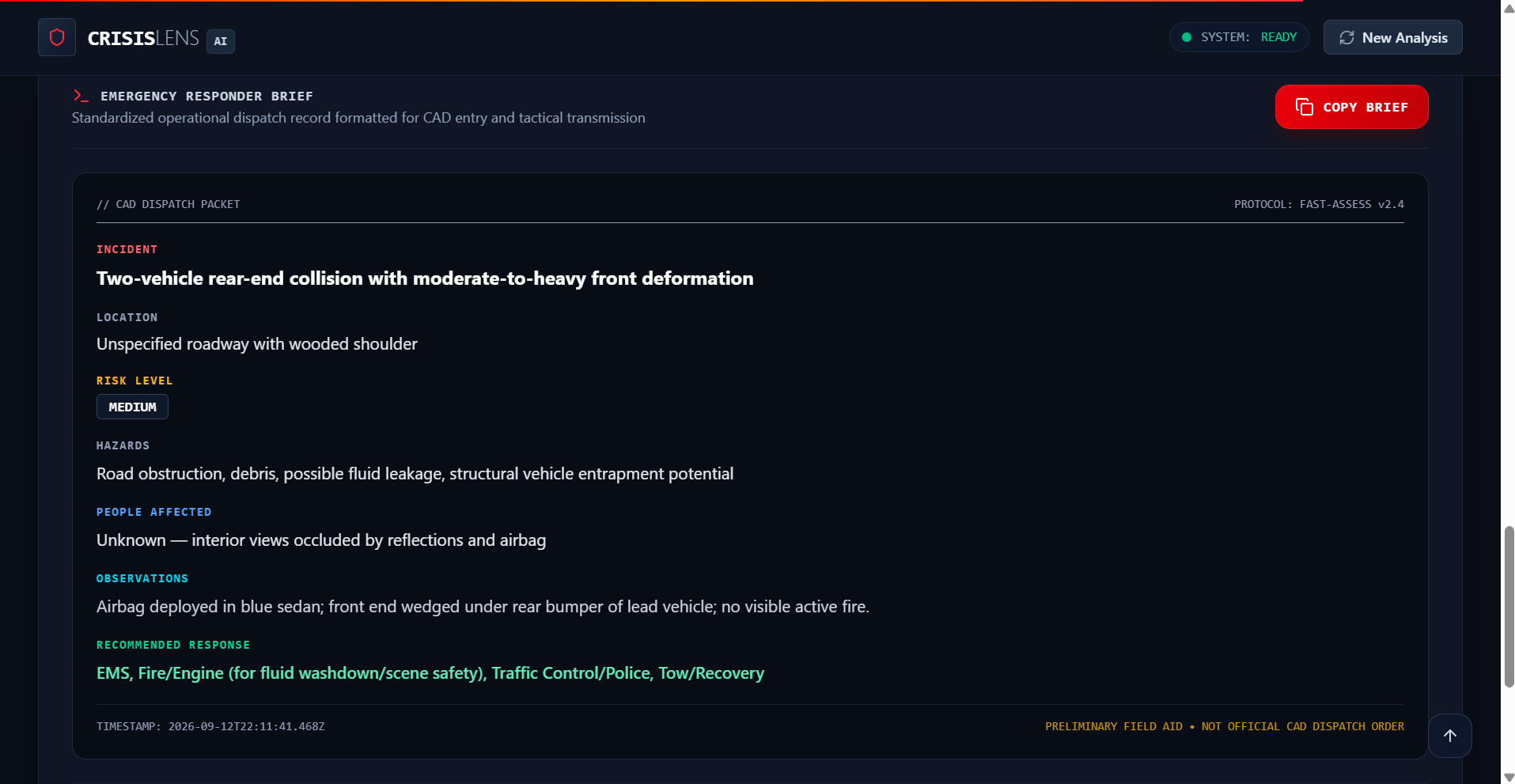
“From raw incident evidence to risk assessment and responder brief — the complete CrisisLens AI workflow.”
Inspiration
During an emergency, the first challenge is often not the lack of information—it is the amount of unstructured information arriving at once. An incident image can contain smoke, damaged vehicles, hazards, blocked roads, structural damage, or people who may need assistance, but interpreting all of that quickly can be difficult.
We were inspired by the idea of turning raw emergency evidence into a concise intelligence brief that can help someone understand a situation faster.
This led us to build CrisisLens AI around a simple question:
What if an incident image could be converted into a clear risk assessment and responder-ready brief within seconds?
Our goal was not to replace emergency professionals, but to create an AI-powered decision-support layer that helps organize available information quickly while clearly separating what is visible, what is uncertain, and what is unknown.
What it does
CrisisLens AI analyzes an uploaded incident image and/or written description using multimodal AI.
It identifies and presents:
- Incident type — such as vehicle accident, fire/smoke, flooding, structural damage, crowd/public safety, or other hazards.
- Risk level — LOW, MEDIUM, or HIGH.
- Visible hazards — such as fire, smoke, damaged structures, road hazards, flooding, or other observable risks.
- People affected — reporting only what can actually be determined from the available evidence.
- Important observations — key details extracted from the image or description.
- Immediate safety actions — conservative guidance based on the detected situation.
- Responder Brief — a concise summary containing the incident, location, risk level, hazards, affected people, observations, and recommended response.
The system follows a strict principle: unknown information remains unknown. It does not invent casualty counts, locations, hazards, or other details that cannot be established from the provided evidence.
CrisisLens AI is designed as decision-support technology, not a replacement for emergency services, firefighters, police officers, doctors, or trained responders.
How we built it
We built CrisisLens AI as a full-stack web application.
Frontend
- React
- TypeScript
- Vite
- Tailwind CSS
- Lucide React
- Motion-based UI interactions
The interface was designed as an emergency-intelligence dashboard rather than a traditional chatbot. Users can upload an image, provide an incident description, optionally provide a location, and receive a structured analysis.
Backend
We used:
- Node.js
- Express
- TypeScript
- Google's Gemini API through the official
@google/genaiSDK
The API key is kept on the server rather than exposed in the browser.
The frontend sends the incident evidence to:
POST /api/analyze
The backend sends the relevant multimodal information to Gemini and requests a structured response containing the incident classification, risk assessment, hazards, observations, safety actions, and responder brief.
We also added demo incident presets so the complete workflow can be demonstrated quickly.
Challenges we ran into
One of the biggest challenges was making the AI useful without allowing it to confidently invent information.
Emergency scenarios contain uncertainty, so a system that simply generates a convincing description can be dangerous. We therefore designed the analysis around explicit uncertainty handling and instructed the system to avoid fabricating information.
Another challenge was converting a general-purpose multimodal model into a structured emergency-analysis workflow. Instead of returning a long conversational response, we needed consistent fields that could be displayed directly in the dashboard.
We also had to balance visual impact with trust. An emergency application should feel modern and technically advanced, but excessive animations, flashy gradients, or unnecessary UI elements can reduce clarity. We therefore focused on a professional, information-first interface.
Finally, we had to make the application responsive and usable while handling image uploads, loading states, API failures, and analysis results.
Accomplishments that we're proud of
We are proud that CrisisLens AI turns a relatively simple input—an image and/or description—into a structured emergency intelligence workflow.
Some of the features we are particularly proud of are:
- Multimodal incident analysis
- Structured LOW/MEDIUM/HIGH risk assessment
- Hazard identification
- Explicit handling of unknown information
- Conservative immediate safety guidance
- Automatically generated responder briefs
- One-click responder brief copying
- Image upload with preview and validation
- Demo incident presets
- Responsive emergency-intelligence dashboard
- Server-side API key protection
- Clear disclaimer separating AI decision support from professional emergency response
Most importantly, we focused on building something that demonstrates a real workflow, rather than simply wrapping an AI model inside a chatbot interface.
What we learned
We learned that building an AI application is not just about connecting an API to a user interface.
The difficult part is designing the system around the model.
We learned the importance of:
- Structured AI outputs
- Strong prompt design
- Explicit uncertainty handling
- Validation of model-generated information
- Clear separation between observed facts and assumptions
- Designing interfaces around real user workflows
- Protecting API credentials
- Handling failure states and unreliable network/API conditions
- Communicating AI limitations clearly
We also learned that for high-stakes scenarios, knowing what the AI does not know is just as important as knowing what it can detect.
What's next for CrisisLens AI
CrisisLens AI is currently focused on image and text-based incident analysis, but the concept can be expanded significantly.
Future versions could include:
- Real-time video incident analysis
- Multiple-image incident reconstruction
- Continuous monitoring of changing situations
- Geospatial incident mapping
- Integration with emergency operation centers
- Historical incident analysis
- Multi-incident prioritization
- Automated incident timelines
- Integration with authorized emergency-response systems
- Better localization and multilingual emergency briefs
- Human verification workflows before information is forwarded to responders
The long-term vision is to build a reliable emergency intelligence layer that helps transform chaotic incident information into structured, understandable, and actionable information—while keeping humans in control of critical decisions.
Built With
- artificial-intelligence
- computer-vision
- emergency-response
- express.js
- gemini
- generative-ai
- google-ai
- multimodal-ai
- node.js
- react
- risk
- typescript


Log in or sign up for Devpost to join the conversation.