-
-
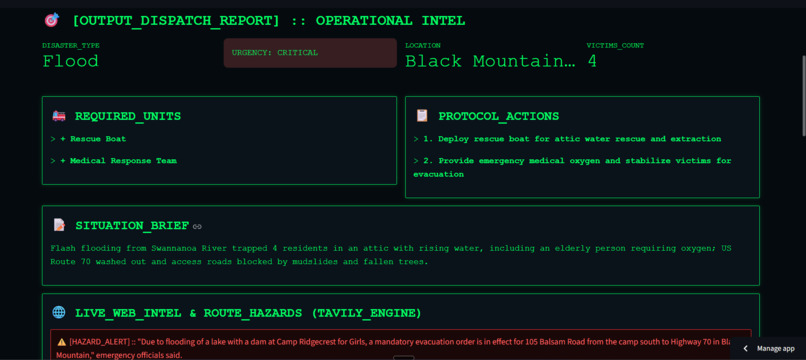
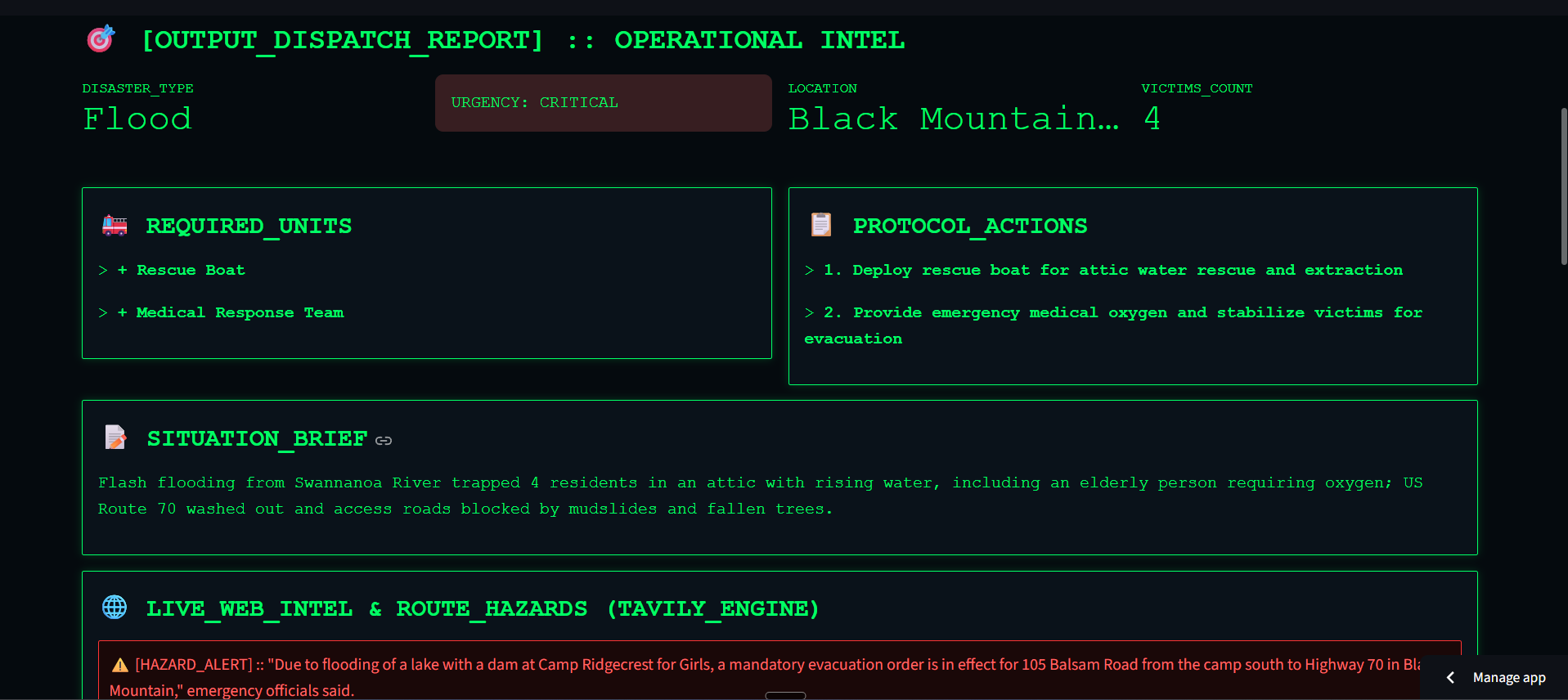
Output
-
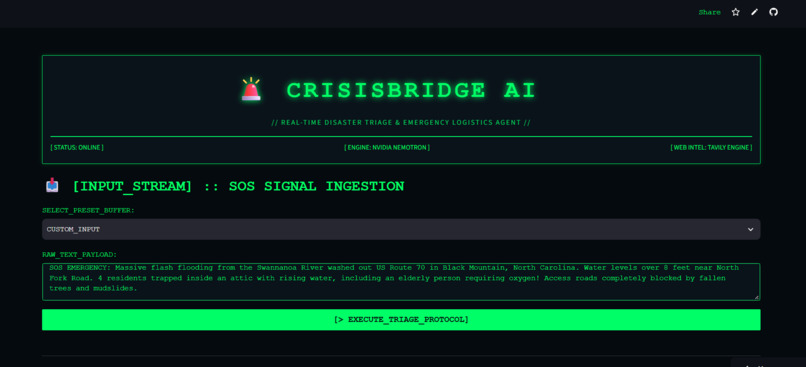
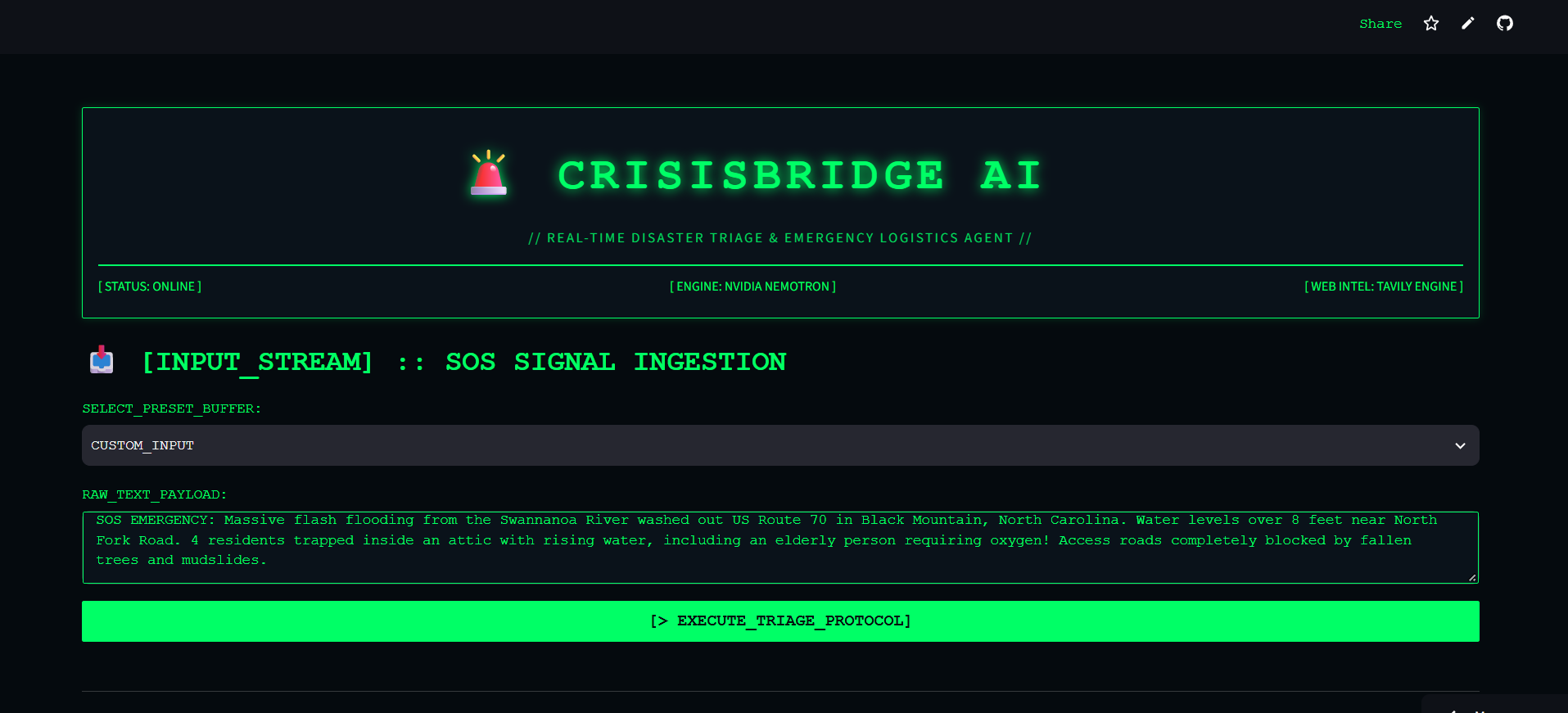
Input
🚨 CrisisBridge AI — Real-Time Disaster Triage & Emergency Logistics Agent
"When natural disasters strike, seconds save lives. CrisisBridge AI bridges the chaotic gap between panicked citizen SOS signals and rapid, hazard-aware emergency response units."
💡 Inspiration
During catastrophic events like severe flooding, earthquakes, or urban fires, emergency communication channels quickly become overwhelmed. Human dispatchers face an impossible bottleneck: manually reviewing thousands of frantic, unstructured distress signals coming in via SMS, messaging apps, social media feeds, and transcribed emergency calls.
In these critical moments, total response latency ($T_{\text{total}}$) is dictated by the sum of triage time ($T_{\text{triage}}$) and emergency transit time ($T_{\text{transit}}$):
$$T_{\text{total}} = T_{\text{triage}} + T_{\text{transit}}$$
When dispatchers spend valuable minutes parsing chaotic descriptions to deduce location, victim counts, and required gear, $T_{\text{triage}}$ spikes dangerously. Furthermore, dispatching first responders blindly down routes that are already flooded or blocked by debris inflates $T_{\text{transit}}$.
We were inspired to build CrisisBridge AI to drive $T_{\text{triage}} \to 0$ by leveraging the frontier reasoning power of NVIDIA Nemotron-4 on Nebius Token Factory, combined with real-time web route hazard verification via Tavily.
⚡ What It Does
CrisisBridge AI serves as an intelligent command center for emergency dispatchers:
- Automated Signal Extraction: Ingests raw, unstructured distress messages in any format or local dialect.
- Structured AI Triage: Instantly parses the message into structured JSON containing disaster classification, victim estimates, urgency tier ($\text{Urgency} \in {\text{CRITICAL}, \text{HIGH}, \text{MEDIUM}, \text{LOW}}$), and specific unit requirements (e.g., Rescue Boats, Trauma Teams, Heavy Extraction Gear).
- Live Web Hazard Grounding: Automatically extracts the location and queries Tavily Search API in real time to scan local news, weather alerts, and social bulletins for active road closures or secondary hazards around the site.
- Interactive Dispatch Dashboard: Displays metric cards, situational brief summaries, and live warning badges on a clean Streamlit interface.
🛠️ How We Built It
We designed CrisisBridge AI as a modular, agentic workflow built entirely in Python:
- AI Engine & Model Hosting: Powered by
nvidia/nemotron-4-340b-instructhosted on Nebius Token Factory. We connected through the OpenAI-compatible Python SDK via Nebius high-performance inference endpoints. - Live Search & Grounding: Integrated Tavily Search API (
tavily-python) to fetch real-time web search results regarding infrastructure damage and blocked access routes surrounding the extracted disaster coordinates. - Dashboard Interface: Built a clean, responsive dispatcher UI using Streamlit, featuring interactive preset selectors, error badges, metric columns, and dynamic hazard alert boxes.
- Environment & Security: Configured full environment variable isolation using
python-dotenvwith zero-leak.gitignoresecurity practices.
🧮 Triage Scoring Logic
To evaluate risk priority without bias, our system prompt instructs Nemotron to evaluate urgency based on a multi-variable threat model:
$$\text{Urgency Index} = f(\text{Severity}) \times \left(1 + \frac{\text{Victims}}{10}\right) + \delta_{\text{vulnerable}}$$
Where $\delta_{\text{vulnerable}}$ accounts for immediate factors like trapped elderly individuals, infants, or medical crises mentioned in the raw SOS text.
🛑 Challenges We Faced
- Ensuring Strict JSON Schema Outputs: LLMs occasionally append conversational prose or markdown formatting around JSON responses. We addressed this by enforcing system-level schema definitions and configuring
response_format={"type": "json_object"}inside the API client. - Handling Real-Time API Rate Limits & Fallbacks: During extreme network conditions or key setups, external search APIs can fail. We implemented defensive fallback handling so the primary AI triage pipeline remains 100% functional even if live web search is delayed.
- Isolating Project Environments: Resolving duplicate workspace files and configuring Windows PowerShell Execution Policies (
RemoteSigned) to ensure smooth virtual environment setup across different developer machines.
🎓 What We Learned
- Power of Nebius Token Factory: Deploying frontier NVIDIA models via standard OpenAI client syntax makes cutting-edge open-source AI accessible within minutes without complex infrastructure management.
- Agentic Search Integration: Combining LLM reasoning with focused live search tools (like Tavily) dramatically increases real-world utility by preventing hallucinations and grounding responses in live ground-truth data.
- Human-Centric UI Design: When building for emergency responders, clarity and speed trump complexity. Clean metrics and clear color-coded warning badges save critical cognitive energy.
🚀 What's Next for CrisisBridge AI
- 🎙️ Multimodal Voice Input: Direct integration with audio models for transcribing live 911/emergency hotline voice calls in real time.
- 🛸 Drone Image Analysis: Combining vision-language models to cross-reference satellite/drone footage with incoming text alerts.
- 🗺️ Interactive GIS Routing: Interactive map rendering showing live emergency vehicle GPS positions alongside Tavily-verified hazard markers.


Log in or sign up for Devpost to join the conversation.