-
-
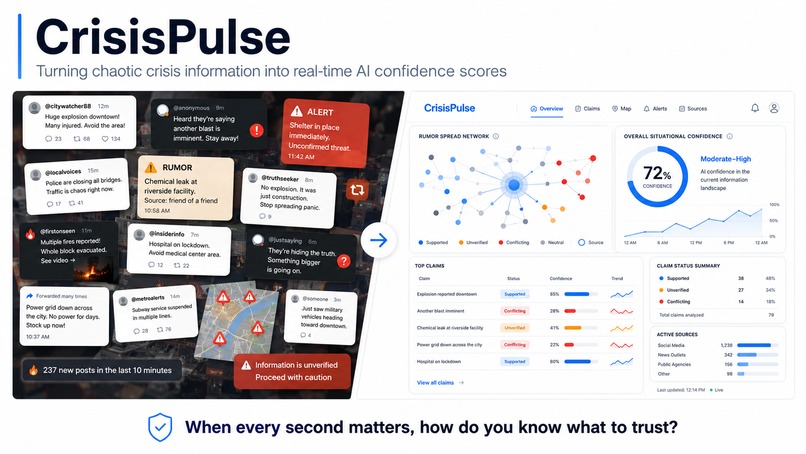
CrisisPulse Cover Image
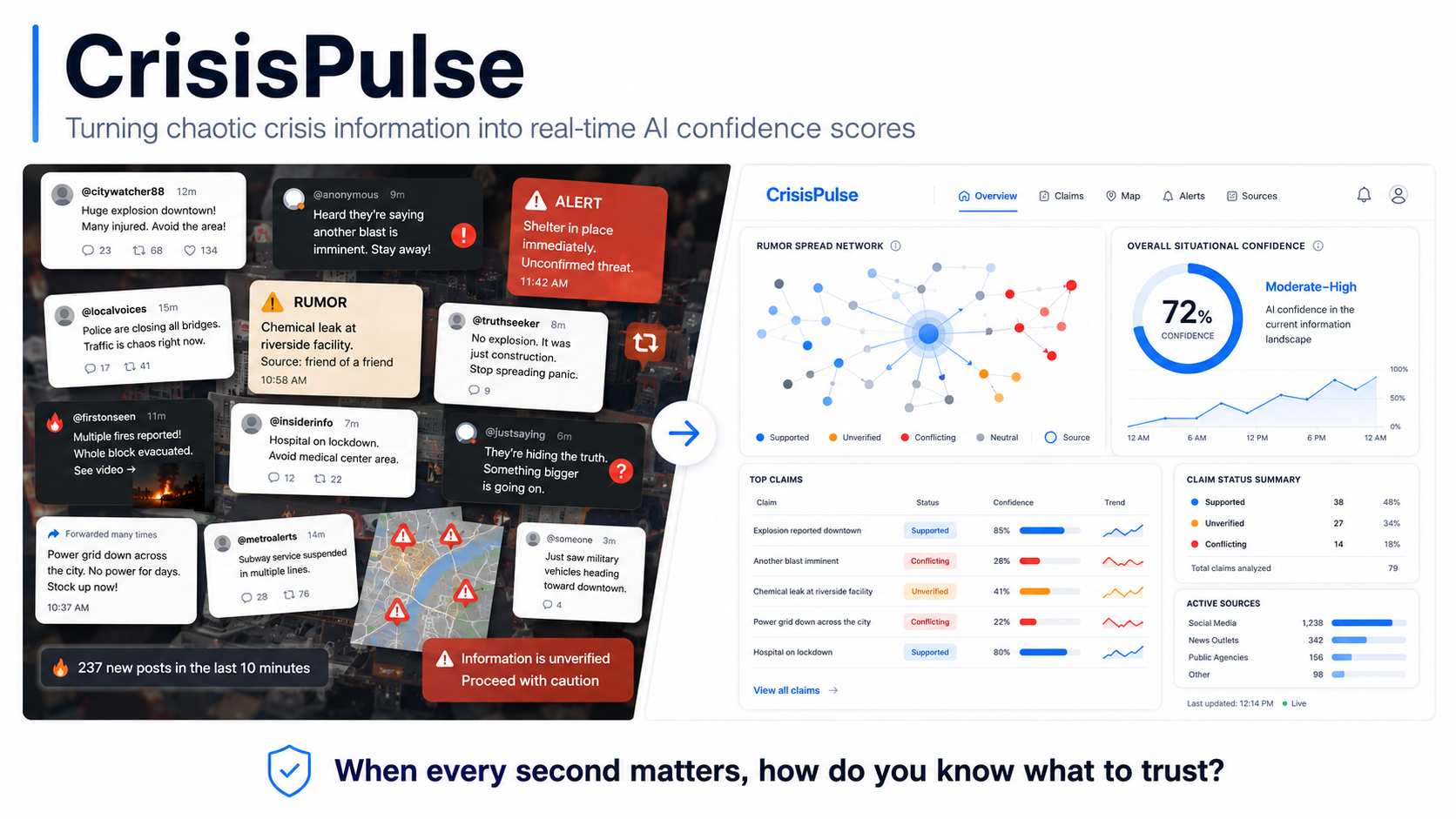
CrisisPulse
Inspiration
CrisisPulse was inspired by our own experiences with emergencies and the uncertainty that surrounds them. One experience that deeply impacted us was the Canyon 2 Fire in Southern California in 2017. During the evacuation, reliable information was extremely limited. Reports online were inconsistent, rumors spread rapidly, and official updates lagged behind the actual danger. At one point, we could see trees burning only a short distance away while still lacking a clear understanding of the fire’s progression or severity.
Experiences like this occur every day around the world. During natural disasters, political unrest, infrastructure failures, and humanitarian crises, emergency responders and community members are often forced to make life-impacting decisions using fragmented and conflicting information. Social media platforms provide real-time updates from people on the ground, but they also amplify misinformation, speculation, and panic.
We wanted to build a system that could help people navigate this information chaos.
CrisisPulse was created as an AI-powered crisis intelligence platform capable of evaluating the credibility of crisis-related claims through real-time community discussions. Rather than replacing official reports or human judgment, CrisisPulse acts as a decision-support system that identifies patterns of agreement, contradiction, and uncertainty across large volumes of online information.
Our goal was to create a tool that could help emergency responders, volunteers, journalists, and communities make faster and more informed decisions during the critical first moments of a crisis when official information may not yet exist.
What it does
CrisisPulse analyzes crisis-related claims and evaluates their credibility using a hybrid AI architecture that combines:
- Natural Language Processing (NLP)
- Semantic embedding retrieval
- Transformer-based Natural Language Inference (NLI)
- Graph-based evidence reasoning
- Temporal trend analysis
- Heuristic confidence fusion modeling
A user submits a claim such as:
"The Philippines earthquake is causing huge casualties."
CrisisPulse then:
- Processes and extracts important entities and crisis terminology from the claim.
- Searches Reddit for real-time community discussions related to the event.
- Retrieves relevant posts and comments using semantic similarity rather than simple keyword matching.
- Uses a transformer-based NLI model to determine whether evidence supports, contradicts, or is neutral toward the claim.
- Builds an evidence relationship graph to identify consensus and contradiction patterns.
- Calculates a transparent confidence score using weighted heuristic modeling.
- Displays the results through an interactive dashboard with evidence explanations and temporal analysis.
The system does not decide whether information is "true" or "false." Instead, it provides users with interpretable evidence and confidence metrics so that emergency responders and communities can make informed decisions more quickly during rapidly evolving situations.
Audience
CrisisPulse is designed for emergency communication teams, public information officers, journalists, volunteers, and communities affected by crises.
When emergencies occur, their biggest constraint is time. They may face hundreds of posts, reposts, comments, news updates, and community reports spreading across the internet simultaneously. They need to quickly identify which claims are gaining traction, which reports conflict with official information, and which rumors could cause harm if left unchecked.
For people directly affected by a crisis, the challenge is equally significant. During rapidly evolving events, individuals often turn to social media for immediate updates, where conflicting reports and misinformation can create confusion and uncertainty.
Unlike social media trend analysis tools that focus on what is spreading the fastest, CrisisPulse focuses on what is supported by the strongest available evidence. A claim may be highly viral yet still receive a low confidence score if supporting evidence is weak or contradictory.
CrisisPulse helps these users transform large volumes of unstructured online discussion into organized, evidence-based situational awareness.
Solution Overview
How It Works
A user submits a crisis-related claim, such as:
"The wildfire near Riverside is spreading rapidly and evacuations are underway."
CrisisPulse then:
- Retrieves relevant Reddit posts and comments in real time.
- Uses Sentence Transformer embeddings to identify semantically related discussions.
- Applies a BART-MNLI Natural Language Inference model to classify evidence as:
- Support
- Contradict
- Neutral
- Aggregates evidence signals into an explainable confidence score.
- Presents transparent reasoning through visualizations, evidence graphs, and source analysis.
Why CrisisPulse Is Different
Traditional AI chatbots generate responses from general knowledge and may hallucinate, overlook conflicting evidence, or lack access to real-time information.
CrisisPulse is specifically designed for crisis verification by:
- Retrieving live social media evidence
- Comparing multiple independent reports
- Detecting contradictions across sources
- Tracking how information evolves over time
- Providing source transparency and human review
- Producing explainable, evidence-backed confidence scores instead of black-box answers
- Evaluating evidence reliability rather than measuring content virality
Rather than replacing human judgment, CrisisPulse serves as a decision-support system that helps users evaluate rapidly evolving crisis information more effectively.
How we built it
Overall Architecture
CrisisPulse was developed entirely in Python and deployed using Streamlit as an interactive dashboard interface.
The system combines multiple AI and machine learning techniques into a unified pipeline:
User Claim
   ↓
Claim Parsing & NLP
   ↓
Evidence Retrieval (Reddit API)
   ↓
Semantic Similarity Ranking
   ↓
Natural Language Inference
   ↓
Graph-Based Evidence Analysis
   ↓
Confidence Fusion Engine
   ↓
Temporal Analysis
   ↓
Visualization Dashboard
Step 1 — Claim Processing
When a user enters a claim, the system first processes the text using:
spaCy for:
- Named Entity Recognition (NER)
- Part-of-speech tagging
- Linguistic parsing
- Lemmatization
KeyBERT for:
- Keyword extraction
- Crisis-related keyphrase generation
We also created a custom crisis dictionary and stopword filtering system to eliminate irrelevant filler words before evidence retrieval.
Example Extraction
| Input Claim | Extracted Features |
|---|---|
| "The Philippines earthquake is causing huge casualties." | Philippines, earthquake, casualties |
This stage generates optimized search queries for downstream retrieval.
Step 2 — Real-Time Evidence Retrieval
Using the processed query, CrisisPulse retrieves real-time evidence from Reddit through the Reddit API.
The system collects:
- Post titles
- Post content
- Community comments
- Metadata
- Timestamps
Reddit was selected for the prototype because it provides large-scale real-time community discussion during crises.
Future iterations will integrate:
- X/Twitter
- News APIs
- Emergency alert systems
Step 3 — Semantic Embedding Retrieval
Traditional keyword search performs poorly during crises because people describe the same event differently.
Example
| Claim | Evidence |
|---|---|
| "casualties" | "fatalities reported" |
Even though the wording differs, the semantic meaning is highly related.
To solve this, we implemented semantic embedding retrieval using Sentence Transformers.
Each sentence is converted into a high-dimensional embedding vector:
$$ \vec{x} = [x_1, x_2, x_3, ..., x_n] $$
Similarity between evidence and the original claim is computed using cosine similarity:
$$ Similarity(A,B)=\frac{A \cdot B}{||A|| \ ||B||} $$
This allows CrisisPulse to retrieve semantically relevant evidence even without exact keyword overlap.
Step 4 — Natural Language Inference (NLI)
One of the core AI components of CrisisPulse is contradiction and stance detection.
We used:
- Hugging Face Transformers
- Facebook BART-Large-MNLI
BART-Large-MNLI is a transformer-based Large Language Model fine-tuned for Natural Language Inference.
For each evidence item, the model predicts whether it:
- Supports the claim
- Contradicts the claim
- Is neutral toward the claim
Example
| Claim | Evidence | Output |
|---|---|---|
| "The earthquake caused casualties." | "Officials report no deaths." | Contradiction |
Unlike keyword systems, the transformer reasons about meaning and context.
Step 5 — Graph-Based Evidence Reasoning
After stance classification, evidence relationships are modeled as a graph using NetworkX.
- Nodes represent evidence items.
- Edges represent support or contradiction relationships.
This allows the system to identify:
- Consensus clusters
- Contradictory outliers
- Agreement density
- Evidence propagation patterns
Graph-based reasoning helps prevent isolated misinformation from outweighing broad evidence consensus.
Step 6 — Confidence Fusion Modeling
Rather than relying solely on a black-box AI score, we implemented a transparent heuristic confidence fusion engine.
Supporting and contradicting evidence are weighted and aggregated into a final confidence score.
Simplified representation:
$$ Confidence = \alpha S - \beta C + \gamma T $$
Where:
- (S) = support evidence score
- (C) = contradiction evidence score
- (T) = temporal consistency score
- (\alpha,\beta,\gamma) = weighting coefficients
This hybrid approach combines machine learning outputs with interpretable heuristic modeling.
Step 7 — Temporal Analysis
Information changes rapidly during crises.
Early reports are frequently incorrect or incomplete.
CrisisPulse tracks evidence over time and recalculates confidence as new information emerges.
This allows the system to detect:
- Increasing evidence convergence
- Rapid contradiction spikes
- Shifting community consensus
Temporal analysis significantly improves adaptability during evolving emergencies.
Step 8 — Visualization Dashboard
The final outputs are displayed through a Streamlit dashboard featuring:
- Confidence scores
- Evidence rankings
- Contradiction graphs
- Temporal trend monitoring
- Evidence source transparency
The dashboard was designed to prioritize interpretability and human oversight.
Challenges we ran into
Multi-Platform Integration
One of our original goals was to aggregate evidence from multiple platforms simultaneously, including Reddit, X/Twitter, Instagram, and Facebook.
However, API restrictions, inconsistent data structures, and authentication limitations made this difficult within the scope of the hackathon.
For the prototype, we focused entirely on Reddit while designing the system architecture for future platform expansion.
AI Hallucination & Confidence Modeling
Our initial confidence engine relied on a generative AI agent to explain confidence levels dynamically.
While promising in theory, the model frequently hallucinated unsupported conclusions and generated inconsistent reasoning.
To improve reliability and transparency, we removed this component and replaced it with a heuristic fusion engine directly tied to measurable evidence signals.
This significantly improved interpretability and reduced hallucination risk.
Query Processing
Processing human claims proved unexpectedly difficult.
Users naturally include:
- filler words
- ambiguous phrasing
- incomplete context
- emotionally charged language
Early retrieval pipelines often produced irrelevant Reddit results.
To address this issue, we implemented:
- stopword filtering
- crisis-specific vocabularies
- linguistic parsing
- entity extraction
- semantic query refinement
These safeguards greatly improved evidence relevance.
Accomplishments that we're proud of
We are especially proud that CrisisPulse evolved beyond a simple fact-checking tool into a fully integrated hybrid AI reasoning system.
Some accomplishments we are particularly proud of include:
- Successfully integrating transformer-based Natural Language Inference into a real-time crisis analysis pipeline.
- Designing a graph-based contradiction reasoning engine capable of identifying consensus and disagreement patterns.
- Building a transparent confidence fusion model rather than relying entirely on opaque AI outputs.
- Creating an interactive dashboard capable of visualizing evidence relationships in real time.
- Developing an end-to-end working prototype within a hackathon timeframe.
Most importantly, we are proud that CrisisPulse addresses a meaningful real-world problem with direct humanitarian relevance.
What we learned
This project exposed us to several advanced AI concepts that we had not previously explored in depth.
We learned about:
- Transformer architectures
- Natural Language Inference (NLI)
- Semantic embeddings
- Unsupervised machine learning
- Graph-based reasoning
- Temporal evidence modeling
- Confidence fusion systems
We also gained practical experience with:
- Hugging Face Transformers
- Sentence Transformers
- spaCy NLP pipelines
- DBSCAN clustering
- Streamlit deployment
- NetworkX graph analytics
Beyond technical skills, we learned how difficult it is to build responsible AI systems for high-stakes environments.
A major takeaway from this project was that AI should support human decision-making rather than replace it.
Building transparent, interpretable systems proved far more valuable than building systems that simply generated answers.
AI Ethics & Human Oversight
CrisisPulse was intentionally designed as a decision-support tool, not an autonomous decision-making system.
The platform never declares whether a crisis claim is definitively true or false.
Instead, it provides:
- confidence estimates
- supporting evidence
- contradicting evidence
- transparency into reasoning
Human users remain fully in control of all decisions.
This is especially important during crises where misinformation, uncertainty, and incomplete evidence are common.
We also identified several risks during development.
Risk: Coordinated misinformation campaigns
Large groups of users may repeat false claims simultaneously.
Mitigation
Our graph reasoning engine analyzes contradiction density and evidence diversity rather than relying solely on post volume.
Risk: Hallucinated AI conclusions
Generative models may produce unsupported reasoning.
Mitigation
We removed AI-generated confidence explanations and replaced them with measurable heuristic evidence aggregation.
Risk: False certainty during evolving events
Early crisis information is often incomplete or inaccurate.
Mitigation
Temporal analysis continuously updates confidence scores as new evidence emerges.
Most importantly, CrisisPulse is designed to augment human judgment rather than replace it.
Emergency responders and community members make the final decisions.
CrisisPulse simply helps them process large amounts of chaotic information more quickly during the critical first moments of a crisis.
What's next for CrisisPulse
We plan to significantly expand CrisisPulse beyond the current prototype.
Future development goals include:
- Multi-platform integration (X, Facebook, Instagram, news APIs)
- Source credibility weighting
- Image and video verification
- Geospatial crisis mapping
- Multilingual support
- Mobile deployment
- Real-time alert systems
- Community responder collaboration tools
We also hope to improve the confidence engine through additional machine learning research and larger-scale testing.
Ultimately, our vision for CrisisPulse is to become a real-time crisis intelligence platform that helps communities navigate uncertainty with greater speed, transparency, and confidence during emergencies.
Built With
- bart-large-mnli
- dbscan
- graph-analytics
- hugging-face
- keybert
- natural-language-interface
- natural-language-processing
- networkx
- numpy
- pandas
- plotly
- python
- pyvis
- scikit-learn
- semantic-search
- sentence-transformers
- spacy
- streamlit
- transformers

Log in or sign up for Devpost to join the conversation.