-
-
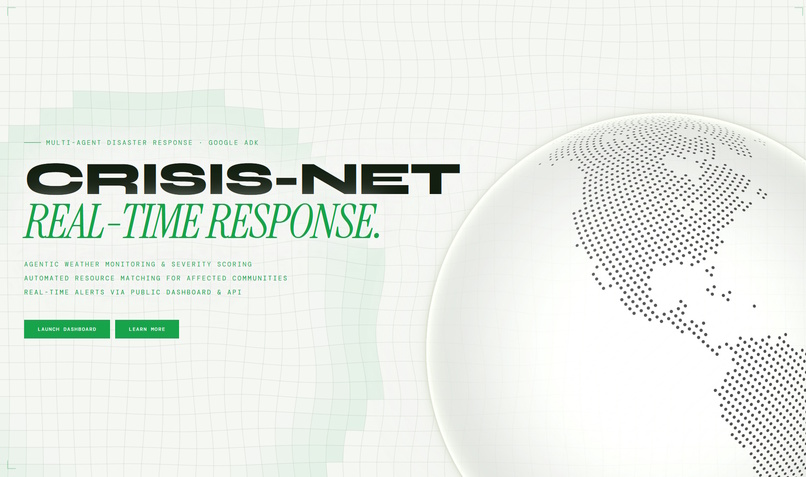
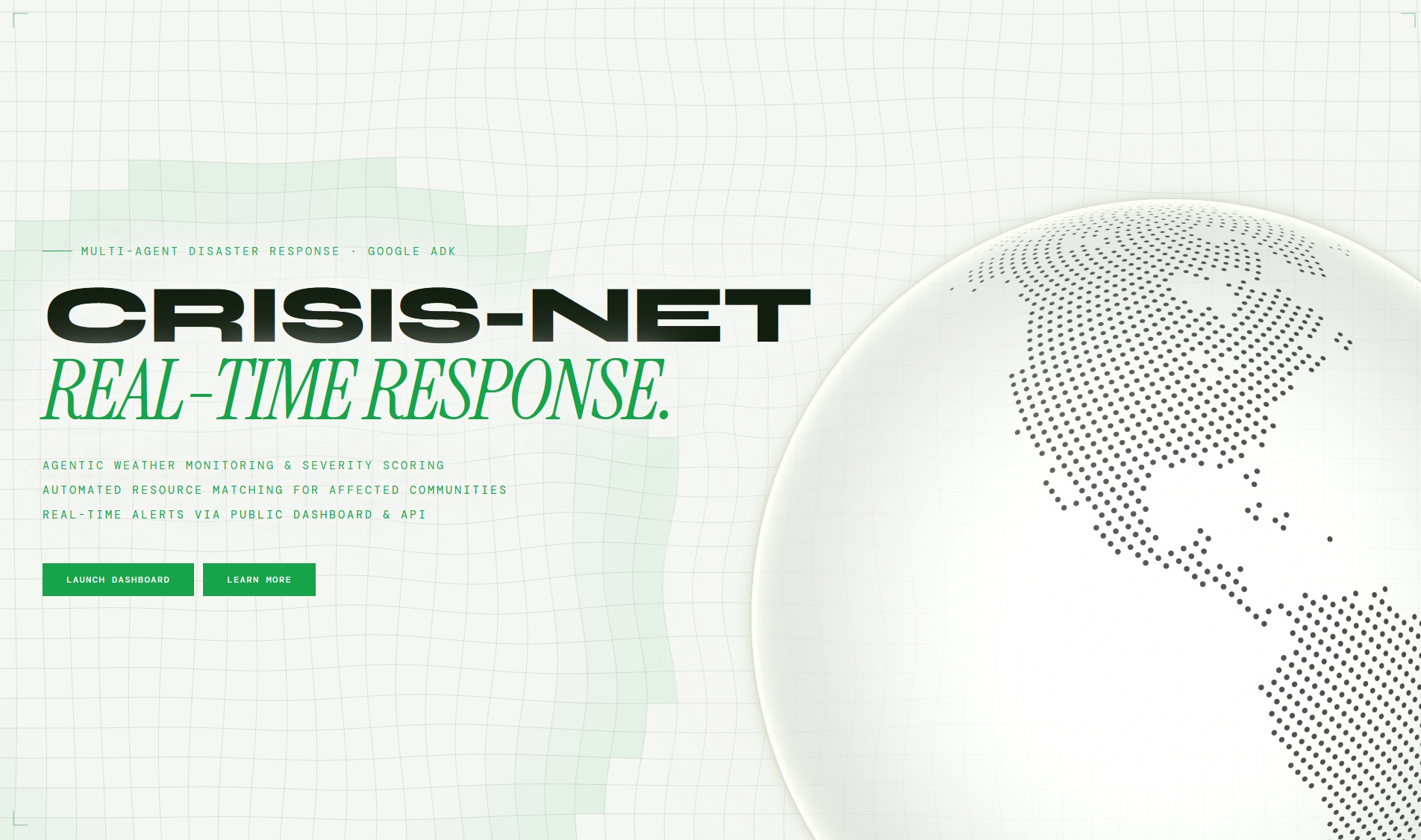
Crisis-Net Home Page
-
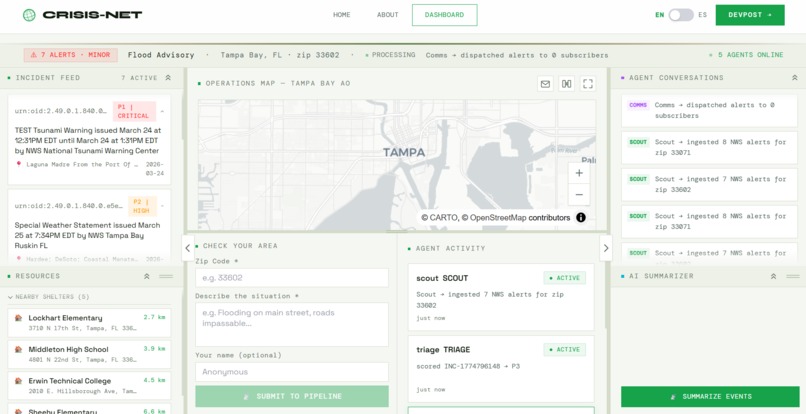
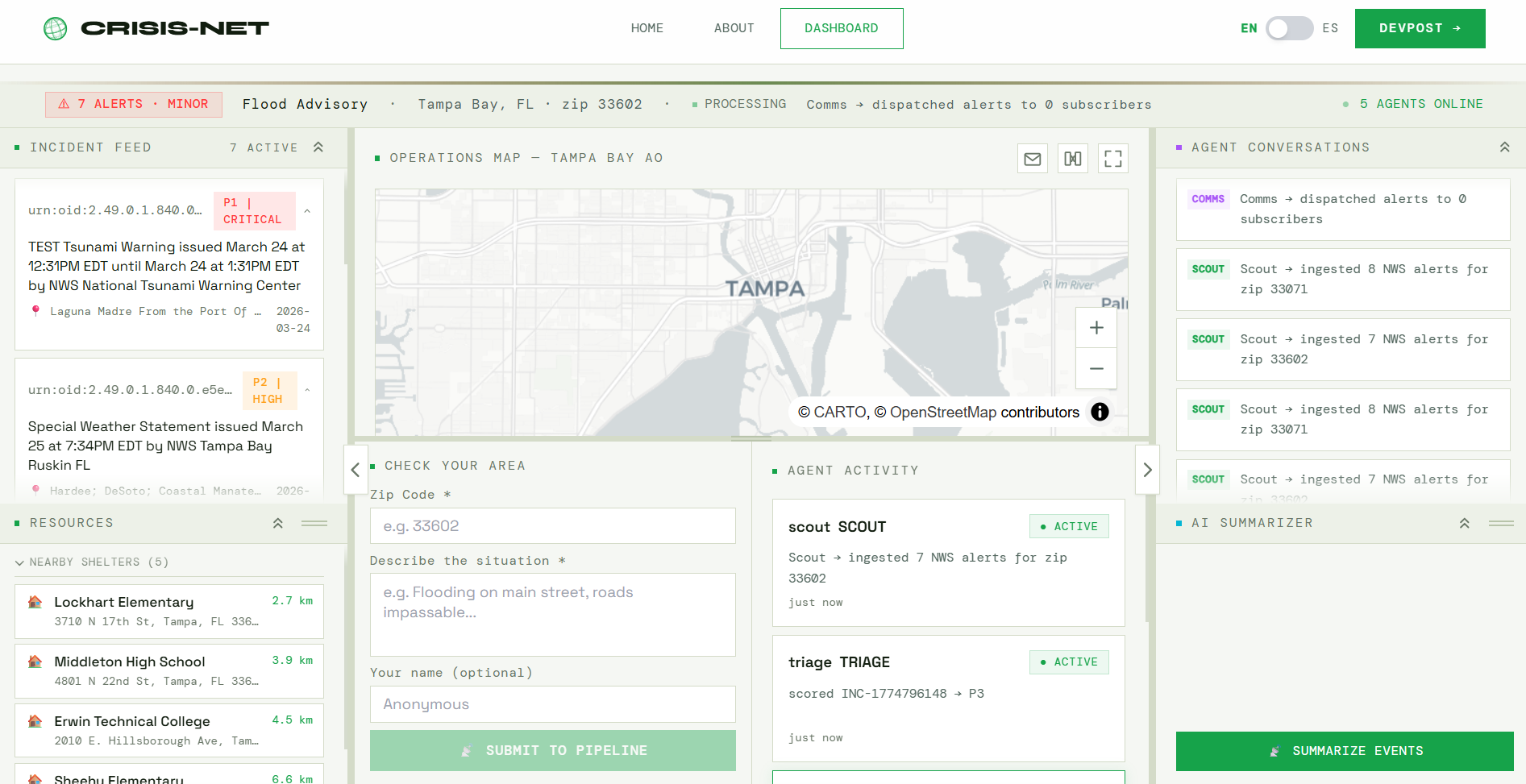
Crisis-Net Dashboard
Inspiration
Tampa Bay is one of the most hurricane-vulnerable metro areas in the United States — yet when a storm hits, the coordination between emergency agencies breaks down. Victims don't know what assistance programs exist for them. Responders manually triage hundreds of reports. Help exists but doesn't reach people fast enough.
What it does
Crisis-Net is a multi-agent AI system that automates the full disaster response pipeline for a given
ZIP code:
- Scout - Pulls live alerts from the National Weather Service and FEMA, flags anomalies in real time
- Triage - Scores event severity using storm category, population density (US Census), and NOAA historical damage data
- Resource Matcher - Finds and matches FEMA programs, shelters, and local non-profits to affected ZIP codes
- Comms - Drafts multilingual alerts (English, Spanish, Haitian Creole) via Mailgun and exposes an API for government EOC systems
- Coordinator - Orchestrates the full pipeline using Google ADK's ParallelAgent and SequentialAgent, running the full cycle in ~94 seconds
A public-facing dashboard shows live incidents on a map, real-time agent activity, resource matches,
and historical event data. Citizens can also submit field reports directly from the dashboard.
How we built it
- AI: Google ADK + Gemini 2.5 Flash Lite for agent reasoning and real-time translation
- Data: NWS CAP alerts, FEMA disaster declarations, US Census population API, NOAA historical records, pgeocode for ZIP-to-coordinate resolution
- Database: Supabase (PostgreSQL) for incidents, resources, and subscriber management
- Alerts: Mailgun email dispatch to opted-in residents
- Frontend: Next.js 16 + TypeScript + Tailwind CSS. Interactive map via Leaflet/MapLibre. Charts via
Recharts. Framer Motion animations. - Backend: Python + FastAPI, with Google ADK driving the agent pipeline. Each agent is an LLM Agent
backed by Gemini 2.5 Flash. The Coordinator is a SequentialAgent that chains Scout → ParallelAgent
(Resource) → Comms. APScheduler triggers the pipeline on a polling interval. - Deployment: Vercel (frontend)
Challenges we ran into
Our team ran into a myriad of difficulties relating to backend connectivity to frontend components. Most prominently was deciding upon the data that the API was capable of capturing live, and which to visualize as live data on the dashboard for users. Challenges in collecting user data and sending out alert emails were also encountered.
Accomplishments that we're proud of
- Full end-to-end pipeline from a ZIP code input to a multilingual public alert in under 2 minutes
- Real-time agent activity feed so operators can see exactly what each agent is doing at every step
- Multilingual support (English & Spanish) for the majority of the website.
What we learned
- Google ADK's agent orchestration model is powerful given the right prompt. Being able to handle complex tasks.
- Disaster response data is fragmented across a dozen federal APIs with inconsistent schemas.
What's next for Crisis-Net
- Live Triage Agent with ML severity scoring (the model stub is already in the codebase)
- Tweak and refine the emailing system
- Push notifications to opted-in residents via SMS
- Integration with Hillsborough County's official EOC feed
- Expanding beyond Tampa to any US ZIP code
- Make the dashboard's Spanish translation robust
Built With
- gemini
- google-adk
- next.js
- python
- react
- supabase
- tailwind-css
- typescript


Log in or sign up for Devpost to join the conversation.