-
-
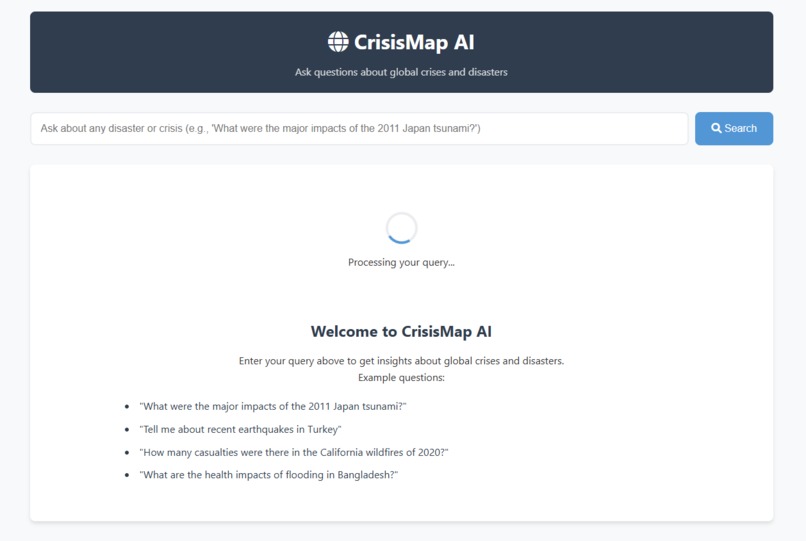
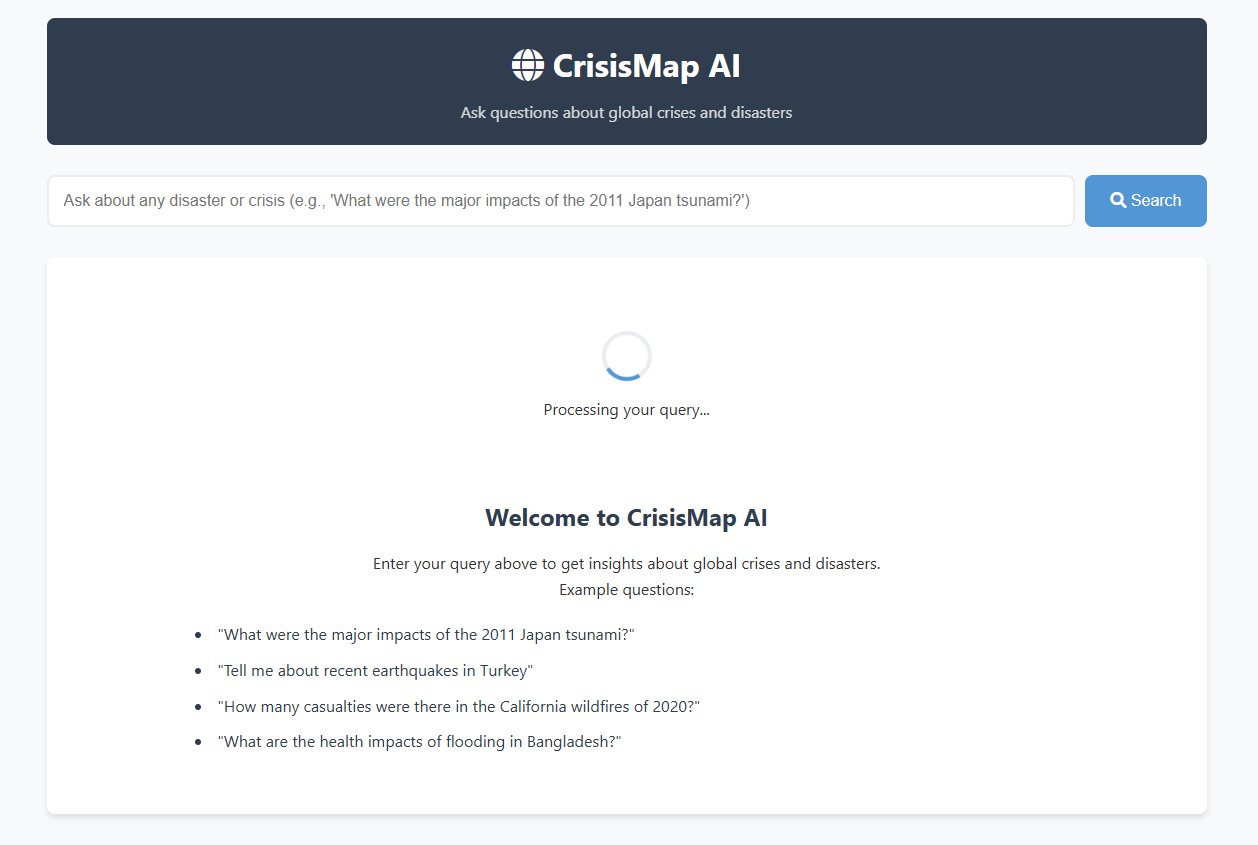
A static web interface for CrisisMap AI that takes user crisis-related queries and uses an LLM to return relevant disaster insights
Inspiration
In today's world of frequent natural disasters and humanitarian crises, finding relevant information quickly can save lives. I built CrisisMap AI to solve the challenge of information overload during critical situations, inspired by events like California wildfires and recent earthquakes where fragmented data hampered effective response.
What It Does
- Ingests crisis data from multiple sources (official databases, news feeds, social media)
- Converts crisis reports into vector embeddings for powerful semantic search
- Processes natural language queries about disasters and humanitarian crises
- Provides AI-generated summaries and analysis of complex situations
- Supplements database information with real-time web scraping for current data
- Enables unified access to previously fragmented crisis information
How I Built It The architecture combines powerful technologies:
- Data Layer: MongoDB Atlas with vector search for semantic querying
- AI Processing: Microsoft's Phi-3-mini-4k-instruct model for language understanding
- Data Pipeline: Processing various datasets (WHO, EM-DAT, USGS) with AI-enrichment
- Web Scraping: Using Beautiful Soup to augment results with latest information
- API Layer: FastAPI providing a performant interface for queries
Challenges & Learnings
Building this system taught me about:
- Data Standardization: Unifying diverse crisis data formats
- LLM Integration: Optimizing the Phi-3 model within resource constraints
- Vector Search: Fine-tuning MongoDB's vector search parameters
- Security: Implementing proper credential protection
What's Next I plan to expand with real-time social media monitoring for early detection, multi-language support for global accessibility, advanced crisis prediction using historical patterns, and interactive mapping and visualization. By continuing development, I hope to enable more effective and informed responses to global crises.
Built With
- all-minilm-l6-v2
- api
- asgi
- beautiful-soup
- bootstrap
- docker
- dotenv
- fastapi
- git
- html/css/javascript
- hugging-face
- jinja
- llm
- mongodb
- mongodb-atlas
- natural-language-processing
- phi-3-mini-4k-instruct
- python
- pytorch
- sentence-transformers
- t5-small
- transformers
- uvicorn
- vector-search
- web-scraping

Log in or sign up for Devpost to join the conversation.