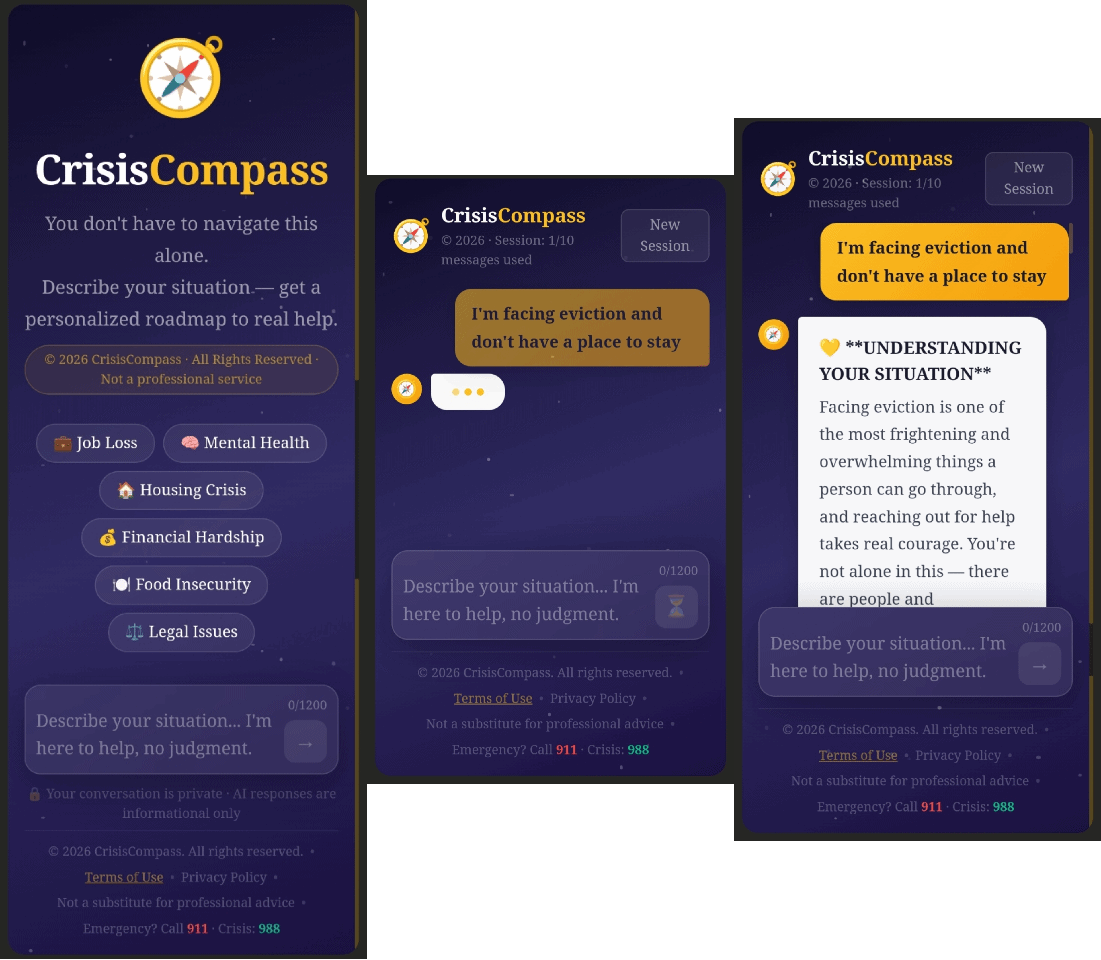
🧭 CrisisCompass — My Story
Inspiration — the real human moment + the P = (0.75)^n math that became the product thesis What we learned — 3 sharp lessons on prompting, validation, and trust
How we built it — 4 phases + the pipeline diagram
Challenges — tone vs. structure, validation UX, scope control, and trust design
✨ What Inspired Me
Honestly, this idea came from something I saw around me every day.
I noticed that when people go through something really hard — losing a job, struggling mentally, not being able to pay rent — they don't just suffer from the problem itself. They suffer from not knowing where to go. They open Google, they search, they click ten links, and they still don't find a clear answer. They give up. And that always bothered me.
I kept thinking — we have AI that can do so many things. Why can't it just sit with someone in their worst moment and say "okay, here's exactly what you need to do"? That felt like something worth building.
So when the hackathon came, I didn't have to think too hard. This was the one.
💡 What Gave Me the Idea
I was talking with someone close to me who was going through a rough patch financially. They told me they spent almost three days just trying to figure out what help was available to them. Three days. And they still didn't get a clear answer.
That hit me hard. Because I knew the help existed. Government schemes, NGOs, community support — it's all out there. But it's scattered everywhere, written in language nobody understands, hidden behind forms and phone numbers that don't pick up.
That's when I thought — what if someone could just describe what they're going through, in plain words, and instantly get a real roadmap? No jargon. No ten clicks. Just — here's what to do, here's who to call, here's your next step.
That's CrisisCompass.
And the math backed it up too. If reaching help takes $n = 7$ steps and each step has a drop-off rate of $p = 0.25$:
$$P(\text{success}) = (1 - p)^n = (0.75)^7 \approx 13\%$$
Only 13% of people actually make it through. CrisisCompass brings that down to one single step:
$$P(\text{success}) = (0.75)^1 = 75\%$$
That's a 5.6× improvement just by removing friction. When I saw that, I knew we were solving something real.
🔨 What I Personally Did
I was the team lead, so a big part of my job was making sure we were all moving in the right direction — especially in the beginning when everything feels chaotic.
But my real hands-on work was the AI prompt research. I was the one sitting with the Claude API, testing responses, reading them out loud, asking myself — does this actually feel human? Would someone in crisis feel helped by this, or just informed?
I went through over 14 versions of the system prompt. Early ones felt like reading a government FAQ. Cold. Structured but lifeless. I kept going until the responses felt like they came from someone who genuinely cared.
I also did the competitive research — mapping out what already existed, why it wasn't enough, and how CrisisCompass was different. That research gave the whole team confidence that we were building something that actually needed to exist.
And I wrote the pitch — the deck narrative, the framing, the closing line:
"Google exists for information. CrisisCompass exists for when life breaks down."
That line came to me at like 1am and I knew it was the one.
🧱 What Was Hard for Me
The hardest thing was getting the AI to feel warm without losing structure.
Structure is necessary — the frontend needs to parse the response into sections. But the moment a response feels too structured, it stops feeling human. And for someone in crisis, a cold response is almost worse than no response.
I spent hours on just that balance. Empathy first, roadmap second. That ordering — making someone feel heard before giving them steps — changed everything.
The other hard thing was leading under pressure. Around hour 8, the team wanted to add multilingual support, GPS filtering, saved sessions. All great ideas. But I had to be the one to say — not now. Ship the core brilliantly. Cut the rest.
Saying no to your own team's good ideas is genuinely difficult. But I held the line and I'm glad I did.
📚 What I Took Away
I learned that the most important work isn't always the most visible.
The prompt nobody sees. The research nobody credits. The decision to cut a feature. The one line in a pitch that makes everything click.
That's where the real impact lives.
I also learned that leading a team isn't about being in everything. It's about being clear enough at the start that the team can run without you watching every move.
And personally — I learned that I care about this problem. Not just as a project. As something that actually matters. People fall through cracks every day because systems aren't built for them in their worst moments. If CrisisCompass helps even a few of them — that's enough for me.
$$\text{Impact} = \text{Clarity} \times \text{Empathy} \times \text{Execution}$$
That's the formula I'll carry forward from this.
Built With
- 211.org-api-cloud-&-deployment:-vercel-(frontend)
- bash-frameworks-&-libraries:-react-18
- brave-search-api
- csp
- css3
- devpost-security:-https/tls
- env-variables
- express.js
- figma
- firebase-firestore-dev-tools:-github
- github-actions-(ci/cd)-databases:-supabase-(postgresql)
- google-places
- jsx
- languages:-javascript-(es2022)
- pillow-ai-&-apis:-anthropic-claude-api-(claude-sonnet-4-20250514)
- postman
- python-3.11
- python-pptx
- railway-(backend)
- rate-limiting
- regex-input-sanitization
- tailwind-css
- vs-code


Log in or sign up for Devpost to join the conversation.