Inspiration
Every one of us has experienced — or watched someone close experience — a life crisis: a sudden job loss, an unexpected medical bill, a divorce, a natural disaster, or a financial collapse. In those moments, the most dangerous enemy isn't the crisis itself. It's the paralysis that comes from not knowing what to do first.
Most people in crisis can't afford a lawyer, financial advisor, or crisis counselor on short notice. They turn to Google and get overwhelmed. They call friends who mean well but don't know the right answers. They freeze.
We built CrisisCoach because we believe that access to clear, actionable, expert-level guidance in a crisis should not be a privilege of the wealthy. It should be available to anyone, anywhere, in any language, at 2am when everything falls apart.
What It Does
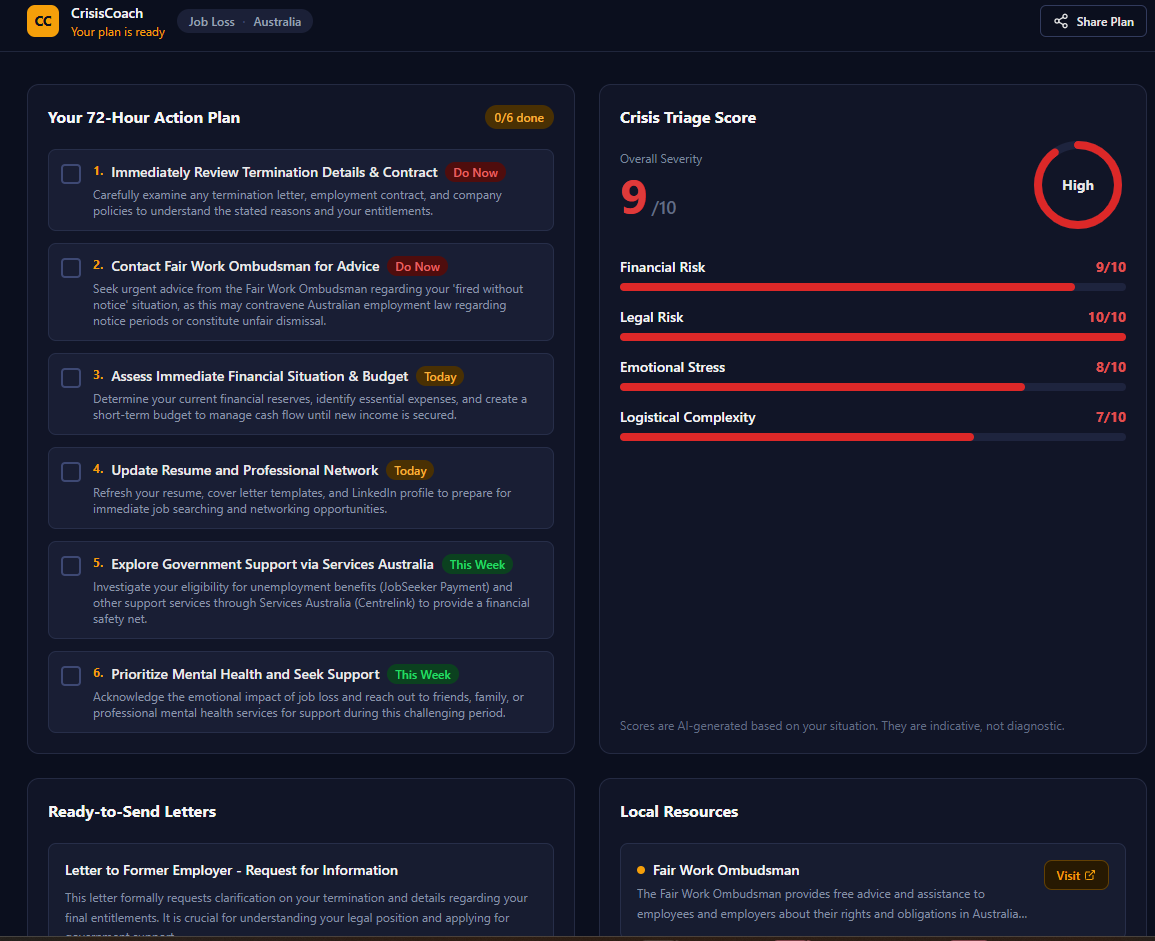
CrisisCoach is an AI-powered personal crisis management companion. You describe your emergency — in plain language, in your own words — and CrisisCoach immediately:
- Triages your situation across four crisis dimensions: financial, legal, emotional, and logistical.
- Builds a personalized 72-hour action plan with step-by-step priorities ordered by urgency and impact.
- Generates ready-to-use scripts — negotiation letters to landlords, creditors, or employers; appeal templates; emergency contacts customized to your country.
- Provides a live checklist and document tracker so nothing falls through the cracks under pressure.
- Monitors your progress through multi-turn conversation, adapting the plan as your situation evolves.
It works across crisis types: job loss, eviction, medical emergencies, divorce, debt crises, natural disasters, and business failure. It is localized by country, understanding local laws, institutions, and resources.
How We Built It
We built CrisisCoach entirely on MeDo, using its multi-turn conversational interface to design, iterate, and deploy a full-stack application in record time.
The build process started with a natural language architecture conversation on MeDo — describing the user flow, triage logic, and output formats we needed. MeDo generated the full frontend, including the crisis intake form, the dynamic 72-hour action plan renderer, the checklist tracker, and the letter generation interface.
For AI intelligence, we integrated the Anthropic Claude API directly through MeDo's plugin system, using a custom system prompt that configures Claude as a crisis management expert with country-aware legal and financial knowledge. The multi-turn chat capability in MeDo allowed us to refine the triage logic across several iterations without writing a single line of backend code manually.
We used MeDo's web search plugin to give CrisisCoach real-time awareness of local support resources, government programs, and legal aid contacts by country. We also integrated a document generation plugin that converts crisis scripts and action plans into downloadable PDFs users can share with lawyers, banks, or family members.
Challenges We Ran Into
The hardest challenge was tone calibration. A person in crisis is fragile — the AI needed to be calm, authoritative, and empathetic simultaneously, without being cold or dismissive. We iterated through many system prompt versions on MeDo before landing on a voice that felt like a trusted advisor rather than a chatbot.
The second major challenge was jurisdictional complexity. "What to do when you lose your job" looks completely different in Kenya versus Germany versus the United States. We had to build a country-detection layer into the intake flow and instruct the prompt to switch legal and institutional references accordingly.
Finally, we wrestled with information overload. Crisis victims can't process 20 action items at once. We worked hard with MeDo to enforce a strict "top 3 now, rest later" prioritization logic in every output, so the first screen a user sees is always calming, not overwhelming.
Accomplishments That We're Proud Of
We are most proud of the moment we tested CrisisCoach with a real scenario — a single parent who had just received an eviction notice with 7 days to respond — and the app produced a complete, legally accurate, emotionally grounded 72-hour plan in under 90 seconds.
We are proud that CrisisCoach works in multiple languages, making it genuinely accessible to non-English speakers in the developing world who face crises with even fewer resources.
We are proud of the letter generation feature — watching a negotiation letter to a landlord appear, tailored to the user's specific situation and local tenancy laws, felt like giving someone a superpower they didn't know they had.
And we are proud of how much we built, how fast, using MeDo — a full-stack, AI-powered, production-deployed application that would have taken a team of engineers weeks to build traditionally.
What We Learned
We learned that the hardest part of building an AI app is not the technology — it's the empathy. Designing for someone who is scared, stressed, and overwhelmed forced us to think about UX in a fundamentally different way. Every word, every layout choice, every response length matters when someone is in crisis.
We learned that MeDo's multi-turn conversation model is not just a development convenience — it is a genuine creative tool. The ability to describe, see, critique, and refine in real-time collapsed the distance between idea and product dramatically.
We also learned that country-aware AI is underbuilt. Most AI tools assume a US or Western European user. Building localization into CrisisCoach revealed a massive gap in how AI serves the global majority — and a massive opportunity.
What's Next for CrisisCoach
- Crisis type expansion — adding domestic violence, mental health emergencies, and natural disaster protocols with specialized expert-validated playbooks.
- Human escalation layer — integrating live connections to legal aid organizations, financial counselors, and crisis hotlines for cases that exceed what AI can handle alone.
- Offline mode — a downloadable crisis kit that works without internet, critical for users in areas with unreliable connectivity during disasters.
- Employer and NGO partnerships — offering CrisisCoach as a white-label employee assistance program (EAP) benefit or an NGO tool for field workers supporting vulnerable populations.
- Proactive crisis prevention mode — monitoring early warning signals (missed payments, employment changes) and nudging users before the crisis fully breaks.
Long term, CrisisCoach becomes the global standard for crisis response — the app everyone hopes they never need, but is profoundly grateful exists when they do.
Built With
- medo
Log in or sign up for Devpost to join the conversation.