Inspiration
The "Golden Hour" of a crisis determines whether a company survives or enters a reputational death spiral. We noticed that during outages or PR disasters, teams don't fail because they lack talent—they fail because of human panic, information silos, and decision paralysis. We wanted to build a "Second Pilot" for the C-Suite: a tool that stays calm when the world is on fire, ensuring the first 60 minutes of a response are data-driven, legally sound, and perfectly coordinated.
What it does
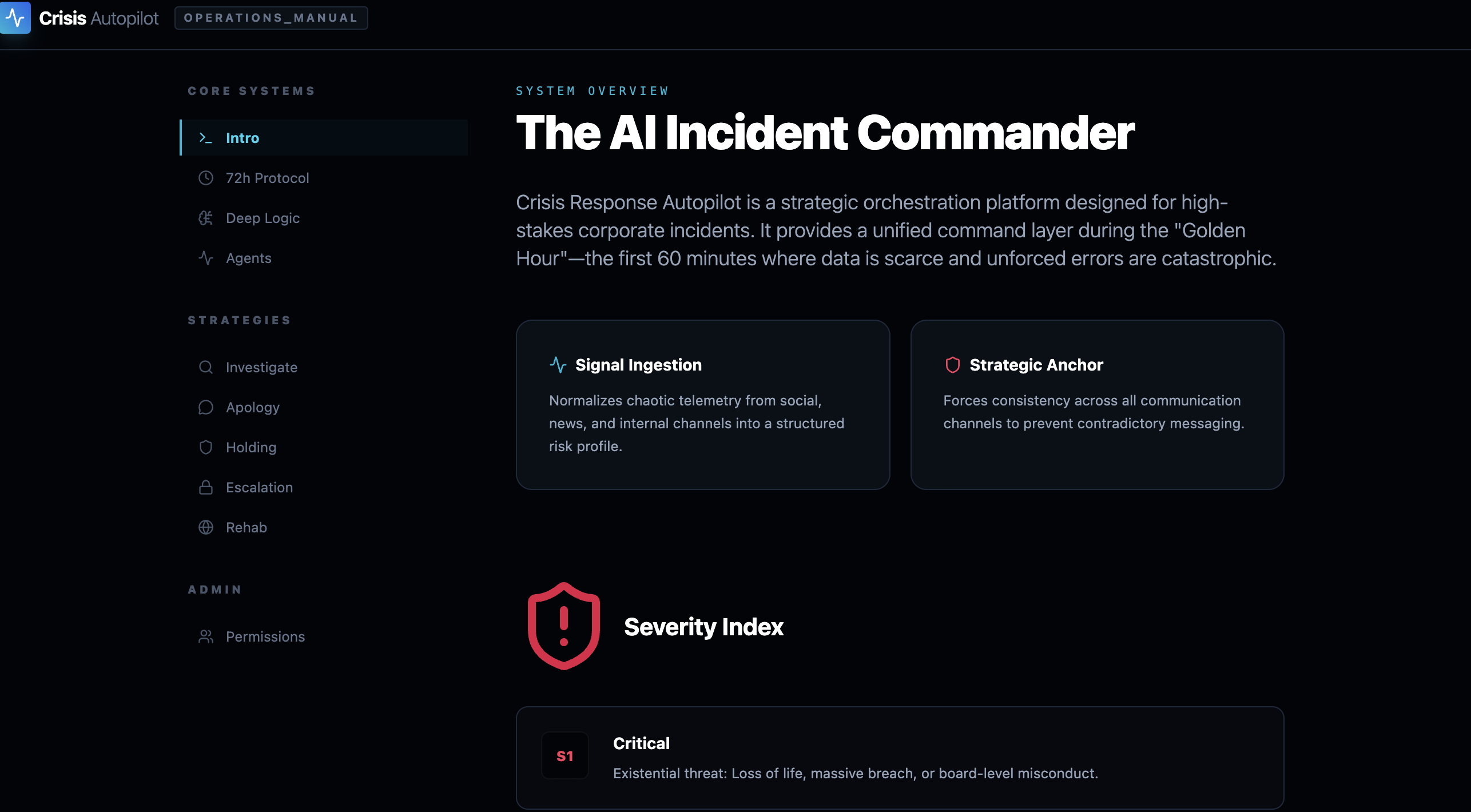
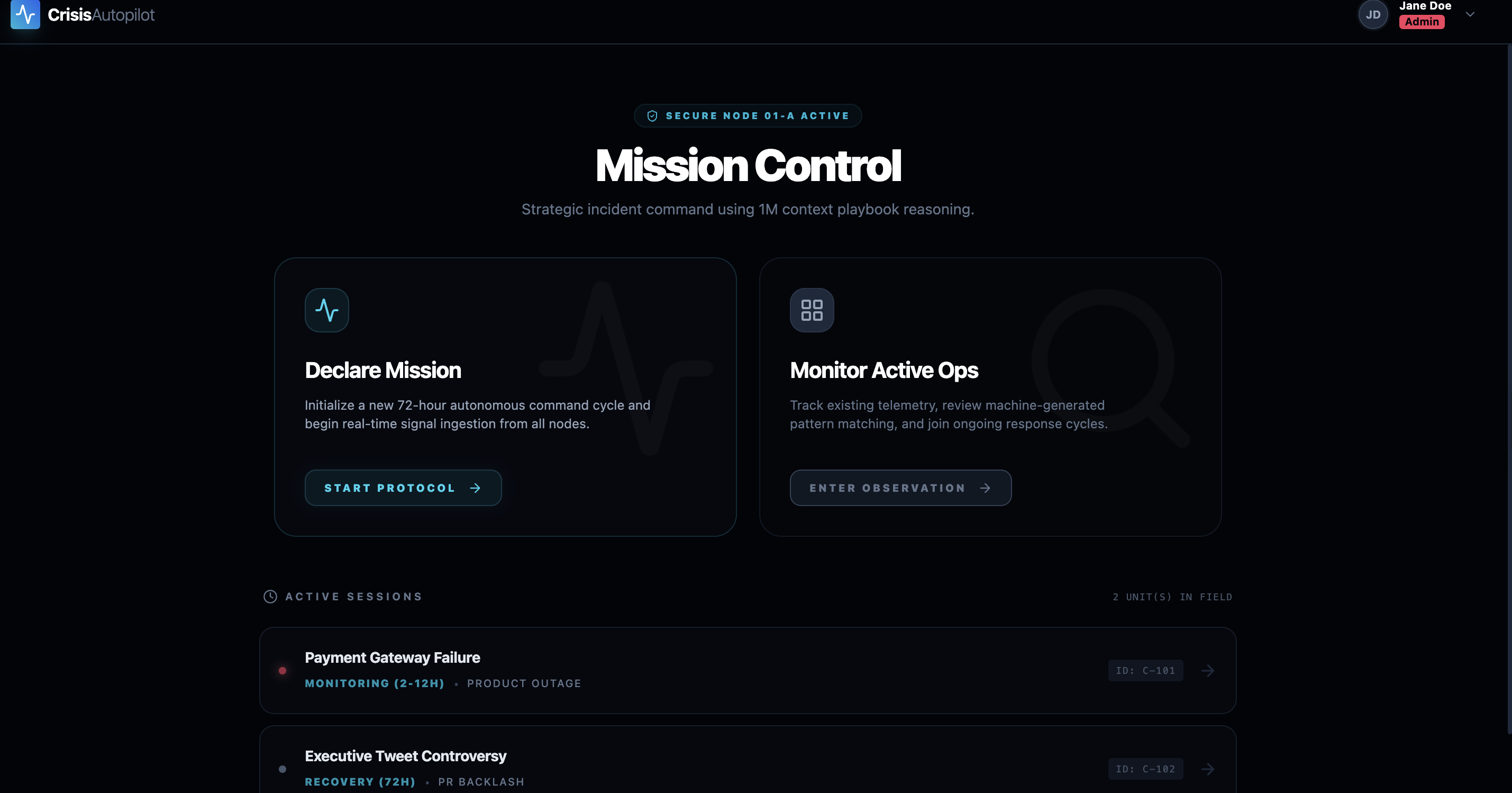
Crises Autopilot is an AI Incident Commander designed for the first hour of a crisis. It ingests signals (like a viral tweet or a system outage alert), classifies the severity, and immediately selects a response strategy (e.g., Acknowledge & Investigate vs. Immediate Apology).
It doesn't just write text; it orchestrates a full response loop:
- Simulates Stakeholder Reactions: Predicts how customers, legal, and investors will react to a specific statement.
- Generates Coordinated Outputs: Simultaneously drafts the internal Slack memo, the public tweet, and the press holding statement.
- Maintains Governance: Enforces approval gates so AI suggests, but humans (Founders/Legal) decide.
- Adapts in Real-Time: If new information arrives (e.g., "the leak was bigger than we thought"), it self-corrects the strategy and updates all pending drafts.
How we built it
We leveraged the Gemini 1.5 Pro model to take advantage of its massive 1M+ context window. This allows the Autopilot to "read" the company’s entire history of legal filings, brand guidelines, and past incident post-mortems in seconds to inform its strategy.
- Reasoning Chains: We implemented "Thought Signatures" that persist over a 72-hour loop, allowing the AI to remember why it made a decision at Hour 1 when it reaches Hour 24.
Multi-Agent Orchestration: We used a swarm of agents, one for social listening, one for legal risk scanning, and one for internal alignment, that feed data into a central "Incident Commander" agent.
Tech Stack: [Gemini API, Firebase, Antigravity].
Challenges we ran into
The biggest hurdle was "Hallucination vs. Factuality" in high-stakes environments. In a crisis, a wrong fact is a liability. We solved this by implementing Browser-Based Verification and "Red Line" constraints—the AI is strictly forbidden from inventing facts and must flag "Unknowns" in every situation report. We also had to balance "Autonomy" with "Control," leading us to build a robust governance UI where no public statement can be released without an explicit cryptographic approval from a human admin.
Accomplishments that we're proud of
- The Strategy Engine: We successfully built a logic gate that scores strategies against PR impact and legal risk, providing a transparent "Reasoning Trace" so executives understand the why behind a recommendation.
- The 60-Minute Compression: In our tests, the Autopilot could take a raw signal and produce a full, multi-channel response plan in under 120 seconds—a process that usually takes a human team 2 to 4 hours.
- Contextual Memory: Seeing the AI catch a contradiction by referencing a brand guideline from page 400 of an uploaded PDF was a "eureka" moment for the team.
What we learned
We learned that in a crisis, empathy is as important as accuracy. We spent significant time "Vibe Engineering" the output to ensure the AI didn't sound like a cold machine during a human-centric disaster. We also learned that "Human-in-the-loop" isn't just a safety feature; it's a requirement for executive trust.
What's next for Crises Autopilot
- The "Vibe Check" Loop: Developing a more advanced simulation where the AI "roleplays" as specific demographics to test how a message will land in different regions.
- Deep Integrations: Moving beyond text to monitor PagerDuty for technical outages and Slack Enterprise for internal sentiment shifts.
- Predictive Drills: Using the engine to run "Wargame" simulations for companies, helping them find holes in their PR strategy before a crisis ever happens.

Log in or sign up for Devpost to join the conversation.