-
-
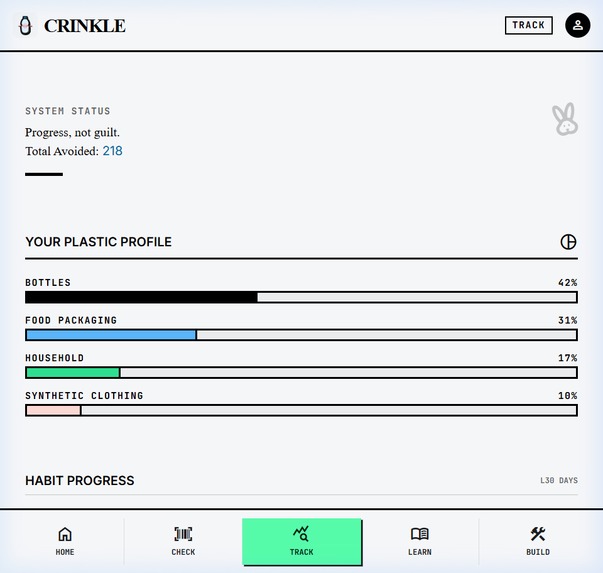
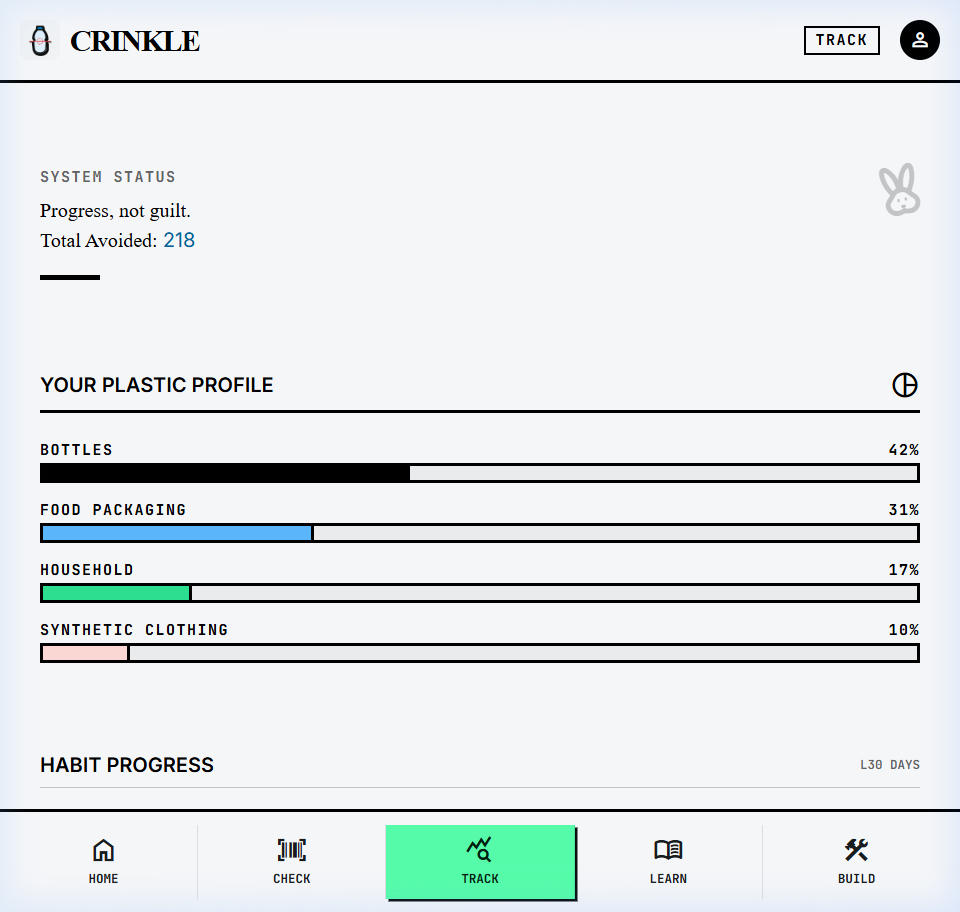
Personal Habit Engine & Milestones (TRACK)
-
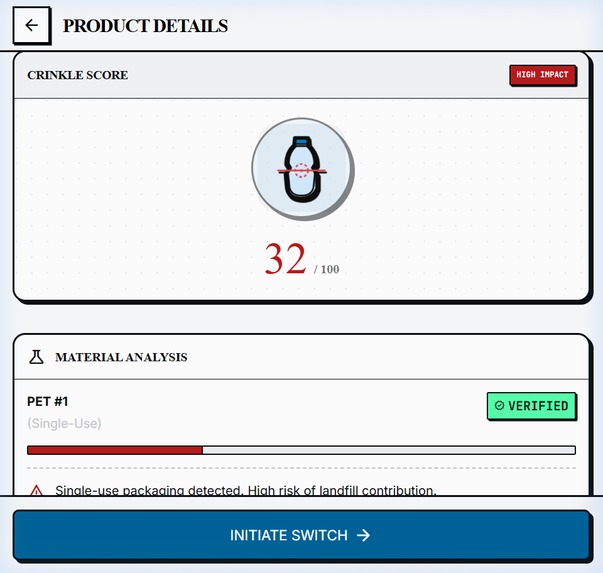
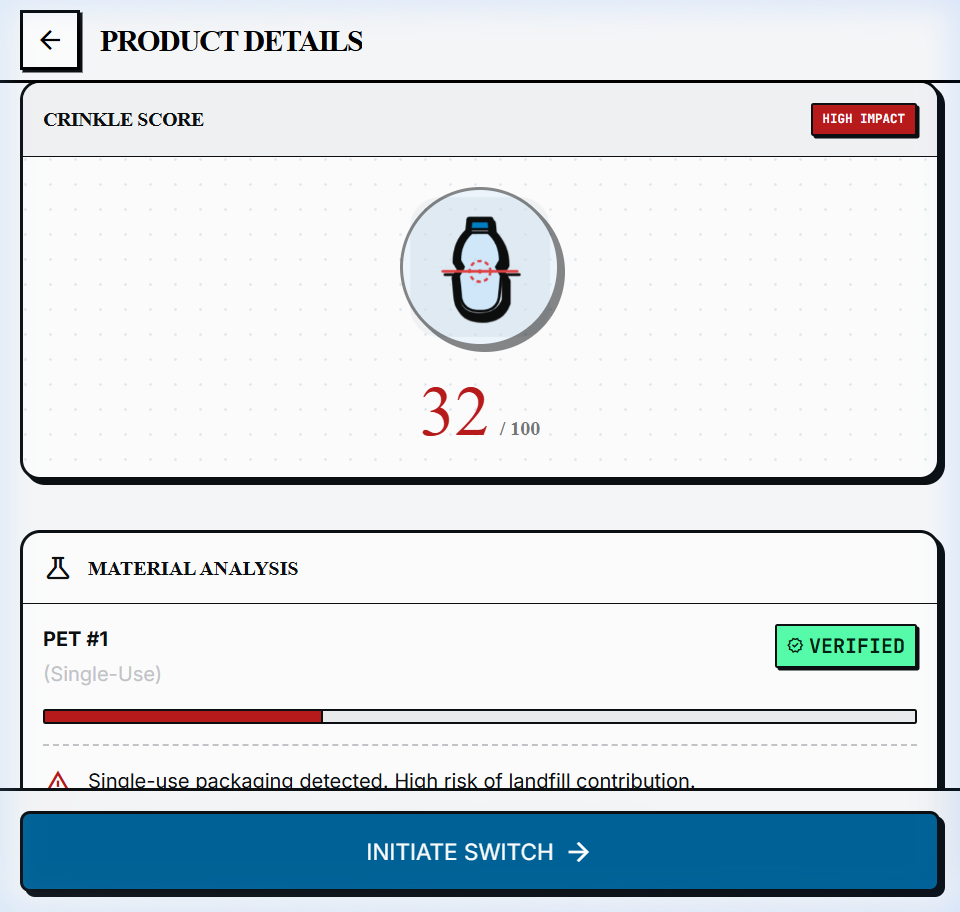
Crinkle Score & Better Choice (RESULT)
-
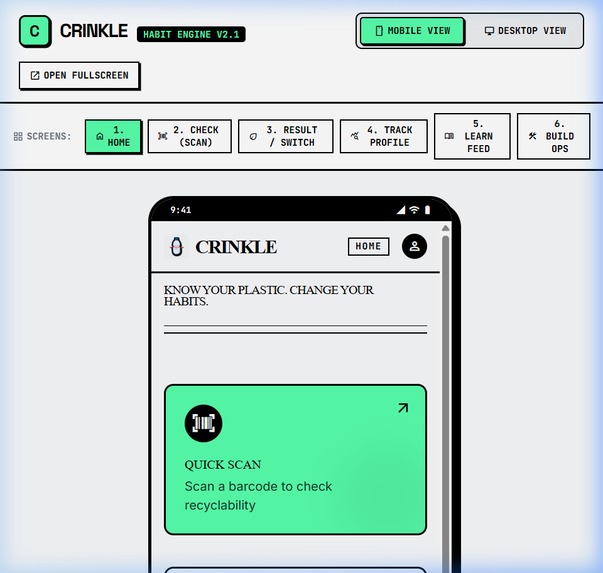
Interactive Viewport Simulator Hub
-
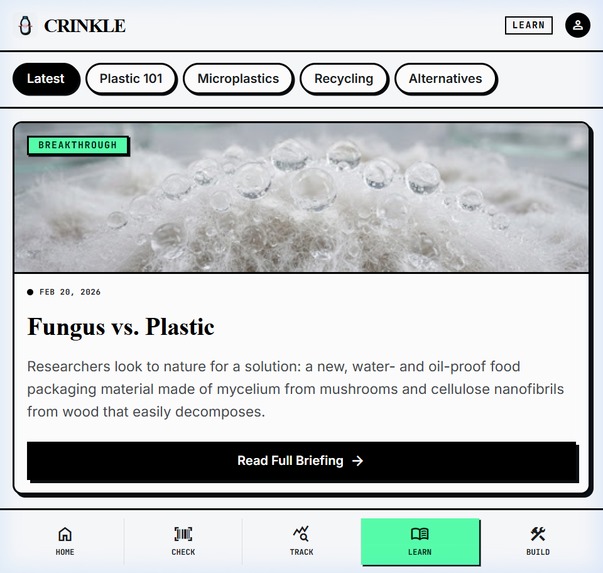
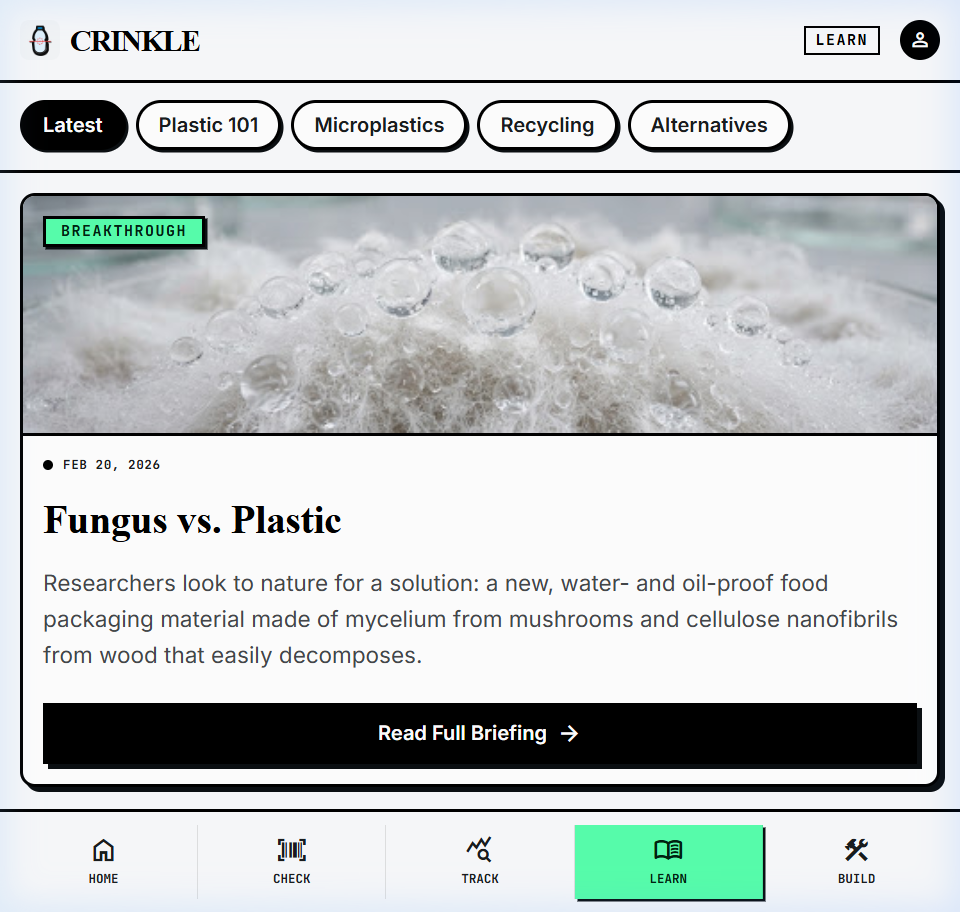
Science Intel & Microplastics Feed (LEARN)
-
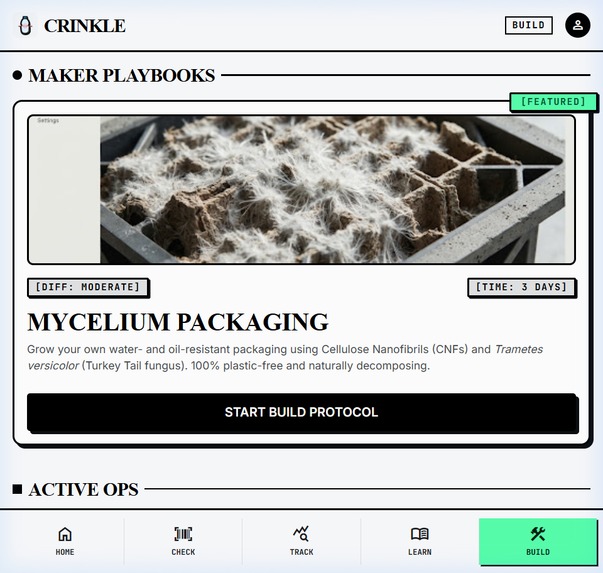
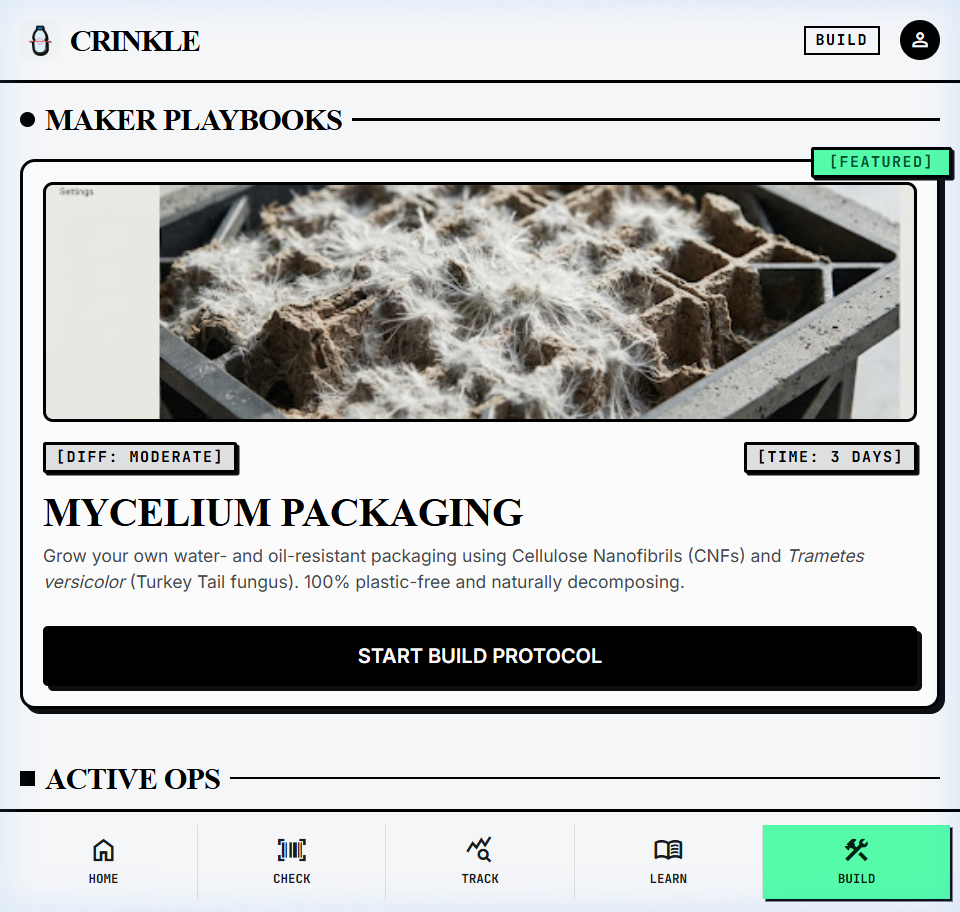
Open-Source Maker Playbooks & Bounties (BUILD)
-
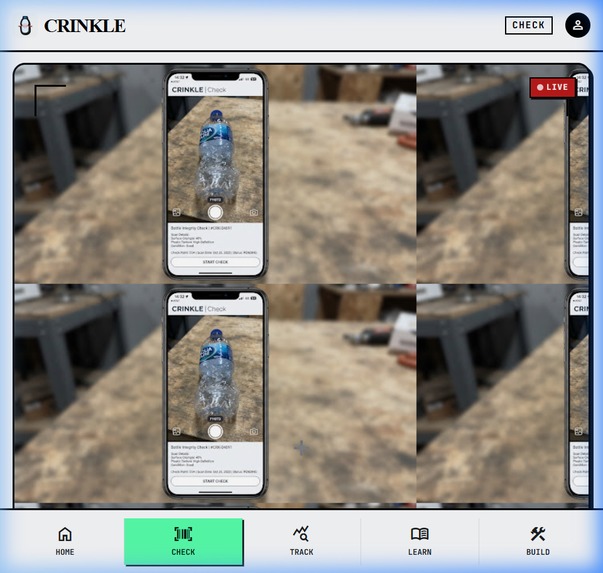
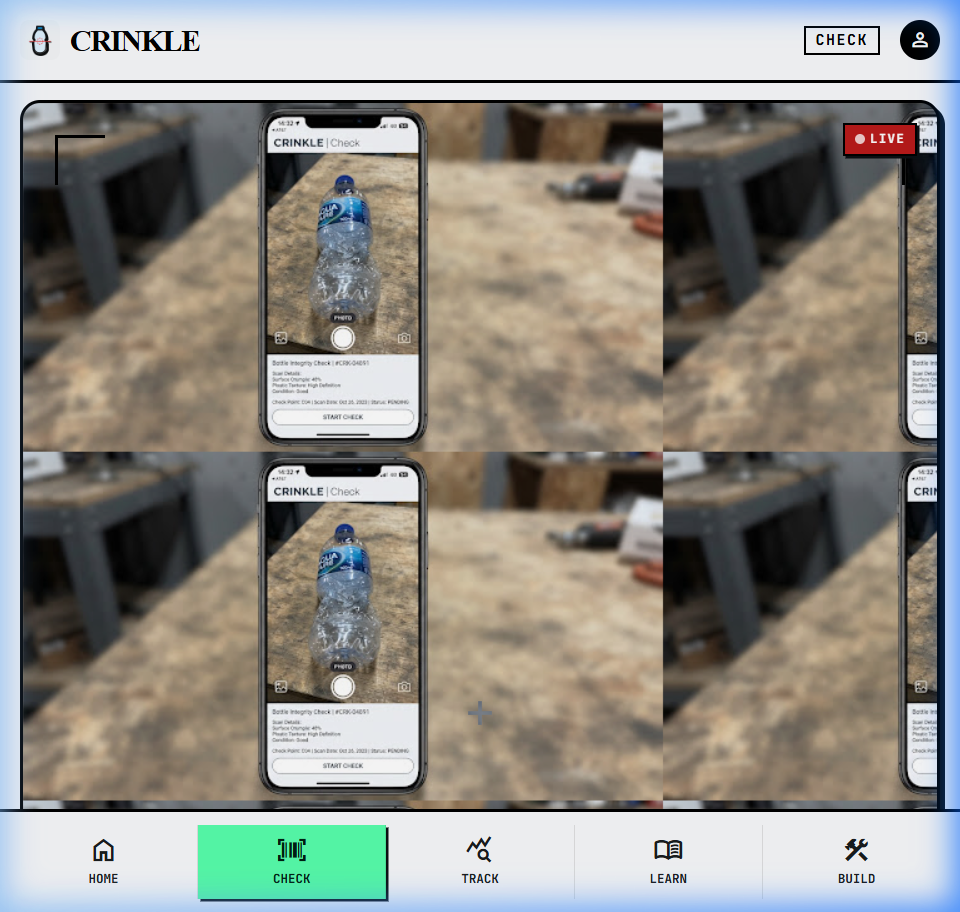
Material Scanner & Viewfinder
CRINKLE
About the Project
The idea
I kept coming back to a simple question:
Why is it so hard for a normal person to make a better decision about plastic?
We see bottles, cups, food packaging, bags, and containers every day. We know plastic is a problem, but the information around it is usually somewhere else — on a recycling website, in a scientific paper, on a product label, or buried in a long article.
I wanted to make that information useful at the moment the decision happens.
That's where CRINKLE started.
CRINKLE is a consumer-first plastic scanner and habit engine.
The idea is simple:
Check → Understand → Change → Track
Instead of only telling someone that plastic is a problem, CRINKLE helps them understand what they're looking at and gives them a practical next step.
What CRINKLE does
1. CHECK — Scan what you're holding
The core experience starts with the scanner.
A user can scan an everyday product and identify the relevant plastic material, such as:
- PET #1
- HDPE #2
- PVC #3
- LDPE #4
- PP #5
- PS #6
The result is designed to be understandable in seconds rather than requiring the user to interpret technical material information themselves.
For example:
PET #1
Single-use beverage bottle
Then CRINKLE presents the relevant environmental considerations and an easy-to-understand assessment.
The goal isn't to make plastic information look complicated.
It's to make it visible.
2. UNDERSTAND — Explain the "why"
A score by itself isn't enough.
If I tell someone:
"This plastic is bad."
They should be able to ask:
Why?
So CRINKLE breaks the result down into understandable information about the material, its use, environmental considerations, and available evidence.
Where information is uncertain, the system should communicate that uncertainty instead of pretending every environmental question has a perfect answer.
This is important to me because environmental technology shouldn't create another layer of misinformation.
3. CHANGE — Turn information into a decision
Awareness doesn't automatically create behavior change.
That's why CRINKLE connects the scan to an action.
After seeing the result, the user can explore a better option — for example, choosing a reusable or refillable alternative instead of another single-use product.
The important part is the transition:
I saw it → I understood it → I changed something.
That is the behavior loop CRINKLE is trying to create.
4. TRACK — Make the change visible
A single better decision can feel insignificant.
But repeated decisions are different.
CRINKLE lets users record their changes and build a personal low-plastic journey.
The dashboard can show things like:
- items avoided
- goals
- streaks
- progress
- recurring plastic habits
- areas where the user has the biggest opportunity to improve
The purpose isn't to create another meaningless leaderboard.
It's to answer a simple question:
Am I actually changing?
Learn
CRINKLE also has a learning layer.
Because once someone starts asking questions about plastic, they usually have more questions.
Why does plastic persist?
What are microplastics?
What do the recycling numbers actually mean?
What happens after something goes into a recycling bin?
What alternatives exist?
How are alternative materials made?
The Learn section is designed to turn those questions into short, practical learning experiences.
The goal is not to make people environmental scientists.
It's to help ordinary people understand enough to make better decisions.
Build
The long-term idea goes beyond consuming differently.
I also want people to understand how alternatives are actually created.
That's why CRINKLE includes a Build direction.
For example, one learning path could explore materials such as mycelium-based packaging and break the process into:
PROBLEM → MATERIAL → PROCESS → PROTOTYPE → EVIDENCE
The point isn't to tell everyone that one material is magically the answer.
It's to give people a framework for exploring alternatives, understanding their tradeoffs, and learning how environmental solutions are developed.
From an App to a Community
This is where I see CRINKLE becoming much bigger than a scanner.
A consumer can start with one bottle.
But eventually, the system could connect:
Consumers ↔ Makers ↔ Researchers ↔ Businesses ↔ Communities
Consumers create demand for better choices.
Makers experiment with alternatives.
Researchers contribute evidence.
Businesses respond to changing demand.
Communities share what actually works.
The app becomes the entry point into a broader movement around understanding and reducing unnecessary plastic use.
Why I Built It
I've had ideas around waste, plastic, and environmental problems for a long time.
I've thought about things like waste management and microplastics before, but having an idea and actually building something are two very different things.
This hackathon gave me a reason to finally turn one of those ideas into something tangible.
I didn't want to build another environmental dashboard that looks impressive but doesn't change what a person does.
I wanted to start with the person standing in front of a shelf, holding a product, and asking:
"Should I buy this?"
That small moment felt like the right place to start.
How I Built It
I approached CRINKLE as a consumer product rather than just a technical demo.
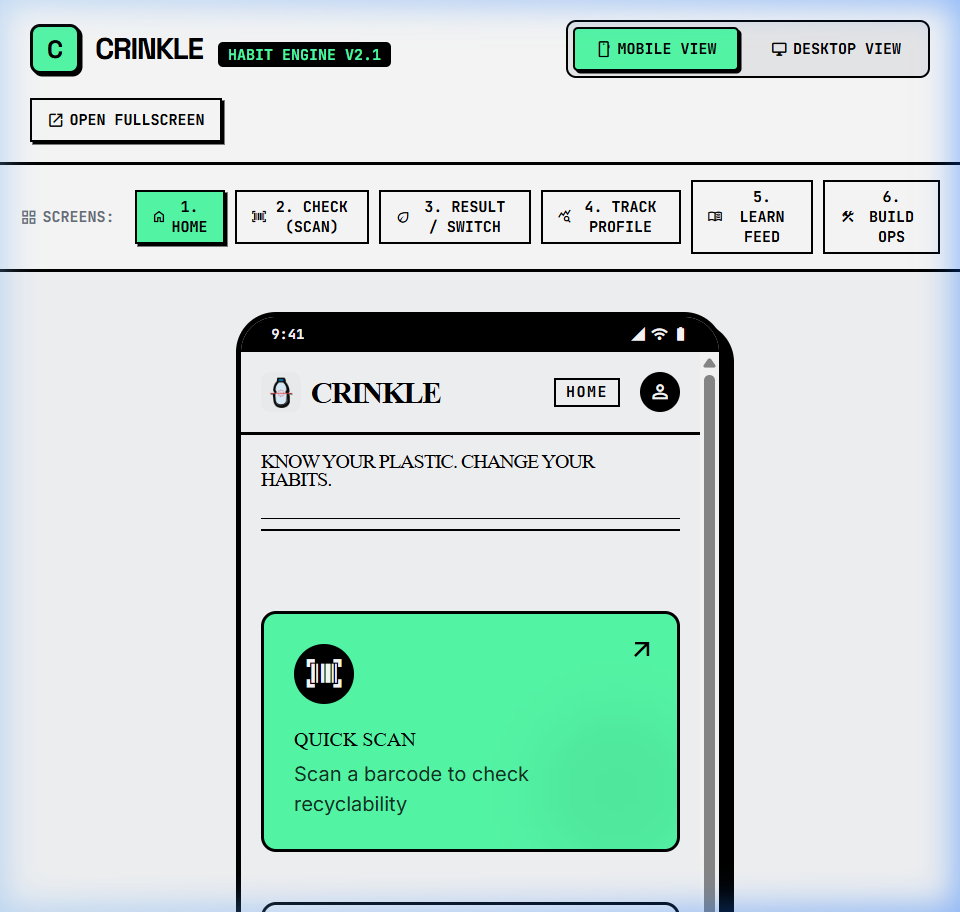
The product architecture is centered around a few connected experiences:
CHECK
Plastic identification and assessment.
CHANGE
Alternative recommendations and action logging.
TRACK
Personal behavior and progress.
LEARN
Environmental and material education.
BUILD
Exploration of alternative materials and practical experimentation.
The interface was designed around a tactile editorial identity instead of the typical "green technology" aesthetic.
The CRINKLE visual language uses:
- bold carbon-black outlines
- hard offset shadows
- paper-like surfaces
- red scanner elements
- technical polymer labels
- hand-drawn material details
- strong visual hierarchy
The intention was to make environmental technology feel like something people would actually want to use.
What I Learned
The biggest thing I learned is that awareness isn't the same thing as action.
It is easy to build a page explaining why plastic is harmful.
It is much harder to design the moment after someone learns that information.
What do they do next?
Can they find an alternative?
Will they actually choose it?
Can they see their progress?
Can they learn enough to make the next decision themselves?
That changed the way I thought about the product.
CRINKLE isn't really about giving someone a plastic score.
The score is just the beginning of a larger loop:
Information → Decision → Action → Feedback → Better Decision
Challenges
One of the hardest parts was deciding how much the product should try to do.
There are huge problems surrounding plastic:
microplastics, waste management, recycling infrastructure, packaging, consumer behavior, manufacturing, policy, and material science.
It would be easy to build a product that tries to solve all of them at once.
But that would make the MVP meaningless.
So I focused the first version around something much smaller:
Help one person understand one plastic product and make one better decision.
Another challenge was communicating environmental information without oversimplifying it.
Environmental problems are complicated.
A material isn't automatically "good" or "bad" in every situation.
Context matters.
Evidence matters.
Tradeoffs matter.
That is why transparency and evidence are part of the product direction.
What's Next
The hackathon version of CRINKLE is only the starting point.
The next stage would be improving the material database, strengthening evidence and sourcing, expanding product recognition, improving alternative recommendations, and measuring whether the experience actually changes behavior.
From there, the platform could grow into the community layer:
learn → experiment → share → improve
The long-term goal is not to shame people for using plastic.
It's to make the choices around plastic easier to see, easier to understand, and easier to change.
We don't need everyone to become perfect overnight.
We need more people to start making better decisions — and then make those decisions easier for the next person.
The Vision
CRINKLE starts with a simple question:
"What am I holding?"
Then:
"Why does it matter?"
Then:
"What can I do differently?"
And eventually:
"What can we build instead?"
That's the direction I'm taking CRINKLE.
Check what you're using. Change what you can. Build what's next.

Log in or sign up for Devpost to join the conversation.