-
-

HOME PAGE
-
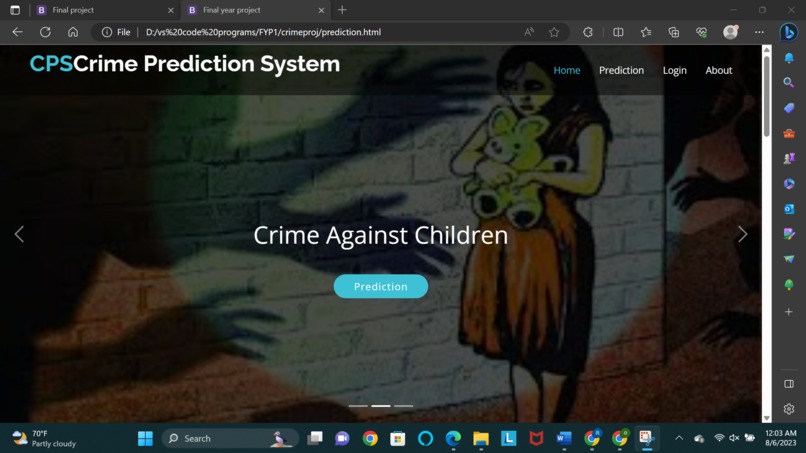
interface page
-
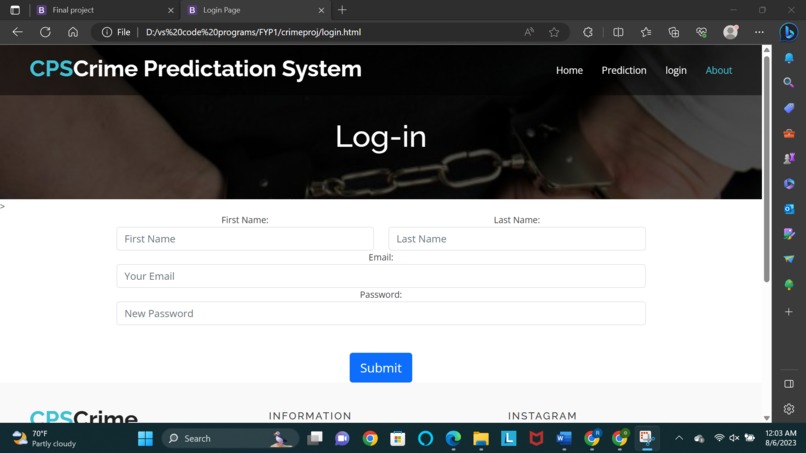
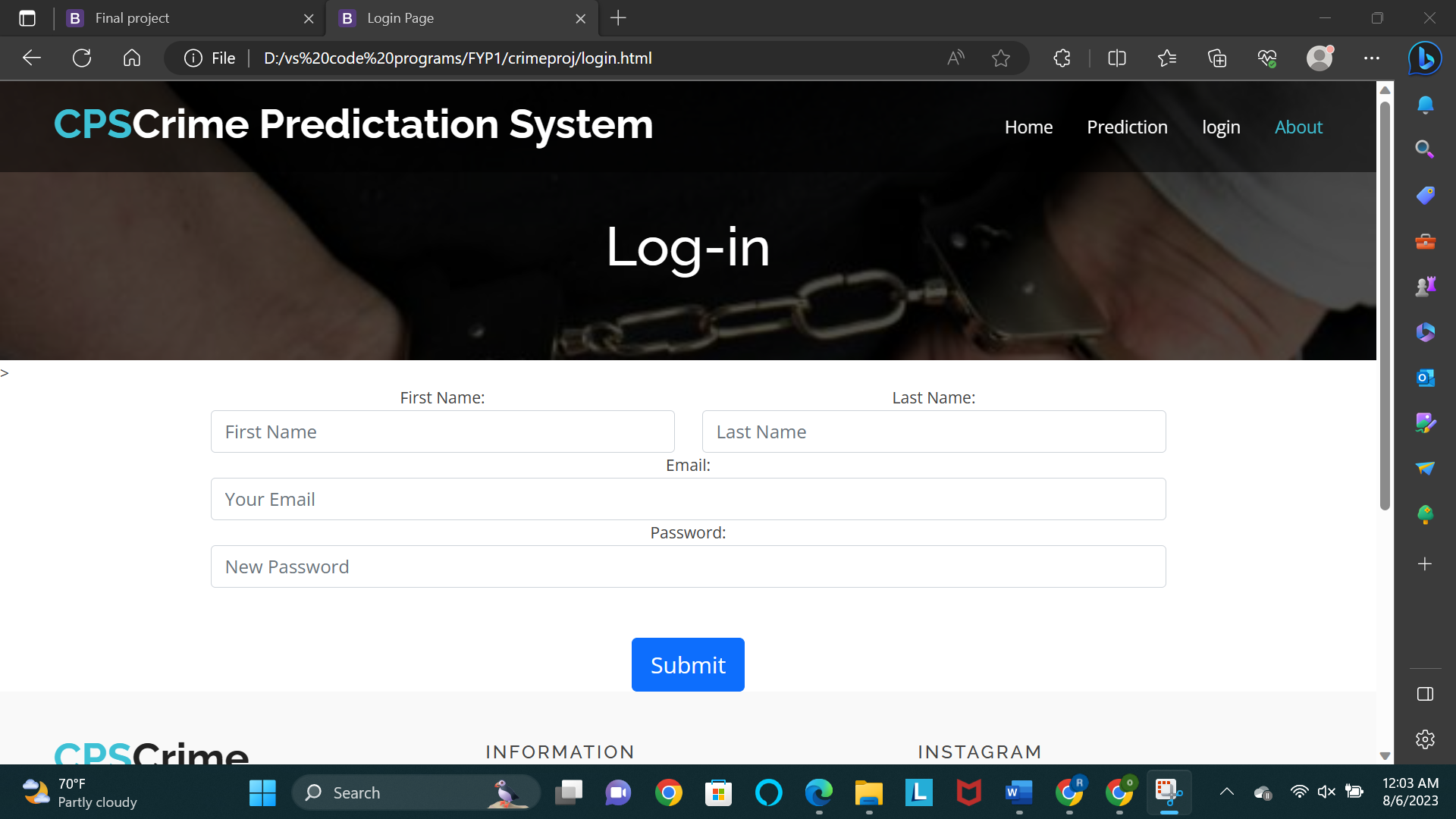
login page
-
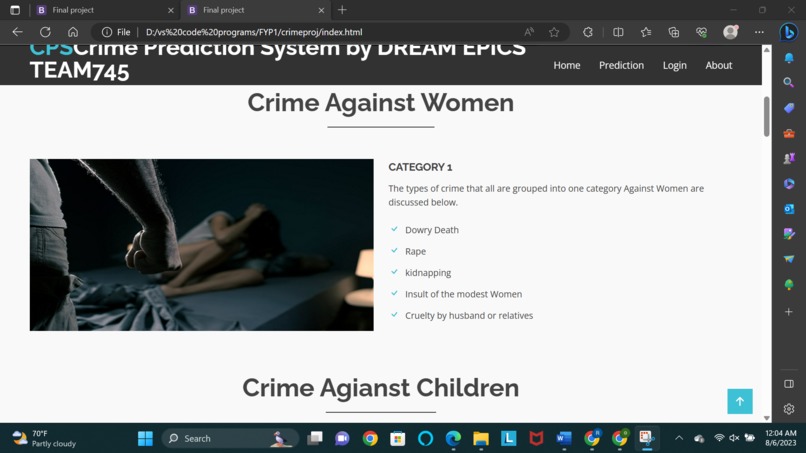
web page
-
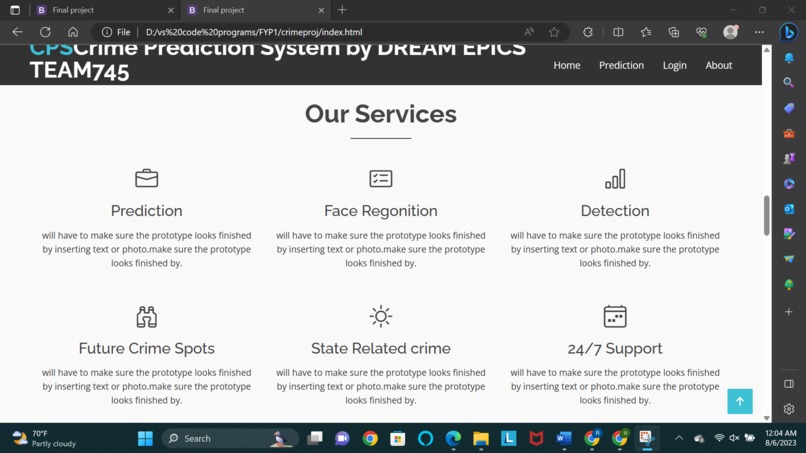
services




Inspiration
The motivation for predictive analytics of crime patterns in India arose after the Indian Government’s plan to forecast crime by 2018, since no such system yet exists that would benefit the strategizing of crime control. The plan mainly includes predicting crime considering the factors - geographical areas, population, lifestyle, race, social issues etc. Keeping the government’s vision in mind, we aimed to prepare a primary model towards accomplishing it. Our system covers the factors of predicting crimes for a few upcoming years covering geographical areas (states) as one of the parameters. Also, for visualizations we have covered various demographic factors like population, literacy rates with respect to area.
What it does
The main idea of the project is to help ease the policing and security policy making and implementation by providing an elaborate view of the crime patterns that could be observed in the coming years. It also includes the idea to visualize the crime case reporting of the past years in order to identify critical areas that need to be looked upon.
In India, there has been a drastic pattern of crime observed in the past few years giving rise to a threat to the security of common man. Considering this perilous situation, we aim to study these crime patterns and realize the changes in the overall crime based on the data obtained from the official Indian Government websites. The raw data obtained was converted to a suitable format using data mining techniques such as eliminating missing values, eliminating redundant data, data transformation, etc. This data was fed to algorithms like Linear Regression, Random Forest for performing predictions. Crime type predictions are performed, for four years, for each state as well as all the states of India using the data from year 2001-2020. These predictions are displayed using simple visualization charts. One important aspect that is used with these algorithms is that of identifying the trend changing year in order to increase the accuracy of the predictions.
The entire system is established through a website - “Crime Prediction System”. The website provides three main services - predictions, visualizations and observations. Under the predictions service, four major sectors of crime are considered - crime against women, crime against children, crimes under the Indian Penal Code (IPC) and crimes under Special and Local Laws (SLL). The visualizations service consists of the total crime against women, total crimes against children and the total IPC crimes with respect to population of an area. The observations service provides a headline of all the notable statistics and information perceived during execution of the system. This website provides a user-friendly environment for all its users to take the entire benefit of studying the crime patterns across all the states of India for diverse purposes.
How we built it
The purpose of Software Requirement Specification is to guide the users about the various sections of the proposed System “Crime Prediction System”, scope and limitation of the system.
The proposed system contains three major modules with their functionalities:
1) Visualization: The proposed system is supposed to Visualize the Crime data after classifying and clustering the datasets using matplotlib: bar graphs, line graphs, Animates, scatter plots, and choropleth (map) plots. It will also create figures with multiple sub-figures, and customize labels, colors, error bars, etc.
2) Prediction: The system uses statistics to predict outcomes to detect crimes and identify suspects, after the crime has taken place using the dataset. Nearly any regression model can be used for prediction purposes by making specific assumptions with regard to one or more of the parameters.
3) Some basic modules to improve the nature of Interaction: ● Statistical Reports or Observations ● Dashboards ● Geographical Analysis tools ● Notifications
Challenges we ran into
Accomplishments that we're proud of
What we learned
What's next for CRIME PREDICTION SYSTEM
Built With
- anaconda
- chart.js
- css
- html
- javascript
- python


Log in or sign up for Devpost to join the conversation.