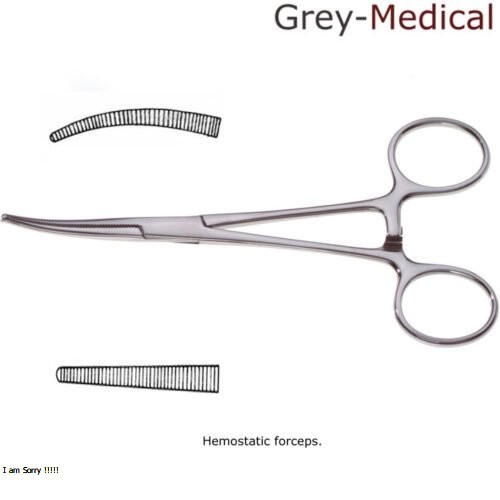
Crile vs Kelly: Understanding the Difference Between Two Essential Hemostatic Forceps
When it comes to surgical procedures, precision, and efficiency are paramount. Among the numerous instruments available to surgeons, hemostatic forceps play a vital role in controlling bleeding and securing blood vessels. Two commonly used hemostatic forceps are Crile forceps and Kelly forceps. While these tools may appear similar at first glance, they have distinct features that make them suitable for different purposes. In this blog, we will explore the differences between Crile and Kelly forceps, their applications, and when to choose one over the other.
What are Hemostatic Forceps?
Hemostatic forceps, often referred to as clamps, are surgical tools designed to grasp and secure tissues, blood vessels, or other structures during surgery. These instruments help surgeons maintain a clear field of vision by controlling bleeding and isolating structures. Hemostatic forceps typically have a locking mechanism to maintain grip without continuous manual effort. Among the wide array of hemostatic forceps, Crile and Kelly are two of the most widely used types.
Overview of Crile Forceps
Crile forceps, also known as full-serrated clamps, are straight or curved instruments used for clamping blood vessels or tissue. These forceps are fully serrated along the length of their jaws, providing a firm and secure grip.
Key Features of Crile Forceps:
- Full Serration: The jaws are serrated from the hinge to the tip, allowing better control and grip.
- Straight or Curved Design: Available in both straight and curved variations to suit different surgical needs.
- Size: Typically 5.5 to 6.5 inches in length, making them versatile for various applications.
- Material: Made of stainless steel for durability and resistance to corrosion.
Applications of Crile Forceps:
- Commonly used in general surgeries to clamp medium-sized blood vessels.
- Ideal for procedures where complete grip and control are needed throughout the entire jaw.
- Frequently employed in ligating blood vessels before cutting or suturing.
Overview of Kelly Forceps
Kelly forceps, also known as half-serrated clamps, are versatile surgical tools with a unique serration pattern that distinguishes them from Crile forceps. They are typically used for clamping larger blood vessels and tissues.
Key Features of Kelly Forceps:
- Half Serration: The serration is present only on the distal half of the jaws, with the proximal half being smooth.
- Straight or Curved Design: Available in both variations, catering to diverse surgical requirements.
- Size: Generally larger than Crile forceps, often ranging from 5.5 to 7 inches in length.
- Material: Constructed from high-grade stainless steel for durability.
Applications of Kelly Forceps:
- Commonly used for clamping larger blood vessels and tissues.
- Useful in procedures where a smoother proximal jaw is beneficial to avoid crushing delicate tissues.
- Suitable for both human and veterinary surgical procedures.
When to Use Crile Forceps
Crile forceps are the go-to choice when precision and control are required throughout the entire length of the jaws. They are ideal for procedures involving medium-sized blood vessels where a strong, consistent grip is necessary. These forceps are particularly useful in:
- General surgeries.
- Procedures requiring secure clamping before ligation or suturing.
- Applications where tissue slippage must be minimized.
When to Use Kelly Forceps
Kelly forceps are better suited for situations where a lighter grip or reduced tissue damage is desirable. The smooth proximal jaw allows surgeons to avoid crushing delicate tissues while still providing sufficient control. These forceps are commonly used in:
- Clamping larger blood vessels and tissues.
- Procedures involving delicate structures that may be damaged by full serration.
- Both surgical and non-surgical veterinary applications.
Common Misconceptions
Crile and Kelly Are Identical: While they may appear similar, their serration patterns and applications are different. Surgeons must choose the right tool based on the specific requirements of the procedure.
Kelly Forceps Are Always Larger: Although Kelly forceps are generally larger than Crile forceps, size variations exist, and both instruments can overlap in dimensions.
Crile Forceps Cause More Tissue Damage: The full serration of Crile forceps provides a stronger grip, but when used correctly, they do not inherently cause more damage than Kelly forceps.
Conclusion
Crile and Kelly forceps are indispensable tools in the surgical realm, each with unique features that make them suitable for specific tasks. Understanding the differences between these two forceps ensures that surgeons can make informed decisions during procedures, optimizing outcomes and minimizing risks. While Crile forceps offer full serration for a stronger grip, Kelly forceps provide a more delicate option with half serration, catering to diverse surgical needs.
Built With
- crile
- hemostatic

Log in or sign up for Devpost to join the conversation.