-
-
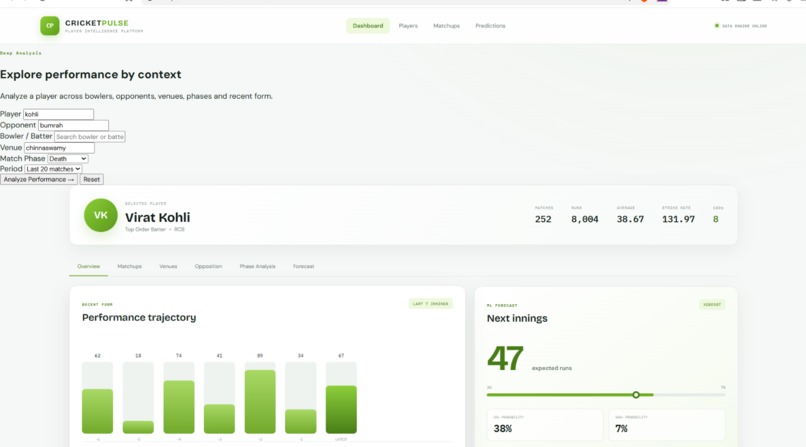
prediction
-
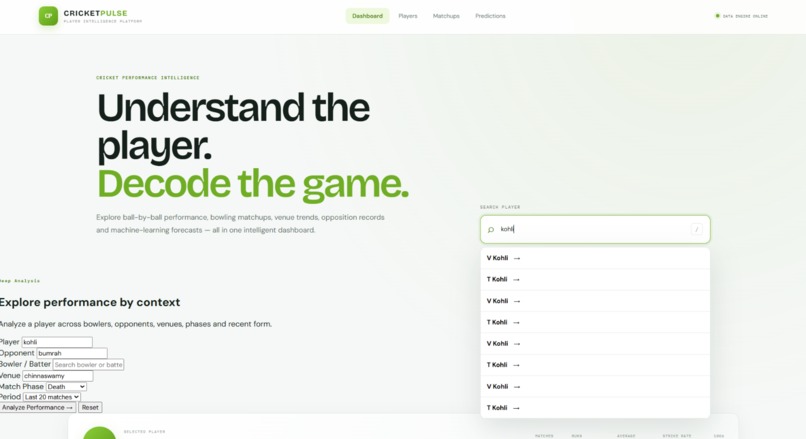
dashboard
-
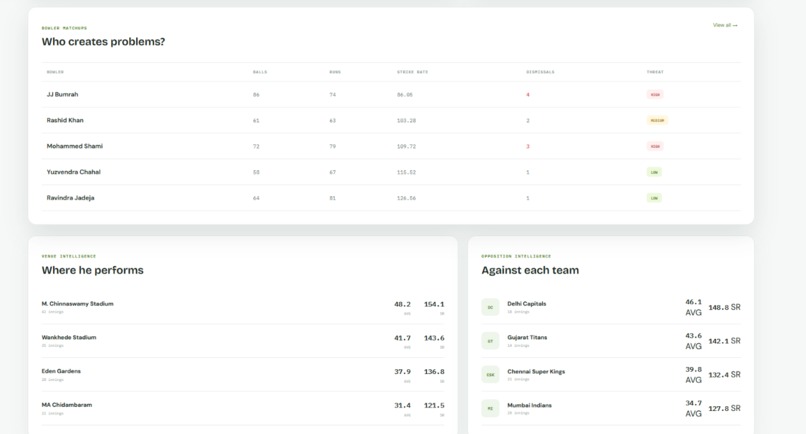
stats
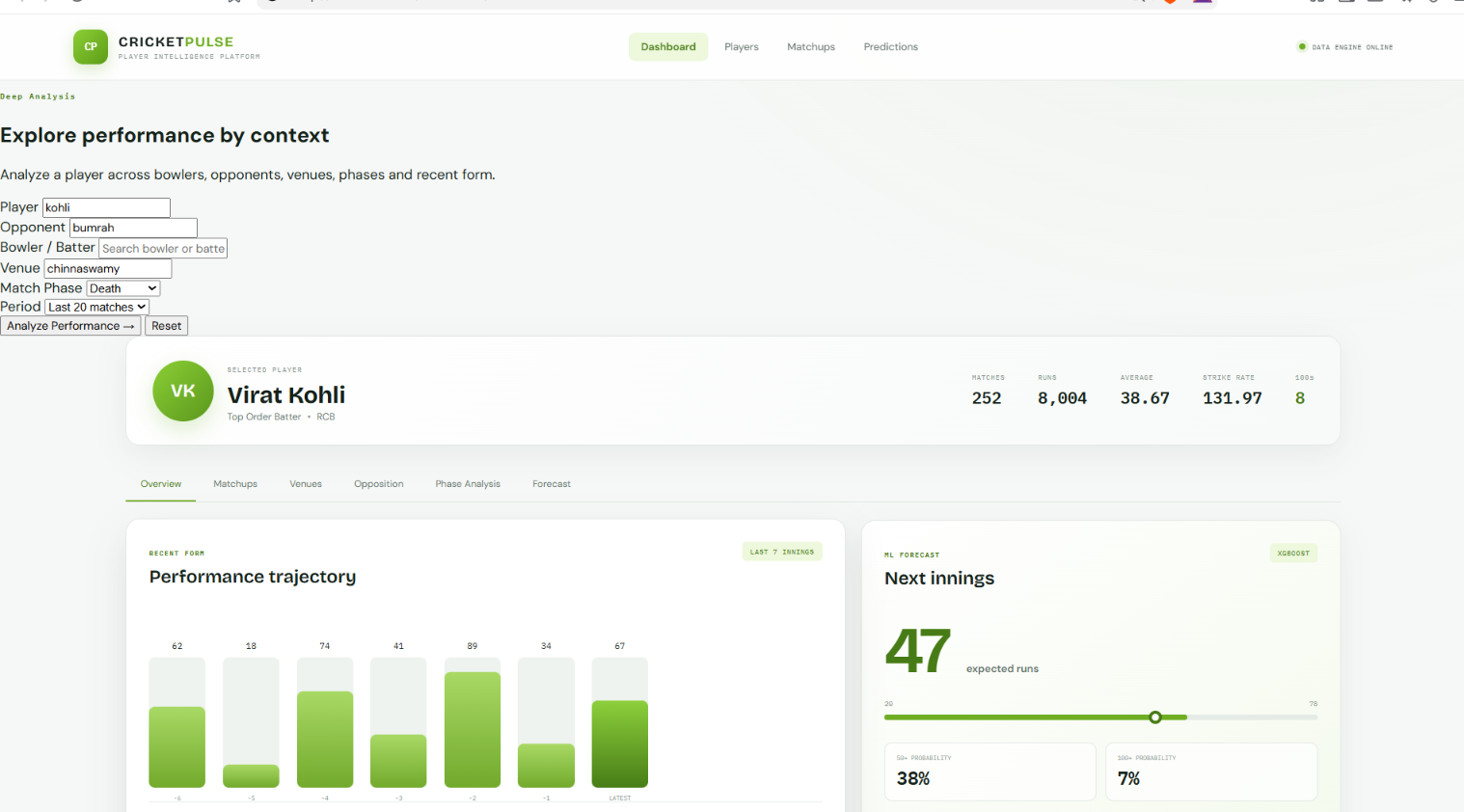
Inspiration
Cricket is a sport where performance is highly dependent on context. A player's overall career statistics do not always tell the complete story — performance can vary significantly depending on the ground, opposition, recent form, batting position, innings, and other match conditions.
I was inspired by the way cricket analysts and commentators study these factors before a match. Questions such as How has this player performed at this ground?, How has the player performed against this opposition? and Is the player currently in good form? made me think about whether these insights could be analyzed systematically using data science and machine learning.
This led me to build Cricket Stats Predictor, a platform that combines cricket statistics, historical analysis, and machine learning to understand player performance and generate data-driven future performance predictions.
What it does
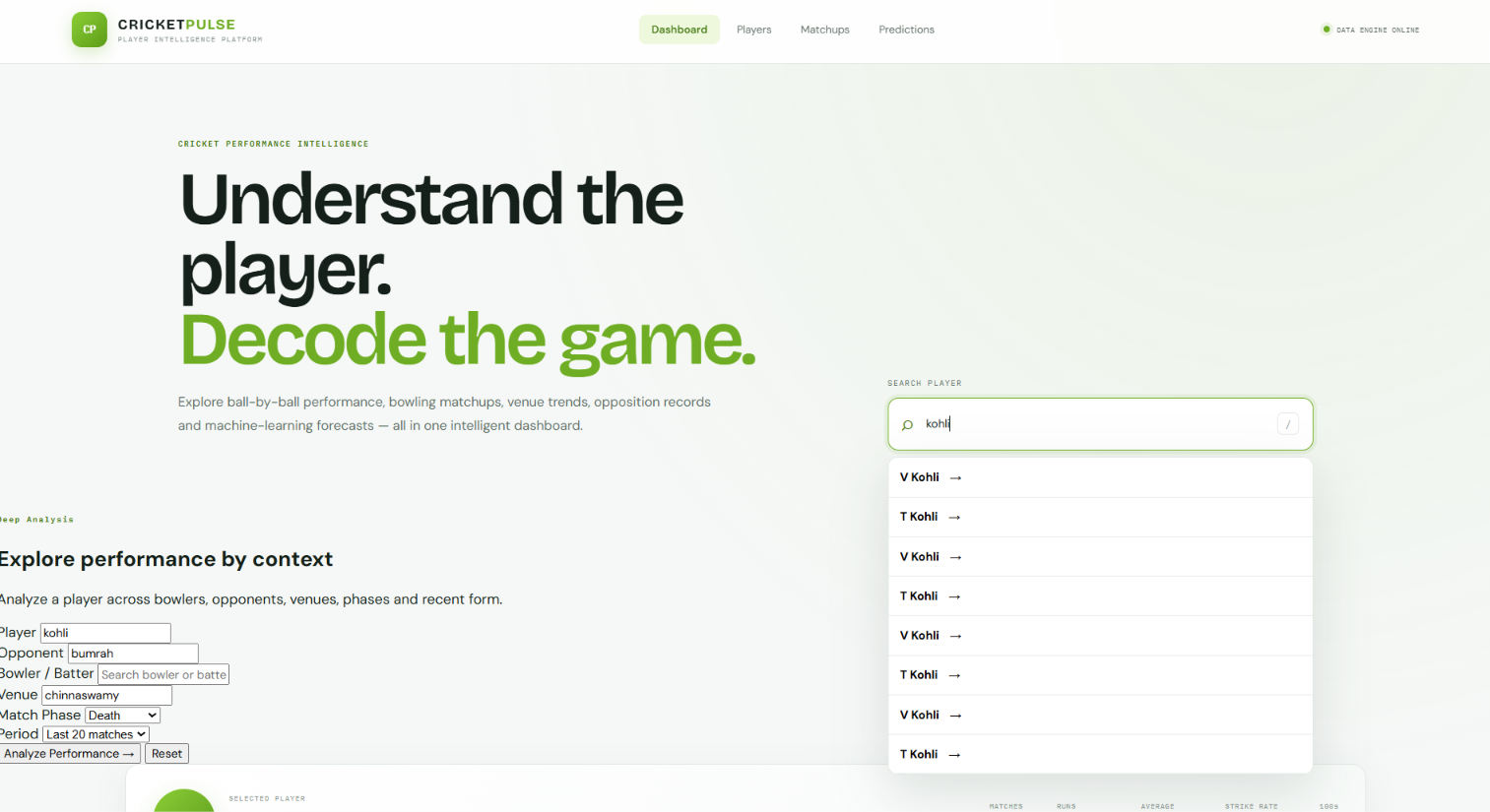
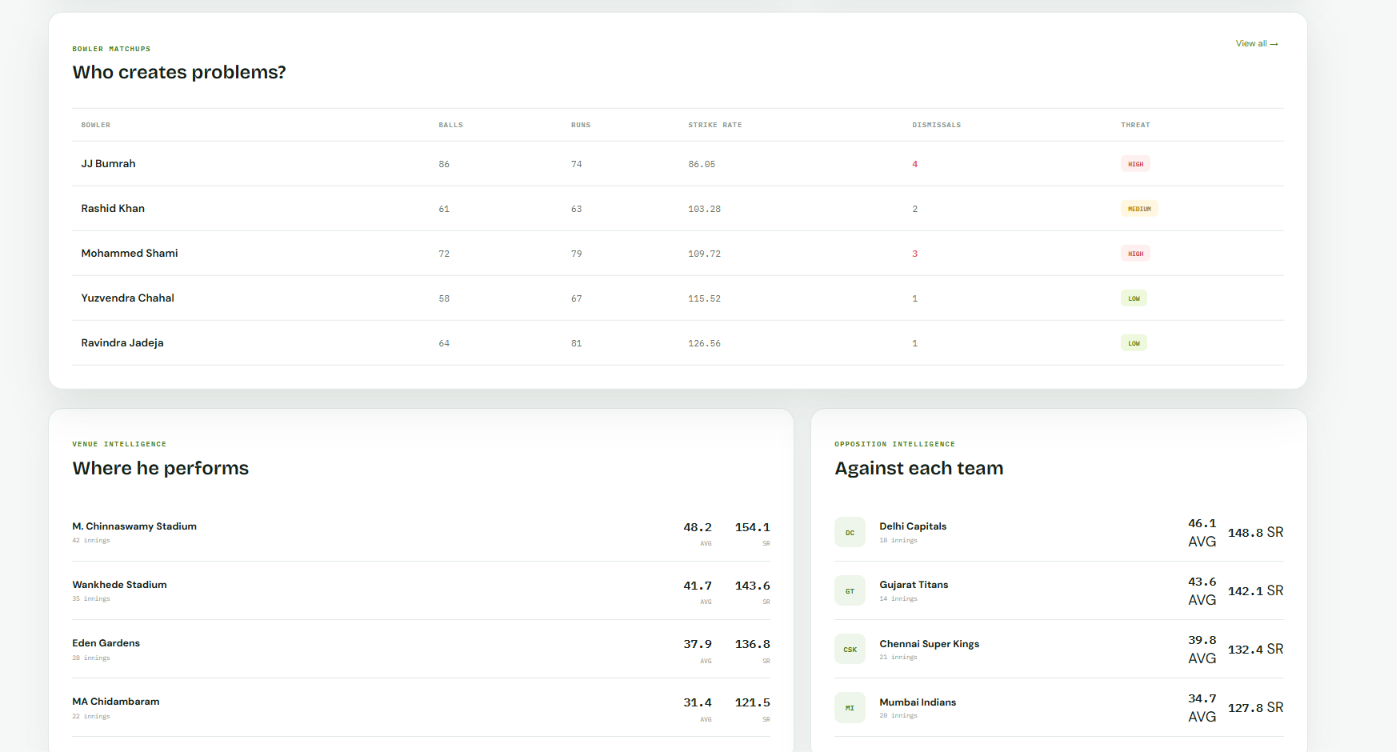
Cricket Stats Predictor analyzes a player's historical and contextual performance rather than relying only on basic career statistics.
The system can analyze factors such as:
- Career performance and consistency
- Recent form and last few matches
- Performance at specific grounds
- Performance against particular opponents
- Batting position
- Performance while batting first or chasing
- Venue-specific trends
- Strike rate, average, runs, wickets and other relevant statistics
Using these features, the prediction system estimates possible future performance and presents the results through an easy-to-understand dashboard.
Instead of treating a prediction as a guaranteed outcome, the goal is to provide data-backed insights, trends, probabilities, and expected performance ranges based on historical patterns.
How we built it
The project was designed as a data science and machine learning pipeline.
First, cricket match and player data is collected and cleaned to make it suitable for analysis. The data is then transformed into meaningful features such as career averages, recent-form statistics, venue performance, opposition performance, and other contextual metrics.
The processed data is used for exploratory data analysis to identify patterns and relationships in player performance.
Machine learning models are then used to learn from historical performances and generate future performance estimates. The prediction layer is separated from the presentation layer so that the application can display both the underlying statistics and the model's predictions.
The frontend is designed to make the analysis interactive, allowing users to select players, formats, grounds, and other relevant factors and explore the resulting statistics and predictions.
Challenges we ran into
One of the biggest challenges was that cricket performance is influenced by many different factors, making it difficult to represent a player's performance using only a few statistics.
Another challenge was handling historical data consistently. Different matches, formats, venues, and players can have different amounts of available data, so the data needed to be cleaned and structured carefully before it could be used for machine learning.
We also had to avoid relying too heavily on career averages. A player may have an excellent career record but a different recent form or a completely different record at a particular venue.
Designing the prediction system to account for these contextual factors was an important part of the development process.
Accomplishments that we're proud of
We are proud of building a system that goes beyond displaying conventional cricket statistics and attempts to connect historical analysis with predictive analytics.
Some of the key accomplishments include:
- Building a structured cricket performance analysis pipeline
- Combining career, recent-form, venue, and opposition statistics
- Creating meaningful features for machine learning
- Developing a prediction workflow based on historical performance
- Presenting complex statistical information through an accessible interface
- Connecting data analysis, machine learning, and a user-facing application into a single project
The project also gave us an opportunity to apply concepts from data science and machine learning to a real-world domain that is familiar and interesting to a large audience.
What we learned
This project taught us that building a prediction system is not just about selecting a machine learning algorithm.
A large part of the work lies in collecting reliable data, cleaning it, understanding the domain, selecting meaningful features, and evaluating whether the predictions actually make sense.
We also learned the importance of contextual features. A player's career average alone may not be enough to understand their expected performance in a particular match.
Through this project, we gained practical experience in:
- Data collection and preprocessing
- Exploratory Data Analysis
- Feature engineering
- Machine learning
- Statistical analysis
- Data visualization
- Building an end-to-end data-driven application
Most importantly, we learned that predictions should be presented with appropriate uncertainty rather than being treated as guaranteed outcomes.
What's next for Cricket Stats Predictor
We plan to expand Cricket Stats Predictor into a more comprehensive cricket performance intelligence platform.
Future improvements could include:
- More detailed ball-by-ball analysis
- Batter vs. bowler matchup analysis
- Pitch and venue characteristics
- Weather and match-condition data
- Toss and innings context
- Player injury and availability information where reliable data is available
- More advanced machine learning models
- Prediction confidence and probability distributions
- Performance comparison across different formats
- AI-generated explanations of why the model produced a particular prediction
- Live match integration and continuously updated player-form analysis
The long-term goal is to make the platform capable of combining **historical statistics, contextual information, and machine learning to provide a deeper and more transparent understanding of cricket performance.
Built With
- css
- data
- fastapi
- javascript
- learning
- machine
- mongodb
- numpy
- pandas
- python
- react
- science
- scikit-learn
- tailwind

Log in or sign up for Devpost to join the conversation.