-
-
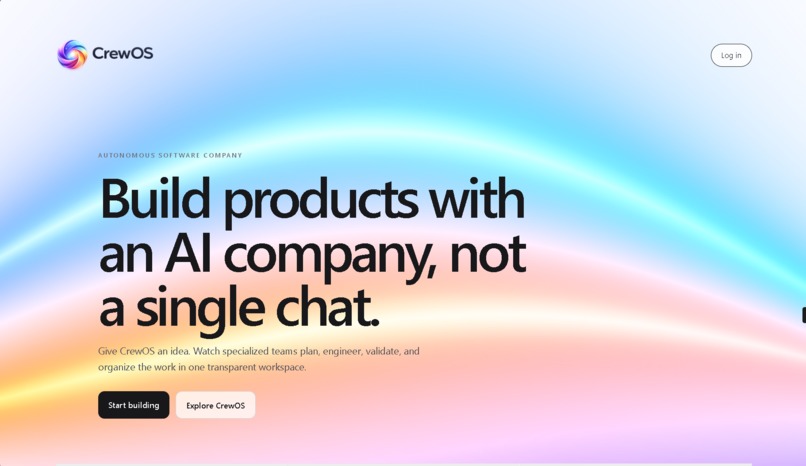
Landing
-
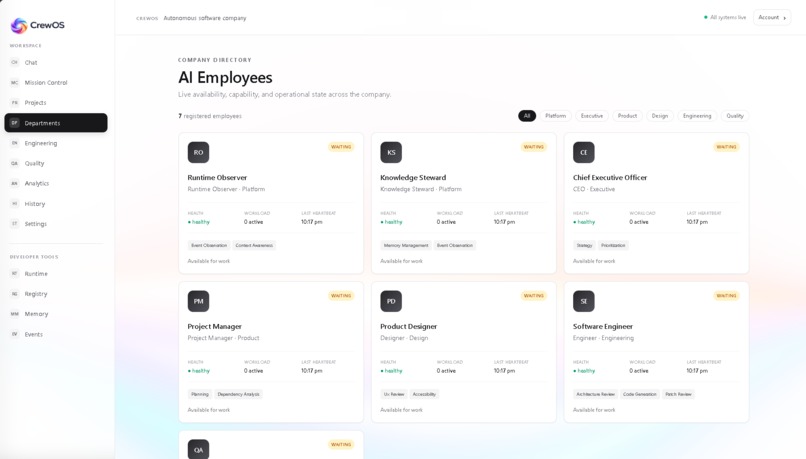
Agents Marketplace
-
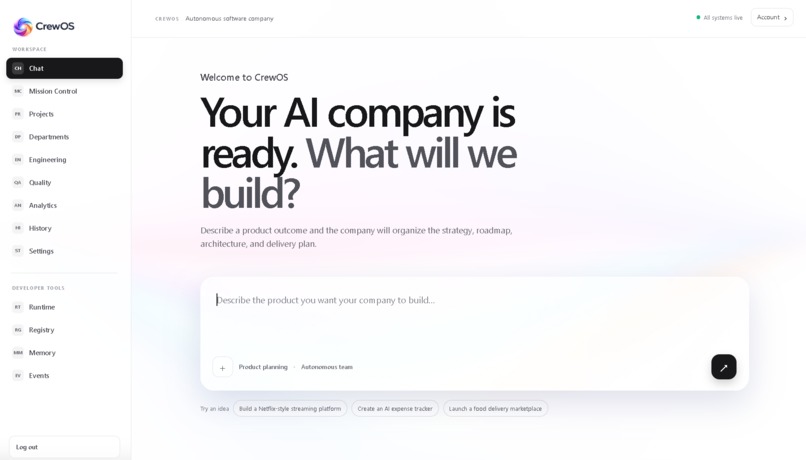
Chat
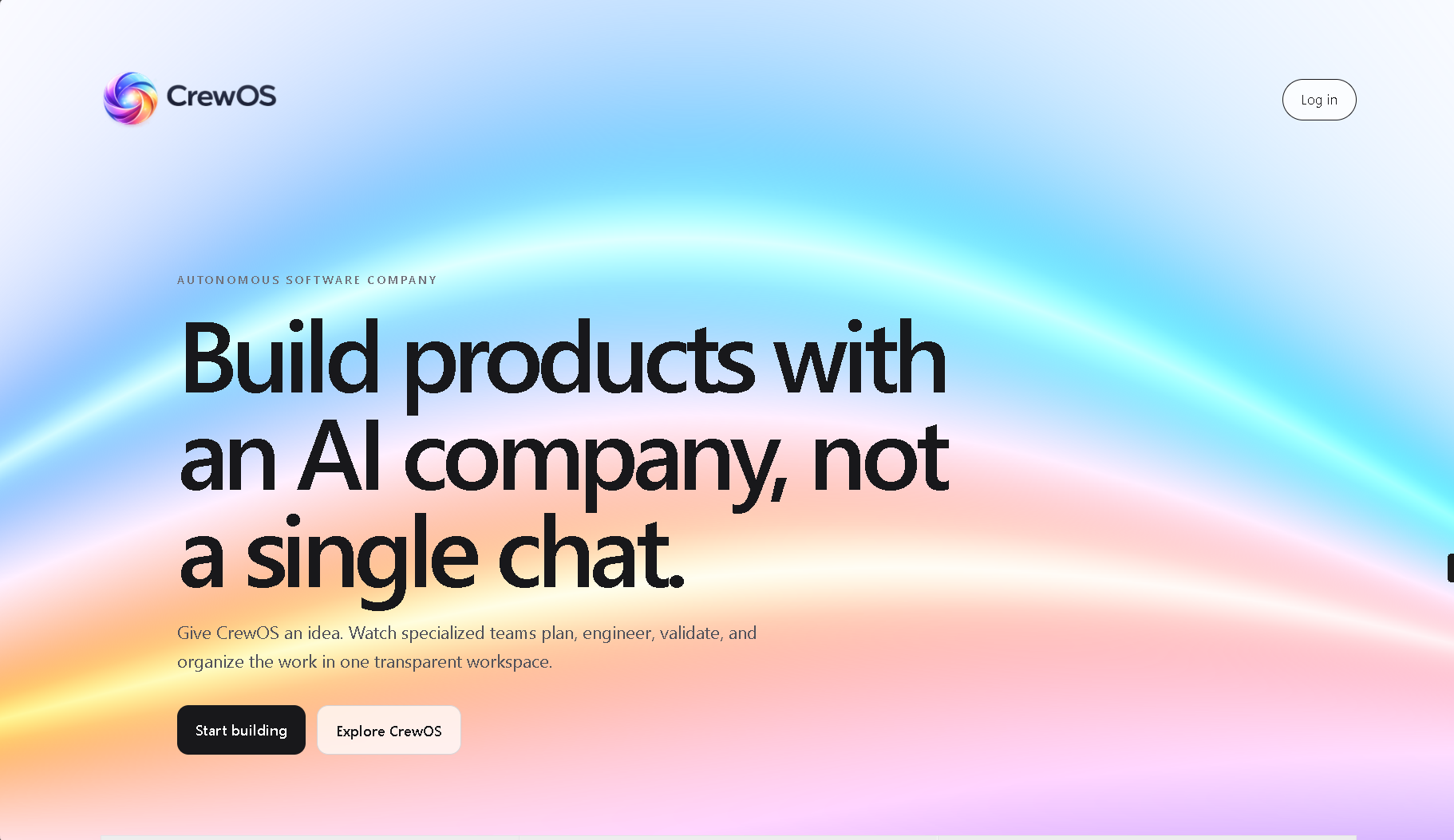
CrewOS — AI Company as a Service
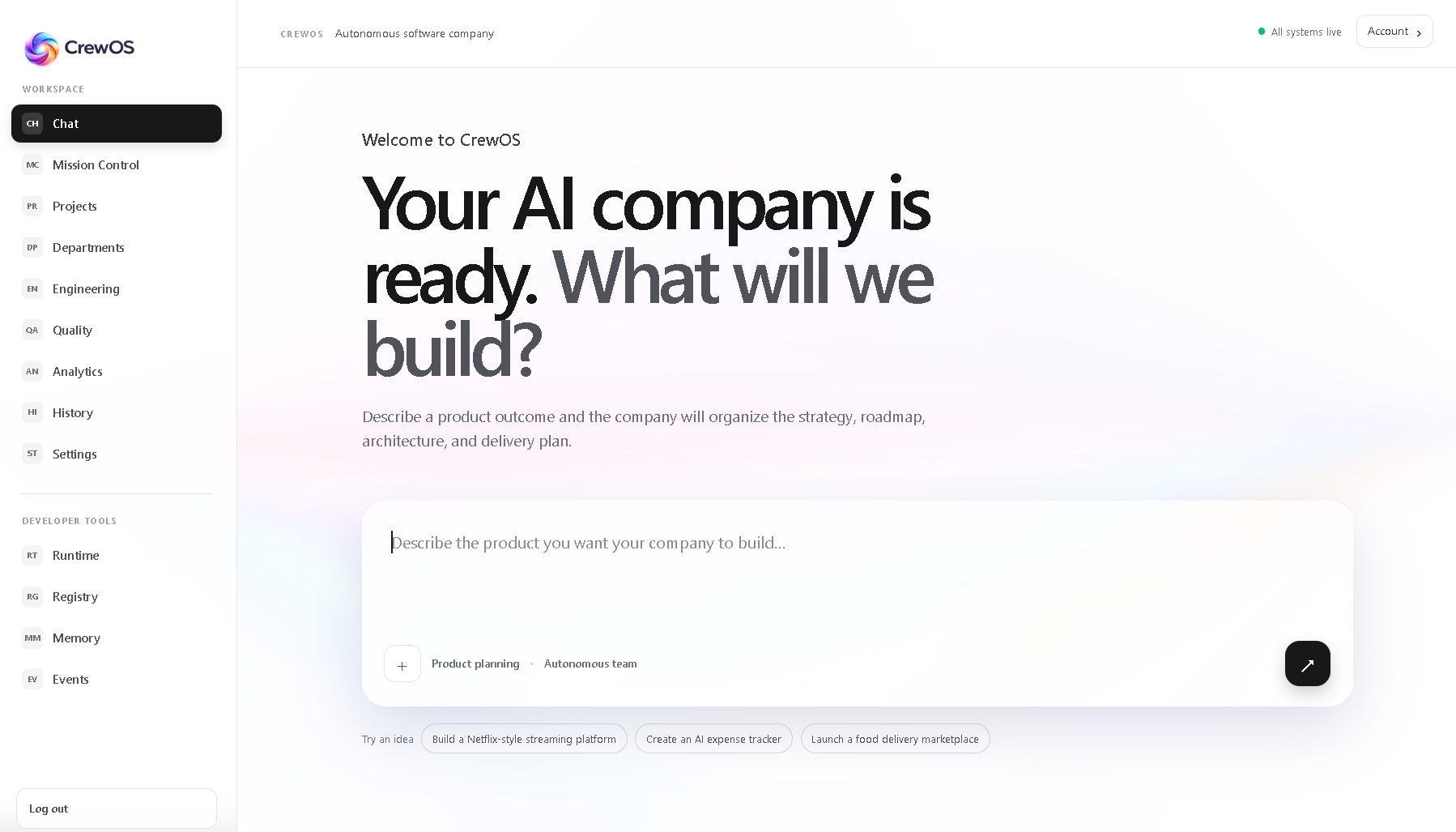
Turn one prompt into a complete software product through an autonomous AI company.
In one sentence
CrewOS is an AI Company as a Service platform where autonomous AI departments collaborate to transform a single product idea into a complete software project—from planning to engineering and quality assurance—in one transparent workspace.
Why now?
- Large language models have become increasingly capable at individual tasks, but building software remains a coordination problem.
- CrewOS demonstrates how specialized AI departments can collaborate through a shared runtime to automate the entire software development lifecycle—not just code generation.
- We believe the next generation of AI applications will be organizations rather than assistants.
Inspiration
Building software is no longer limited by writing code—it's limited by coordination.
A startup founder doesn't just need an AI that writes code. They need product strategy, planning, architecture, engineering, quality assurance, and collaboration across multiple disciplines.
Today's AI tools are incredibly capable, but they still behave like individual assistants. Users are responsible for orchestrating prompts, switching between tools, reviewing outputs, and coordinating the entire development process themselves.
We asked a simple question:
What if, instead of talking to one AI assistant, you hired an entire AI software company?
That became CrewOS.
What it does
CrewOS is an autonomous AI software company.
The user simply enters a single prompt, such as:
"Build me a Netflix-style streaming platform."
CrewOS automatically forms an AI organization where specialized departments collaborate to transform that idea into a production-ready software project.
Instead of generating a single response, AI employees work together exactly like a real software company.
The process includes:
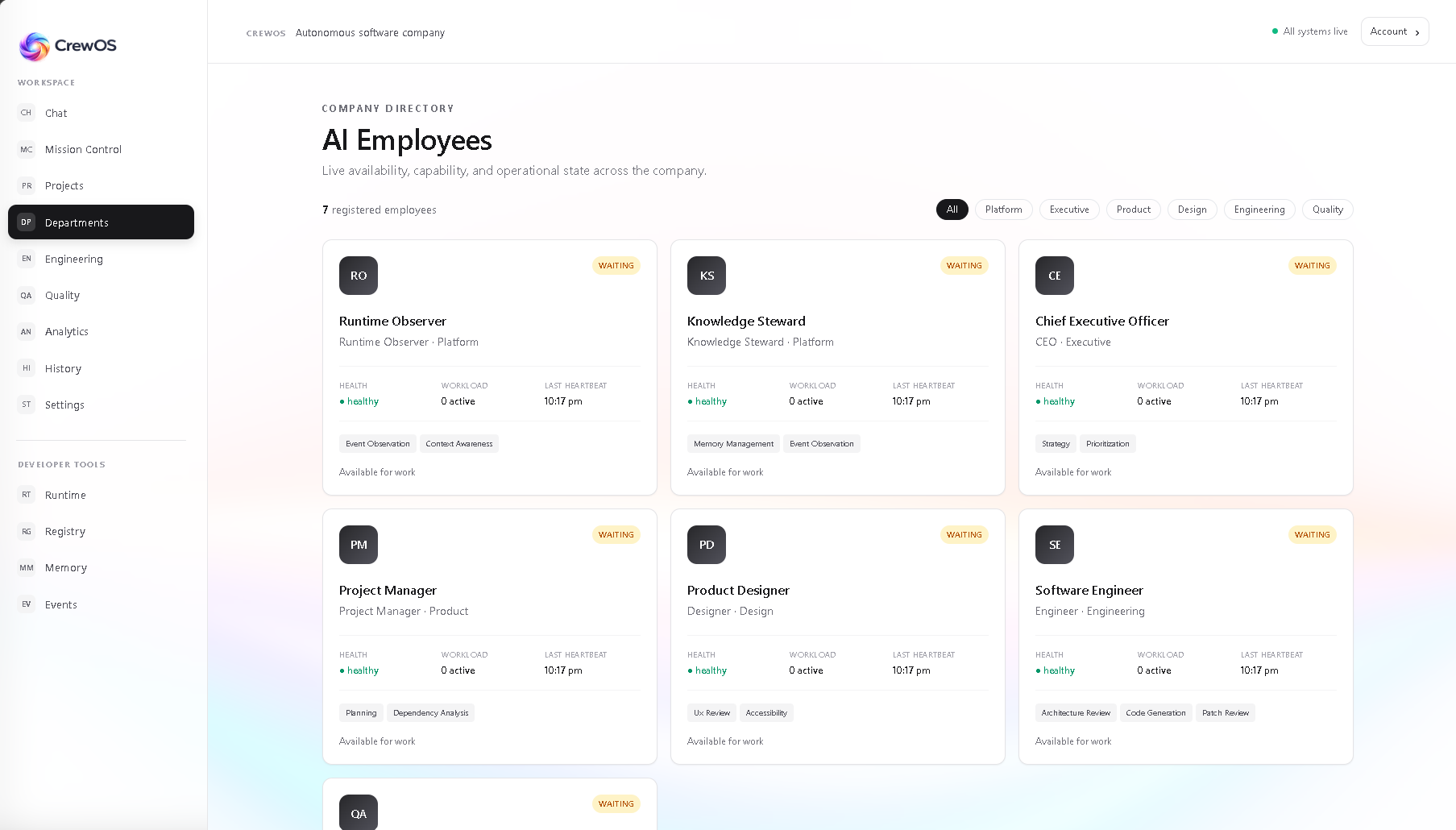
- CEO defining product vision and business strategy
- Project Manager creating roadmaps, milestones, Kanban boards, timelines, and dependencies
- Engineering department analyzing repositories, generating implementations, reviewing patches, and maintaining project history
- Quality Assurance validating work through testing, regression analysis, acceptance checks, and approval pipelines
- Organization-wide collaboration through messaging, decision logs, meetings, and live activity streams
Every department communicates through an event-driven runtime while sharing organizational memory, making the entire software development lifecycle transparent.
How we built it
CrewOS was built as a modular AI Operating System rather than a collection of prompts.
Our architecture includes:
- Event-driven multi-agent runtime
- Shared organizational memory
- Autonomous agent registry
- AI reasoning engine
- Live collaboration layer
- Project planning engine
- Engineering workflow
- Quality assurance pipeline
- Mission Control dashboard
- Real-time communication through WebSockets
Each AI department operates independently while collaborating through a shared event bus and organizational memory.
This architecture allows departments to reason, coordinate, and make decisions without tightly coupling their implementations.
Key Features
Autonomous AI Company
Multiple specialized AI departments working together instead of a single assistant.
AI Project Planning
Automatically transforms natural language ideas into:
- Product vision
- Roadmaps
- Epics
- Tasks
- Timelines
- Dependency graphs
- Kanban boards
Live Collaboration
Watch AI departments communicate, negotiate, and coordinate work in real time.
Engineering Department
Repository-aware implementation workflow featuring:
- Repository analysis
- Code generation
- Patch creation
- Automated code review
Quality Assurance
Every implementation passes through automated:
- Test planning
- Bug reporting
- Regression testing
- Acceptance validation
- Approval pipeline
Mission Control
A live operational dashboard providing complete visibility into planning, engineering, quality, decisions, and organizational activity.
Challenges we ran into
Designing CrewOS required thinking beyond traditional AI assistants.
Some of our biggest challenges included:
- Building an event-driven architecture that allows independent AI departments to collaborate
- Managing shared organizational memory while preserving context
- Designing reusable agent infrastructure rather than hardcoded workflows
- Coordinating planning, engineering, and quality pipelines through autonomous events
- Creating a transparent user experience where users can observe an AI company operating in real time
The goal was to make CrewOS behave like an organization rather than a sequence of prompts.
What we learned
Building CrewOS reinforced that the future of AI applications is not a single increasingly capable assistant—it is coordinated systems of specialized agents.
We also learned that successful autonomous systems require strong orchestration, structured memory, transparent decision making, and observable collaboration as much as powerful language models.
What's next
Our vision extends beyond software development.
The same organizational runtime can power autonomous AI companies for:
- Healthcare
- Education
- Finance
- Legal
- Marketing
- Customer Support
- Human Resources
- Operations
Today, CrewOS builds software.
Tomorrow, it becomes the operating system for AI-powered organizations.
Built With
- axios
- codex
- css
- docker
- fastapi
- git
- gpt-5.6
- jwt
- mongodb
- motor
- openai
- pydantic
- pytest
- python
- query
- react
- redis
- tailwind
- tanstack
- typescript
- vite
- vitest
- websockets
- zustand


Log in or sign up for Devpost to join the conversation.