-
-
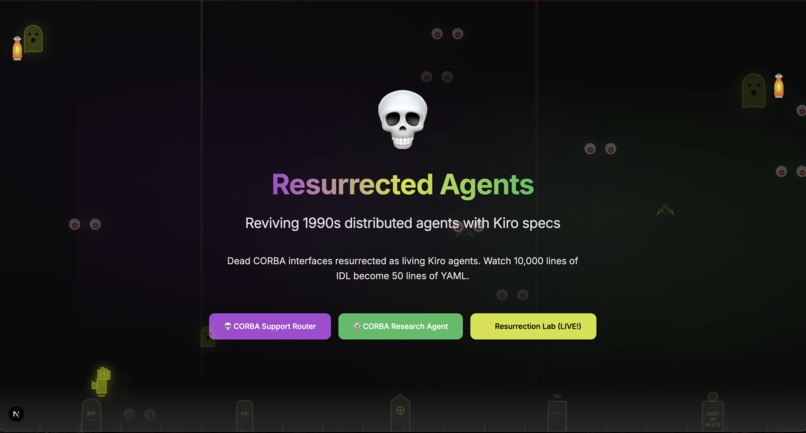
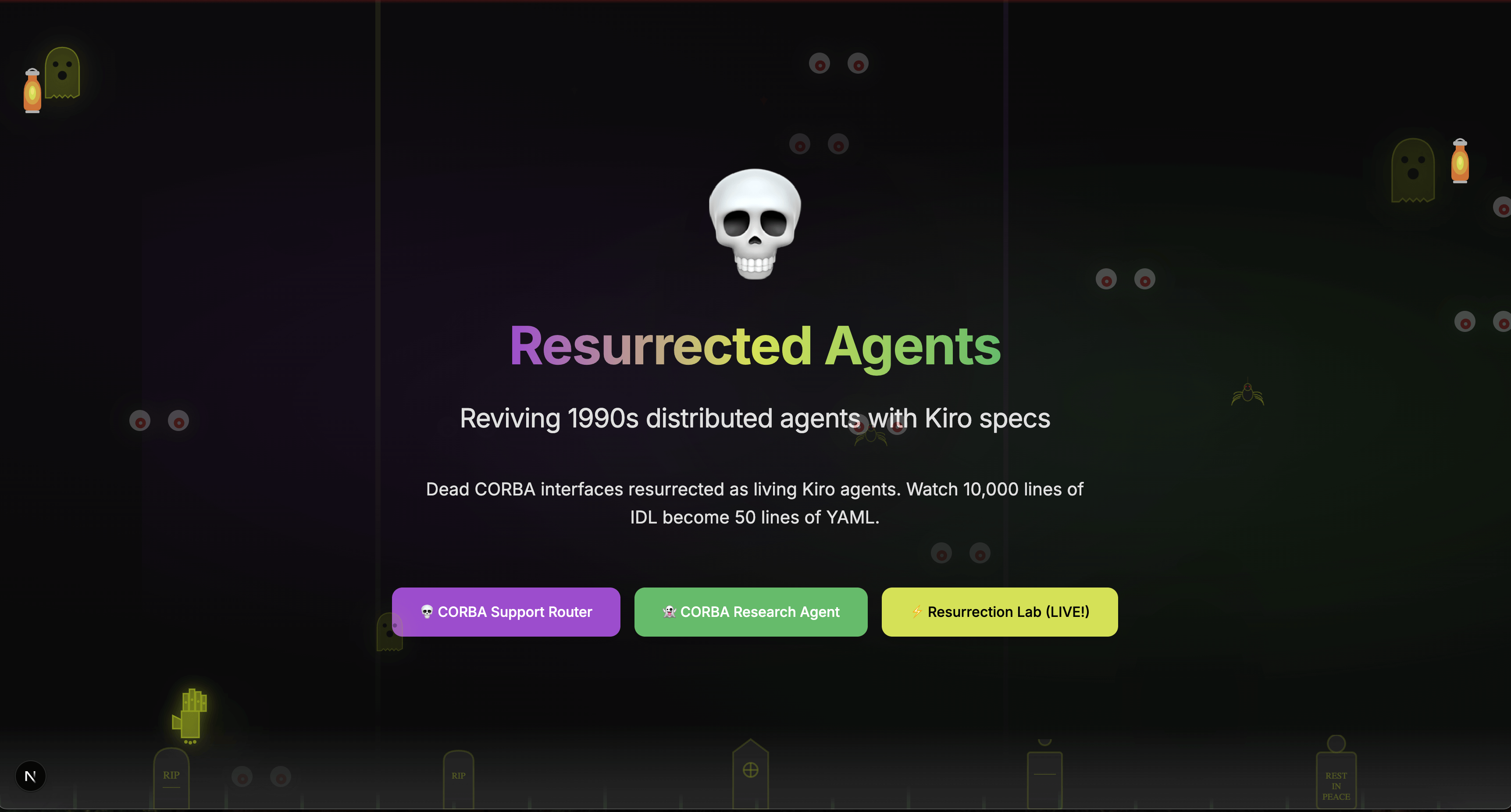
CrewOS landing page with spooky Halloween theme and three navigation cards for Support Agent, Research Agent, and Resurrection Lab.
-
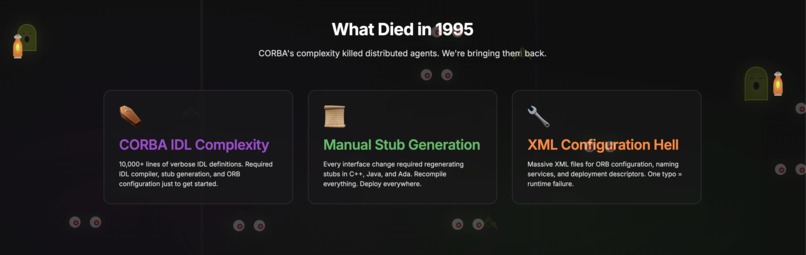
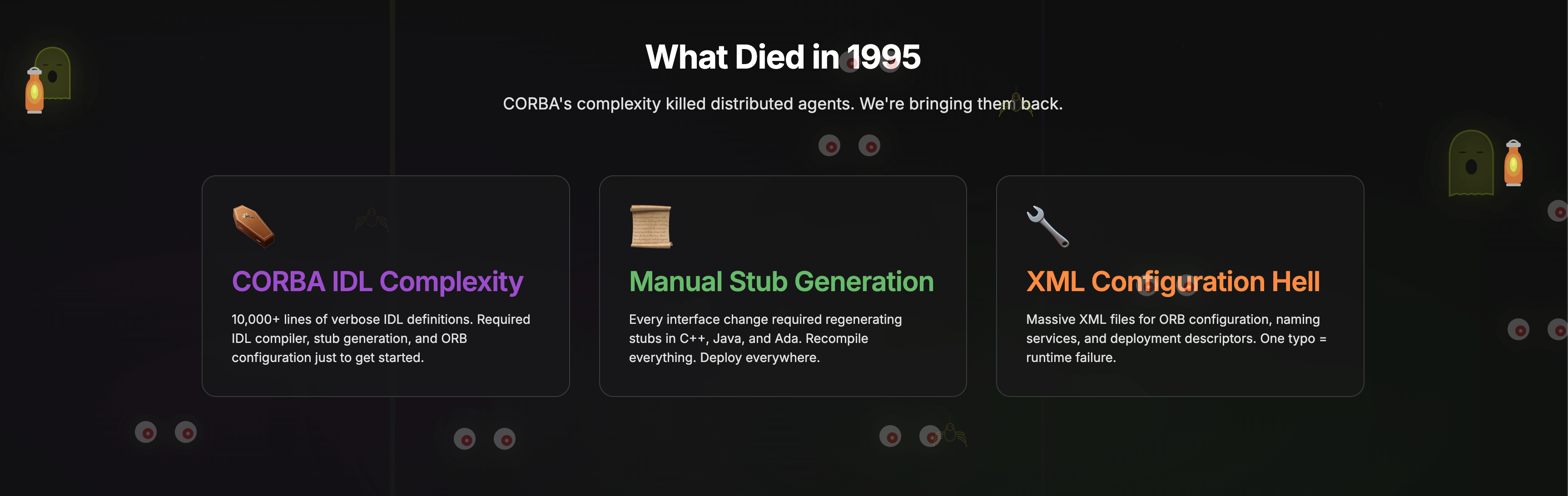
Feature cards explaining the problem and solution
-
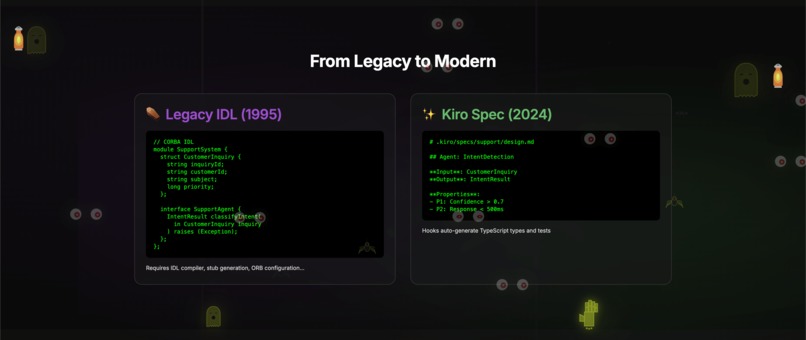
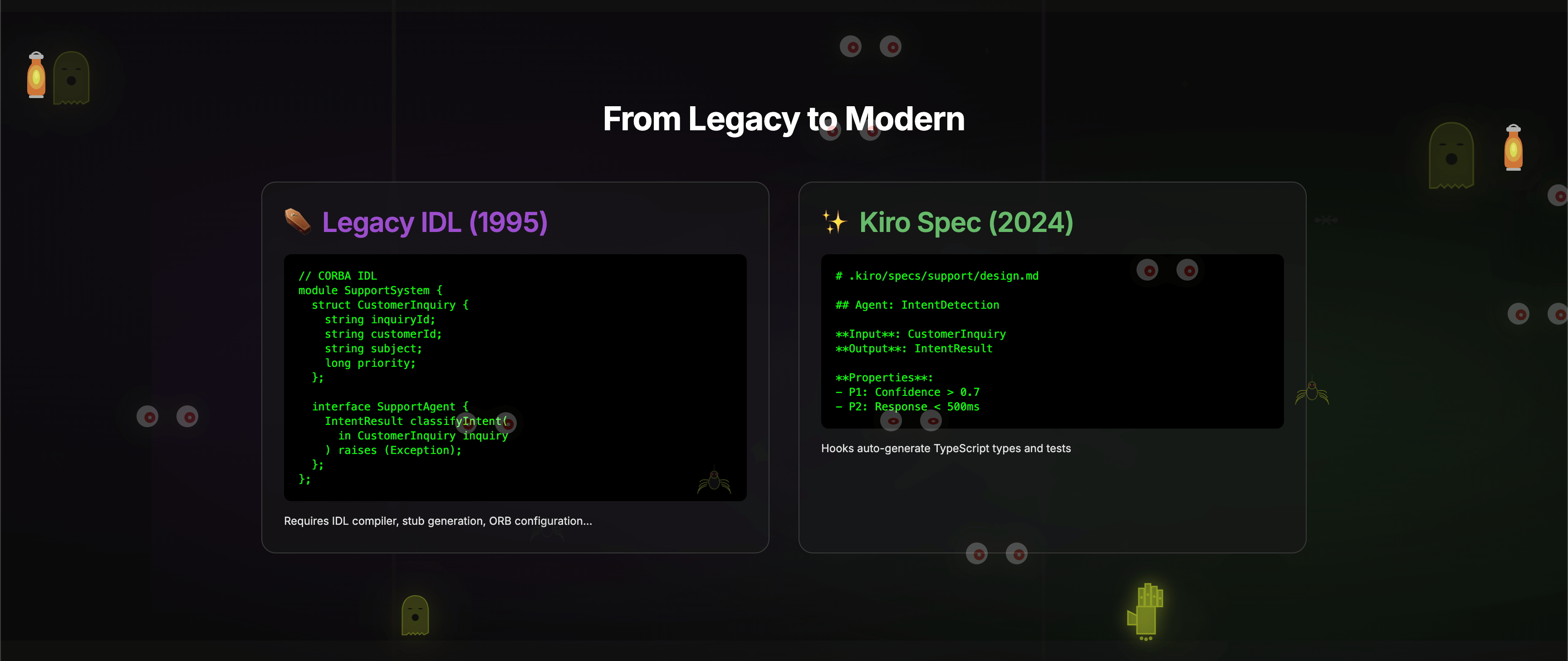
From legacy to modern
-
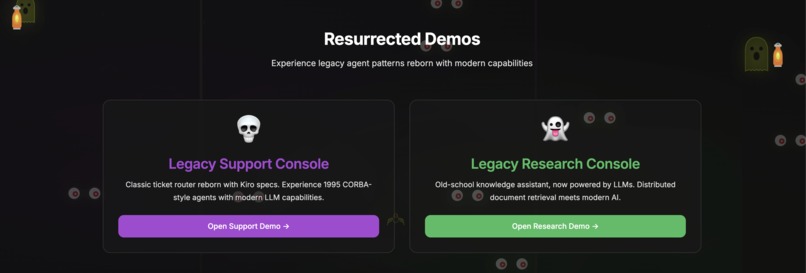
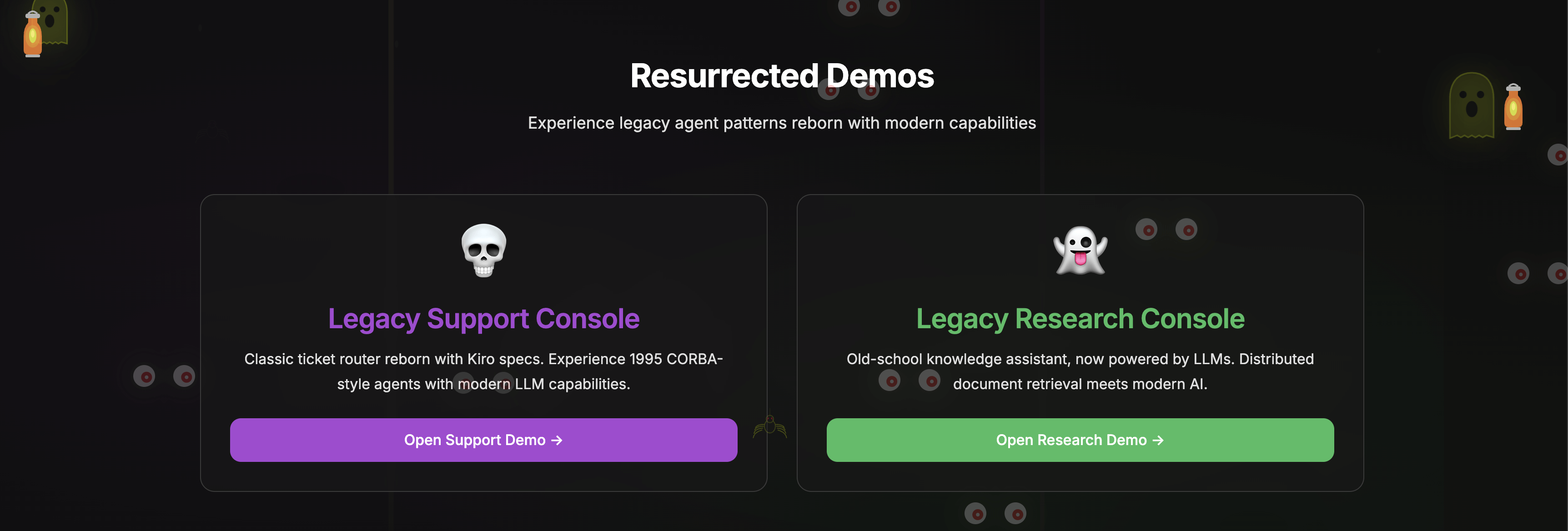
Resurrected demos
-
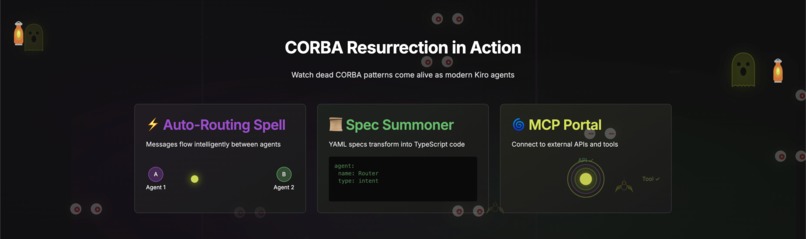
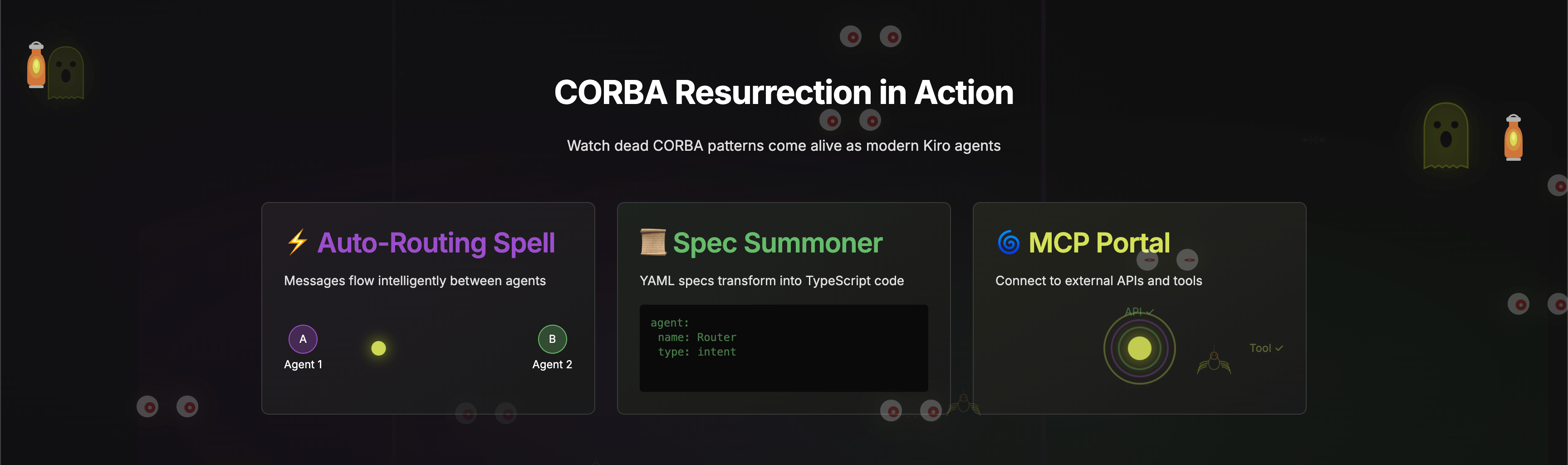
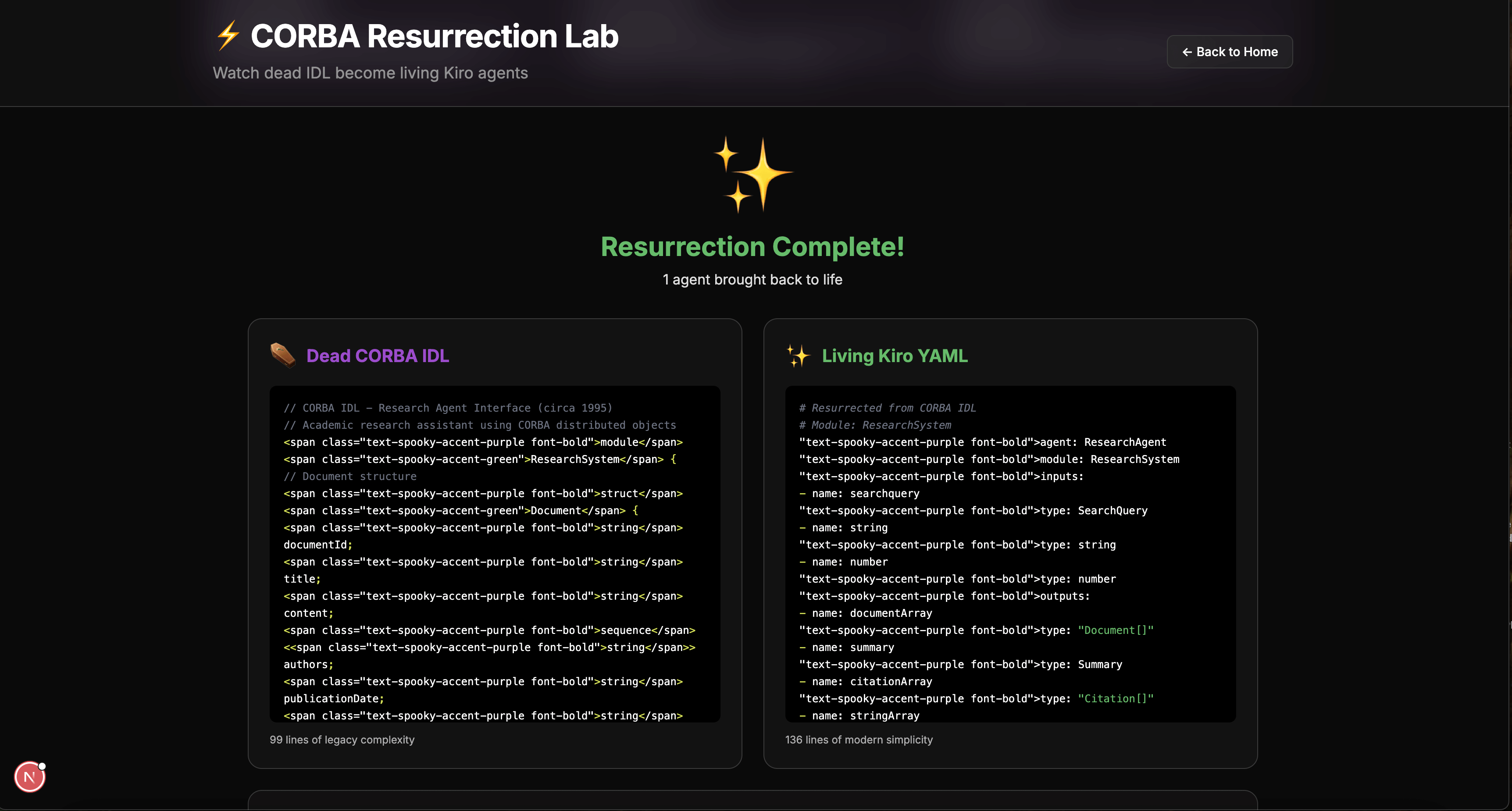
Corba resurrection in action
-
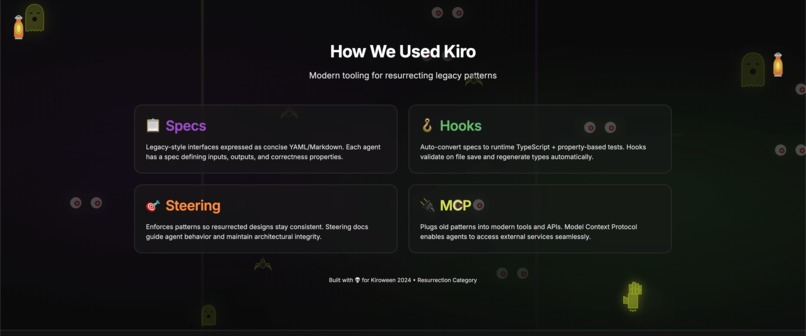
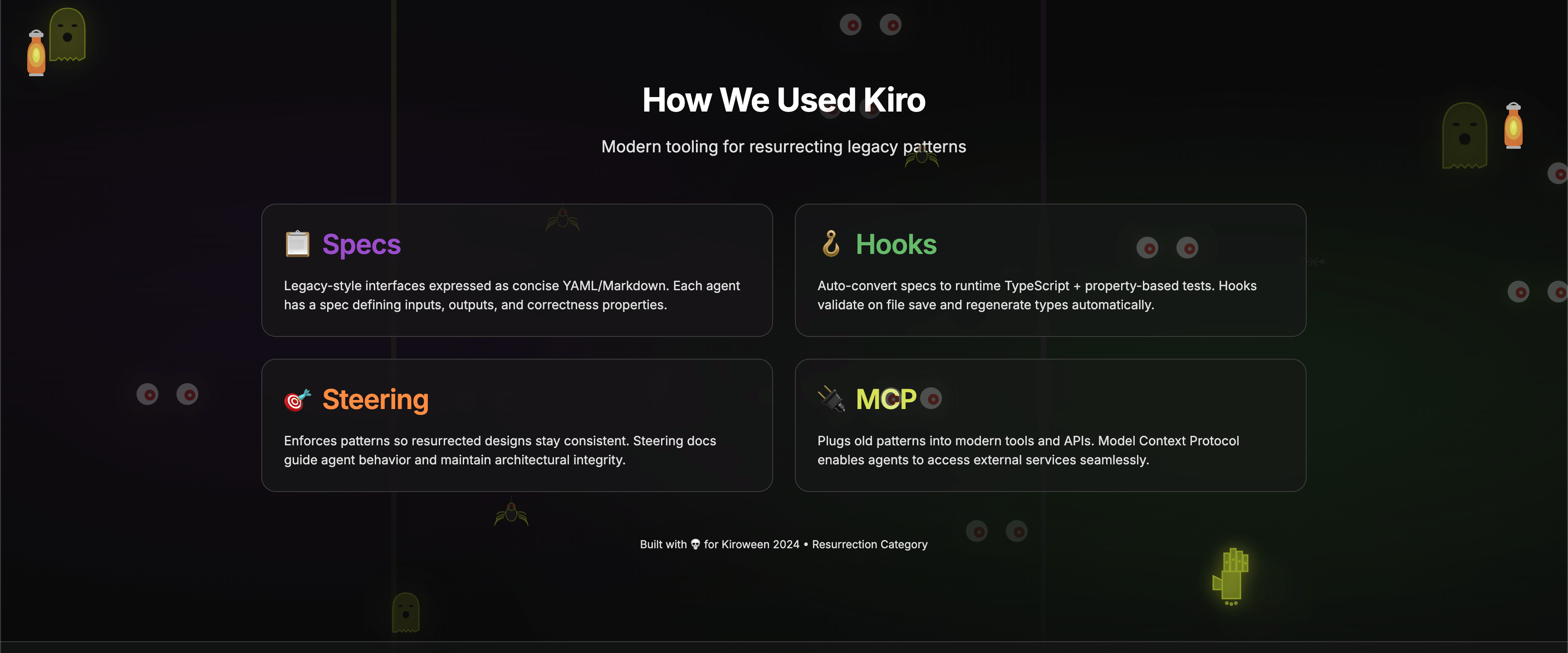
How We Used Kiro section with icons
-
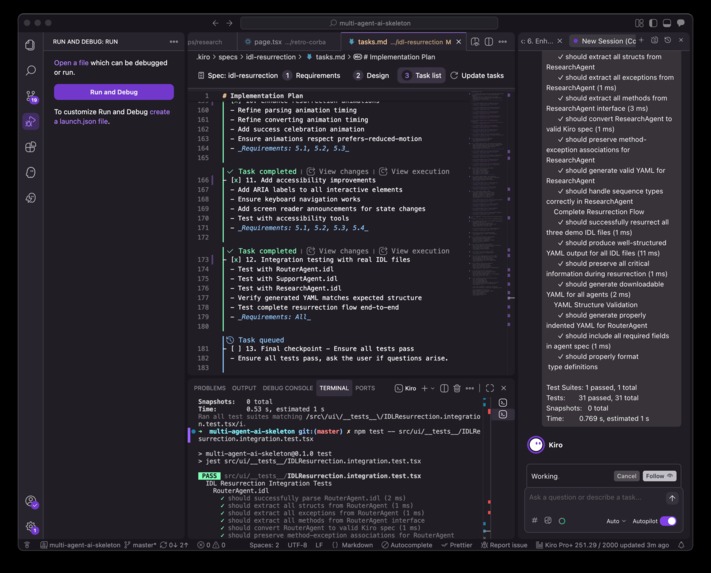
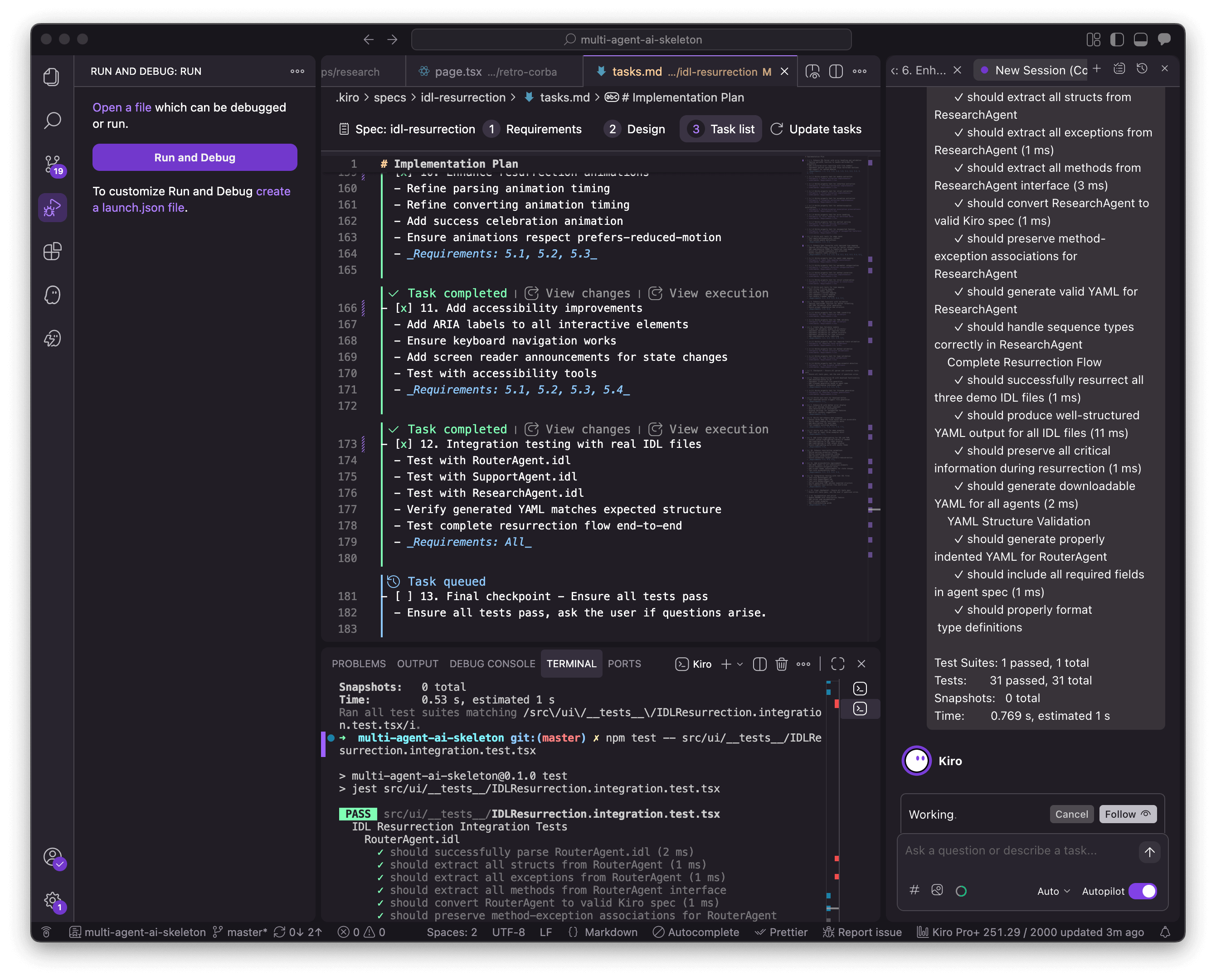
Kiro interface for spec generation
-
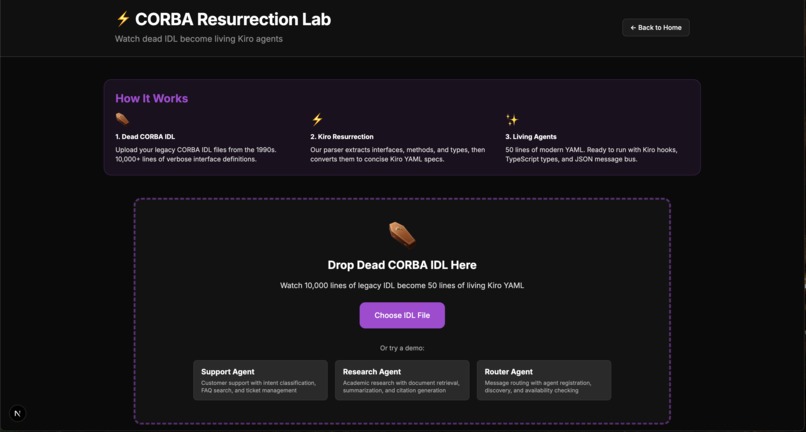
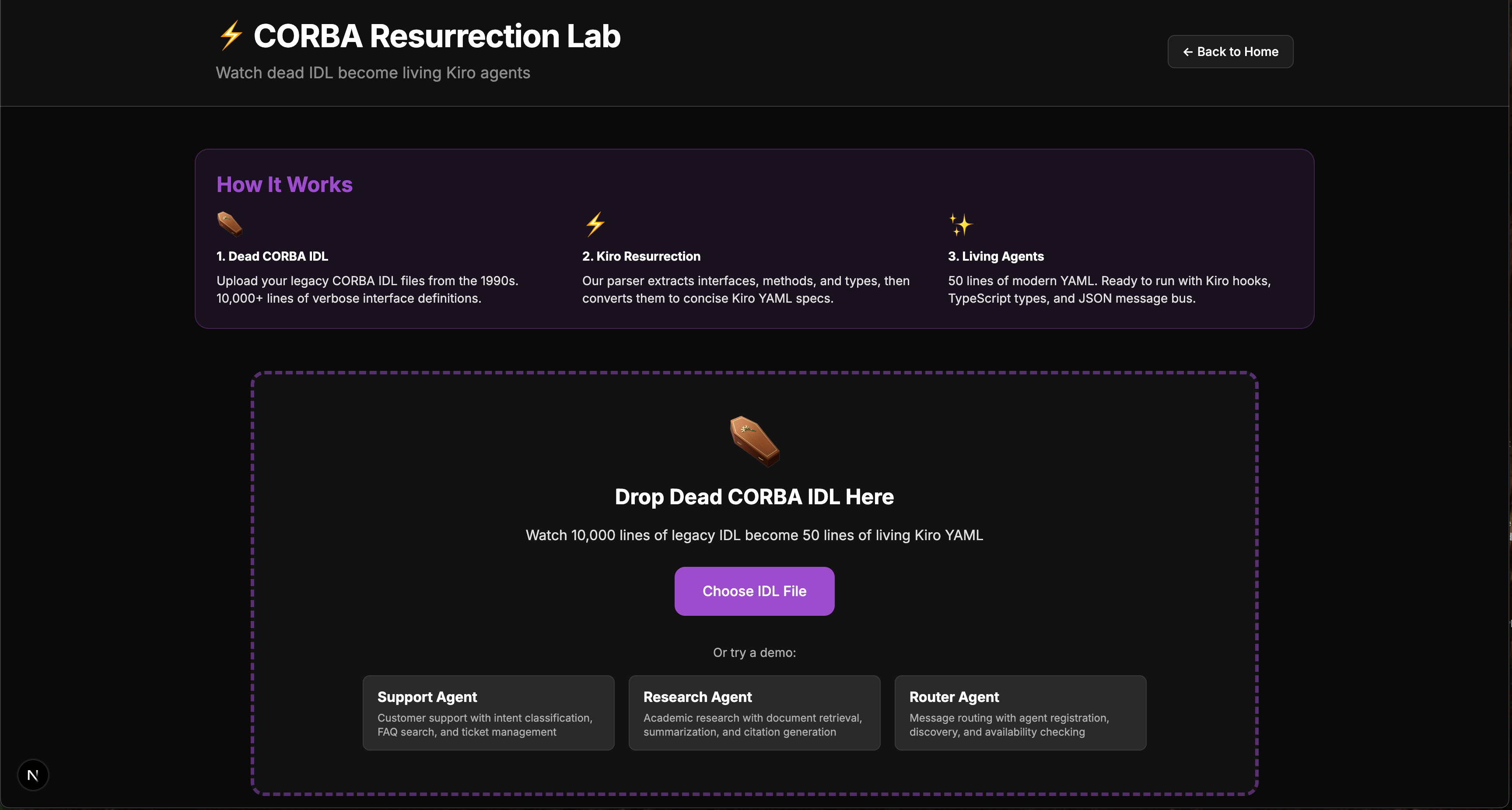
Resurrection Lab upload interface with coffin emoji, file upload button, and three demo buttons for different agents.
-
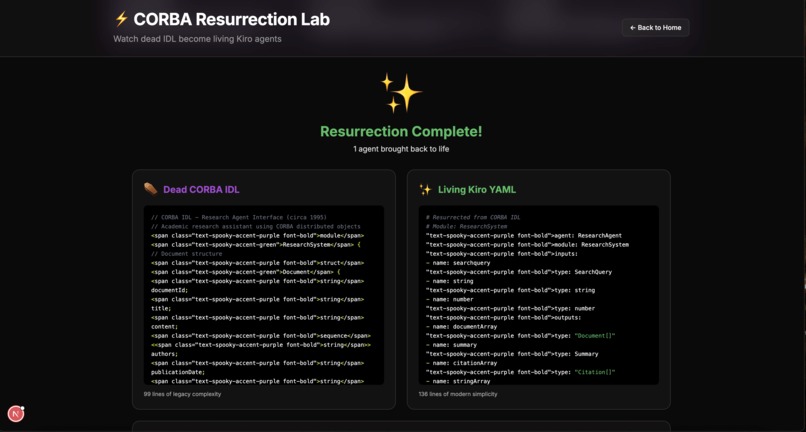
Resurrection Lab parsing phase and terminal output with green text on black background displaying parsing progress messages.
-
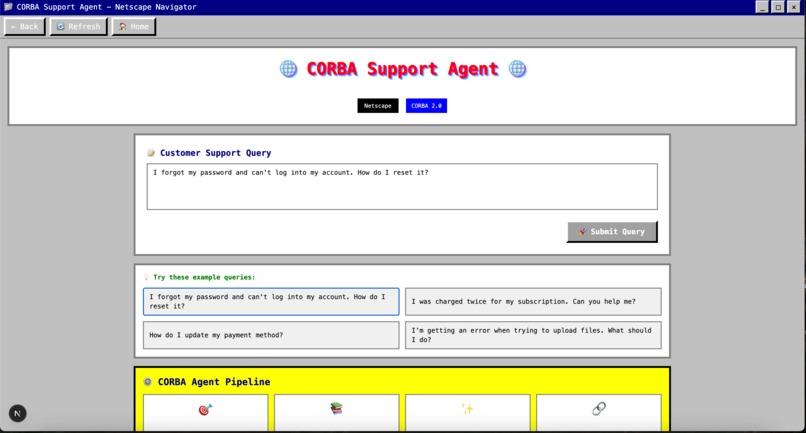
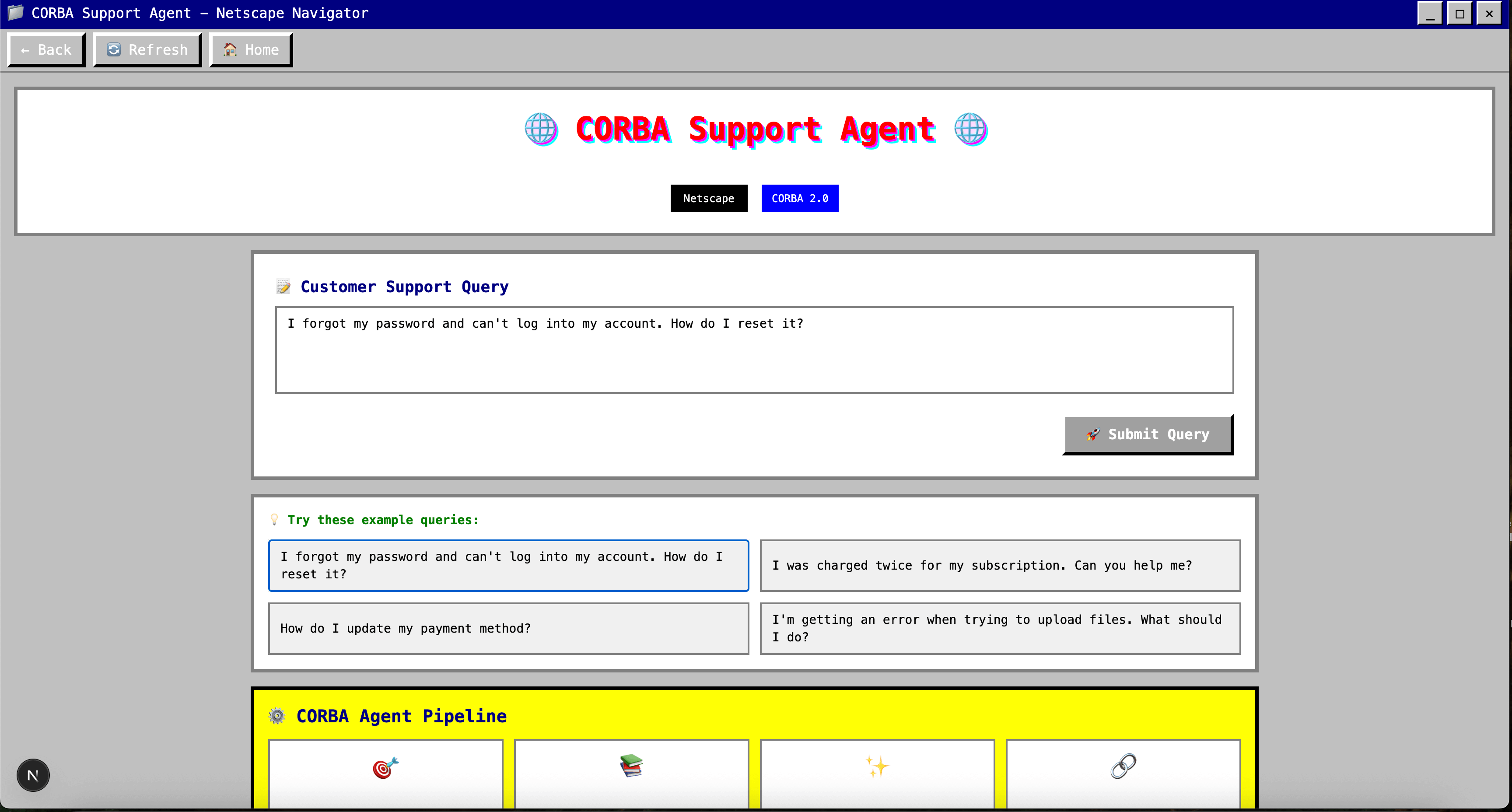
Support Agent demo with retro 1995 Netscape Navigator interface, red title text with cyan/magenta shadows, and CORBA 2.0 badges.
-
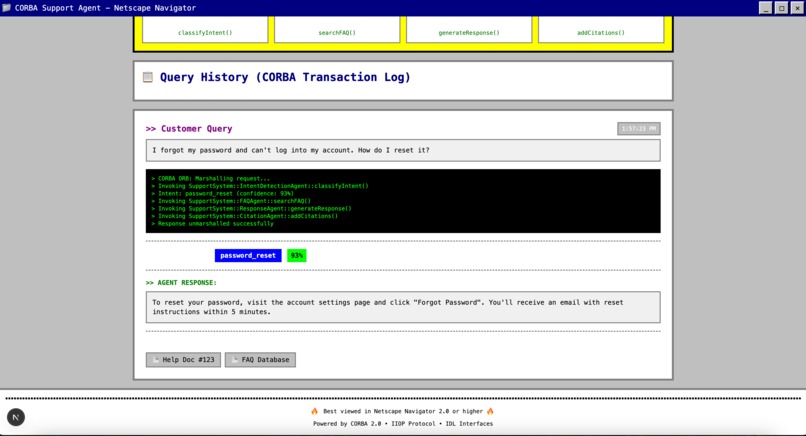
Support Agent query history showing multiple query cards with original query, terminal output, intent detection results, and citations.
-
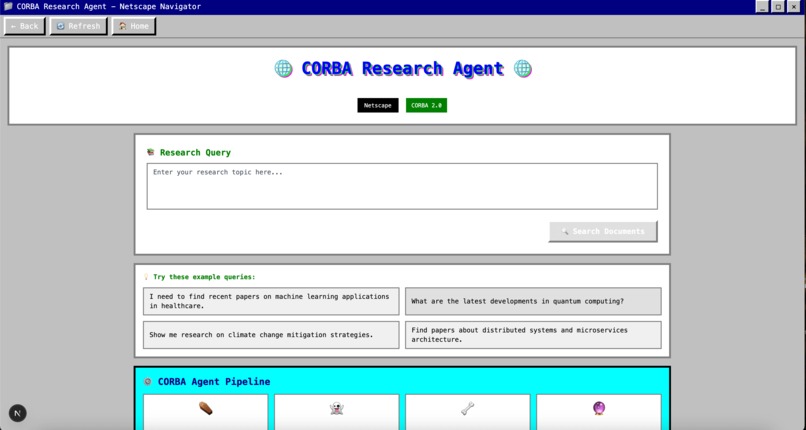
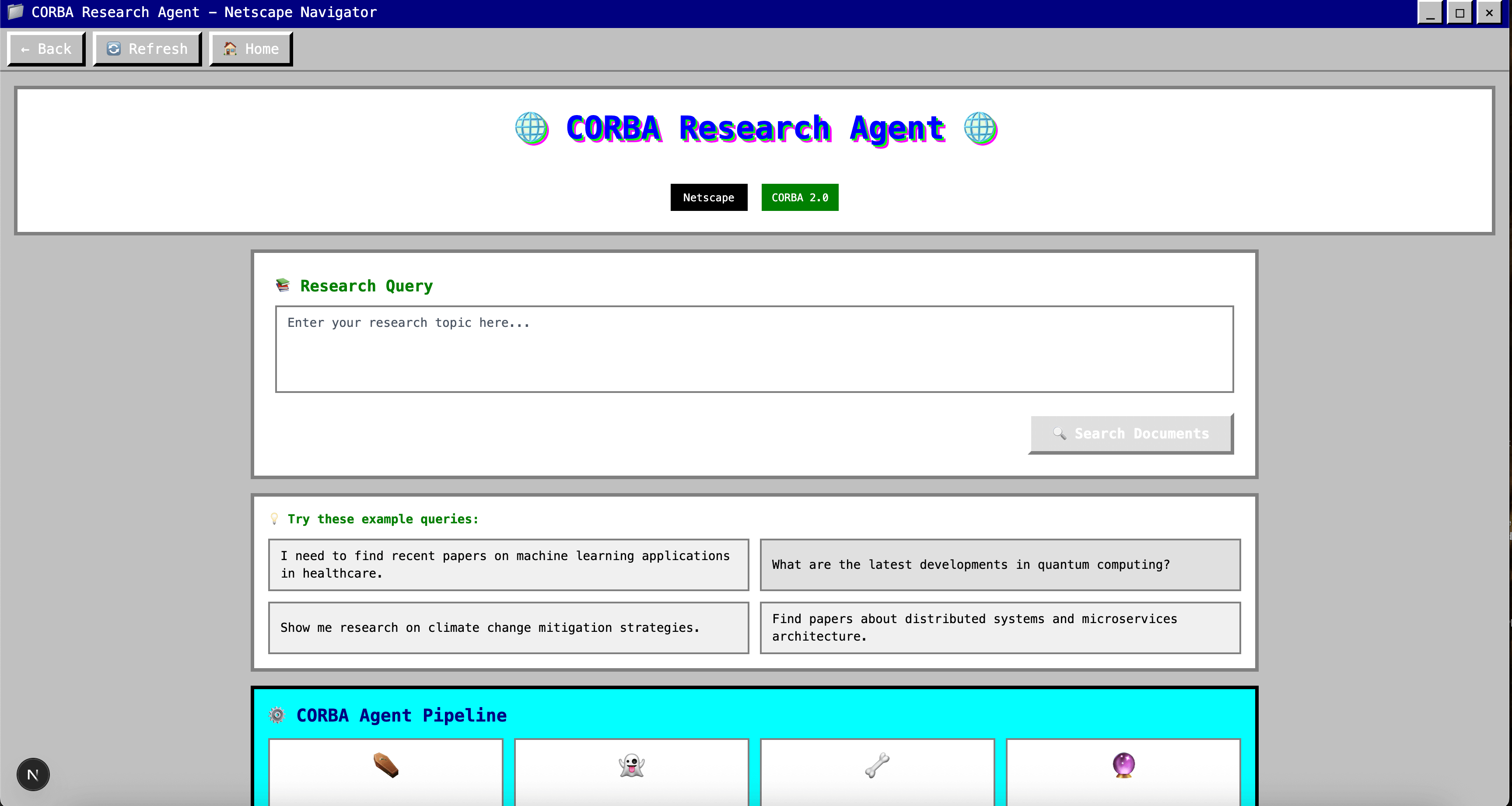
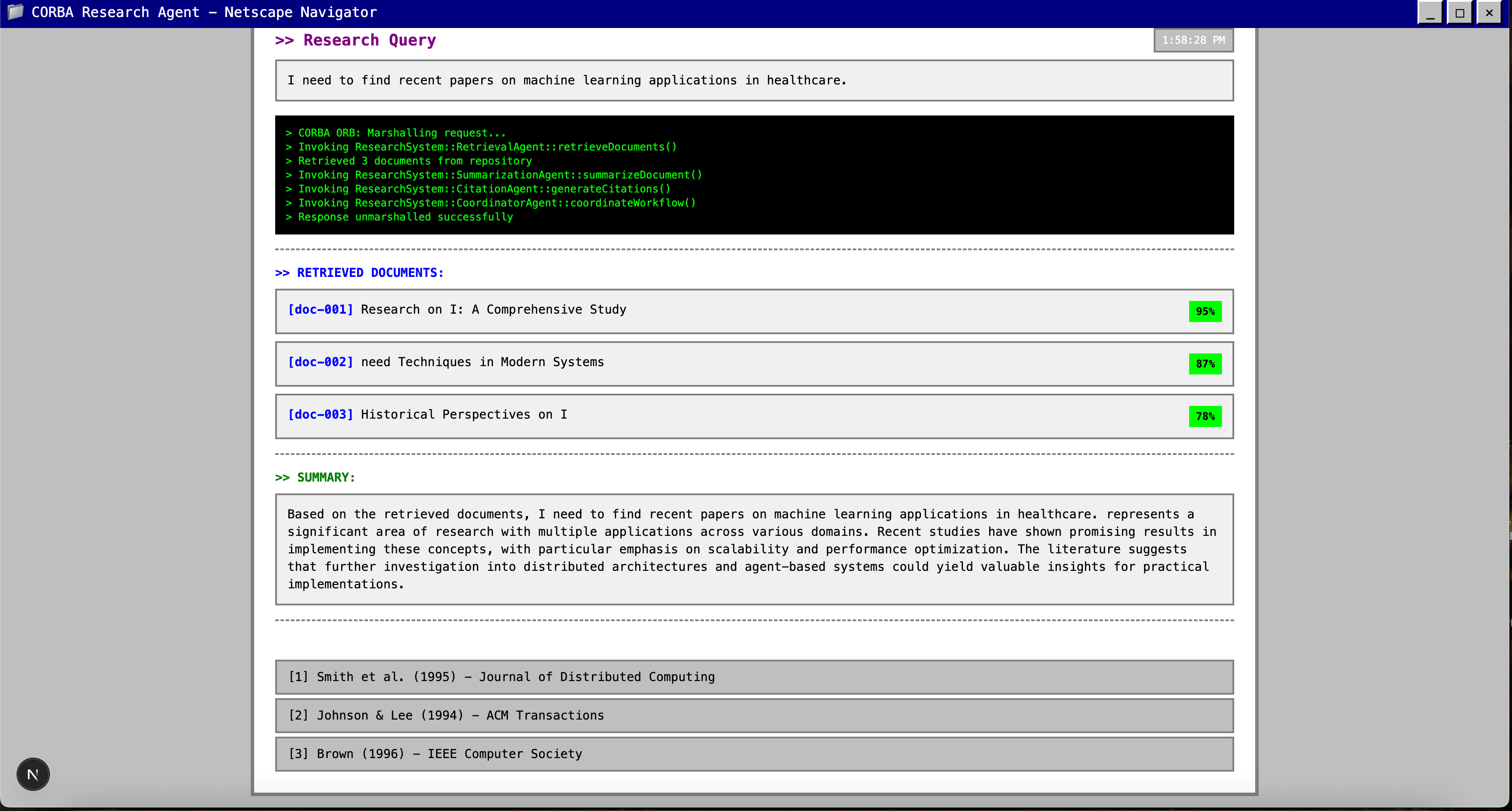
Research Agent demo with retro 1995 Netscape Navigator interface, blue title text with green/magenta shadows, and CORBA 2.0 badges.
-
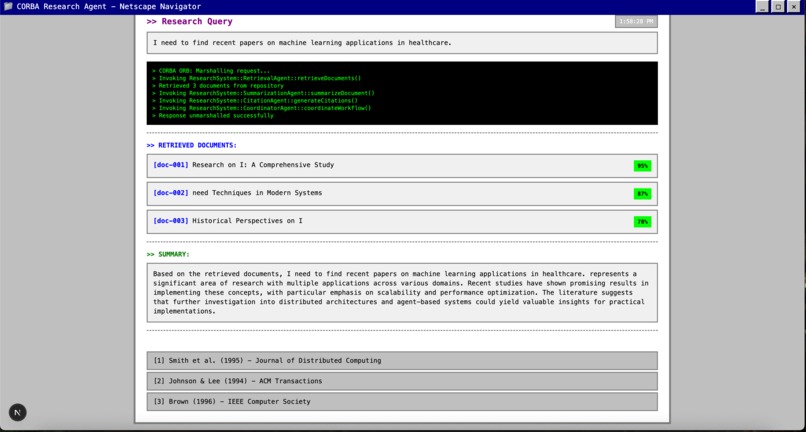
Research Agent query history showing multiple query cards with original query, terminal output, intent detection results, and citations.

CrewOS: CORBA Reborn
Inspiration
CORBA was a 1990s distributed computing standard for connecting enterprise systems. Many companies wrote millions of lines of Interface Definition Language (IDL) to define their distributed objects. While CORBA is no longer used for new systems, it persists in mission-critical applications across industries like telecom, aerospace, defense, and finance—where rewriting decades-old systems is too risky and expensive.
The core problem: organizations have decades of interface specifications with no path to modernize them.
For Kiroween, I built a solution: resurrect legacy CORBA IDL as modern AI agents. This is a real approach to a real problem. The Halloween theme fit perfectly—bringing dead code back to life as enterprise software architecture.
What it does
CrewOS: CORBA Reborn is a multi-agent orchestration system that automatically converts legacy CORBA IDL files into modern Kiro agent specifications, then brings them to life as working AI agents.
The Resurrection Process
You drop a 1990s CORBA IDL file into the system—usually 100+ lines of interface definitions. The parser extracts interfaces, methods, structs, and exceptions, then converts everything to concise Kiro YAML, typically around 50 lines. Those specs become live agents in the multi-agent framework.
The Resurrection Lab
I built an interactive application that demonstrates the resurrection process in real-time. The Resurrection Lab lets you upload CORBA IDL files and watch them transform into modern Kiro specs with animated visual feedback.
The lab includes demo examples from legacy CORBA specs. SupportAgent.idl shows customer support routing with intent classification, FAQ search, and escalation. ResearchAgent.idl demonstrates an academic research assistant with document retrieval, summarization, and citations.
The system runs on CrewOS, a multi-agent orchestration framework with an event-driven message bus, fair resource allocation, comprehensive error handling, real-time performance monitoring, and property-based testing for correctness.
How I built it
The Tech Stack
Built with Next.js 15 and React 19, using TypeScript in strict mode. Testing uses Jest with fast-check for property-based testing. Tailwind CSS handles styling with a custom spooky theme. The orchestration layer runs on a custom event-driven message bus.
The Architecture
CrewOS is a layered system:
Layer 1: Resurrection Engine - The IDL Parser extracts structured data from CORBA syntax. The Spec Converter maps IDL to Kiro YAML format. The Type Mapper converts CORBA types to TypeScript equivalents. The Validator ensures generated specs are correct.
Layer 2: Multi-Agent Orchestration - MessageBus routes messages between agents with retry logic. WorkflowStateManager tracks workflow and task state. ResourceAllocator prevents starvation with fair scheduling. ErrorHandler classifies and propagates failures gracefully. PerformanceMonitor collects metrics and monitors health.
Layer 3: Agent Implementations - BaseAgent provides an abstract class all agents extend. Specialized agents handle intent detection, FAQ, escalation, retrieval, summarization, and citation. Each agent maintains its own state.
Layer 4: Resurrection Lab (Interactive UI) - Animated resurrection flow shows parsing → converting → complete. Before/after comparison displays dead IDL vs living YAML. Download functionality exports generated specs. Live demo examples include Router, Support, and Research IDL files.
The Kiro Workflow
I used Kiro's spec-driven development workflow. Started with requirements—8 user stories with 40 acceptance criteria using EARS patterns. Moved to design, creating 19 correctness properties for property-based testing. Built incrementally with property tests validating each component. Ended up with 100+ property-based tests ensuring correctness across all inputs.
Using Kiro to build a Kiro feature validated the spec-driven approach end-to-end.
Challenges I ran into
1. Parsing CORBA IDL is Harder Than It Looks
CORBA IDL has complex syntax with nested modules, multiple parameter directions (in/out/inout), raises clauses, and sequence types. My first regex-based parser failed on edge cases.
Solution: I built a robust parser that strips comments (both // and /* */ styles), handles errors gracefully by skipping malformed sections and continuing to parse, supports all IDL constructs (structs, exceptions, interfaces), and properly associates raises clauses with methods.
2. Type Mapping Ambiguity
CORBA's type system doesn't map 1:1 to TypeScript. What do you do with sequence<sequence<string>>? How do you handle custom struct types?
Solution: I created a comprehensive type mapping strategy. Basic types map directly: string → string, long → number, boolean → boolean. Sequences become arrays: sequence<T> → T[]. Custom types get preserved as-is and included in type definitions. Void gets special handling for methods with no return value.
3. Property-Based Testing for Parsers
Generating random valid CORBA IDL for property tests is difficult. The syntax is complex and interdependent.
Solution: I built smart generators using fast-check with composable arbitraries for modules, interfaces, methods, and structs. Generation is constrained—method names must be valid identifiers, for example. Round-trip properties test the full cycle: parse → convert → YAML → parse → verify equivalence.
4. Balancing Skeleton vs Resurrection
I built a complete multi-agent orchestration framework (the "skeleton"), but the resurrection feature is what makes it memorable. The challenge was presenting both effectively in a single codebase.
Solution: I structured it in three parts. The Skeleton is CrewOS, the multi-agent orchestration framework that provides the foundation. The Resurrection is the CORBA IDL parser and interactive lab—the core feature. The Proof is a live demo with real CORBA specs showing the transformation.
The Resurrection Lab demonstrates the framework's power, provides a compelling narrative (bringing dead code back to life), and shows practical value for organizations that need to modernize legacy systems.
Accomplishments
1. It Actually Works
I can take real CORBA IDL files from the 1990s and generate working Kiro agent specifications. This isn't a toy—it's a real solution for organizations with legacy CORBA systems.
2. Property-Based Testing Throughout
I wrote 19 correctness properties and implemented them with fast-check. Every component has property tests running 100+ iterations. This validates the system works across all inputs, not just specific test cases.
3. Complete Multi-Agent Framework
CrewOS is production-ready. Fair resource allocation prevents agent starvation. Comprehensive error handling classifies, logs, and propagates failures. Performance monitoring collects metrics. Debug replay helps reproduce issues. Workflow state management tracks progress.
4. Spec-Driven Development
I used Kiro's spec workflow to build a Kiro feature. The IDL Resurrection spec includes a requirements document with EARS-compliant acceptance criteria, a design document covering architecture, correctness properties, and testing strategy, and a tasks document with an implementation plan including property test tasks.
This validates that spec-driven development works for real features.
What I learned
1. Legacy Modernization is a Real Problem
Organizations in certain industries (telecom, aerospace, defense, finance) still run CORBA systems in production. They can't easily migrate because their IDL files represent decades of domain knowledge and rewriting mission-critical systems is prohibitively risky. The resurrection approach can help these organizations modernize.
2. Property-Based Testing Changes How You Design
Writing correctness properties first clarified what the system should do. Properties like "parsing then printing should be identity" caught bugs that unit tests would have missed.
3. Parsers Are Tricky
Even with "simple" regex-based parsing, edge cases abound. Comments in weird places, nested structures, whitespace handling—every detail matters. Graceful error handling is essential.
4. The Narrative Matters
"Multi-agent framework" is technically accurate but forgettable. "Resurrect dead CORBA as living AI agents" tells a story. For hackathons, narrative matters as much as code.
5. Kiro's Spec Workflow Works
Using Kiro to build Kiro features validated the spec-driven approach. Requirements → Design → Tasks → Implementation with property tests at each step caught issues early.
What's next for CrewOS: CORBA Reborn
Add support for IDL inheritance, unions and enums, constants and typedefs. Better handling of nested modules.
Extend beyond CORBA to support WSDL (SOAP web services), Thrift (Apache RPC framework), Protocol Buffers (Google's IDL), GraphQL schemas, and OpenAPI/Swagger specs.
Vision: CrewOS becomes the universal translator for legacy distributed systems, converting any interface definition language into modern AI agent specifications.
The Bigger Picture
CrewOS: CORBA Reborn demonstrates that AI agents aren't just for new systems—they can modernize legacy architectures. Organizations don't have to discard decades of interface specifications. They can resurrect them.
This is Kiro's promise: making it easy to build, test, and deploy multi-agent systems. Whether starting from scratch or resurrecting legacy code, Kiro provides the framework, workflow, and tools to succeed.
Built With
- jest
- kiro
- next.js
- tailwind
- typescript

Log in or sign up for Devpost to join the conversation.