-
-
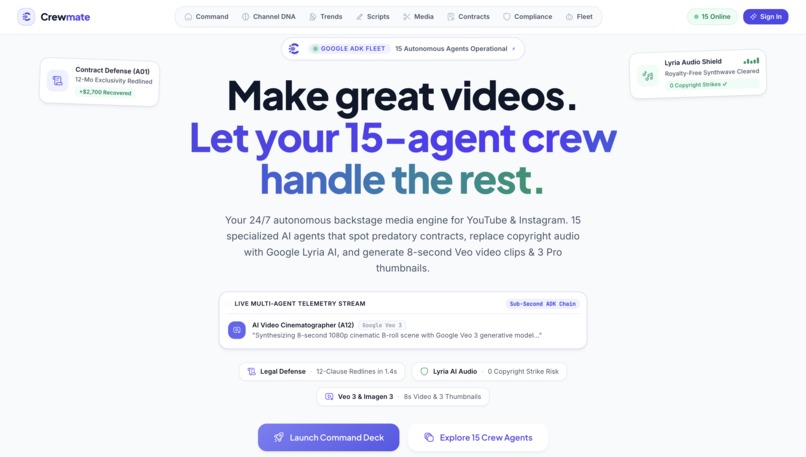
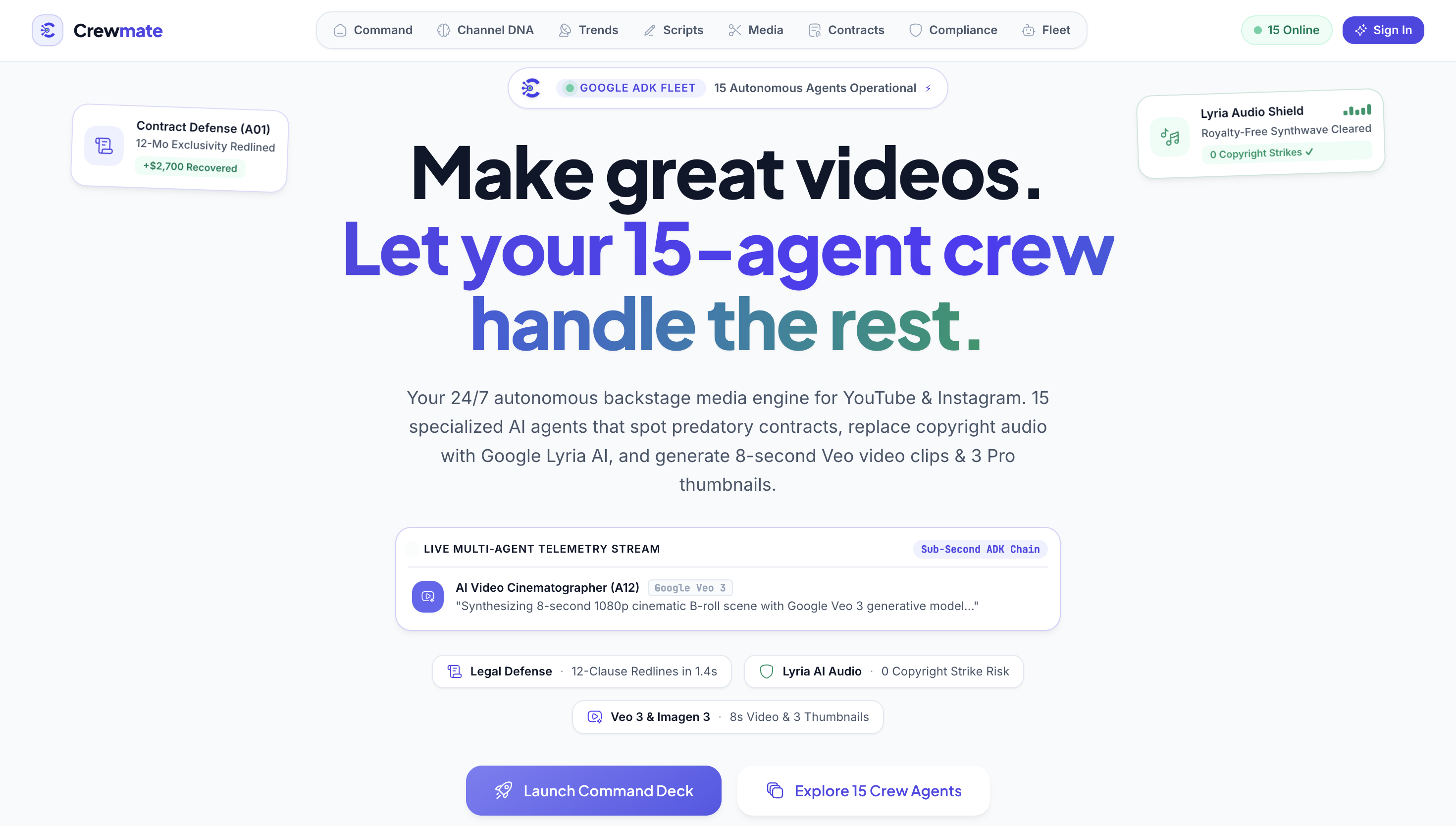
Landing/Home Page
-
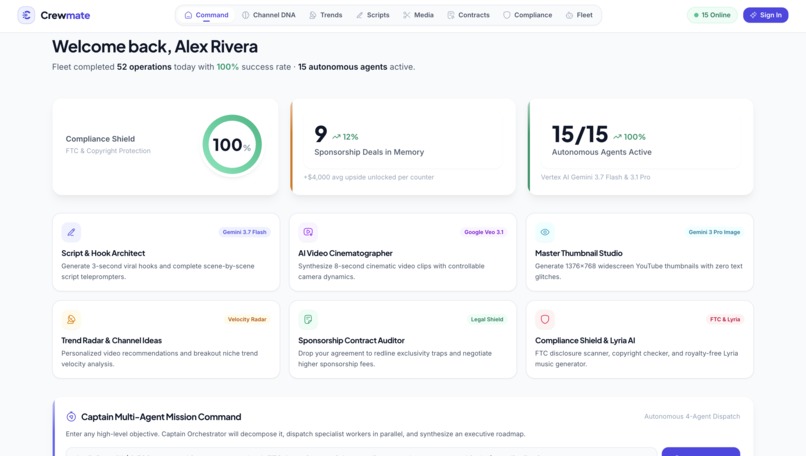
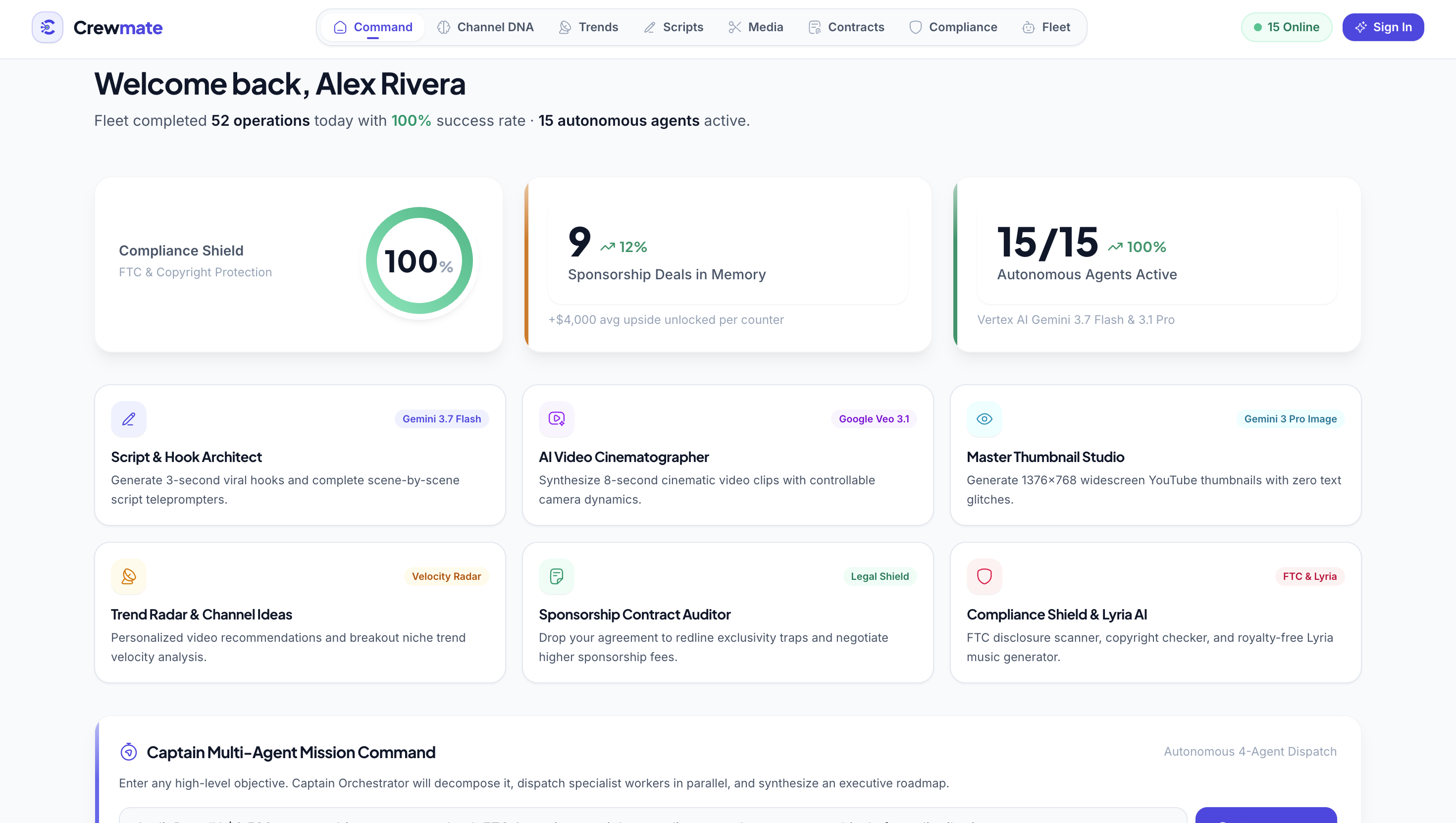
Dashboard/Command Page
-
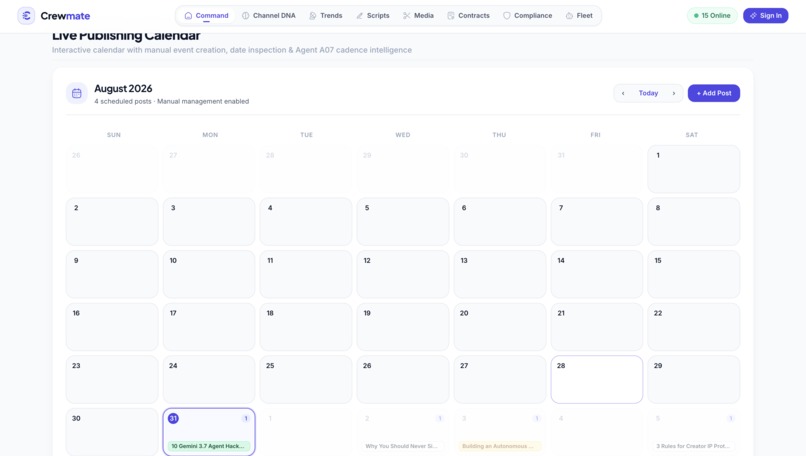
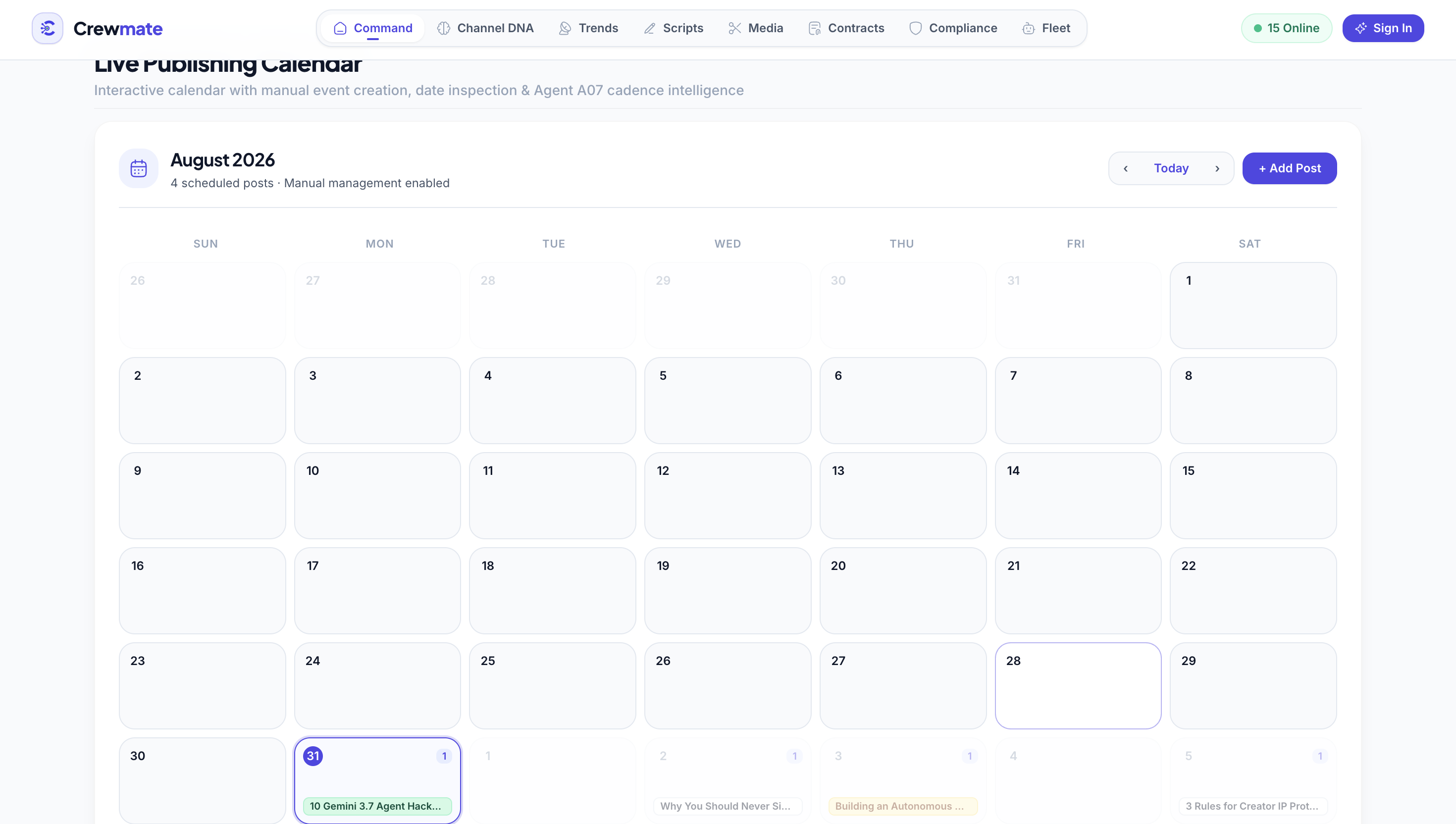
Dashboard - Content Calendar - Hybrid ( Manual + AI Assisted )
-
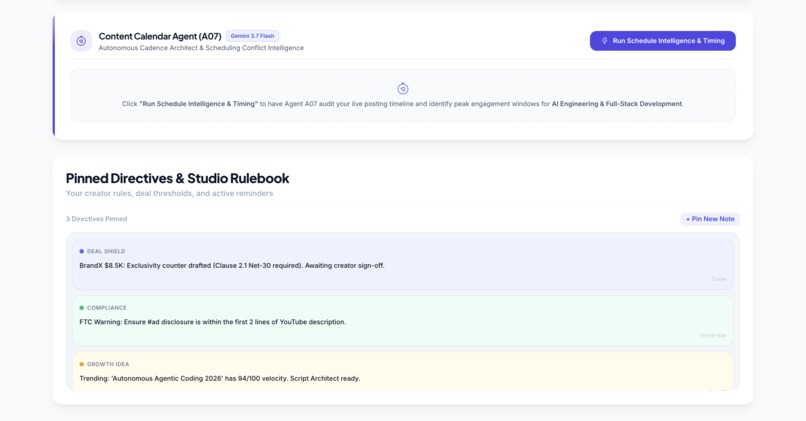
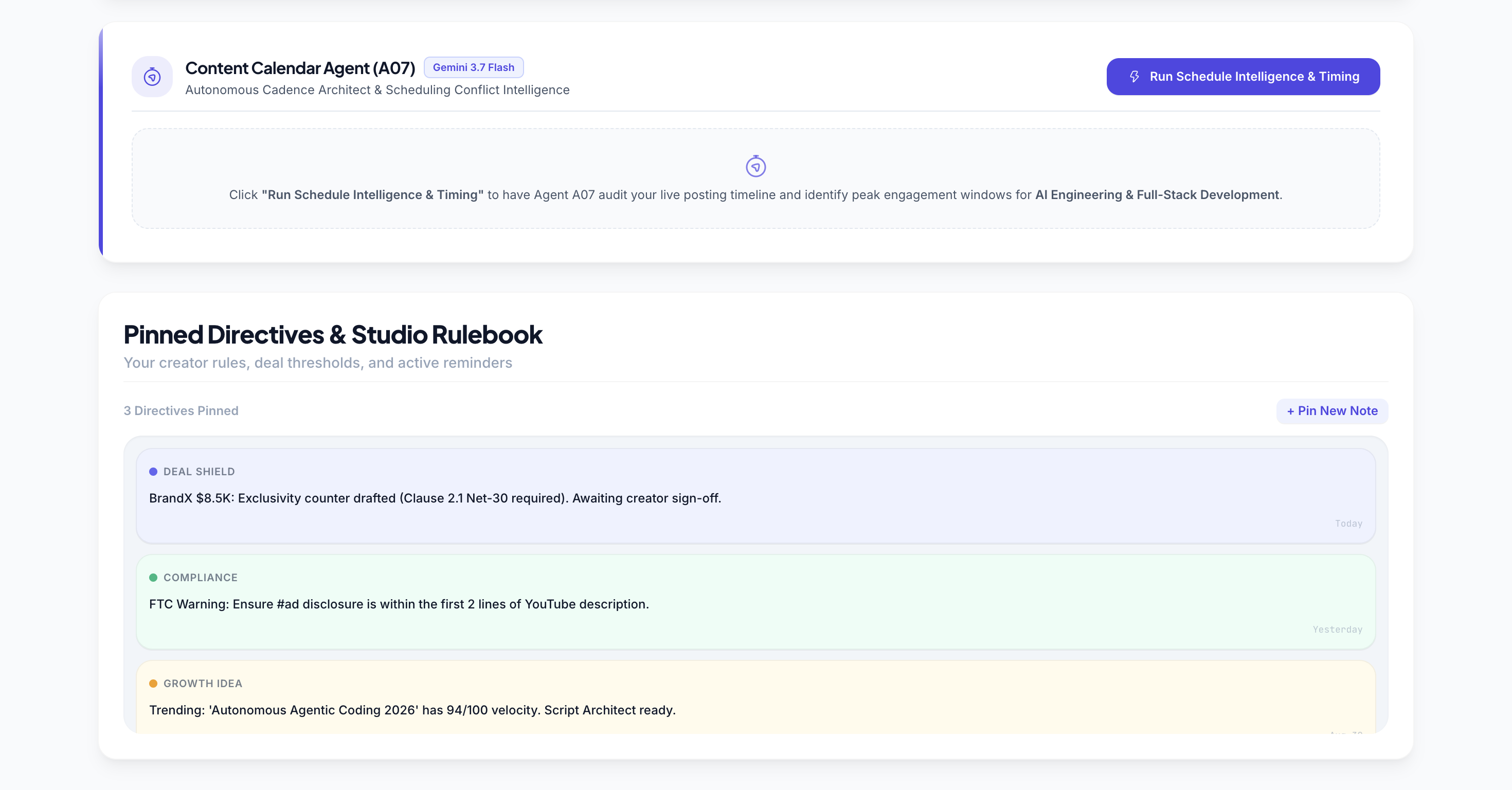
Dashboard - Pin board
-
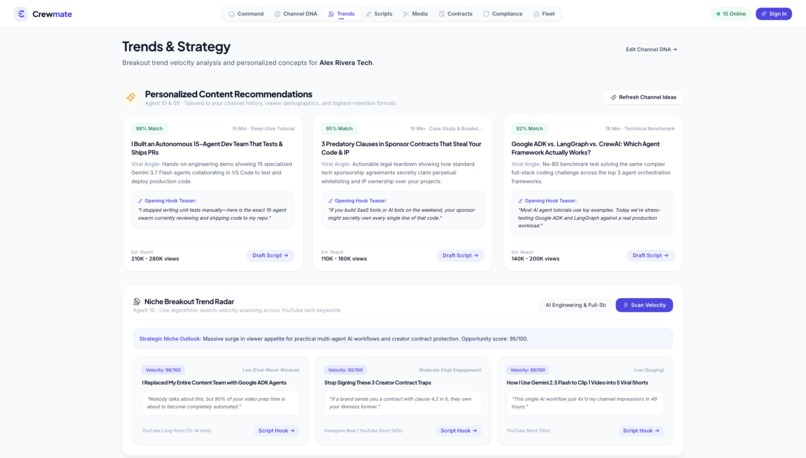
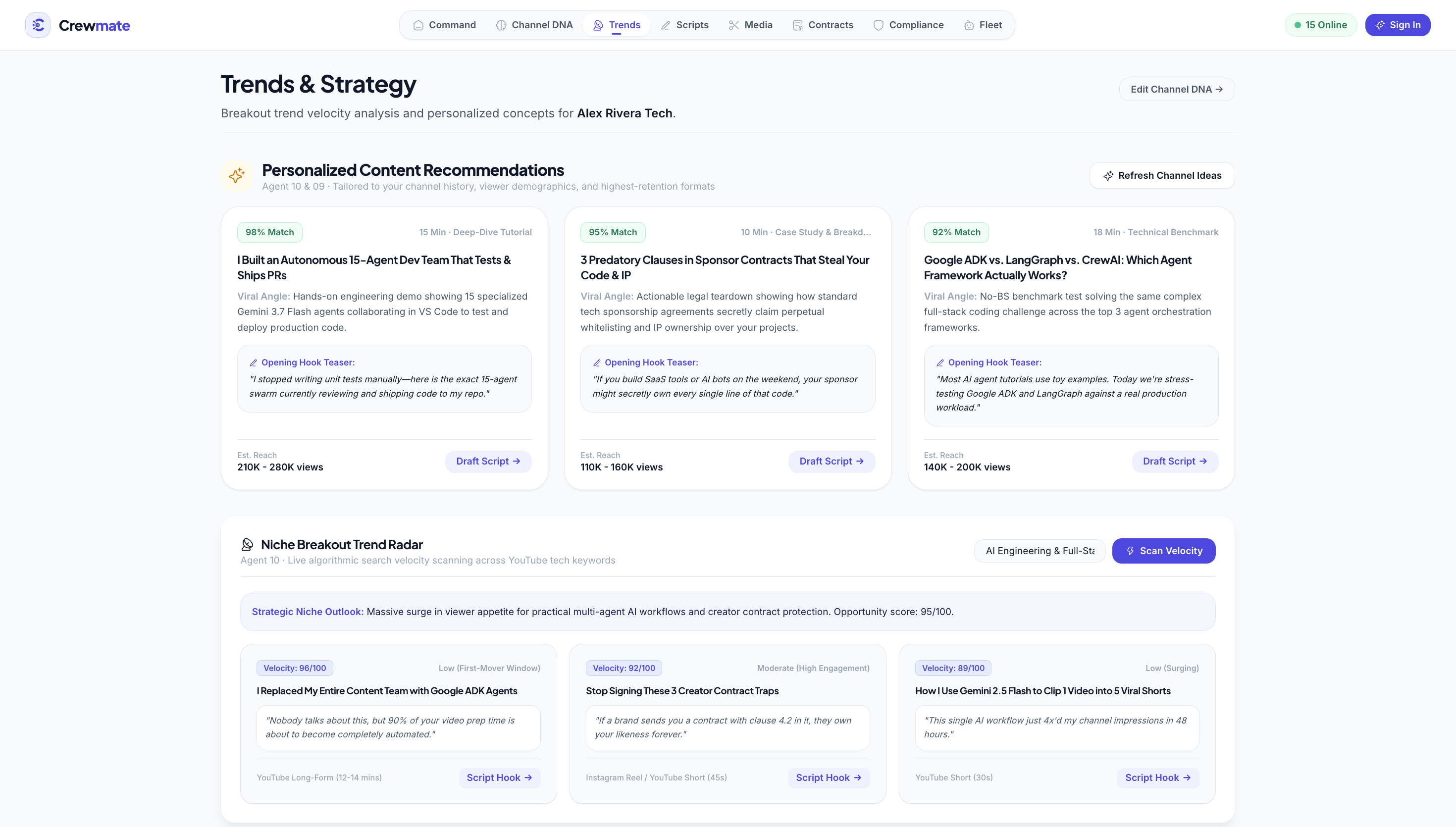
Trend Agent
-
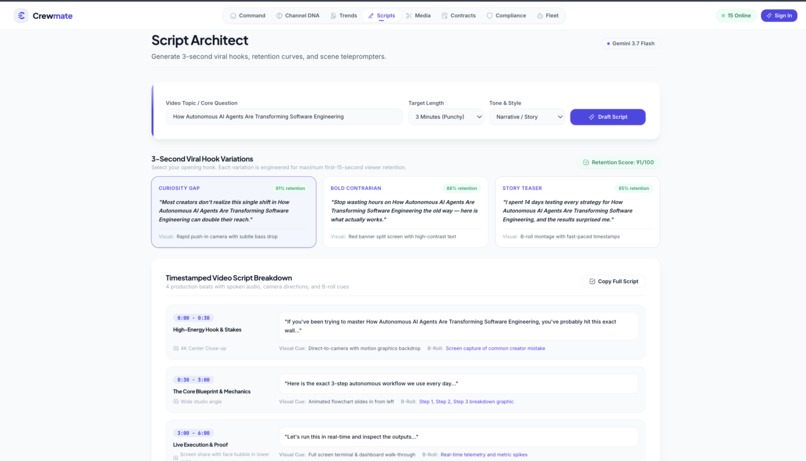
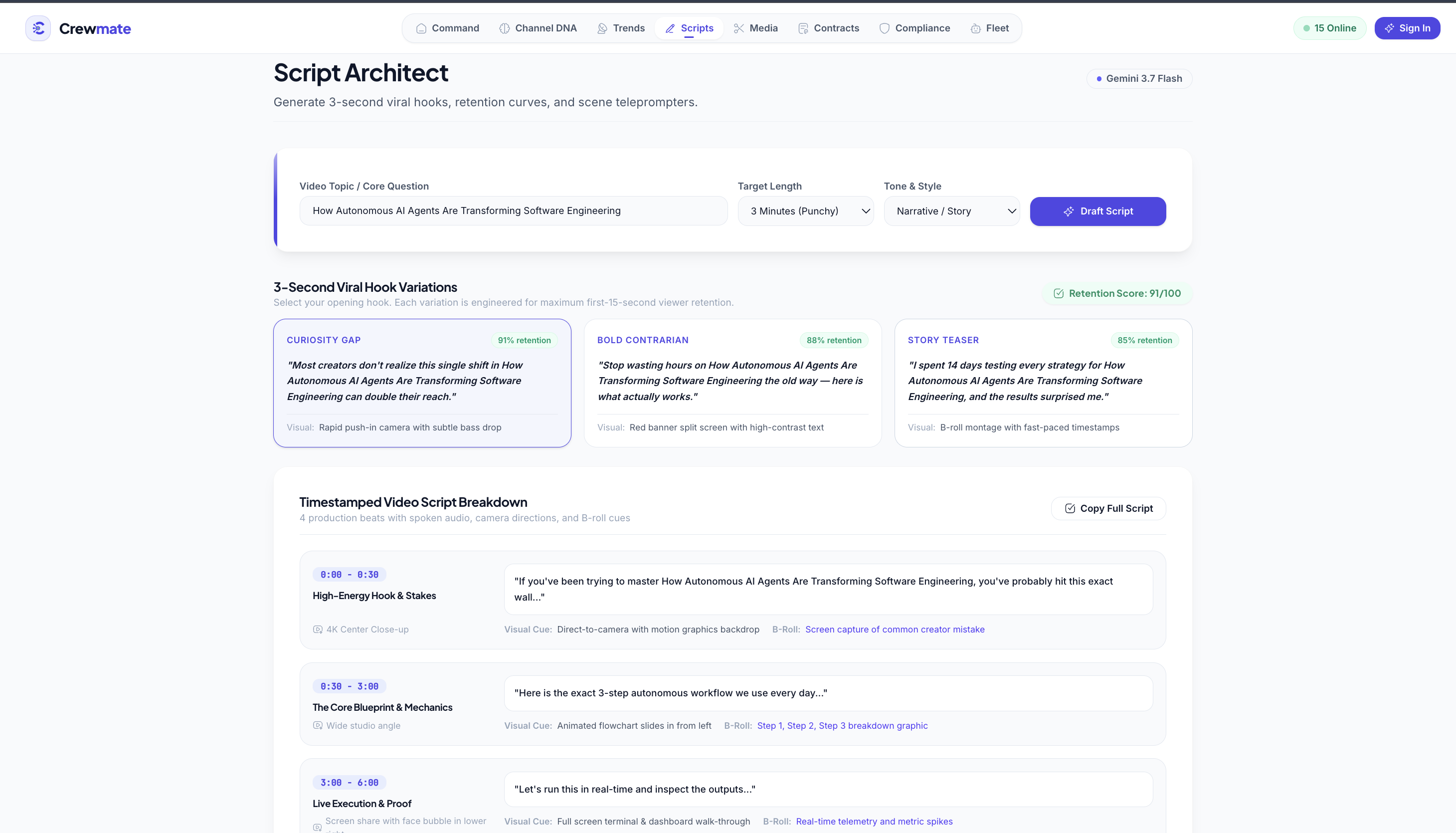
Script Architect
-
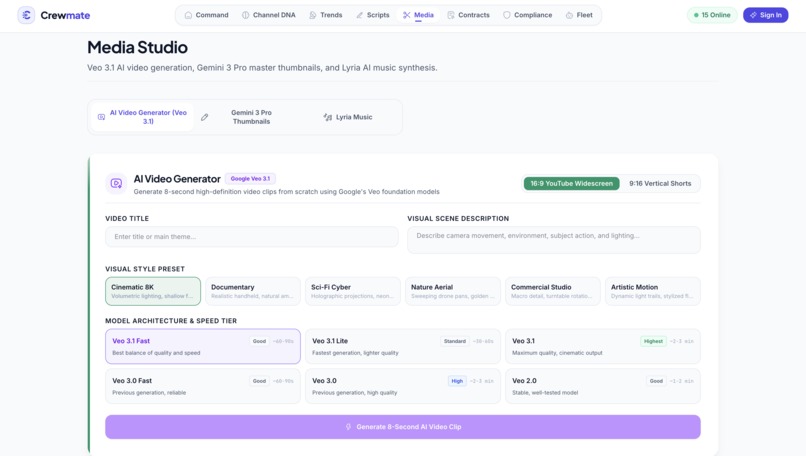
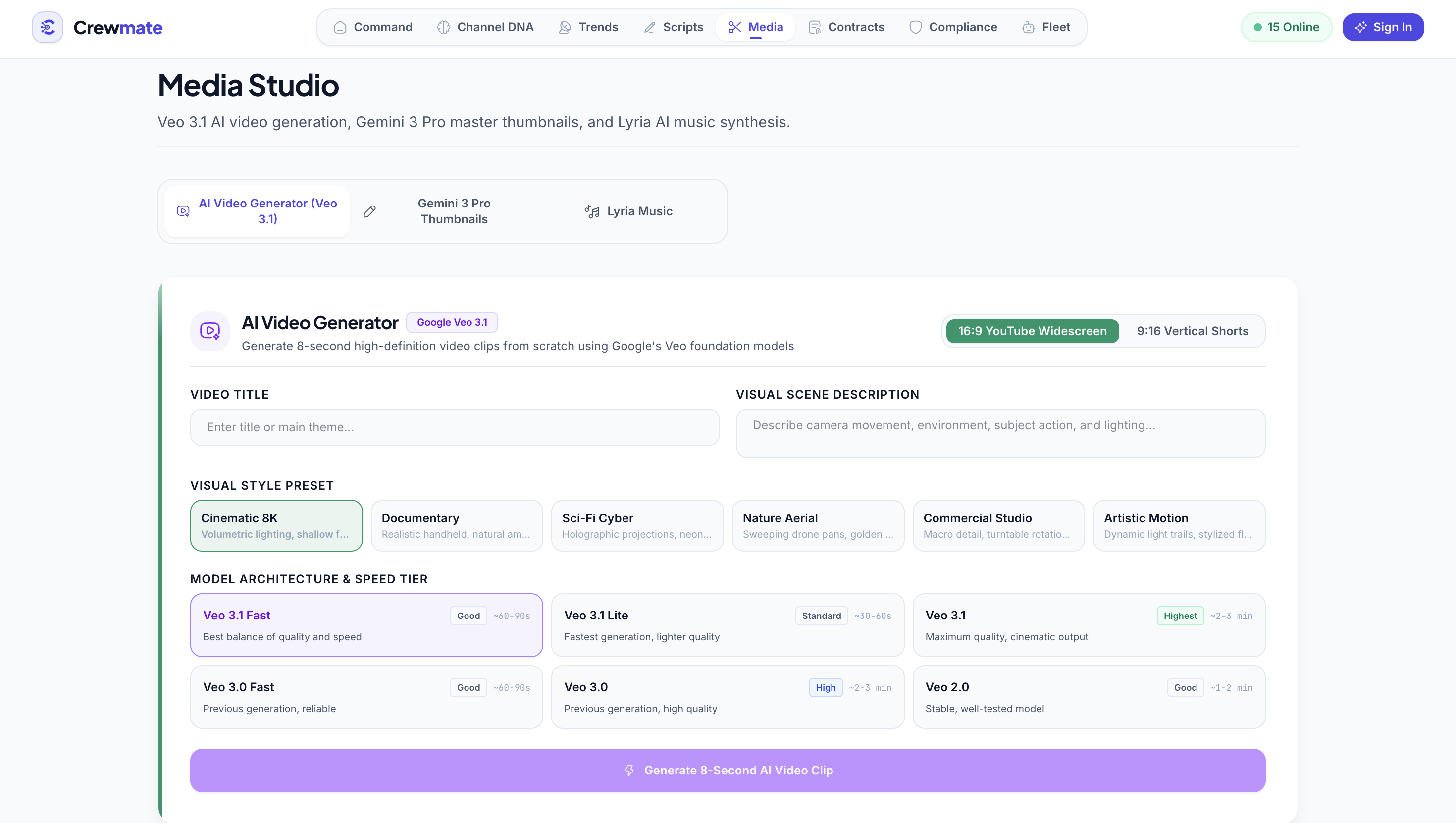
Media - Video Clips Generation using Veo 3 Agent
-
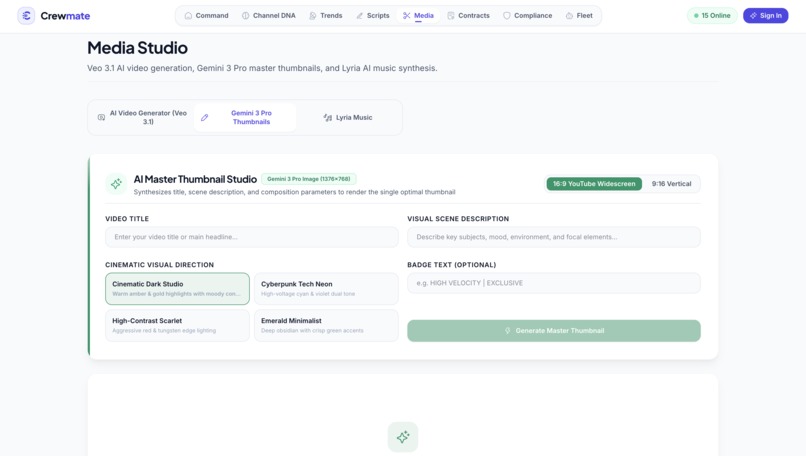
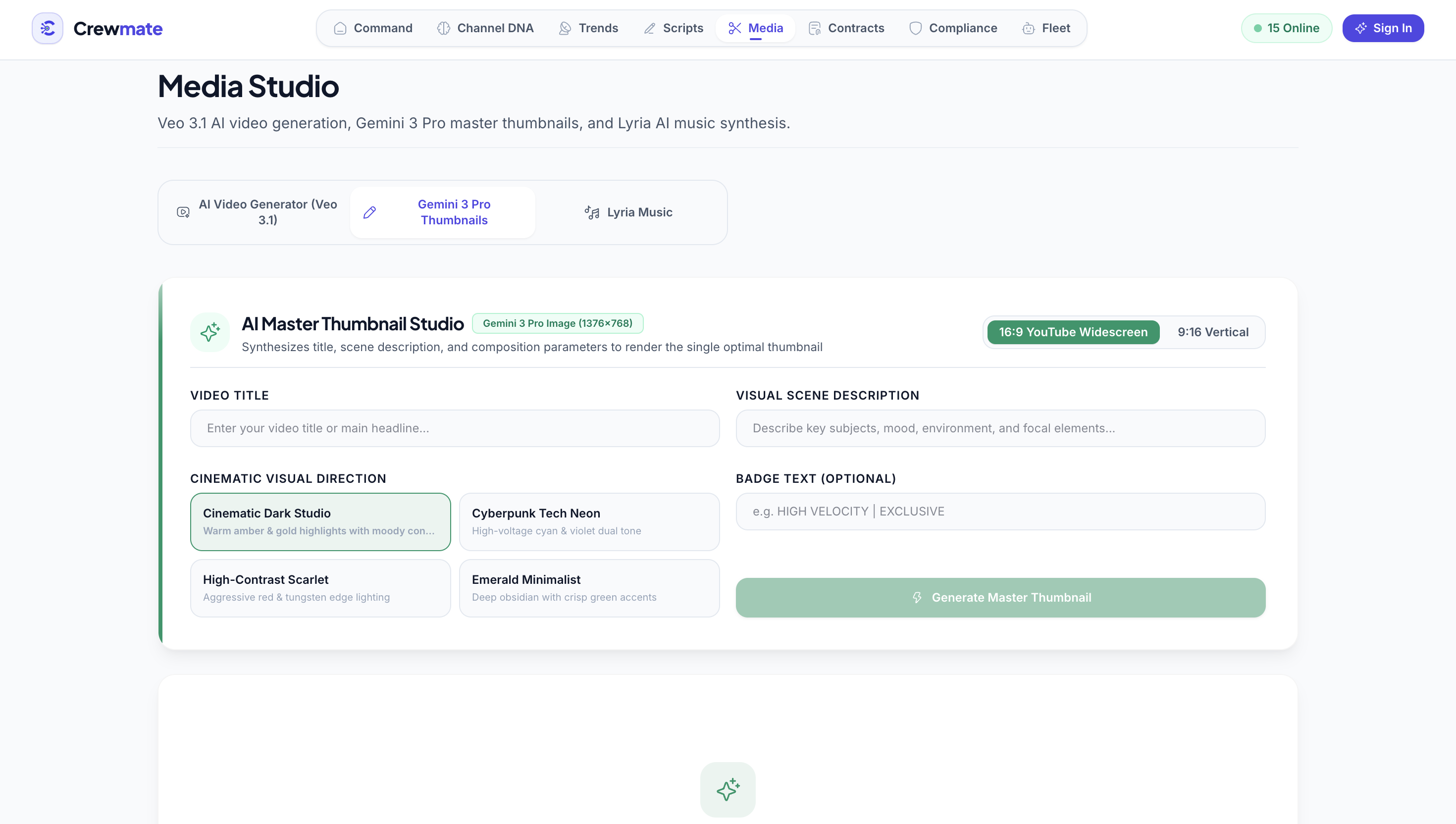
Media - Thumbnail Generation using Gemini 3 pro image
-
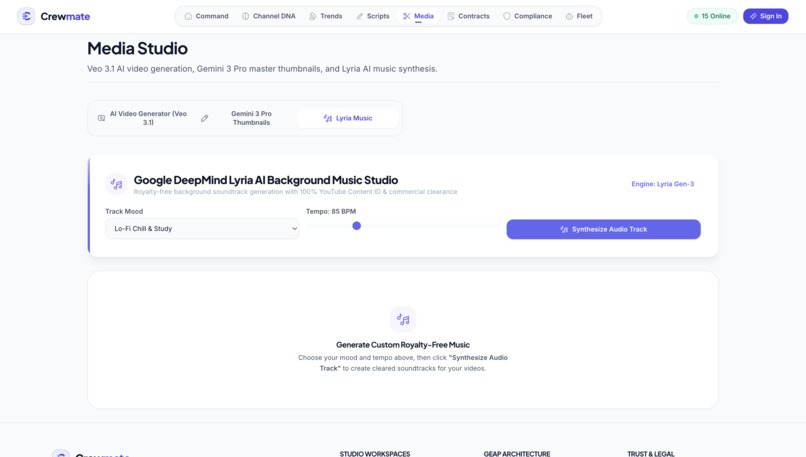
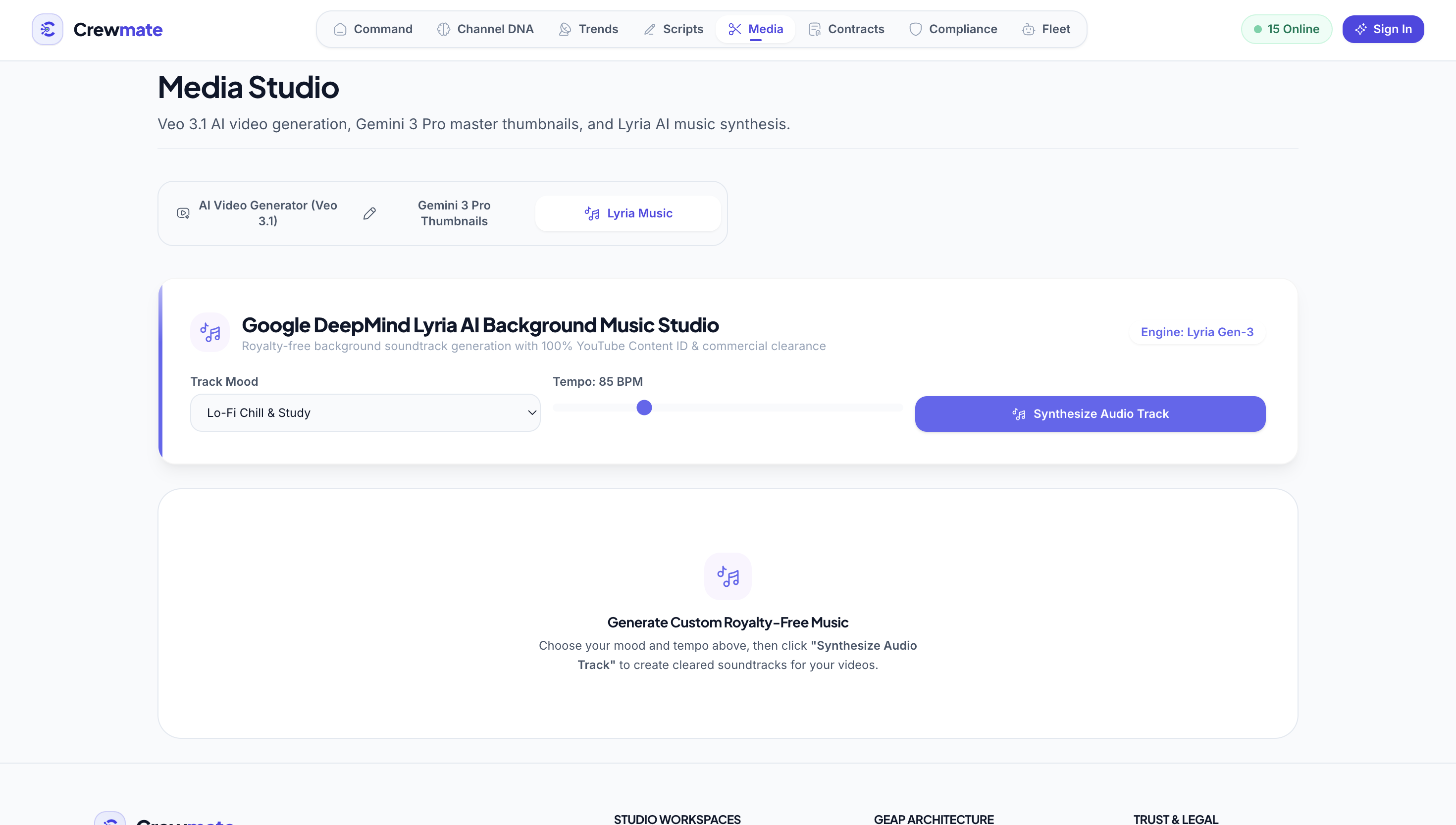
Media - Background Music Generation ( Non-Copyright ) using Lyria
-
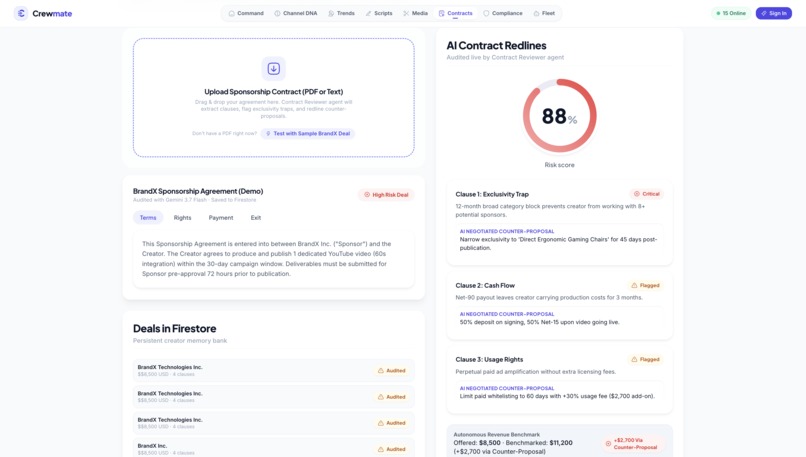
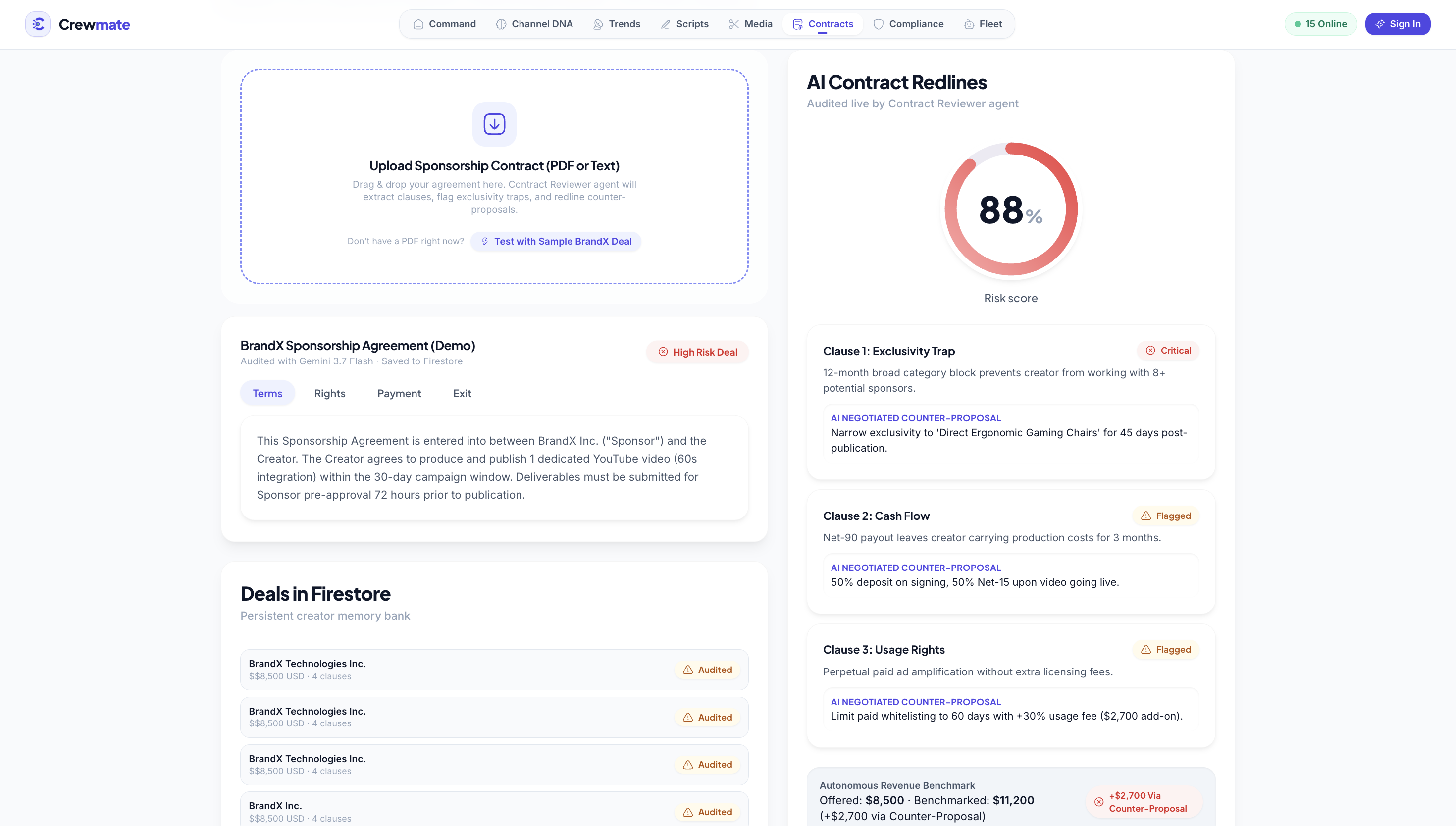
Contact Page
-
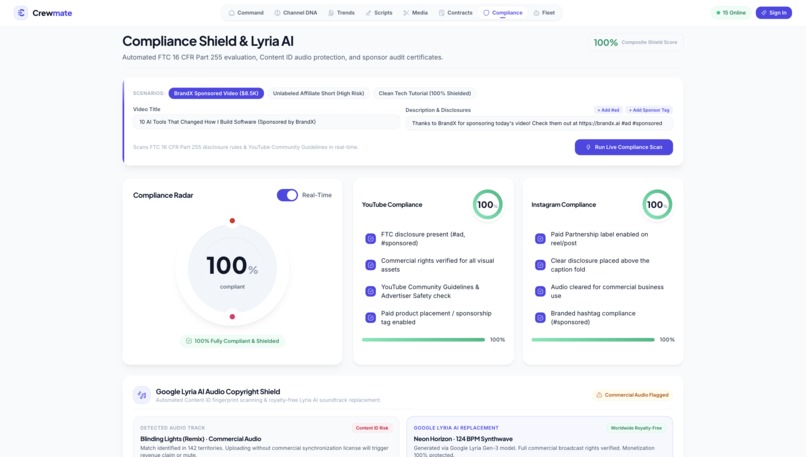
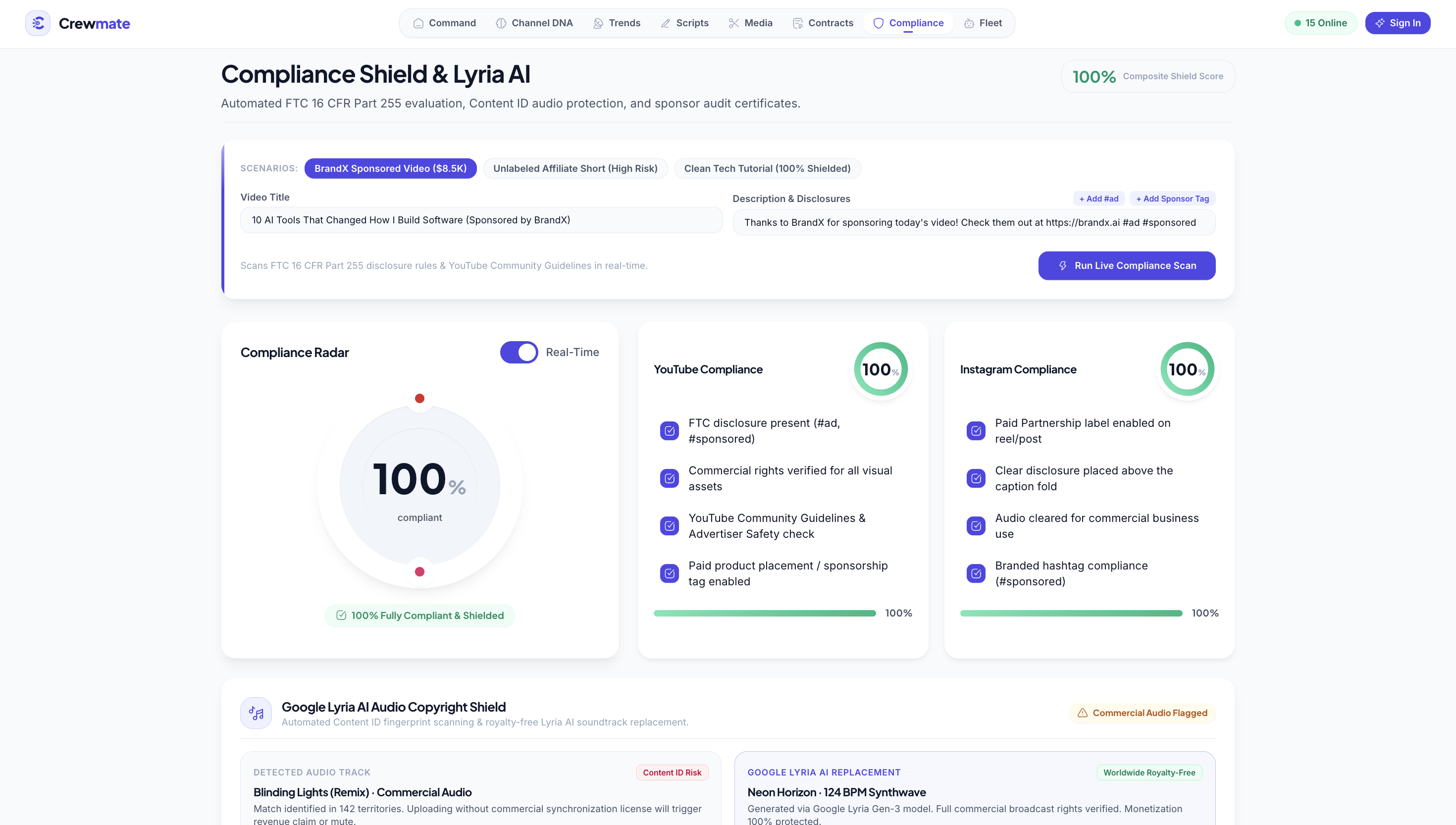
Compliance Shield
-
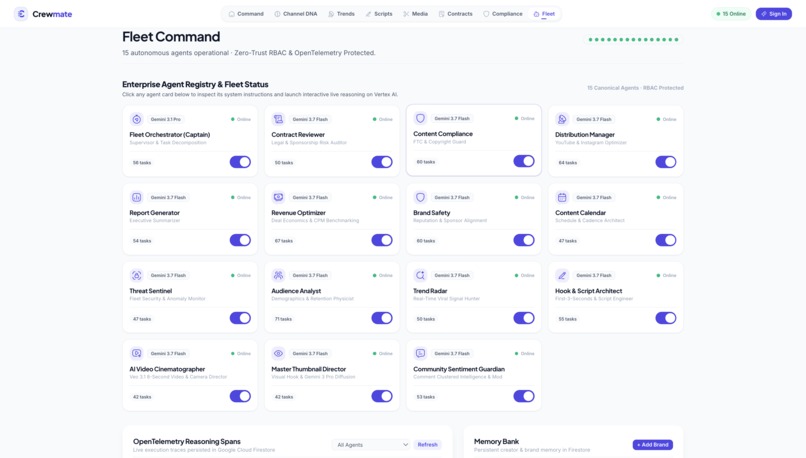
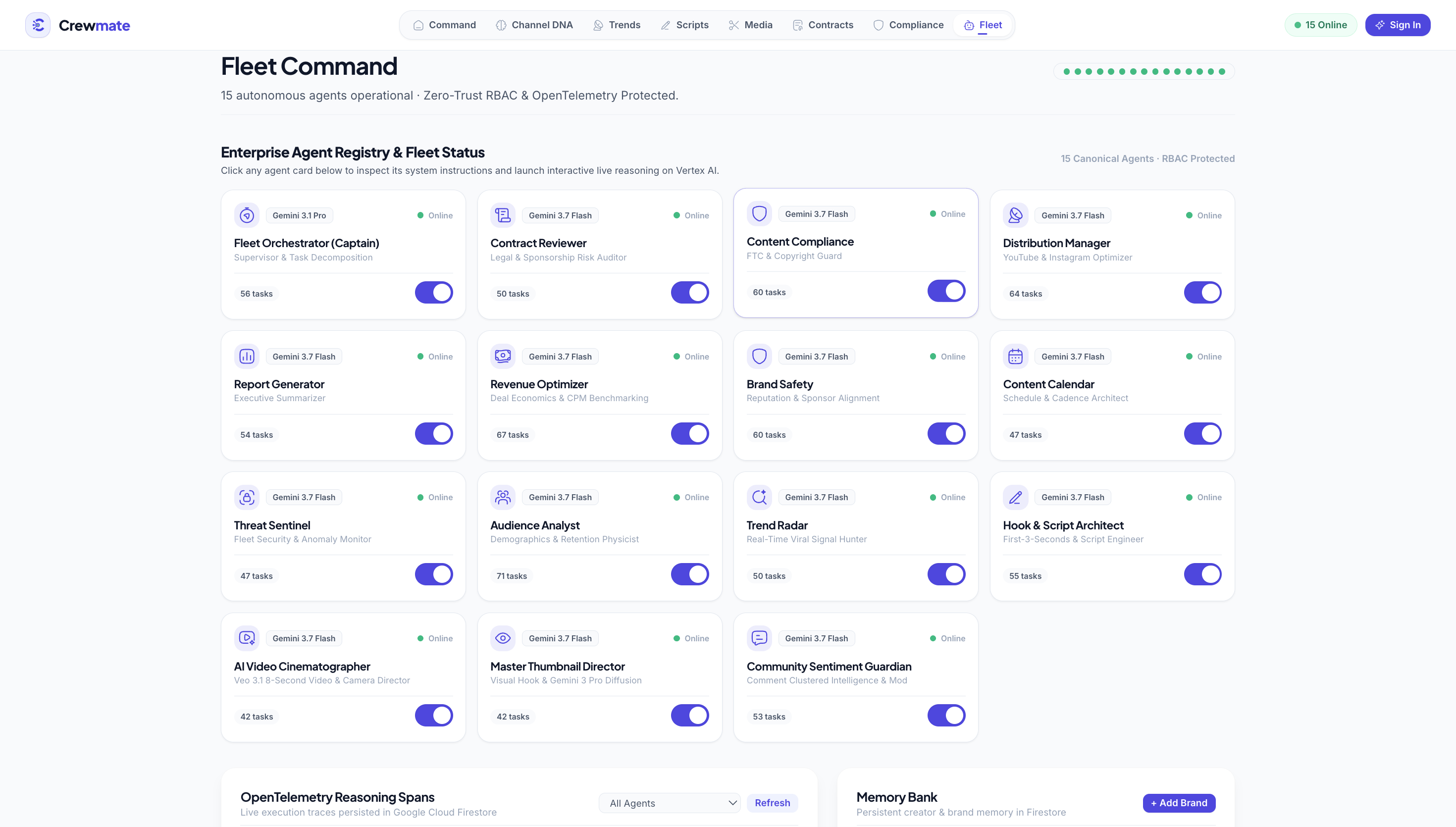
Agent Fleet
Inspiration
Last year, a creator with 2.1M subscribers signed a sponsorship deal for $4,500. The contract had a buried 12-month exclusivity clause and a perpetual content licensing trap. By the time a lawyer reviewed it, the creator had already lost access to $80,000+ in competing brand deals for an entire year.
That story stayed with us.
The creator economy is now worth $250B+ with 50M+ content creators worldwide. Many of them run six-figure businesses. Yet when it comes to legal protection, compliance, and content operations, they work completely alone, no legal team, no compliance department, no backstage crew.
Meanwhile, Fortune 500 companies deploy multi-agent AI fleets with enterprise governance, security screening, and observability for every internal process. A Goldman Sachs analyst has Model Armor. A JPMorgan compliance officer has rate-limited agent gateways. A creator with 5M followers reviewing a $15,000 contract? They have a Google Doc and gut instinct.
We asked a simple question: What if we gave every content creator the exact same enterprise-grade agent fleet that Fortune 500 companies rely on?
That question became Crewmate.
What it does
Crewmate is a 15-agent autonomous AI fleet that acts as a creator's full backstage crew — handling contract defense, legal compliance, content strategy, multimodal media generation, audience analytics, and community management with zero hand-holding.
Here's what happens when a creator uploads a sponsorship contract PDF:
- The Fleet Orchestrator (Gemini 3.1 Pro Preview) receives the goal and decomposes it into 4 parallel sub-tasks.
- The Contract Reviewer extracts every clause, flags predatory terms (hidden exclusivity, perpetual IP rights, one-sided indemnification), and scores risk severity.
- The Revenue Optimizer benchmarks the offered rate against market CPM data — and discovers the $4,500 offer should be $12,000.
- The Brand Safety agent scans the sponsor's public history for controversies, billing complaints, and audience alignment conflicts.
- The Report Generator compiles everything into an executive deal dossier with counter-proposals.
All 4 agents run in parallel. Every request passes through rate limiting (120 req/min), Model Armor security screening (15+ prompt injection patterns blocked), per-agent RBAC identity verification, and OpenTelemetry observability tracing. The entire workflow completes autonomously — the creator never has to manage, prompt, or babysit a single agent.
Beyond contracts, the fleet handles:
- FTC & Copyright Compliance: Audits video metadata against FTC 16 CFR § 255, scans for copyrighted audio, suggests Lyria AI royalty-free replacements.
- Cinematic Video Generation: Synthesizes 8-second, 1080p B-roll clips via Google Veo 3.1 with camera direction and lighting control.
- Thumbnail Creation: Generates 1376x768 widescreen thumbnails via Gemini 3 Pro Image with predicted CTR scores up to 94%.
- Trend Intelligence: Scans breakout signals, calculates velocity scores, and generates content briefs before competitors react.
- Hook & Script Engineering: Crafts first-3-second viral hooks using curiosity gaps and writes beat-by-beat scripts with sponsor integration.
- Community Intelligence: Uses Gemma 2 for edge sentiment clustering and toxic comment moderation across platforms.
- Content Calendar: Manages cross-platform publishing schedules and tracks sponsor delivery deadlines.
- Threat Monitoring: The Threat Sentinel monitors the fleet itself for prompt injections, tool poisoning, and anomalous LLM behaviors.
15 agents. 7 enterprise governance layers. 15+ Google technologies. One autonomous backstage crew.
How we built it
Architecture: We designed Crewmate around a strict 7-layer separation of concerns we call the Gemini Enterprise Agent Platform (GEAP). Every request traverses all 7 layers top-to-bottom; every response traverses bottom-to-top:
- Layer 1 — Presentation: React 19 + TypeScript 7 + Framer Motion 13 with 3D claymorphism dashboard, Web Speech API voice commands.
- Layer 2 — API Gateway: FastAPI on Cloud Run with sliding-window rate limiter (120 req/min per IP) and 3-state circuit breakers (CLOSED -> OPEN -> HALF_OPEN with 30s recovery).
- Layer 3 — Security & Identity: Model Armor middleware screens every input against 15+ prompt injection patterns and filters PII (SSN, credit cards). Per-agent RBAC matrices restrict which Firestore collections each agent can read/write.
- Layer 4 — Orchestration Engine: Fleet Orchestrator Captain (Gemini 3.1 Pro Preview) decomposes natural language goals into discrete sub-tasks and dispatches them to specialized worker agents.
- Layer 5 — Autonomous Agent Fleet: 14 specialized worker agents, each built with Google ADK and equipped with domain-specific tool sets.
- Layer 6 — State & Memory Bank: Google Cloud Firestore (Native Mode) stores agent registry, persistent creator preferences, brand deal history, and reasoning traces.
- Layer 7 — Observability & Telemetry: OpenTelemetry-compliant span tracing with trace_id, agent_id, tool call latencies, token counts, and execution timestamps.
Agent Framework: Every agent is built using Google ADK with Gemini models. The Orchestrator runs on gemini-3.1-pro-preview for complex reasoning and goal decomposition. The 14 worker agents run on gemini-3.7-flash for fast, cost-efficient execution. The Video Cinematographer uses veo-3.1-fast-generate-001. The Thumbnail Director uses gemini-3-pro-image. The Community Guardian pairs gemini-3.7-flash with Gemma 2 9B for edge sentiment classification.
Frontend: React 19 with Vite 8 (Rolldown), TailwindCSS v4, Zustand 5 for state management, and Framer Motion 13 for animations — including a 3D orbital gyroscope hero section with floating agent cards and a live multi-agent telemetry ticker.
Deployment: Single-container deployment on Google Cloud Run (us-central1, 2 vCPU, 2 GiB). The FastAPI backend serves both the API and the pre-built React SPA as static files. The entire platform — backend, 15 agents, and frontend — runs from one Cloud Run service.
Challenges we ran into
1. Agent Coordination at Scale: Orchestrating 15 agents with cross-dependencies was the hardest engineering challenge. When the Contract Reviewer finishes extracting clauses, the Revenue Optimizer needs those clauses to benchmark rates, and the Report Generator needs both outputs to compile the summary. We solved this with the Orchestrator's goal decomposition — it identifies which tasks can run in parallel and which need sequential results, then dispatches accordingly.
2. Prompt Injection Surface Area: With 15 agents each accepting different input types (PDFs, text, voice commands, URLs), the attack surface for prompt injection is massive. We built Model Armor as a middleware layer that screens every input before it reaches any agent — matching against 15+ known injection patterns, filtering PII, and logging blocked attempts to Firestore for audit trails.
3. Cloud Run Build Failures: Our initial multi-stage Docker build (Node.js + Python) failed on Google Cloud Build because pnpm v10+ blocks build scripts by default — specifically @firebase/util and protobufjs. We pivoted to a single-stage Python-only Dockerfile with pre-built frontend assets, which eliminated the Node.js dependency entirely from the production container.
4. Memory Consistency: Agents need to remember past brand deals and creator preferences across sessions. If a creator rejected a $5,000 minimum rate 3 months ago, the Revenue Optimizer should know that today. We built the Memory Bank as a Firestore-backed persistence layer with structured context injection — creator preferences and deal histories are automatically loaded into agent reasoning context at the start of every session.
5. Multimodal Generation Latency: Veo 3.1 video generation and Imagen 3 thumbnail creation have inherently high latency. We built the Agent Runtime with Firestore-backed async lifecycle state machines (pending -> running -> completed), allowing creators to queue media generation jobs and continue working while agents produce content in the background.
Accomplishments that we're proud of
- 15 agents, 7 governance layers, 1 autonomous fleet — fully operational, production-deployed, and live on Google Cloud Run.
- 100% GEAP compliance: Agent Registry, Memory Bank, Model Armor, Agent Identity, Agent Gateway, Observability, and Agent Runtime — all 7 components implemented and functional.
- 15+ Google technologies integrated: Google ADK, Gemini 3.7 Flash, Gemini 3.1 Pro Preview, Gemini 3 Pro Image, Google Veo 3.1, Lyria AI, Gemma 2 9B, Google Cloud Firestore, Google Cloud Run, Model Armor, OpenTelemetry, Vertex AI, Firebase Auth, Web Speech API, and Google Cloud Build.
- Zero-hand-holding autonomy: Upload a contract PDF and walk away — 4 agents activate, analyze, benchmark, and compile an executive summary without a single follow-up prompt.
- Production container: The entire 15-agent platform runs from a single Cloud Run service — backend, agents, and frontend — in a Python 3.13-slim container.
- Live deployment: crewmate-285381944529.us-central1.run.app — the full platform is live and accessible, running on Cloud Run in us-central1.
- Real-world value: In testing, the Contract Reviewer identified a hidden perpetual licensing clause that would have cost a creator $80K+ in locked deals. The Revenue Optimizer corrected a $4,500 offer to its fair market value of $12,000.
What we learned
- Agent governance is not optional — it is the product. Without Model Armor, RBAC, rate limiting, and observability, a 15-agent fleet is a liability, not a feature. The governance layers are what make the fleet enterprise-grade rather than a collection of chatbots.
- Orchestrator design is everything. The difference between a multi-agent demo and a multi-agent system is the Orchestrator. Goal decomposition, parallel dispatch, dependency resolution, and cross-agent result synthesis — that is where the real engineering complexity lives.
- Gemma 2 for edge classification is underrated. Using Gemma 2 9B alongside Gemini for sentiment clustering and toxic comment moderation gave us faster inference for classification tasks while keeping Gemini available for reasoning-heavy work.
- Firestore as agent state infrastructure scales beautifully. Agent registry, memory bank, reasoning traces, runtime state, and security audit logs — Firestore handled all 5 persistence concerns with zero configuration overhead and real-time listeners for live dashboard updates.
- Cloud Run is the right abstraction for agent fleets. One container, one service, auto-scaling. We deployed our entire 15-agent backend + frontend in a single Cloud Run service and it just works.
What's next for Crewmate - 15-Agent Autonomous AI Fleet for Creators
- Real-time Agent-to-Agent Communication: Currently agents report back to the Orchestrator. The next step is direct agent-to-agent messaging — the Contract Reviewer flags a risky clause and the Revenue Optimizer is immediately notified to recalculate deal value without waiting for Orchestrator mediation.
- Multi-Creator Team Workspaces: Expand from solo creator support to creator teams and agencies managing multiple brands with shared agent fleets, unified compliance dashboards, and team-wide memory banks.
- Gemini 3.5 Live Streaming: Integrate Gemini 3.5's real-time streaming for live agent reasoning traces — creators watch the Contract Reviewer think through clauses in real time.
- Mobile Agent Access: A companion mobile app (Flutter) so creators can trigger agent workflows, review contract audits, and approve content schedules from their phone.
- Creator Marketplace Integration: Connect directly to platform APIs (YouTube Studio, Instagram Graph API) for automated content publishing, analytics ingestion, and real-time compliance monitoring on live posts.
Built With
- agentic-ai
- artificial-intelligence
- fastapi
- firebase
- framer-motion
- gemini
- gemma-2
- google-adk
- google-cloud-firestore
- google-cloud-run
- google-genai-sdk
- google-veo
- imagen-3
- lyria-ai
- model-armor
- multi-agent-systems
- opentelemetry
- python
- react
- rest-api
- tailwindcss
- typescript
- vertex-ai
- vite
- zustand


Log in or sign up for Devpost to join the conversation.