Project Crewline
Inspiration
The idea for Crewline came from our own experiences as event volunteers.
We have frequently shown up to volunteer only to find disorganised operations: nobody knows who is taking over their shift, volunteers are left standing in the sun for hours without water breaks, and coordination group chats are flooded with unaddressed messages. These issues were noticeable at small events with just 30–50 volunteers; as event scale increases, these operational breakdowns multiply rapidly.
This got us thinking about the problem from both sides:
- For managers: Coordinating dozens or hundreds of volunteers, many of whom are first-timers or may not show up at all is a chaotic, high-stress task.
- For volunteers: Lacking direct contact with overwhelmed coordinators turns volunteering into a confusing and frustrating experience. Without scheduled rotations and welfare checks, it can even become a safety hazard in extreme conditions.
This led us to ask:
What if safety and volunteer managers didn’t have to manually scramble through spreadsheets, guess who needs a break, or juggle simultaneous radio calls?
That question became the starting point for Crewline. An AI-powered roster and incident management system designed to eliminate missed communications, automate roster rebalancing, and protect volunteer well-being.
What it does
Crewline is an operational engine that transforms manual roster administration and chaotic radio chatter into an organised, real-time action stream.
It transcribes incoming radio audio, extracts actionable incidents, rebalances rosters dynamically using optimisation algorithms, and monitors messaging channels to ensure no request falls through the cracks.
The goal is to eliminate common operational bottlenecks:
Volunteer No-Show Bottleneck:
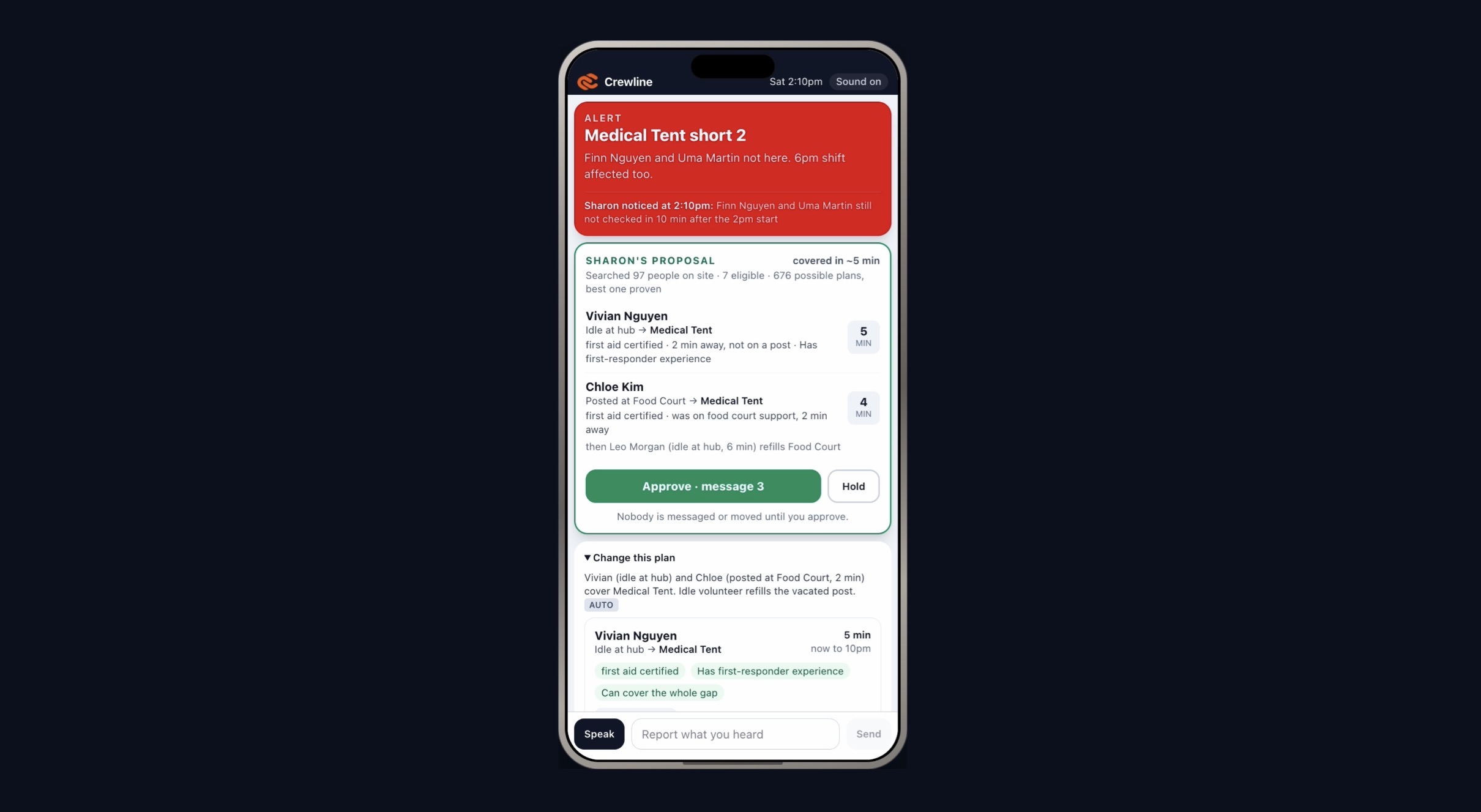
Manually noticing a no-show → Cross-referencing skills and availability → Contacting a replacement → Scrambling to fill the replacement's original role.Radio Overload Bottleneck:
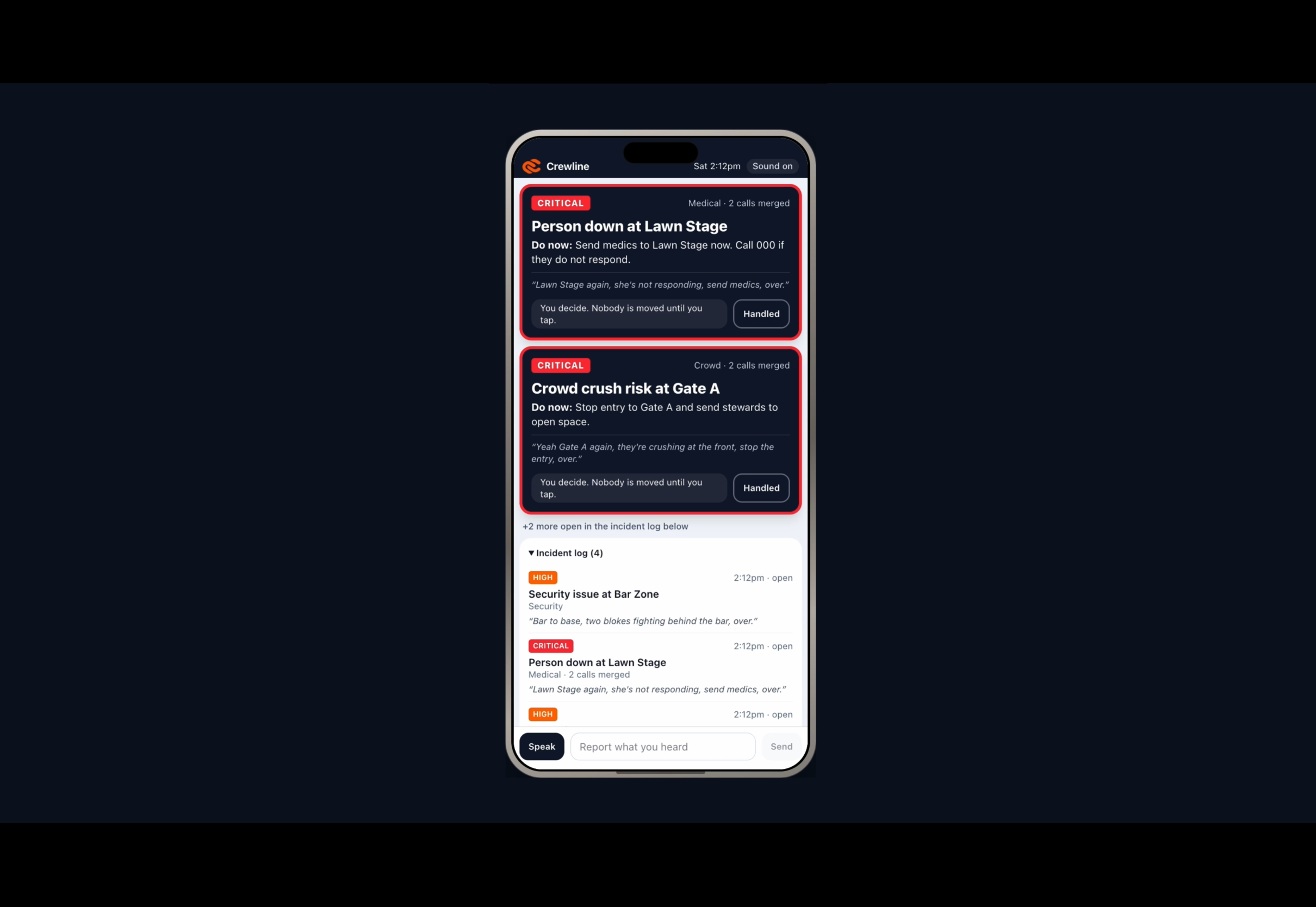
Manager is responding to one call → A second urgent report comes in over the radio → The second call is missed or forgotten → Critical safety incidents go unattended.Chat Clutter Bottleneck:
An urgent volunteer request is sent in a group chat → 20 casual messages bury it → The message is missed → The volunteer is left stranded without assistance.Extreme Weather Check:
The weather is super hot → Volunteers standing in the heat will be monitored → Reminders will be sent automatically every 1.5 hours → Relief will be suggested after 2.5 hours of working in the heat.
Our Solution — End-to-End Execution
Crewline runs continuously in the background across four key pillars:
1. Ingests Rosters and Multi-Channel Communications
Crewline was built to be frictionless and integrate directly into existing workflows. It ingests:
- Volunteer profiles and skill sets via spreadsheet uploads (CSV/Excel).
- Multi-channel walkie-talkie audio captured via USB receiver interfaces.
- Real-time team messaging feeds via integrations with platforms like WhatsApp.
2. Dynamically Rebalances Rosters
When someone fails to check in or calls out, Crewline’s constraint solver automatically identifies the most qualified available replacement based on skill tags, shift proximity, and hours worked. It drafts an updated assignment and prompts the manager for simple, one-click confirmation.
3. Synthesizes Radio and Chat Chatter
Crewline continuously transcribes and analyses incoming audio and chat messages. It clusters duplicate or related reports into a unified incident feed, prioritises them by urgency, and proposes concrete next steps (e.g., dispatching water supplies or medical personnel).
4. Interactive Live Operations Dashboard
Crewline provides coordinators with a single source of truth:
- Live, prioritised incident stream
- Automated shift replacement recommendations
- Volunteer fatigue and break timers
- Quick-action buttons to dispatch assistance or reassign shifts instantly
Challenges we ran into
Technical Challenges: Transcribing Low-Fidelity Radio Chatter
Transcribing walkie-talkie audio was significantly more difficult than handling clean studio speech. Real-world radio feeds are plagued by static, background crowd noise, variable volume levels, and clipped speech from users releasing push-to-talk buttons too early. We had to build preprocessing pipelines to clean the audio stream and fine-tune transcription models to reliably extract critical location and incident entities despite noisy inputs.
Accomplishments that we're proud of
We are proud that Crewline evolved from a simple observation about volunteer fatigue into a comprehensive, end-to-end dispatch and welfare system.
During the hackathon, we successfully brought together:
- Real-time walkie-talkie audio transcription and intent extraction
- Constraint satisfaction optimisation algorithms for roster management
- Multi-channel message deduplication and urgency scoring
- A deployable, live incident-response dashboard for safety managers
What's next for Crewline
- Native integration with major incident dispatch platforms and messaging apps (Telegram, Slack, WhatsApp Business API)
- Automated fatigue/heat risk predictions using local weather data and shift duration
- Offline-first local network support for remote events with limited internet connectivity
Built With
- elevenlabs
- python
- typescript


Log in or sign up for Devpost to join the conversation.