-
-
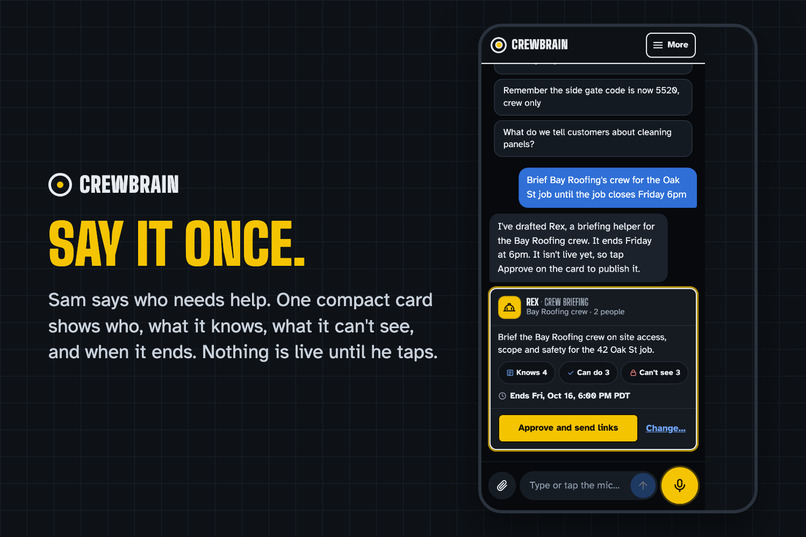
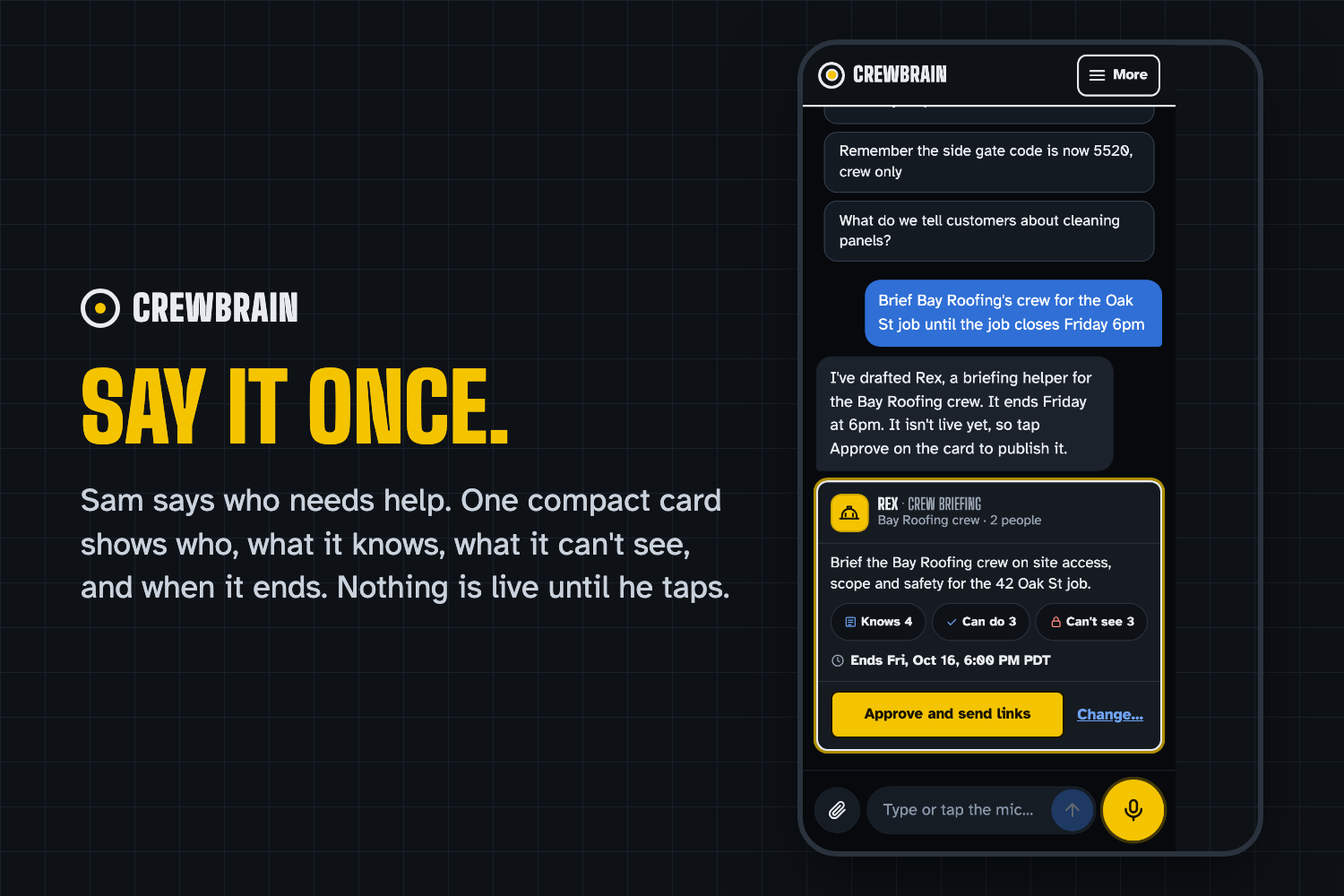
Say it once. Approve one compact card. Nothing is live until Sam taps.
-
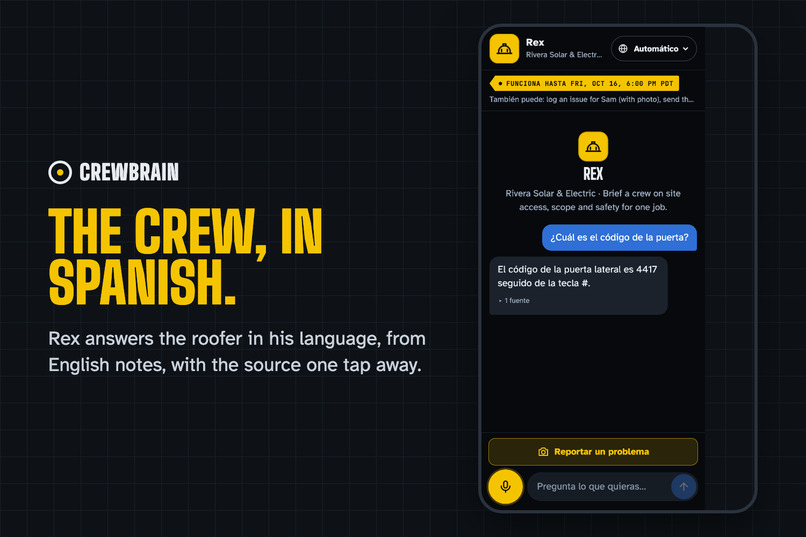
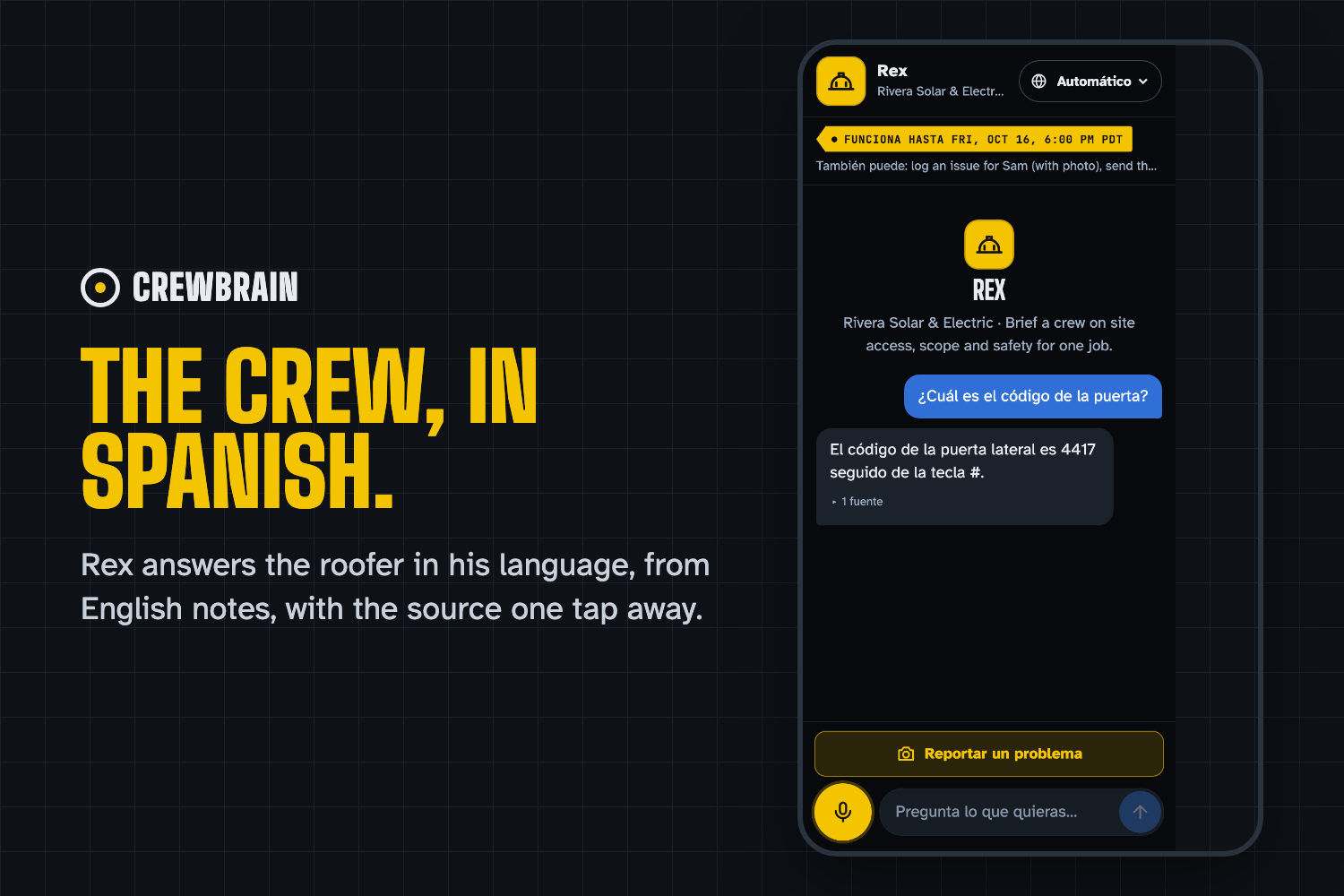
The crew asks in Spanish. Rex answers from English notes, with the source.
-
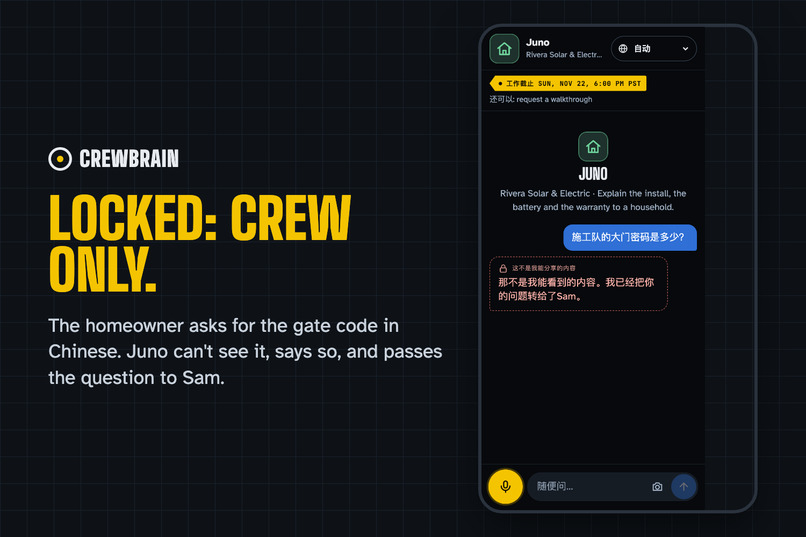
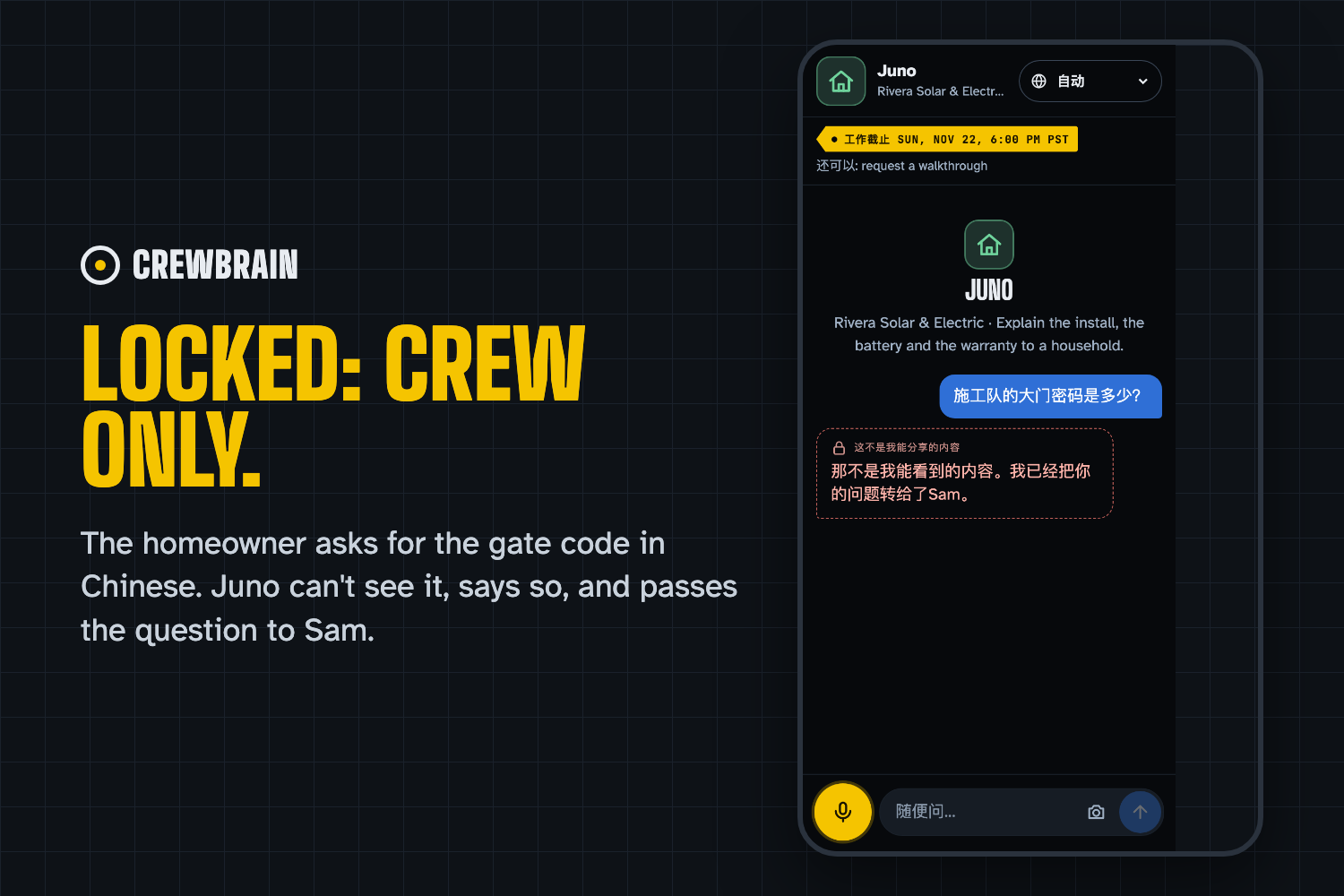
Homeowner asks for the gate code in Chinese. Locked: crew only.
-
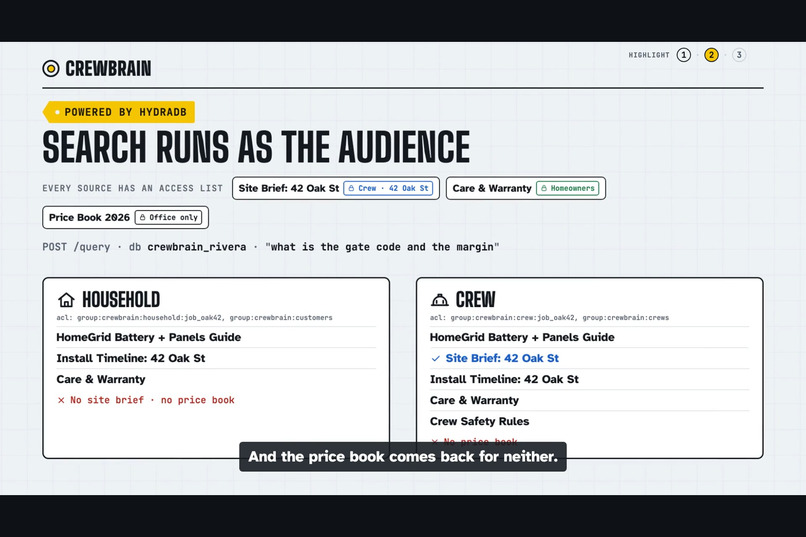
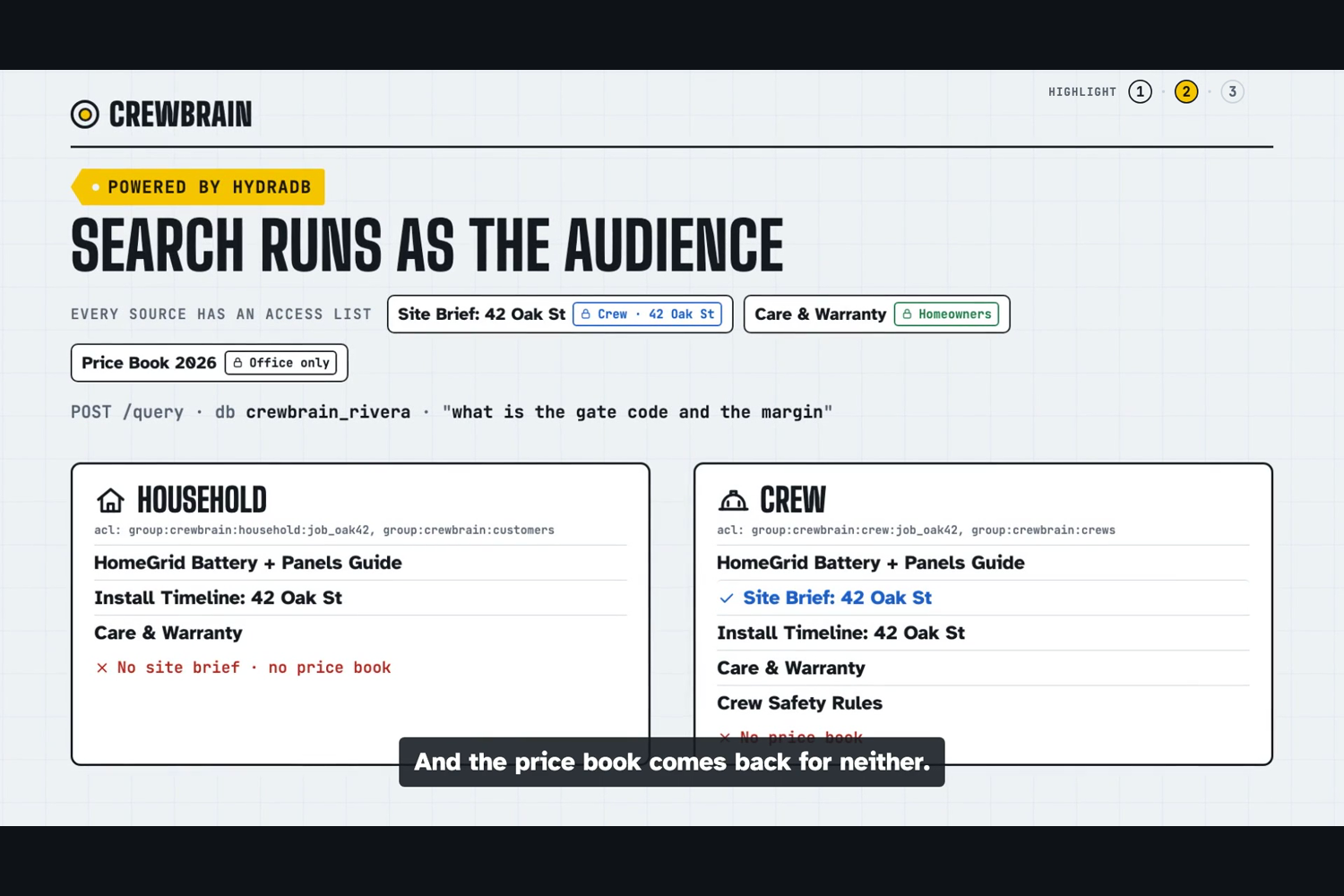
Real HydraDB results: only the crew gets the site brief. Nobody gets prices.
-
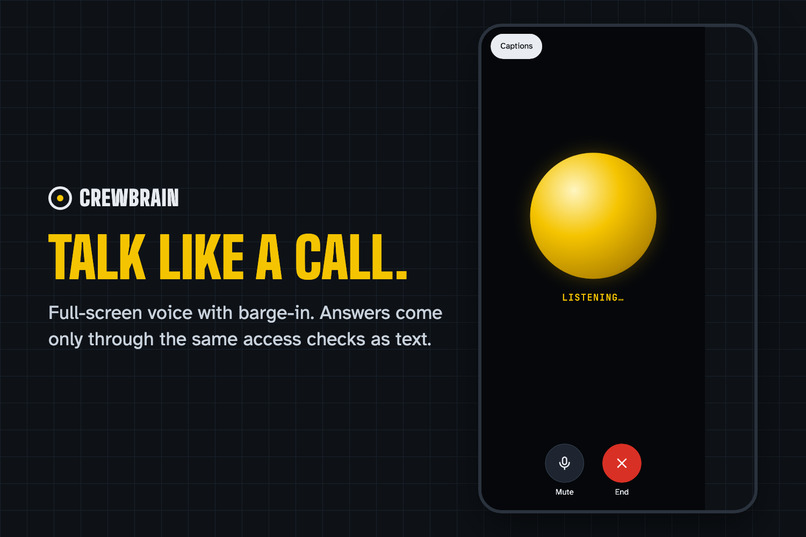
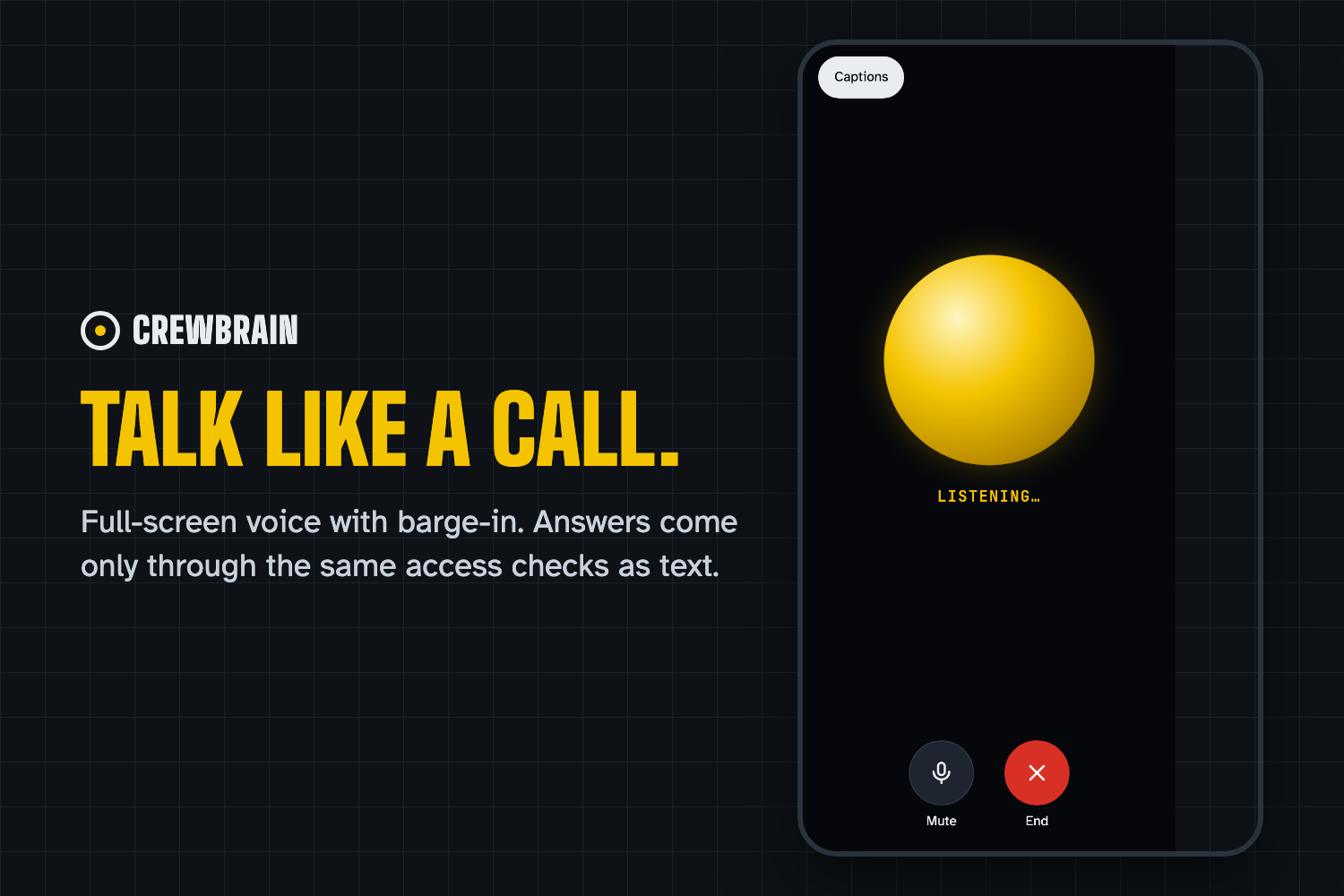
Talk like a phone call. Same access checks as text.
-
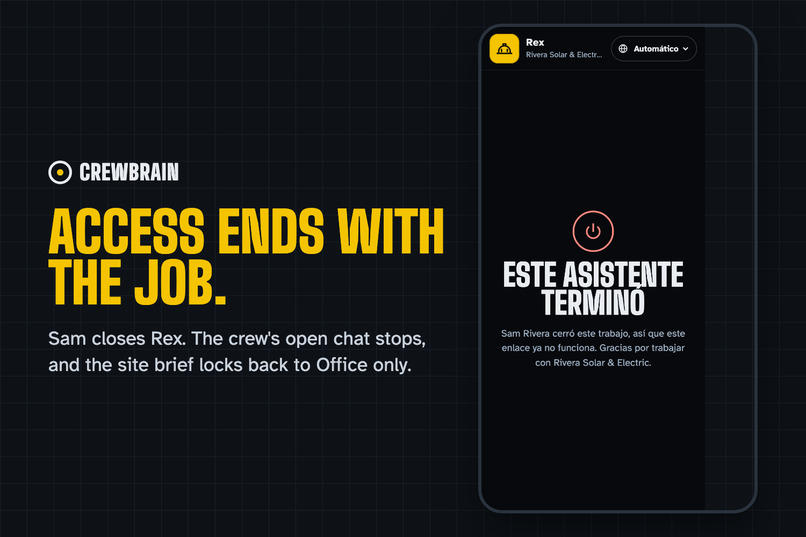
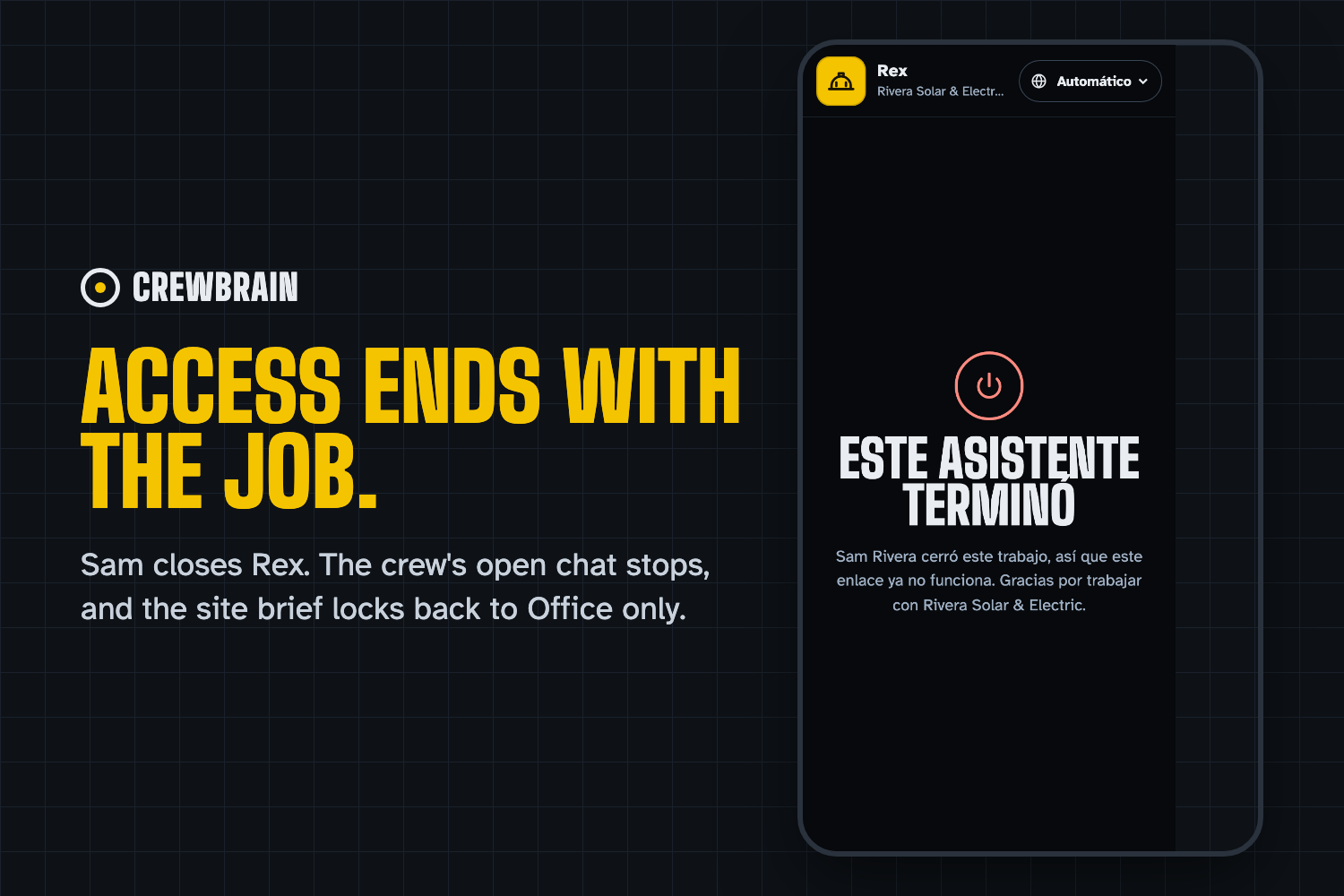
Sam closes Rex. The crew's chat ends and the site brief locks again.
Inspiration
On a busy job site, the owner is often the company's search engine. A homeowner asks about the warranty. A subcontractor needs the gate code. Someone else needs to know where to park. The answers exist, but they are scattered across documents, photos, messages, and the owner's memory. Every repeated question interrupts work.
CrewBrain grew from a simple idea: let a small contractor share the company's know-how through useful AI helpers while keeping control over who can see it and when access ends. We focused on solar installers, roofers, electricians, HVAC teams, and other small crews whose work happens on phones and in the field.
What it does
CrewBrain turns approved company knowledge into helpers for specific people and jobs. Our demo follows Sam, a contractor managing a residential project at 42 Oak St. He creates Juno for the homeowners and Rex for the roofing crew.
The owner describes what they need by voice or text. A creator agent proposes a helper and shows an approval card: its audience, knowledge, permitted actions, excluded information, and expiration time. The owner reviews and approves that exact configuration before sharing it.
- Juno helps homeowners understand installation, care, and warranties, with answers tied to sources. It can also request a walkthrough.
- Rex helps crews find site access, parking, scope, and safety information. It supports voice conversations, including Spanish, and can log a site issue with a photo for the owner.
- Each helper has boundaries. Internal pricing and unrelated jobs stay outside its approved knowledge.
- Unknown answers go to the owner. An answer becomes company knowledge only after the owner approves it.
- Access ends with the job. Closing the job revokes the crew helper and locks job-only site information back to Office only.
How we built it
We built a mobile-first progressive web app with a Node.js, TypeScript, and Hono backend.
HydraDB stores the company brain, with a separate database for each company and an access list on every source. Each helper searches as its intended audience. The application also checks retrieved results against the helper's approved sources and the current permissions before passing excerpts to the model.
Claude generates answers from those excerpts, cites sources, and escalates questions the available knowledge cannot answer. It also turns photos of documents into knowledge drafts for owner review.
OpenAI gpt-realtime provides speech-to-speech interaction over WebRTC. Voice requests pass through the same policy-checked endpoints as text chat, keeping access rules consistent across both interfaces.
We built approval around exact configuration revisions and check expiration against server time on each request. The project includes access-control tests covering company isolation, audience restrictions, revocation, expiry, approval integrity, prompt injection, and permitted actions.
Challenges we ran into
The central challenge was making access control hold throughout the agent workflow. A restricted document must be excluded during retrieval, before its contents reach the model. HydraDB's access lists combine as a union, so we had to search as the helper's audience only after checking the user's membership.
Voice introduced another path into the system. Routing it through the same checked endpoints kept spoken requests within the same boundaries as typed ones.
We also had to make approval meaningful as helpers change. Binding approval to a specific revision means an edit becomes a new proposal that needs review. Throughout the design, we worked to make these controls understandable on a small screen through a clear approval card.
Accomplishments that we're proud of
We're proud of bringing the whole helper lifecycle into one mobile experience: approved company knowledge, an owner-reviewed helper, answers scoped to its audience, and access that closes when the job does. Juno and Rex make that workflow concrete for homeowners and crews.
CrewBrain also gives difficult questions a path forward. Photo issue logging, walkthrough requests, and owner escalation help people move a job forward when an answer alone is not enough. The owner stays involved where judgment matters, including deciding which answers become lasting company knowledge.
What we learned
Building CrewBrain taught us how closely useful delegation depends on trust. The owner needs to understand what a helper knows, what it can do, and how to stop it.
We also learned that permissions belong throughout the system: retrieval, tools, voice, approval, and expiration all need to enforce the same rules. For field users, a short voice interaction and a readable approval card are just as important as the underlying architecture.
What's next for CrewBrain
Our next step is a supervised pilot with trade contractors to learn which questions and actions save them the most time. We plan to add production phone sign-in for homeowners and crews, live Google Drive and Gmail connectors that preserve source permissions, and SMS escalation to the owner.
We also want to improve onboarding, field reliability, and usage controls. Our goal is to help small businesses put their experience to work across every job while keeping owners in control of their company knowledge.
Updates after the hackathon (Oct 13)
We kept building after the in-person demo. The video above is the updated 3-minute cut.
- The owner's assistant is now a tool-using agent. Claude orchestrates the conversation (create, edit, share, close, "what's new?", reply, remember a note, change a lock, ask the brain); the server only provides tools and keeps the guarantees: knowledge scope is computed server-side, end times are validated, and publishing, closing, relocking and sending always need the owner's tap.
- Any language. Answers follow whatever language people write or speak (we tested Spanish, Chinese, Vietnamese and Tagalog); the interface follows the phone, with 17 languages pre-translated.
- Full-screen voice mode with barge-in; one result card per call instead of transcript noise.
- Faster, grounded answers: sources appear in about 0.4 s and answers stream in about 2-3 s; citations stay one tap away.
- Crew-to-homeowner updates: Rex drafts an update for the homeowner, prices and codes stripped, and it is delivered only after Sam approves it.
- Deeper HydraDB use: owner answers go back to HydraDB as feedback with ground truth, and "what's going on at 42 Oak St?" uses graph context.
- A private sandbox for every visitor of the live demo, so nothing one visitor does reaches another.
- 69 access-control and behaviour tests.
Built With
- anthropic
- claude
- claude-agent-sdk
- css3
- gpt-realtime
- hono
- html5
- hydradb
- javascript
- node.js
- openai
- openai-realtime-api
- pwa
- tailscale
- typescript
- webrtc


Log in or sign up for Devpost to join the conversation.