-
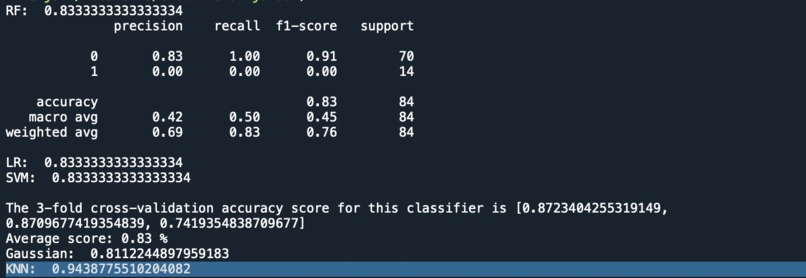
Accuracy values
My parents always taught me to look out for the little guy. When my friend and I found out about this disease and realized that the way to diagnose this disease is examine the brain tissue by carrying out a brain biopsy or, more commonly, after death in a post-mortem examination of the brain, we realized that we had to do something about this. Then, we found out that 90 percent of patients with spontaneous Creutzfeldt Jakob die within a year of diagnosis, while others might die within just a few weeks, according to the NIH. So, in order to allow people to realize they have this disease before death we created a machine learning model with an accuracy of 94.39 percent. This machine learning dataset utilizes the presence of certain proteins in order to make an accurate diagnosis of the disease. We built this machine learning model by first scouring the web to find an efficient dataset with patients and their protein measurements. Then, we implemented different machine learning algorithms in order to see which architecture allowed to the most accurate diagnosis. Thus, after this implementation, it was found that the utilization of the K-Nearest-Neighbors algorithm projected the highest accuracy. Some challenges we faced included the lack of data present online, as this disease is relatively uncommon. Thus, we randomly oversampled the data in order to predict the diagnosis with a greater accuracy when implemented into the real world.
Built With
- python
- spyder


Log in or sign up for Devpost to join the conversation.