-
-
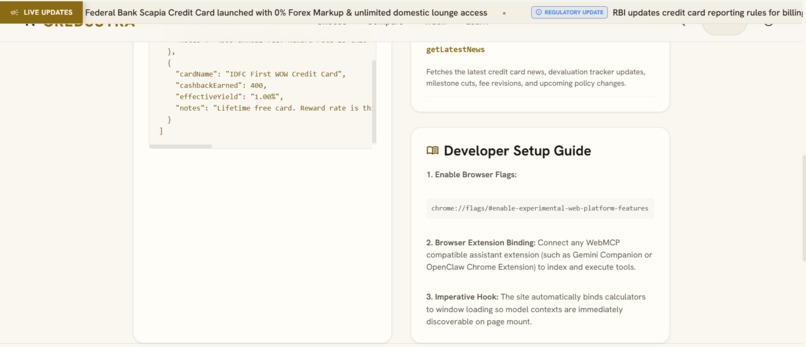
Web MCP instructions
-
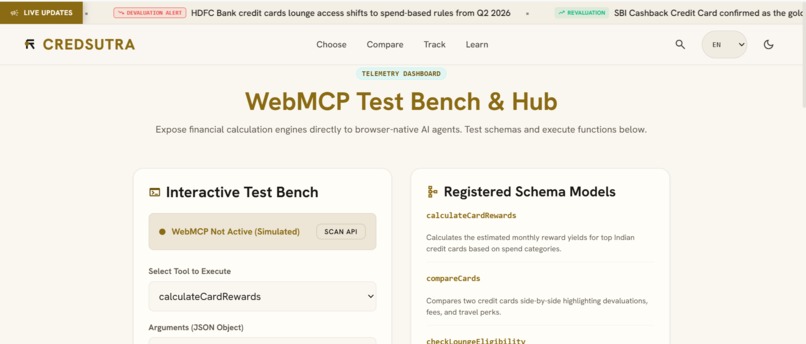
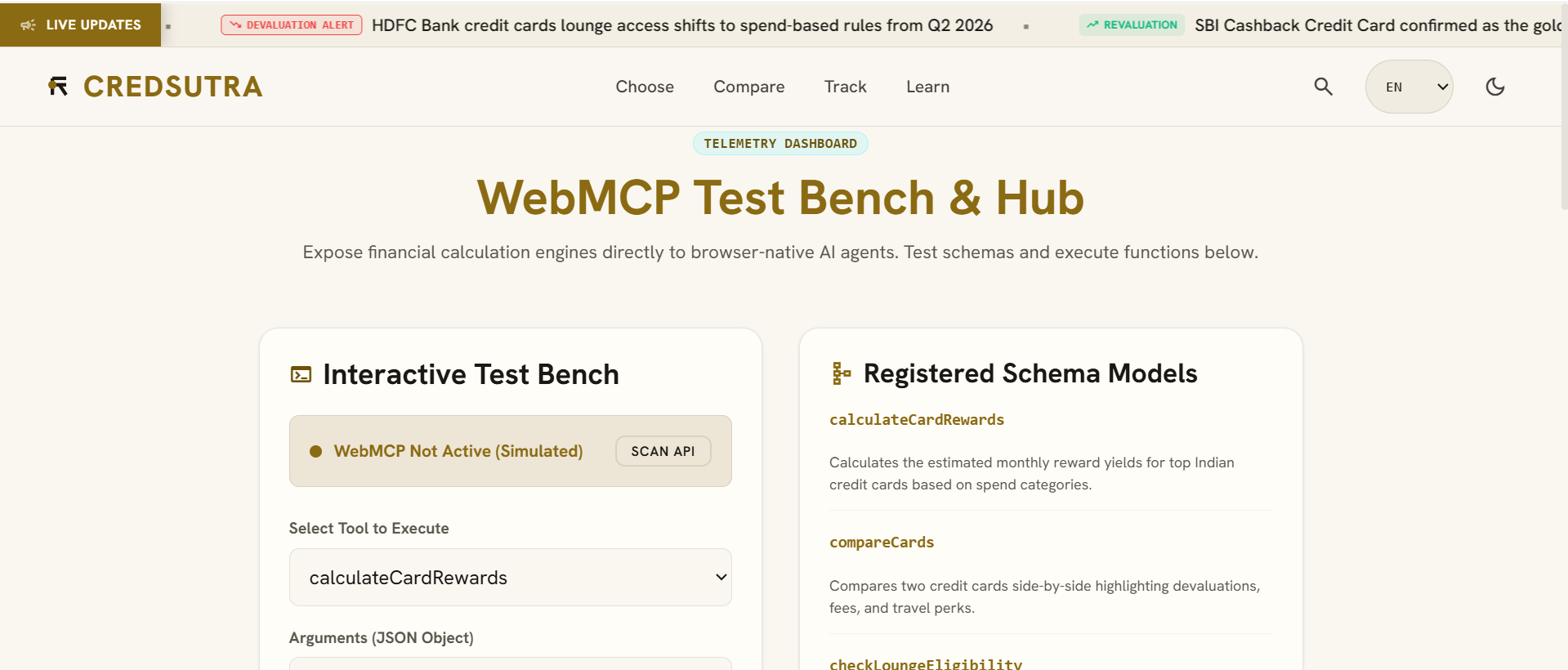
Web MCP Hub
About the Project
I’ve always wanted to build a website that brings together useful, practical information about credit cards.
When I started earning, choosing the right credit card was surprisingly difficult. There were limited sources of information, information was scattered across different websites, and it wasn’t always easy to figure out which card actually made sense for my spending habits. I had the idea of building something that could solve this problem, but like many side projects, I never found the time to actually build it.
AI changed that.
With the rise of AI-powered experiences, I thought: why not finally give it a shot? That idea eventually became CredSutra — a platform designed to help people understand, compare, and choose credit cards based on how they actually spend.
For the OpenAI WebMCP Challenge, I took CredSutra one step further. Instead of making users navigate through pages and manually search for information, I exposed CredSutra's capabilities through WebMCP. The website currently provides six tools that an AI agent can interact with:
- Card Review — get detailed information and insights about a credit card.
- Card Comparison — compare cards and understand their differences.
- Credit Card News — discover relevant and recent card-related updates.
- Reward Calculator — estimate rewards based on spending.
- Lounge Calculator — determine lounge eligibility and benefits.
- Card Recommendation — find cards that fit specific spending criteria.
The interesting part for me was seeing how a website can evolve from being a destination that users browse into a capability that AI agents can interact with.
What I Learned
Building this project taught me that WebMCP is more than just exposing APIs. The real challenge is thinking about how an AI agent will understand and use your tools.
I had to think carefully about tool descriptions, inputs, outputs, and how to structure the capabilities so that an agent can make meaningful decisions instead of simply calling an endpoint.
It also made me rethink the traditional website experience. A user might ask an AI something like:
"I spend ₹50,000 a month on travel and dining. Which credit card would give me the best rewards?"
Instead of the user learning how CredSutra works first, an AI agent can use CredSutra's tools to find the relevant cards, calculate potential rewards, and provide an answer.
Challenges
The biggest challenge was deciding what should become a tool and what should remain part of the website experience.
I also had to make the tools useful independently while ensuring they could work together as part of a larger AI-driven workflow. Designing clear inputs and outputs and making the tools predictable for an agent required more thought than I initially expected.
And, of course, building a real product while learning and experimenting with a relatively new technology comes with plenty of iterations and debugging.
What's Next?
CredSutra is still very much a beginning.
There are many more features I want to add, more credit-card data to bring together, and many ways I can make the recommendations smarter and more personalized.
What started as an idea I had years ago but never got around to building has finally become something real — and WebMCP has given me an exciting new direction for it.
This is just the beginning.
Built With
- antigravity
- astro
- claude
- cli
- cloudflare
- github
- hermes
- openclaw
- paperclip

Log in or sign up for Devpost to join the conversation.