-
-
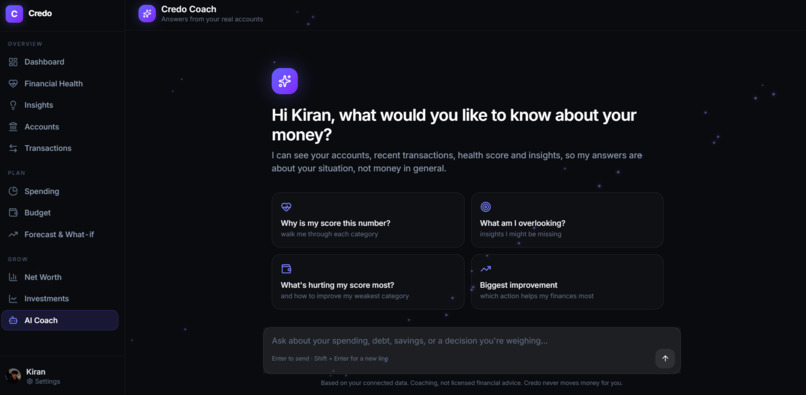
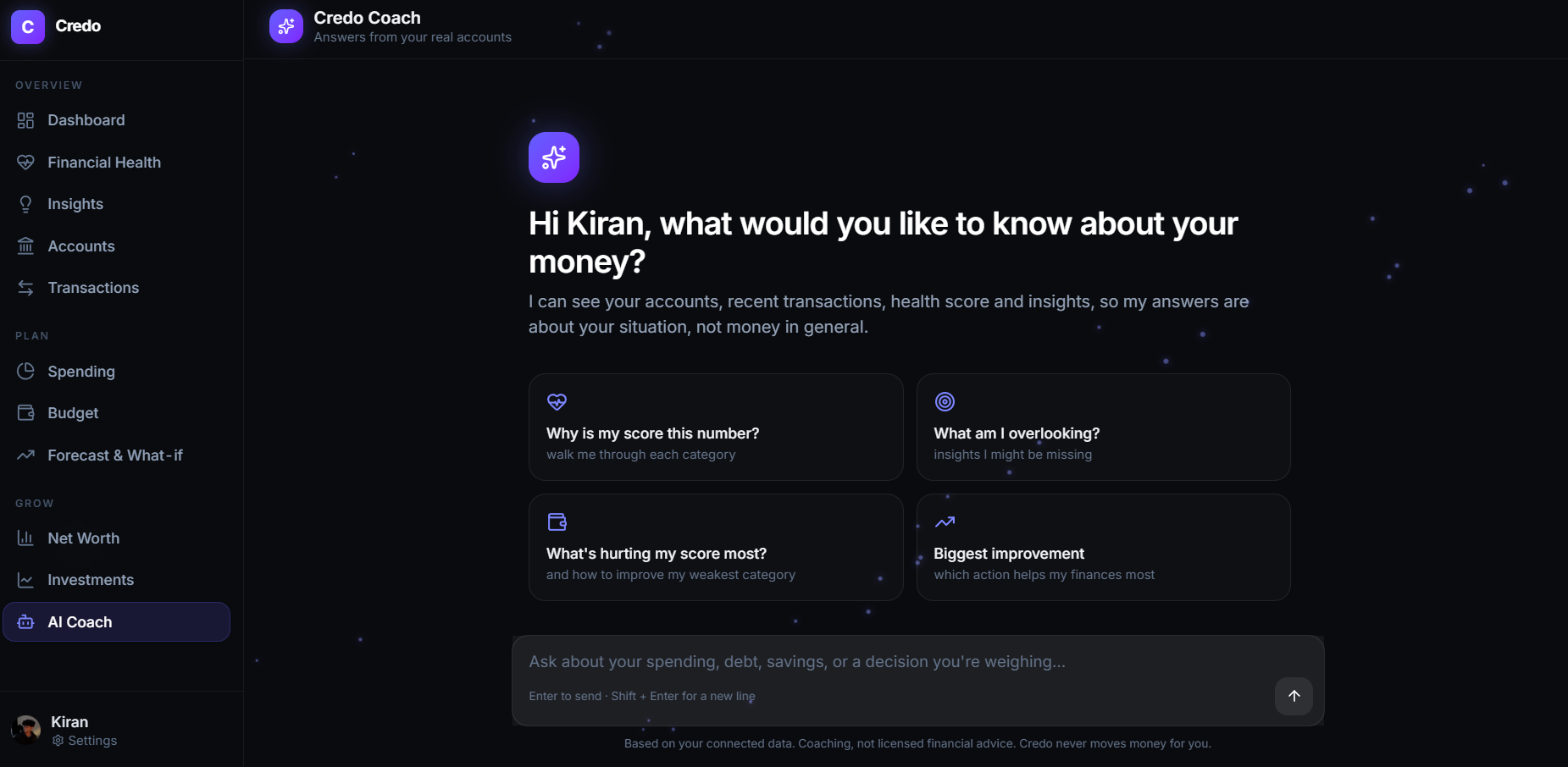
AI Coach
-
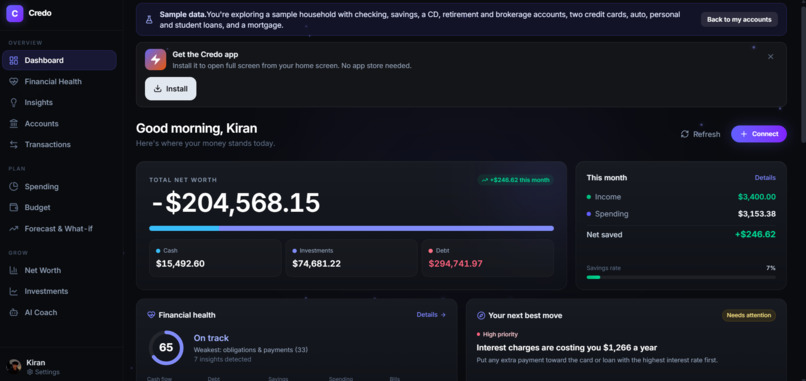
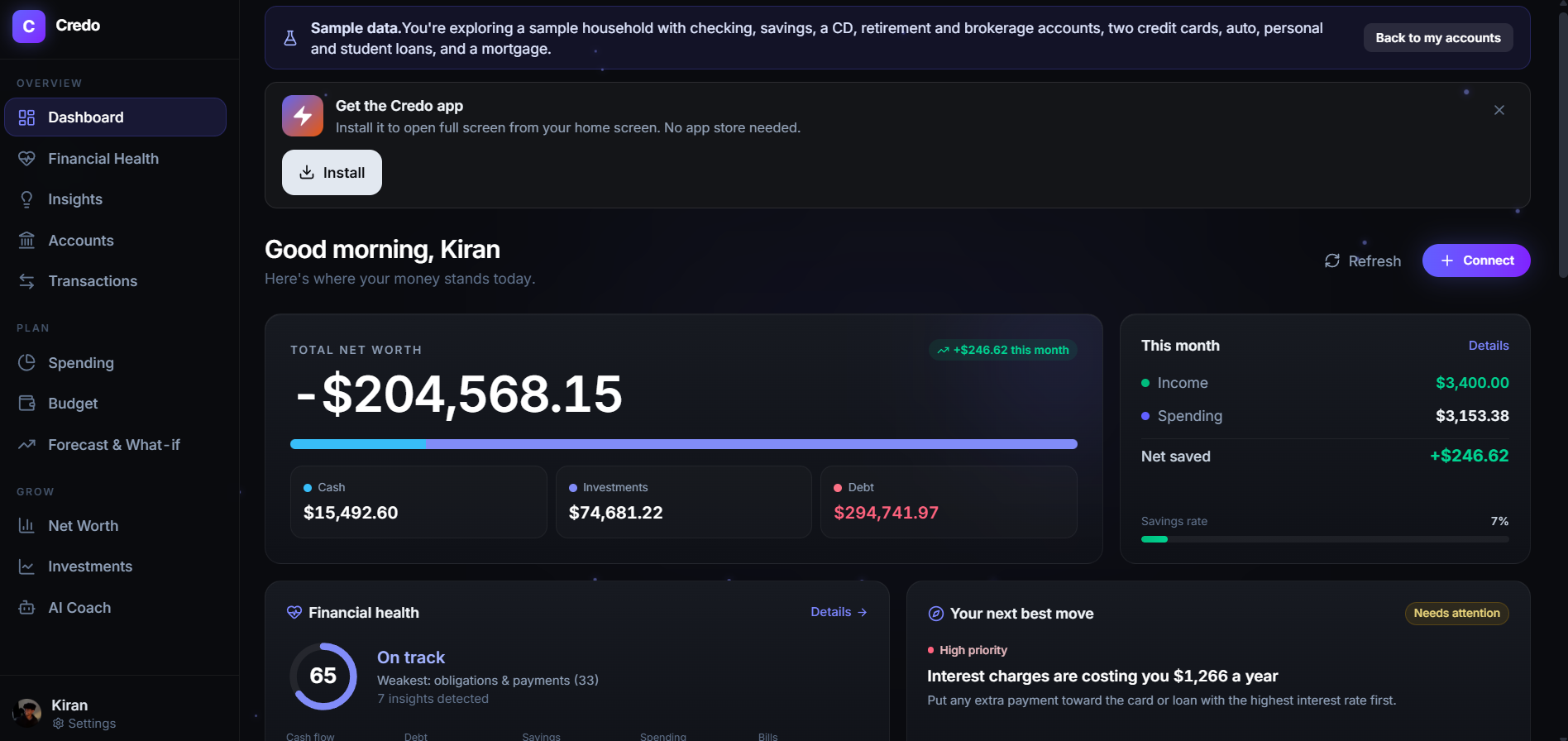
Dashboard
-
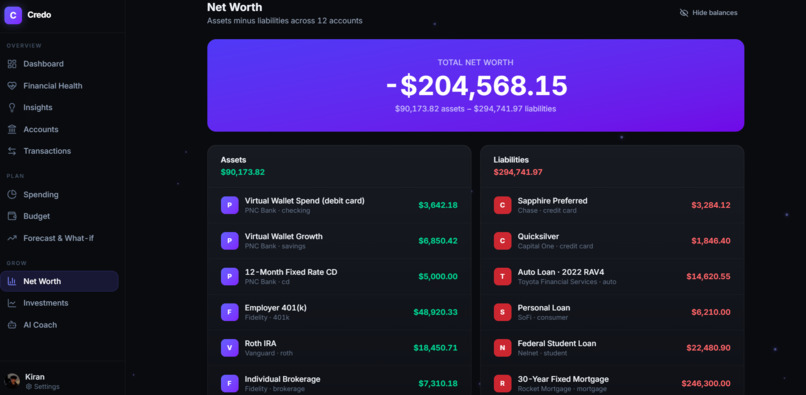
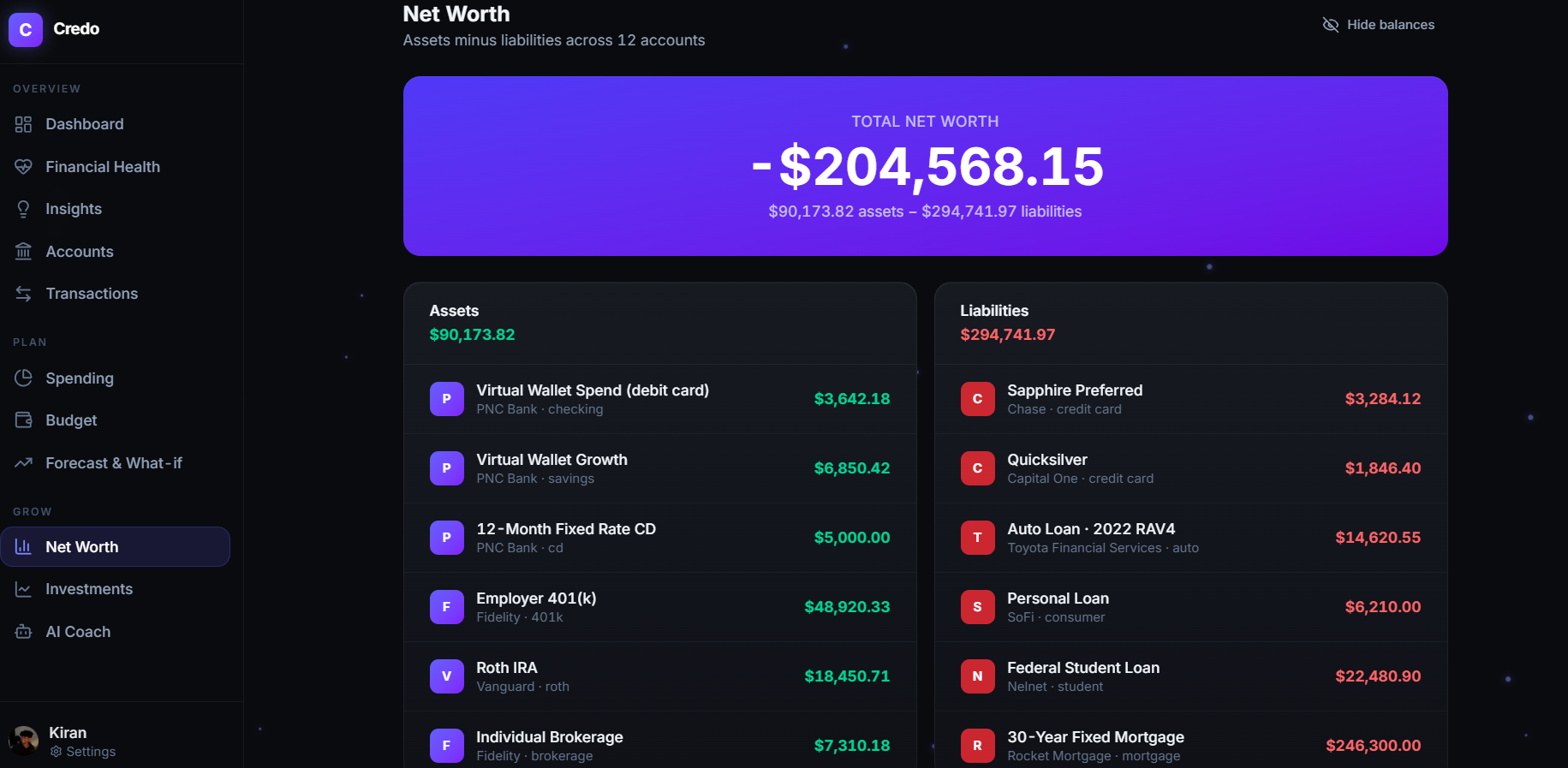
Net Worth
-

Inspiration
Through our team's market research, we noticed that a lot of solutions for this problem area only funnel users in one or two ways. Examples of this include Rocket Money and Credit Karma. With PNC's prompt, we immediately came up with one question. What if we could provide the user with all the tools they needed to make the best financial move, all in one place?
With the question as our spark, our inspiration came from our name. Credo. Credo means "a statement of the beliefs or aims which guides someone's actions." Our mission is to be the guide for people's finances.
What it does
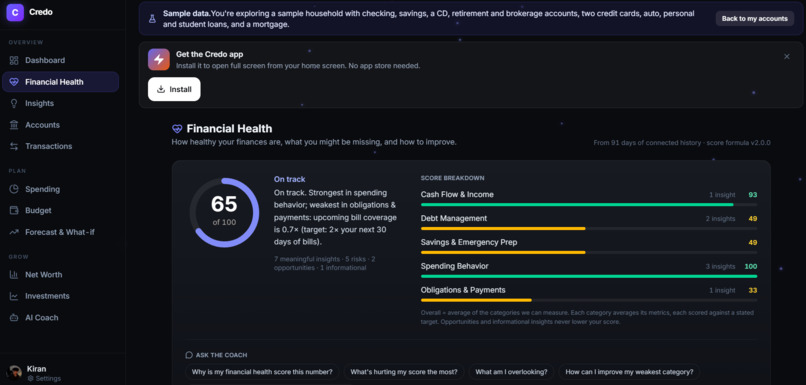
Essentially, Credo is a pipeline of features. The features all relate to each other so the user can intuitively get a big picture of all their finances. These features include 1) A financial dashboard that consolidates accounts, transactions, liabilities, and net worth; 2) A health score that is a number evaluated from the indicators of cash flow, debt management, savings, spending behavior, and financial obligations; 3) A predictive financial forecast that projects future balances and net worth by accounting for upcoming bills and financial commitments 4) A what-if simulator that lets the user explore how decisions like paying down debt, reducing spending, or increasing income could affect their near-term financial future 5) An AI financial coach that provides personalized, conversational financial guidance using the user's actual financial data and suggests actionable next steps.
How we built it
We built Credo using Next.js, React, TypeScript, and Tailwind CSS to create a responsive and user-friendly interface. We used Plaid to securely connect users' bank accounts, Clerk for authentication, and Neon PostgreSQL with Prisma for database management. For the AI functionality, we used Groq's Llama 3.3 70B model for financial analysis and personalized insights. We implemented protected API routes, rate limiting, tokenization (AES-256), and other security measures to safeguard user information. Finally, we deployed our application using Vercel so that we have an accessible platform for users.
Challenges we ran into
It was our first time integrating multiple API's so our biggest challenge was ensuring they worked together seamlessly. As this wasn't built before, integrating multiple technologies that we haven't worked with before took us a lot of research, trial, and error. Getting Groq's model to accurately generate the personalized financial insights we were looking for (instead of general recommendations) was especially difficult. After building everything, it was also a challenge to implement sample data, as we realized multiple things weren't working properly. Working under the hackathon's time constraints was another huge challenge, as we had a big idea with very little time.
Accomplishments that we're proud of
The number one thing we are proud of is that Credo works with real data. We can actually connect our accounts and see our entire financial picture ourselves. We are also especially proud of being able to integrate Plaid's banking API with Groq's Llama 3.3 70B model to have an AI coach that our users could converse with. We also accomplished secure authentication and database management, something extremely important in our current day and age.
Most importantly, we're proud to have created something that isn't big on the scene yet. A platform that goes beyond simply displaying financial data and actually helps users understand their spending habits, make informed decisions, and take greater control of their financial futures.
What we learned
Building Credo was a big lesson on integrating multiple technologies into one full-stack application while balancing functionality, security, and user experience. We learned the importance of designing reliable API workflows, keeping the valuable trust of the user, and optimizing AI responses for accuracy and relevance. Most importantly, we learned how to collaborate effectively under tight deadlines, troubleshoot unexpected challenges, and turn a pretty ambitious idea into a functional product that addresses real-world financial needs.
What's next for Credo
Since Credo is already very broad in its capabilities, next we want to expand the depth of the features. We plan to introduce expansions in banking integrations, strengthen data security, and refine user experience so that it is more intuitive for the user. We want to test the accuracy of Credo's AI coach with a team of financial advisors and also conduct user testing so that we can receive feedback to further improve our features. Ultimately, we want Credo to evolve into a proactive tool that helps users make better financial moves.
Built With
- ai-financial-advisor
- artificial-intelligence
- financial-forecasting
- financial-health
- financial-literacy
- financial-wellness
- fintech
- generative-ai
- hackutd
- javascript
- machine-learning
- personal-finance
- plaid-api
- pnc
- predictive-analytics
- python
- smart-budgeting
