-
-
How it works
-
Cover
-
User journey
-
Texting experience
Inspiration
Many students get their first credit card before anyone explains how credit works. Then something like an apartment application makes that history matter.
Growing up, we were never taught much about money. We wanted help to feel as approachable as texting someone you trust: someone who remembers what you’ve shared, explains unfamiliar terms, and helps you figure out what to do next.
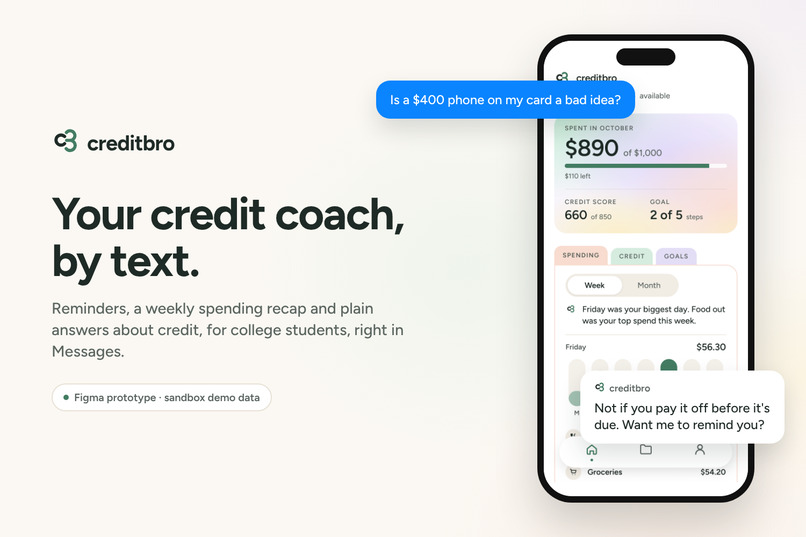
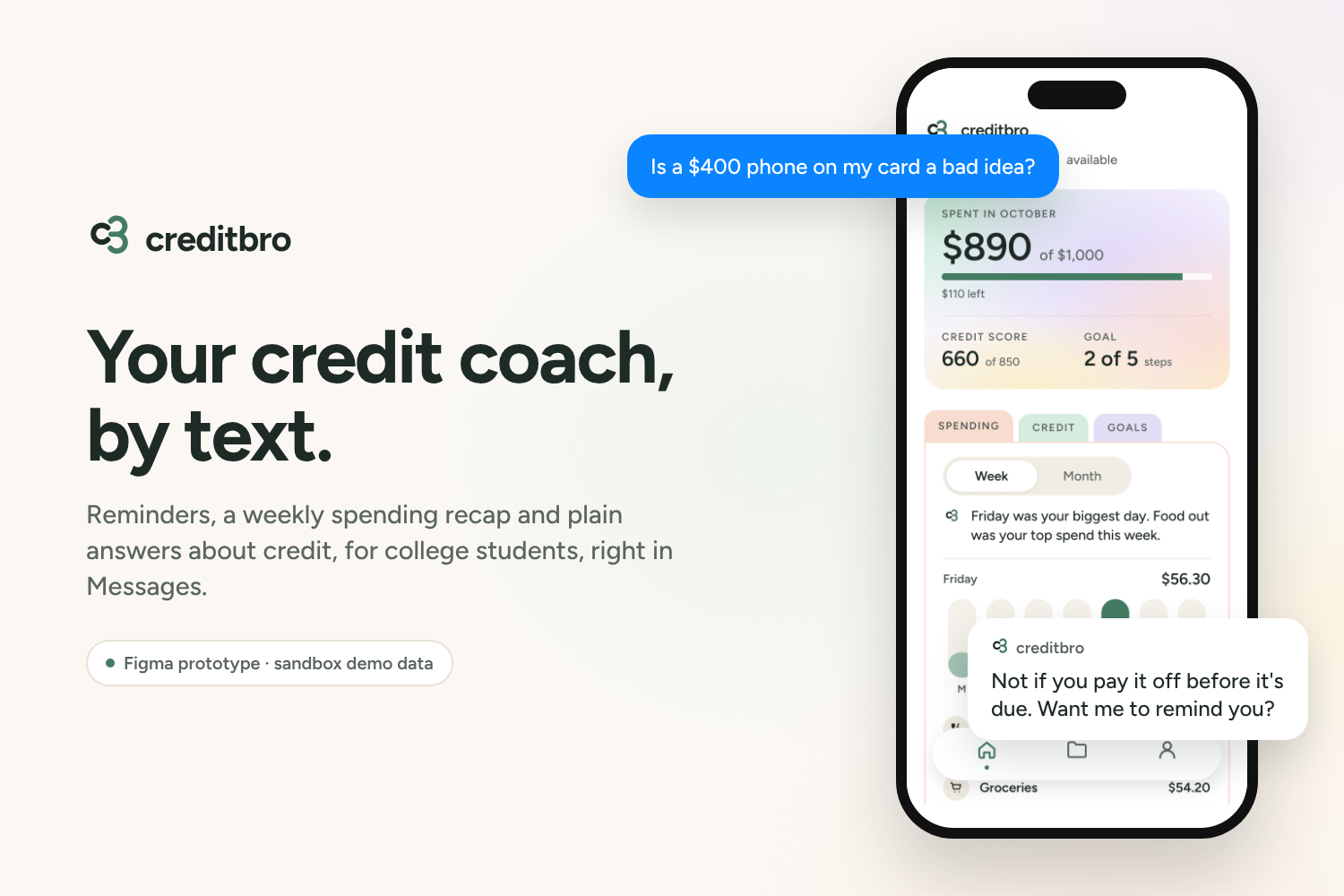
That became Creditbro, your credit coach by text. Our initial focus is college students managing their first credit card and preparing for their first off-campus apartment.
What it does
Creditbro helps students understand credit, remember bills, review spending, and work toward financial goals through short text conversations.
A conversation might start with “Why is my credit score low?” Creditbro can explain relevant credit information, ask about payment habits, and help the student set a reminder. The goal is to connect an explanation to a useful next action.
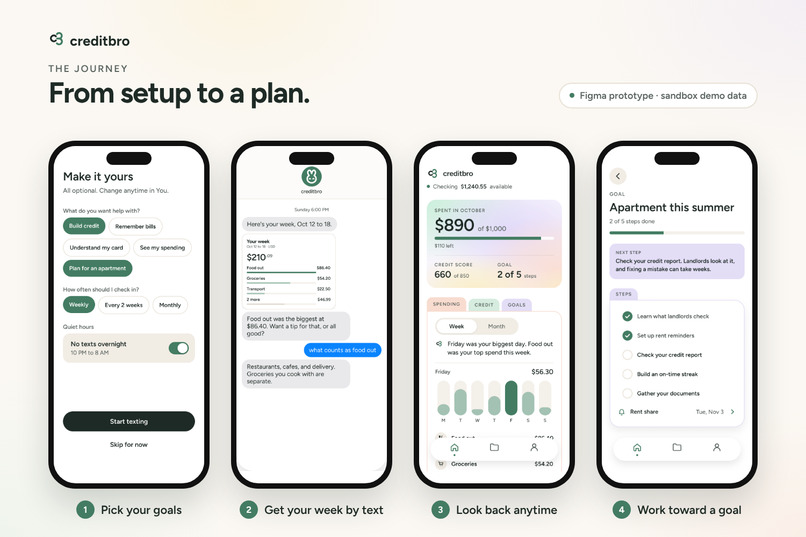
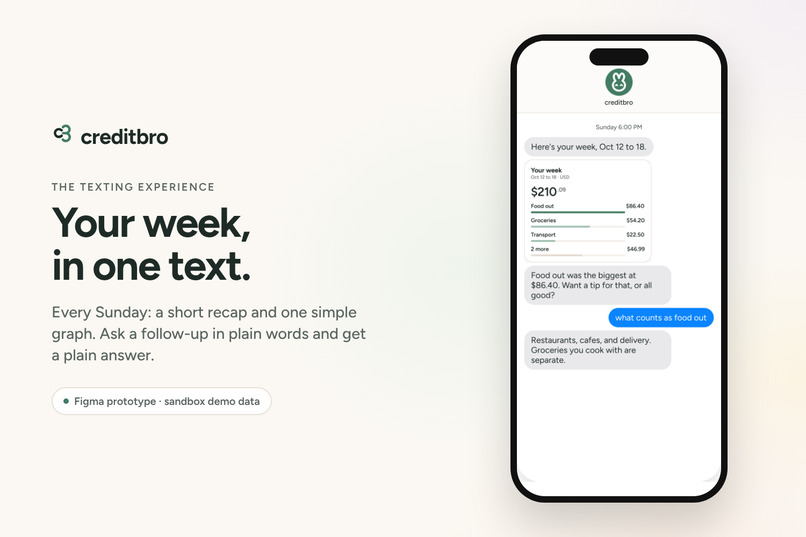
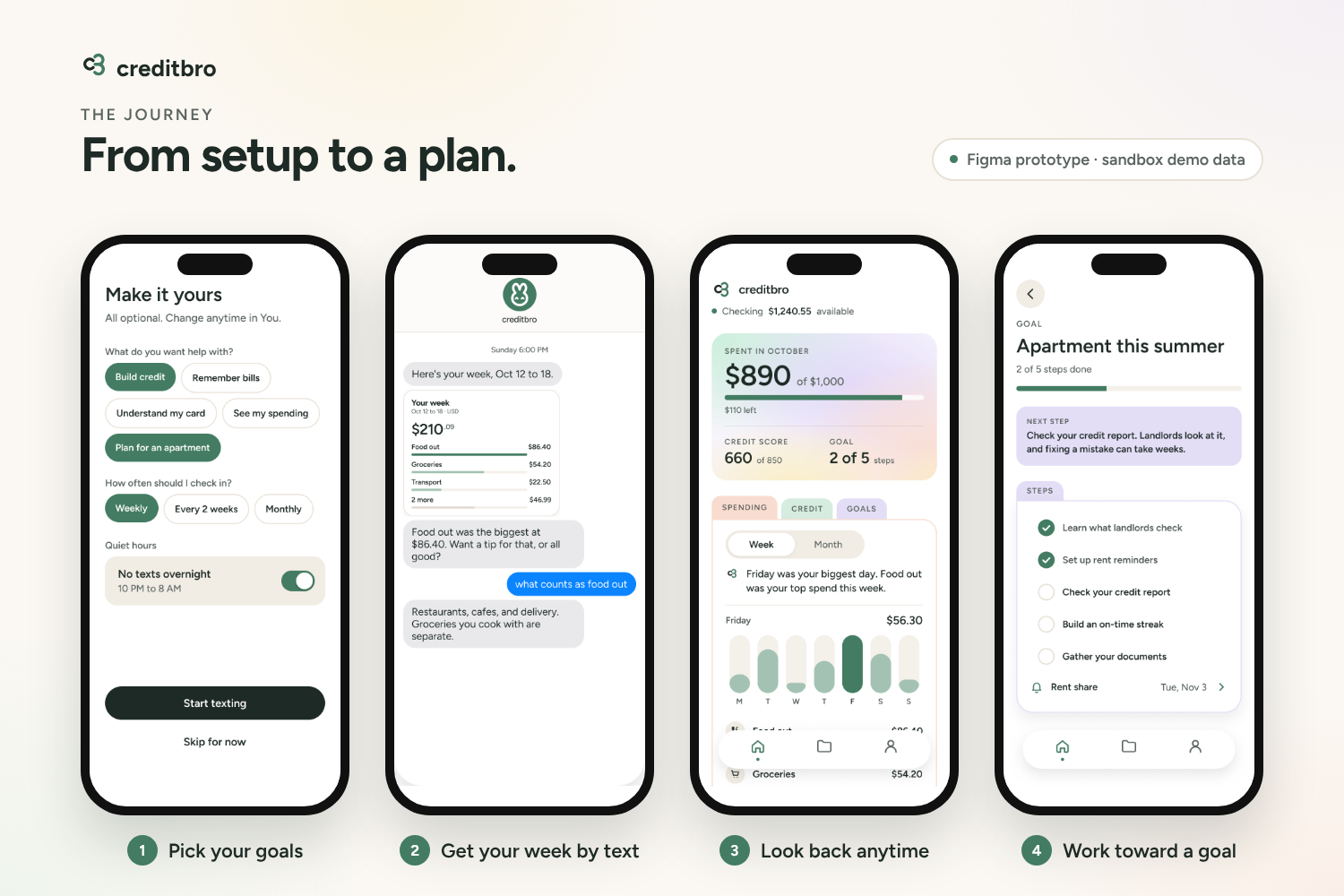
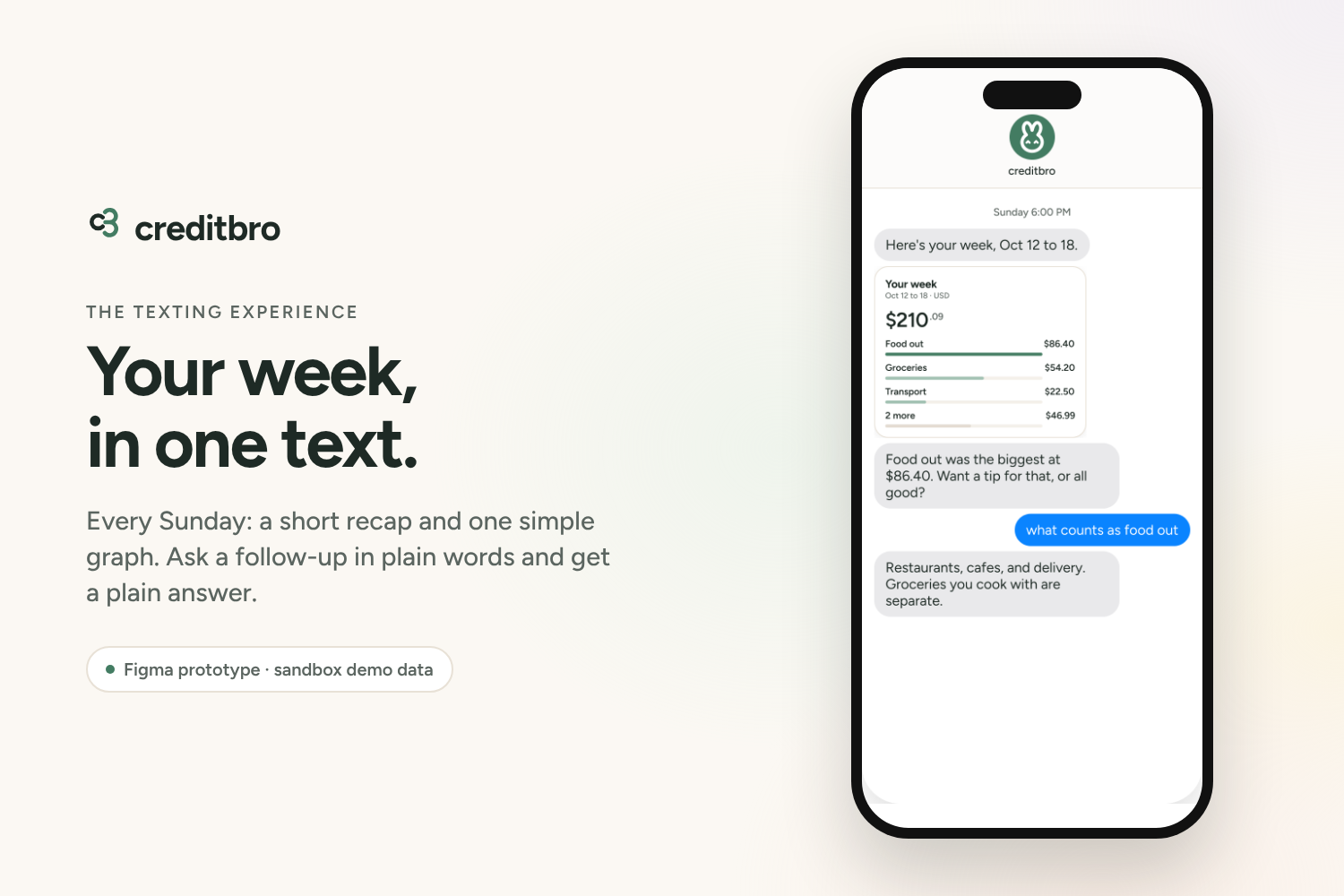
Students choose what information to share and how often they want check-ins. Monthly spending reports provide a visual breakdown, while weekly check-ins are optional.
For bigger goals, students can explicitly request a project, such as preparing for an apartment. After they approve the information shared for planning, Creditbro develops proposed next steps and asks for missing details rather than guessing.
The companion dashboard provides three views:
- Home: spending and credit information.
- Library: reports, reminders, and project plans.
- You: profile information, connectors, and preferences.
The website links to separate phone and desktop dashboard layouts.
Our texting prototype runs through BlueBubbles on a Mac. The public website offers static Figma previews, an isolated Claude conversation demo, and dashboards with fictional example data. The public demo cannot access personal accounts or send phone messages.
How we built it
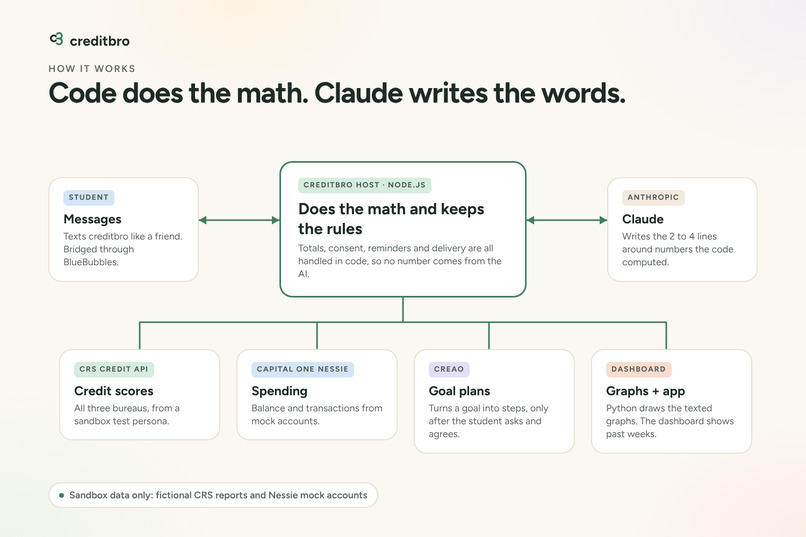
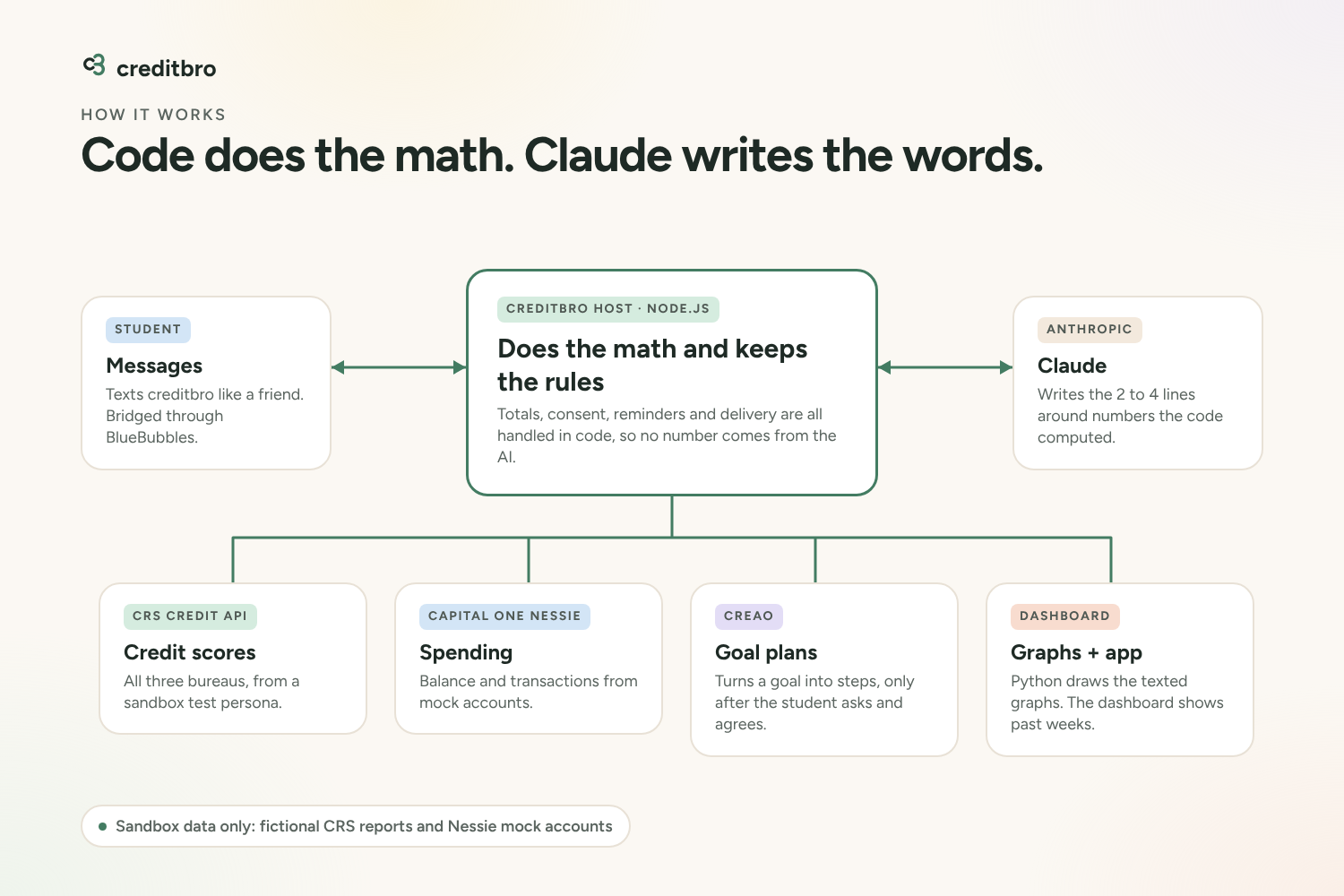
We built a Node.js backend to coordinate conversations, financial context, project planning, reminders, and delivery. Claude interprets student requests and writes the coaching responses. Application code handles calculations, permissions, scheduling, and saved state. Python renders spending summaries as images.
Anthropic / Claude
Claude makes the experience conversational. Students can ask questions in their own words instead of navigating financial terminology or a long questionnaire.
We refined its instructions and examples around a simple principle: answer the question, use the context already available, ask only the next useful follow-up, then stop.
CRS Credit API
Our backend requests CRS sandbox credit reports and extracts dated credit facts, including bureau scores and reported account information.
Those facts inform explanations and authorized project plans. We keep score models and bureau snapshots distinct. A reported balance is not treated as a current bank balance or payment deadline.
Capital One Nessie
Creditbro calls the Nessie API for mock accounts and banking activity. Our code calculates income, spending, and budget summaries from imported transactions.
We distinguish API results from separately authored demo information, including credit limits and payment dates used in scenarios. Nessie and CRS are separate fictional sources; we do not claim they identify the same real person or account.
CREAO
When a student explicitly requests a project and approves sharing relevant context, our backend calls a saved CREAO agent to create a structured planning proposal.
The backend manages asynchronous runs and checks source references and numerical claims before saving the result. Plans contain proposed next steps, not completed financial actions.
Agent ID: 7c1f7506-2488-4564-8935-f3b1ee54666d
Completed run: View the Creditbro planning run
This run uses fictional Nessie banking context and CRS sandbox credit facts. It shows a corrected proposal after our validation rejected an unsupported available-cash claim.
Figma and development workflow
We used Figma to develop the branding, components, dashboard, prototype, and spending-report designs. Claude helped us iterate inside Figma through its MCP connection.
We passed exported assets, design tokens, frame references, and handoff specifications into implementation. Both Claude and Codex helped with ideation. Codex also supported implementation, integration, testing, and deployment.
Our Figma Slides and stage log document the iterations, tool choices, handoffs, and things that did not work. The presentation, prototype, source code, and public website are linked in this submission.
Notability
We used Notability to bring together our sketches, design decisions, and feedback. The finished notes document how Creditbro evolved, what we changed, and what we would improve next.
Challenges we ran into
Getting messaging to work. We initially tried Telnyx, but outbound messages were blocked while carrier registration was pending. After advice from a hackathon mentor, we moved to BlueBubbles and built the prototype around our Mac-based messaging setup.
Making the conversation feel natural. Early versions asked too many questions and produced generic next steps. We revised the flow to answer first, remember context, and ask for one useful detail at a time.
Keeping financial claims grounded. A budget remainder is not the same as available cash. During testing, our validation rejected a planning response that blurred that distinction. The revised proposal separated supported figures from missing information instead of assuming the student could afford a payment.
Coordinating background work. A project plan can finish after the conversation has moved on. A messaging provider accepting a message also does not prove it reached a phone. We built explicit state tracking for planning, retries, cancellation, and delivery outcomes.
Keeping design and implementation aligned. Reports and screens changed through several iterations. Exported tokens and a structured handoff helped us carry those changes into code more consistently.
Accomplishments that we’re proud of
We brought conversation, credit evidence, spending summaries, reminders, and project planning into one connected prototype.
We are especially proud of connecting short text responses with a dashboard that provides more detail when students want it. The experience does not require every question to become a full financial-planning session.
We also built checks around what the agent can claim and do. Missing information stays missing, calculations remain in application code, and a proposed plan is not presented as an action already taken.
What we learned
Connecting APIs is only part of building a useful product. The timing, wording, and next step matter just as much.
We learned to distinguish different kinds of financial information. A credit-report snapshot, imported banking activity, and a student’s stated goal each answer different questions. Combining them responsibly requires preserving their sources and limitations.
We also learned to adapt our workflow. We moved between code, Figma, conversation testing, and visual refinement as the product developed. Documenting what passed between those stages made collaboration easier.
What’s next for Creditbro
We want to move the backend to hosted infrastructure and support messaging without relying on our personal accounts.
We would also like to explore authorized access to real credit reports and banking information, with explicit consent and appropriate privacy controls.
Our proposed first pilot would involve Stanford students in personal finance classes, particularly those managing their first credit card and preparing to rent off campus.
We would evaluate whether students can identify their next payment action, understand reported card usage, and complete a useful step toward their housing goal. These are planned measures, not outcomes we have collected yet.
Built With
- anthropic
- bluebubbles
- capital-one-nessie-api
- claudecode
- codex
- creao.ai
- crs-api
- css
- figma
- html
- javascript
- node.js
- notability
- python
- react
- typescript

Log in or sign up for Devpost to join the conversation.