-
-
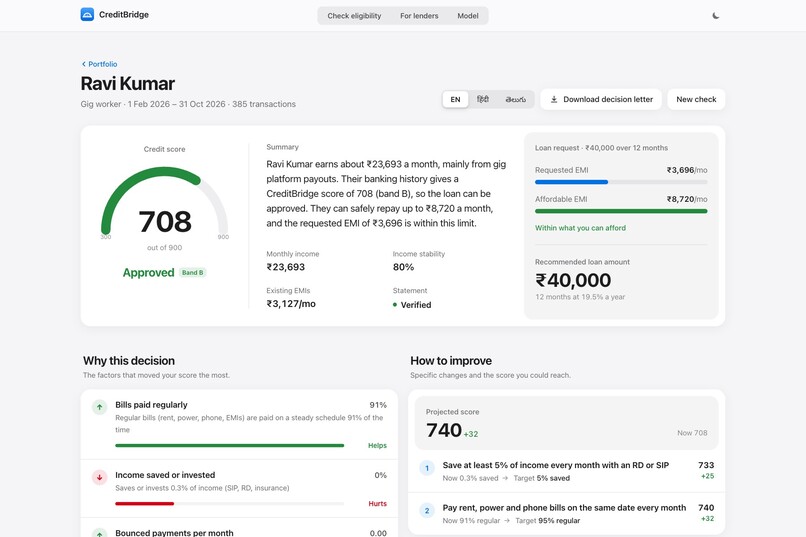
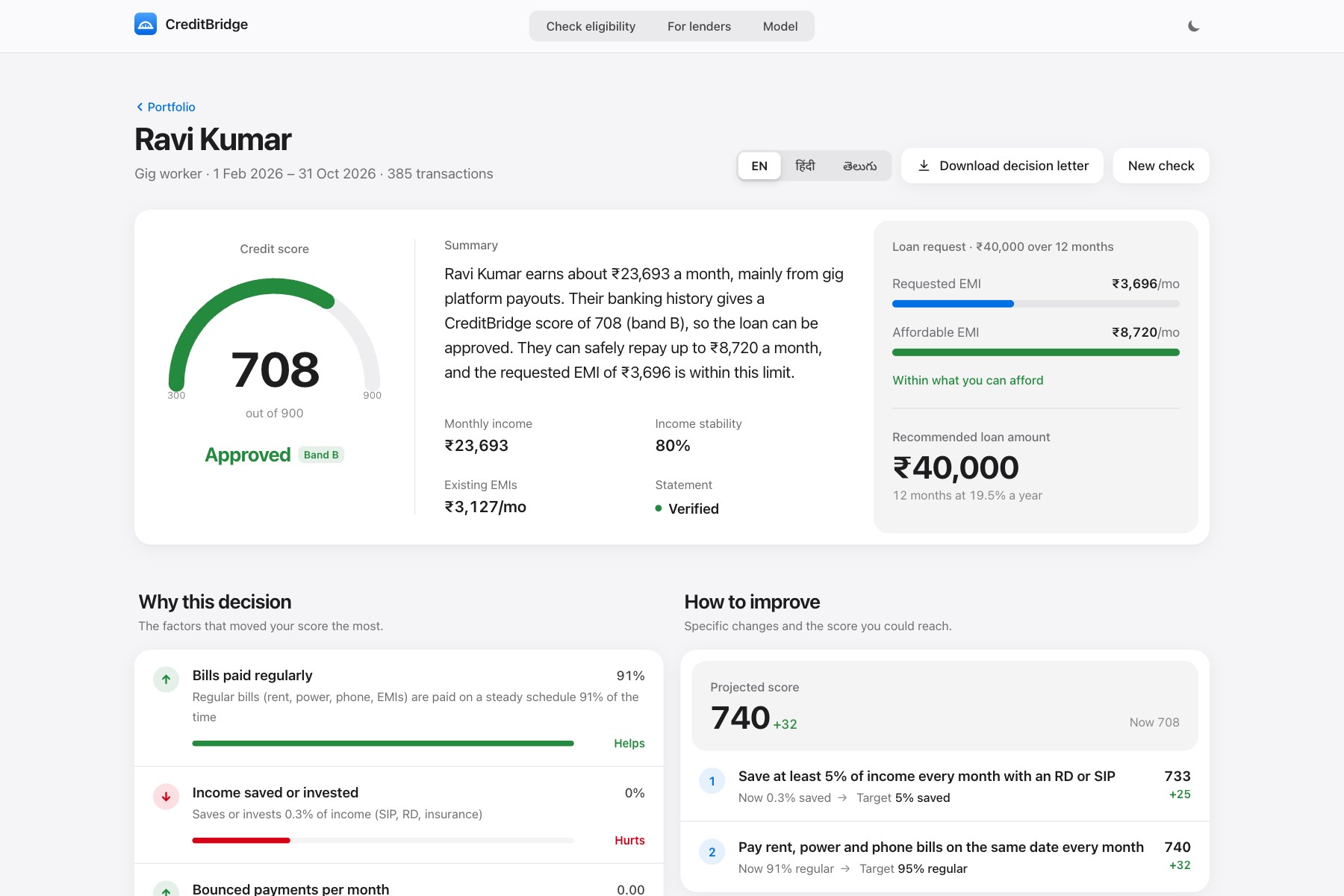
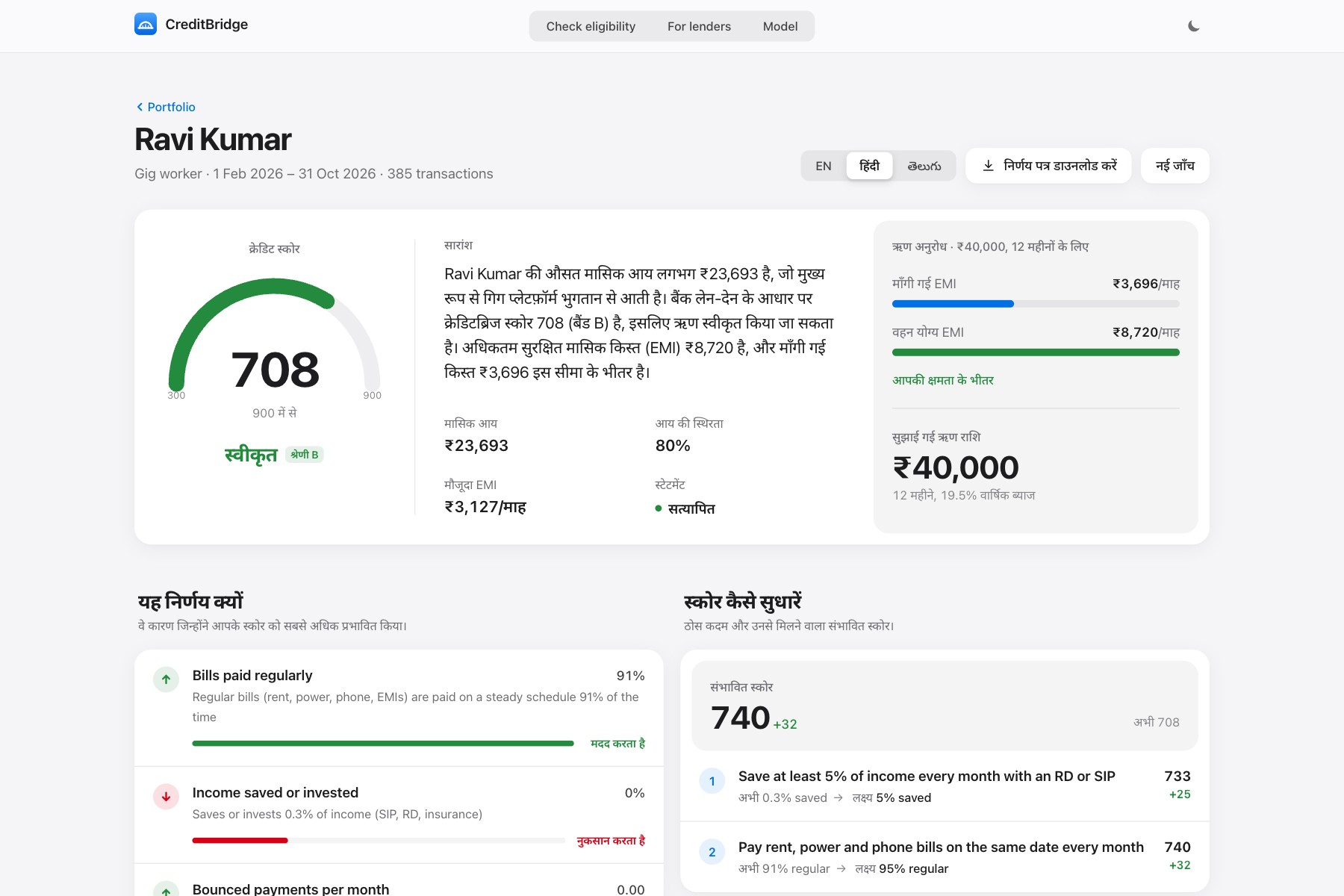
Decision report: score, band, affordable EMI vs requested, plain-language summary
-
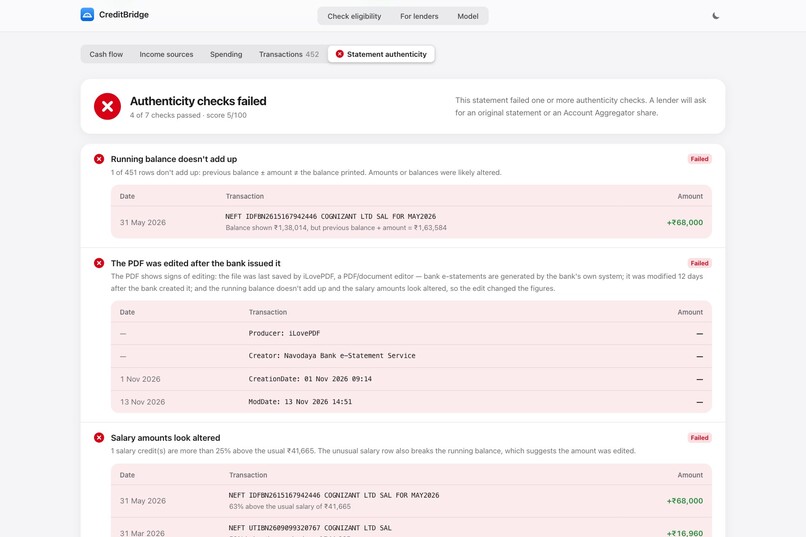
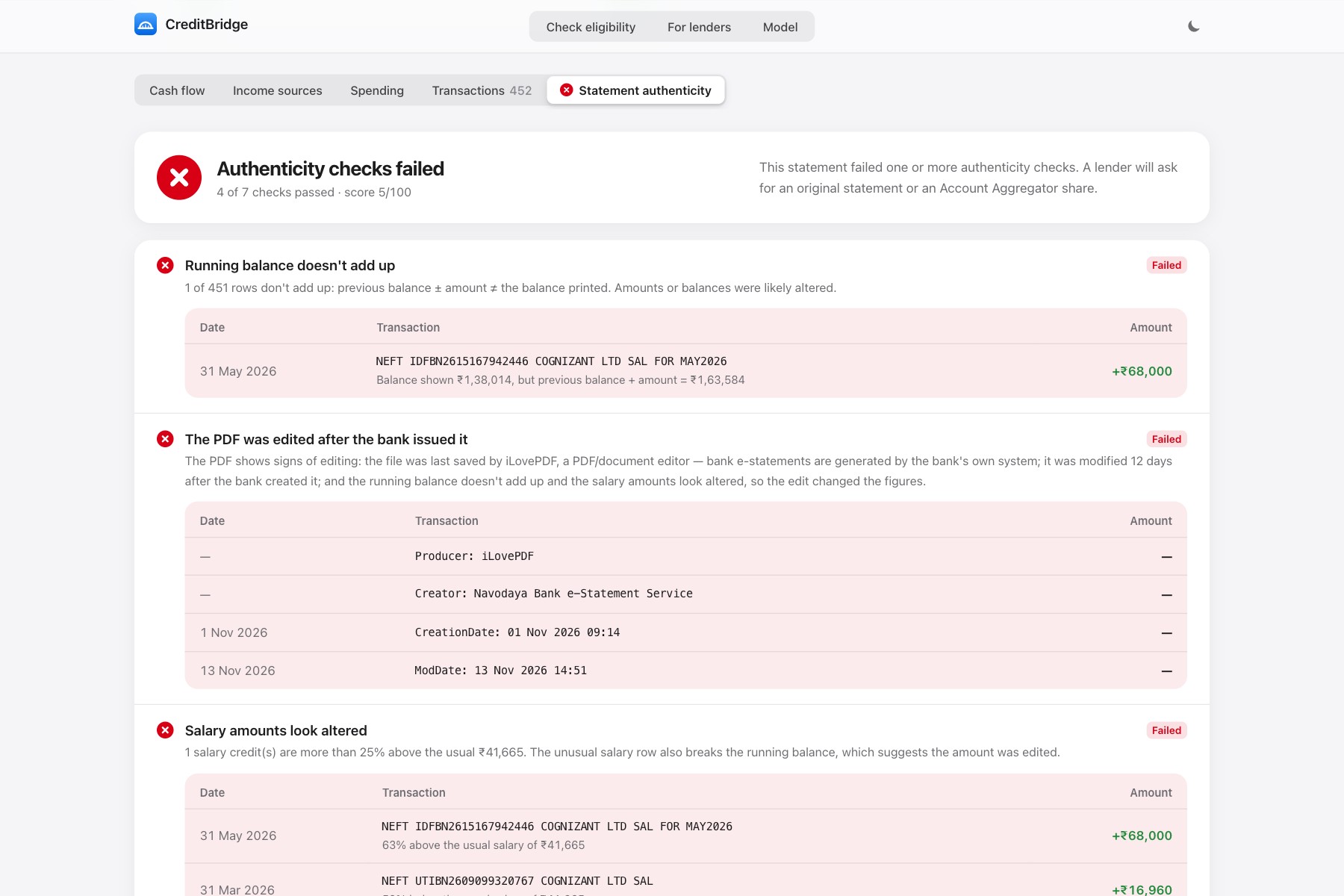
Forged statement caught: balance breaks, PDF edited with iLovePDF, salary altered
-
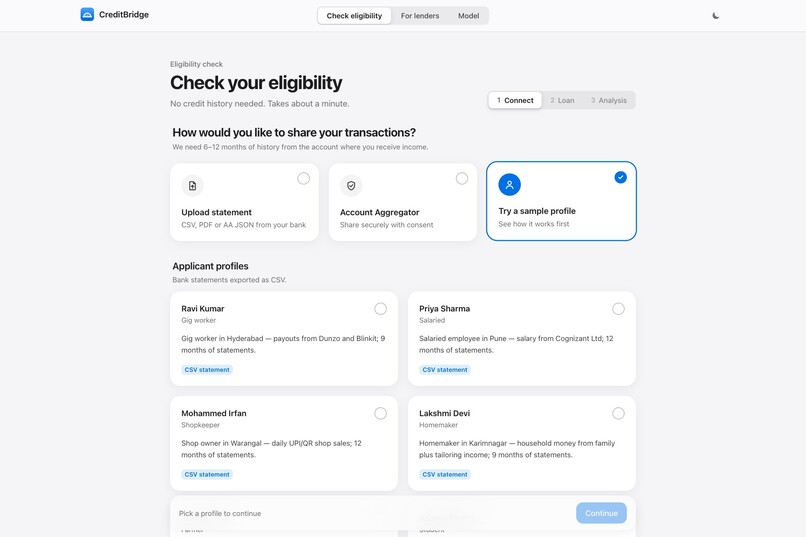
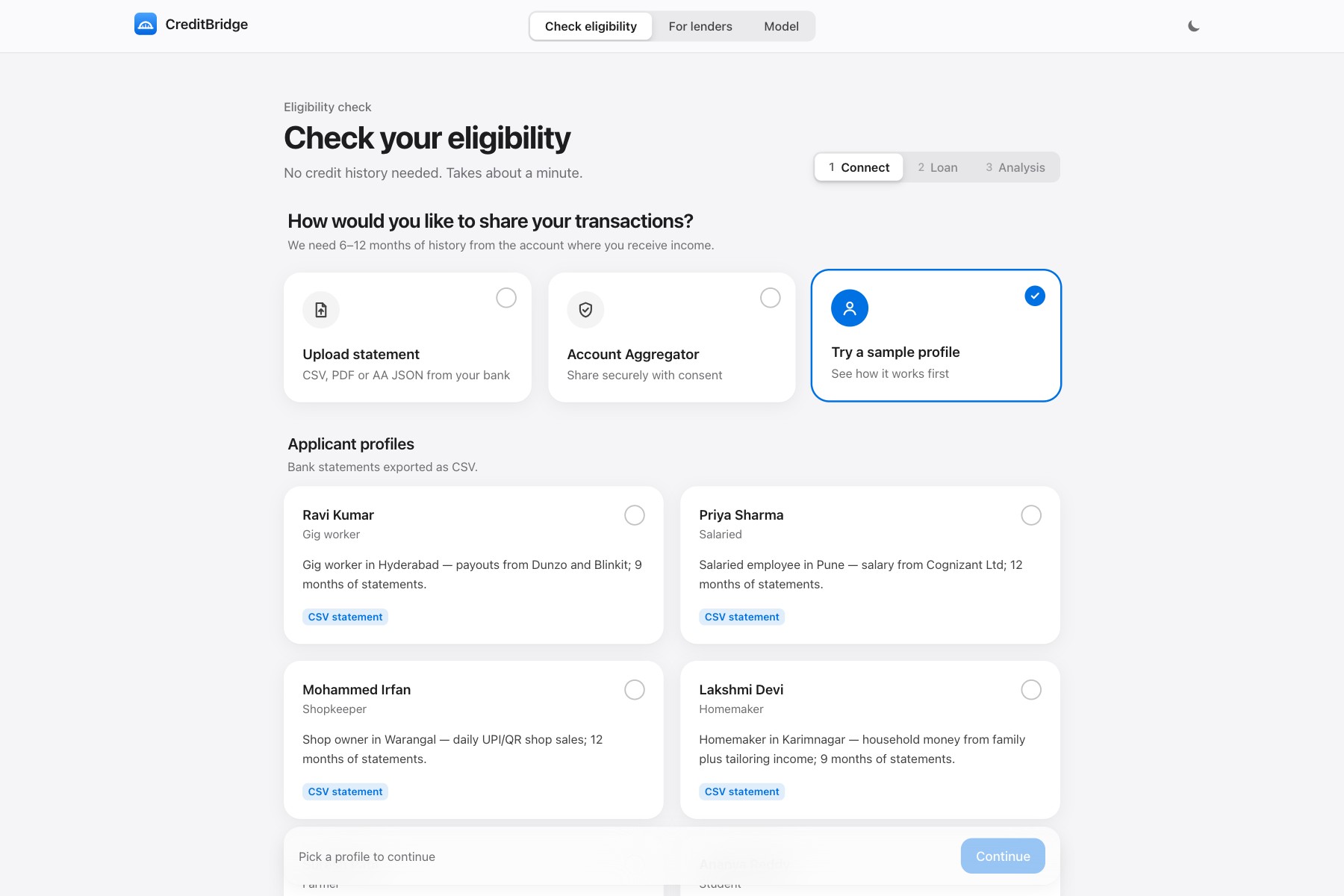
Check eligibility: upload a statement, Account Aggregator consent or a sample profile
-
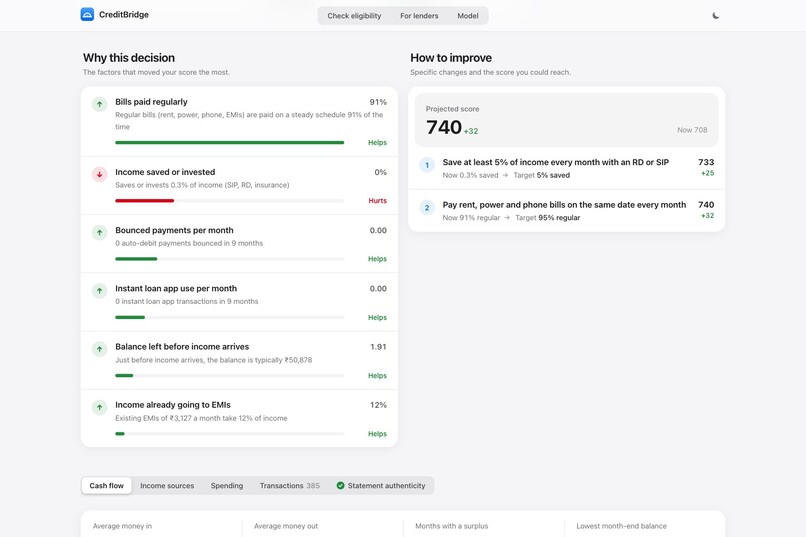
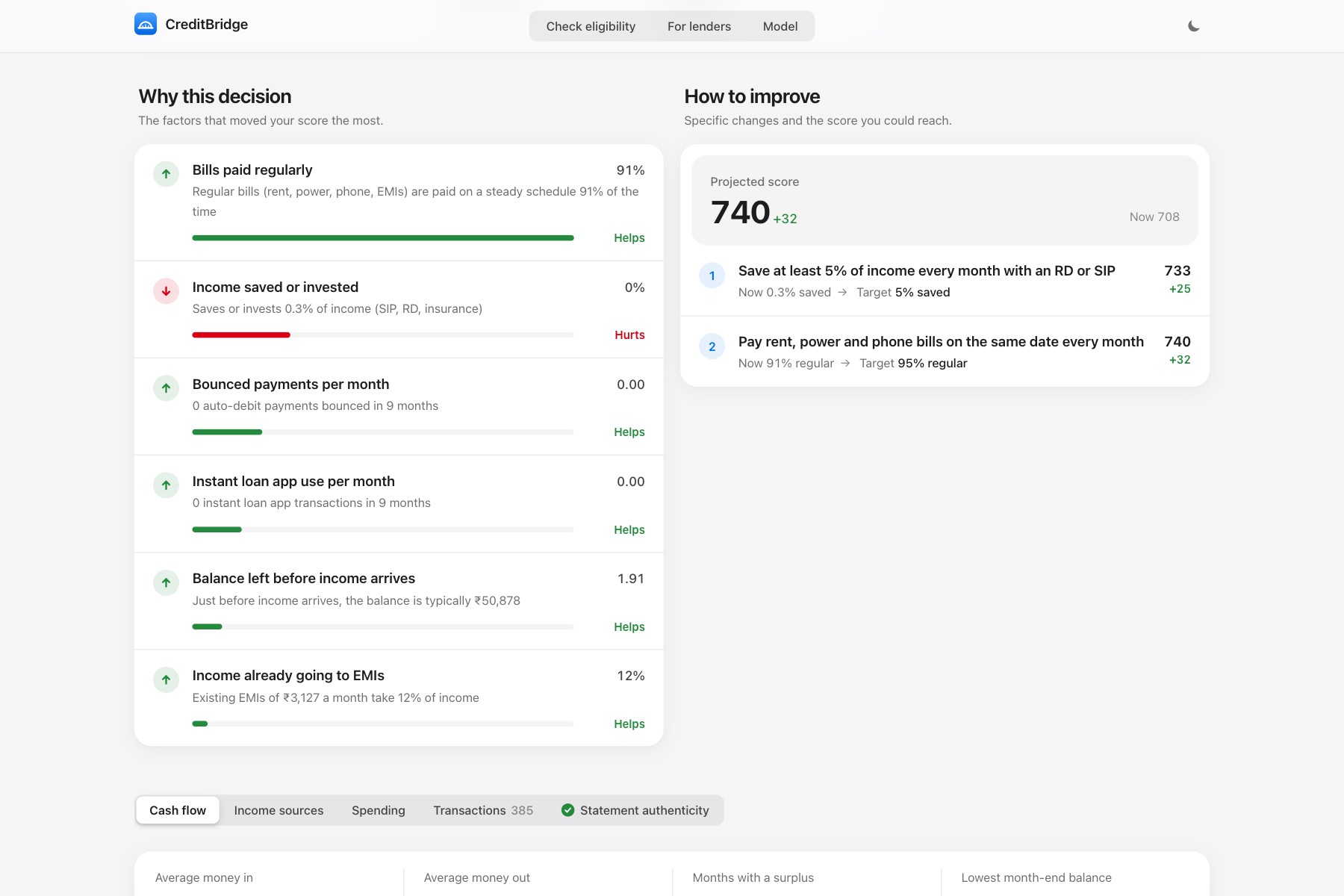
Why this decision and how to improve, with the projected score after each step
-
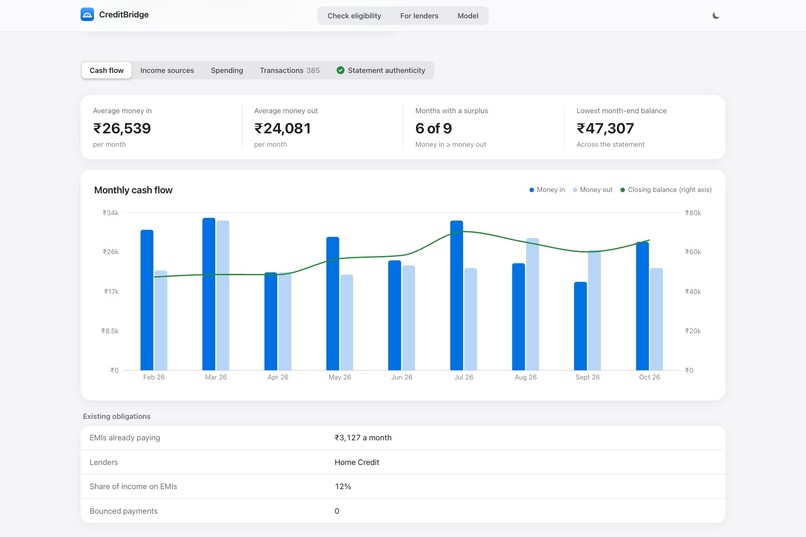
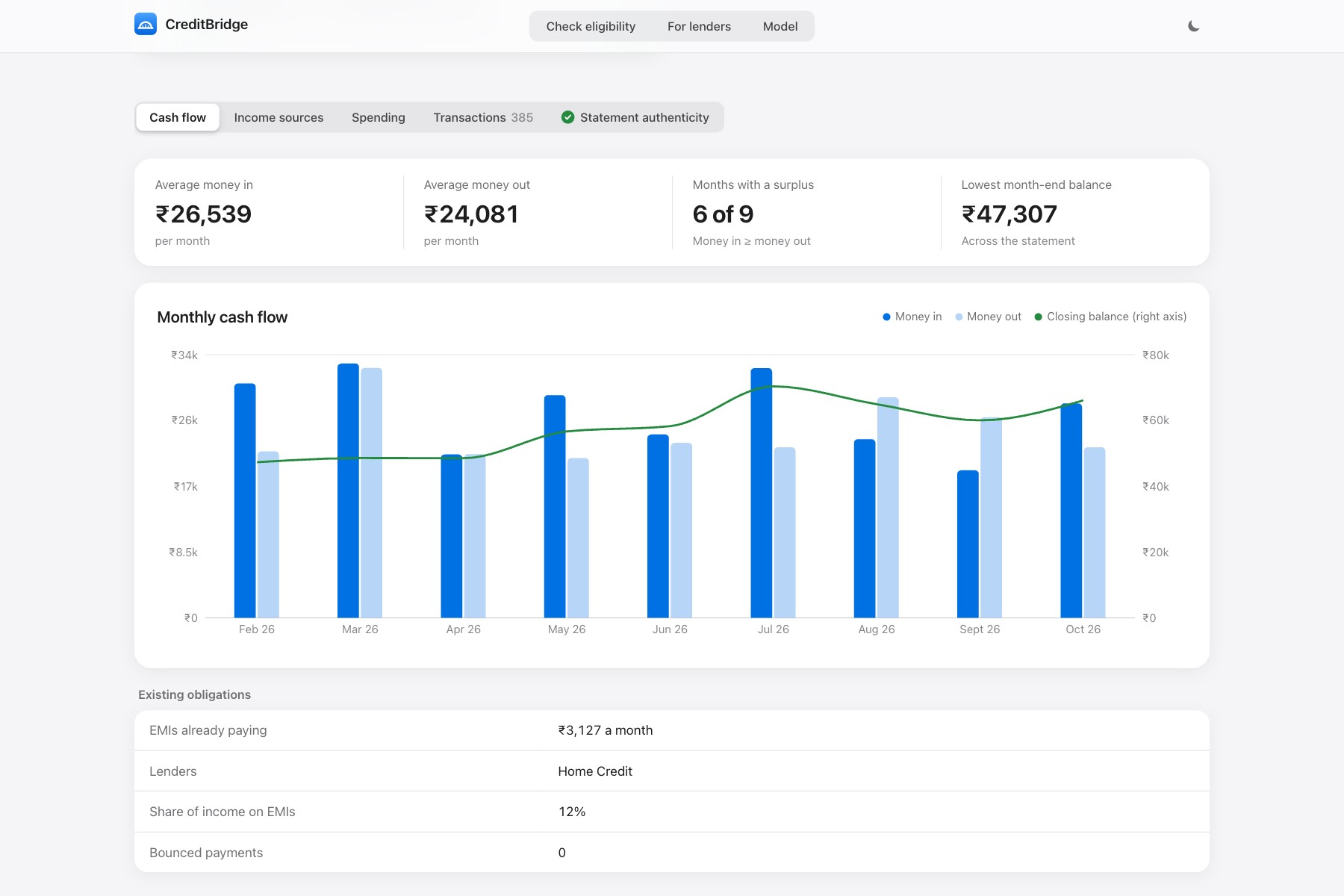
Cash flow: monthly money in/out and balance, existing obligations
-
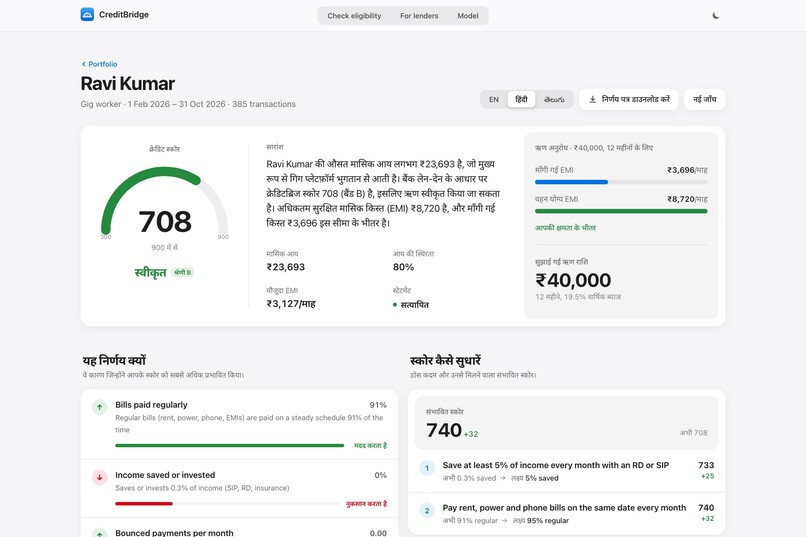
Every report in English, Hindi and Telugu
-
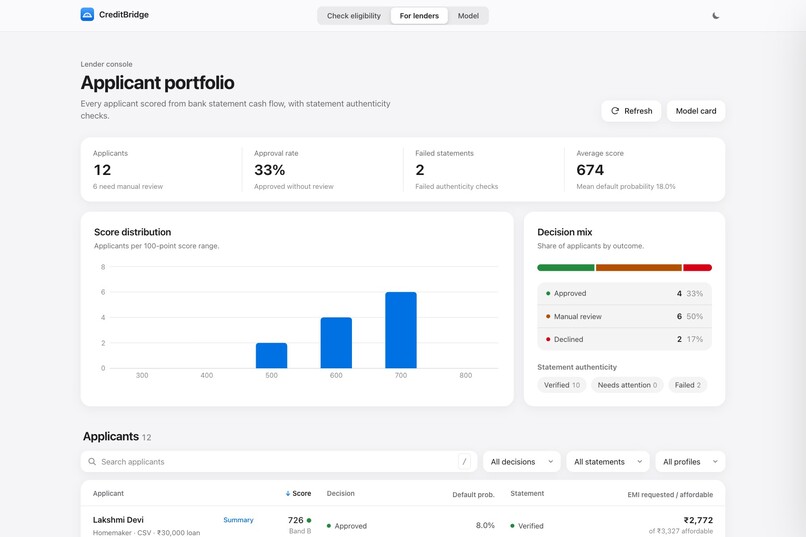
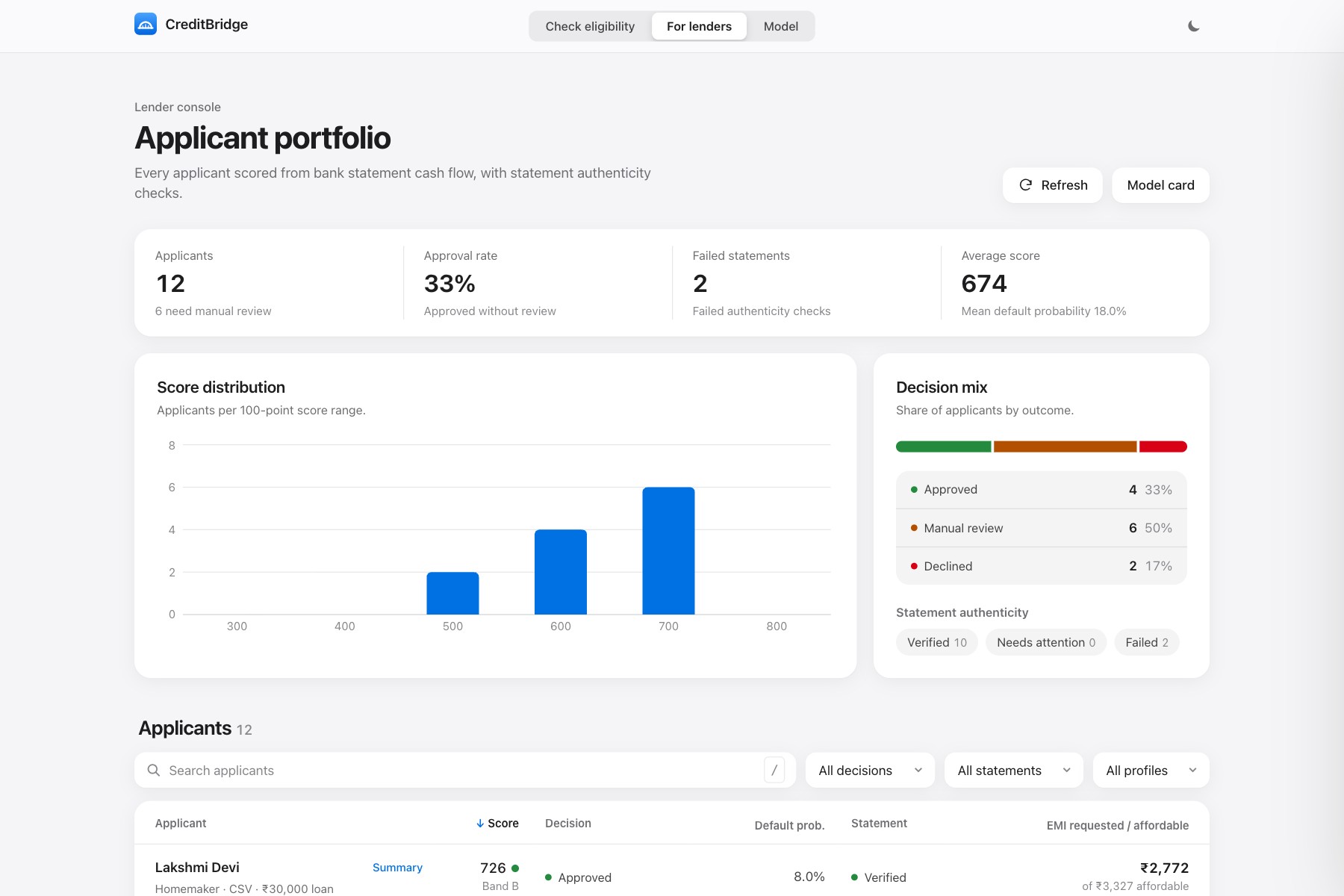
Lender console: portfolio KPIs, score distribution, decision mix, flagged statements
-
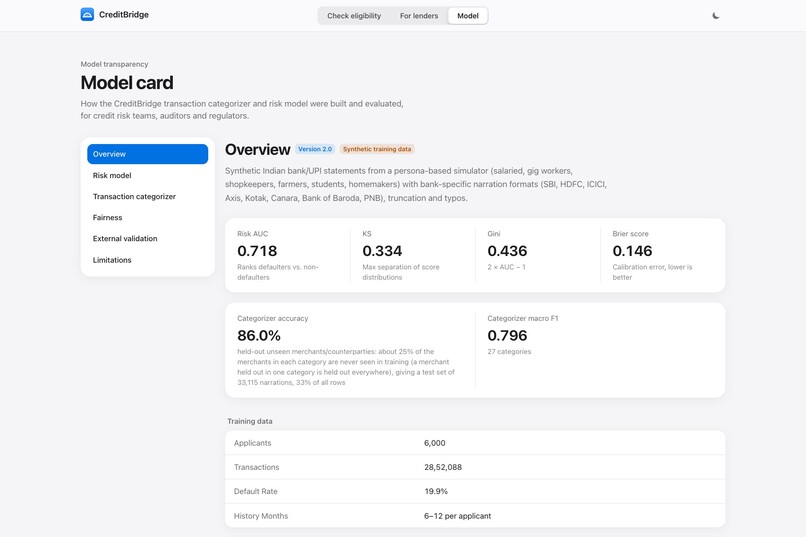
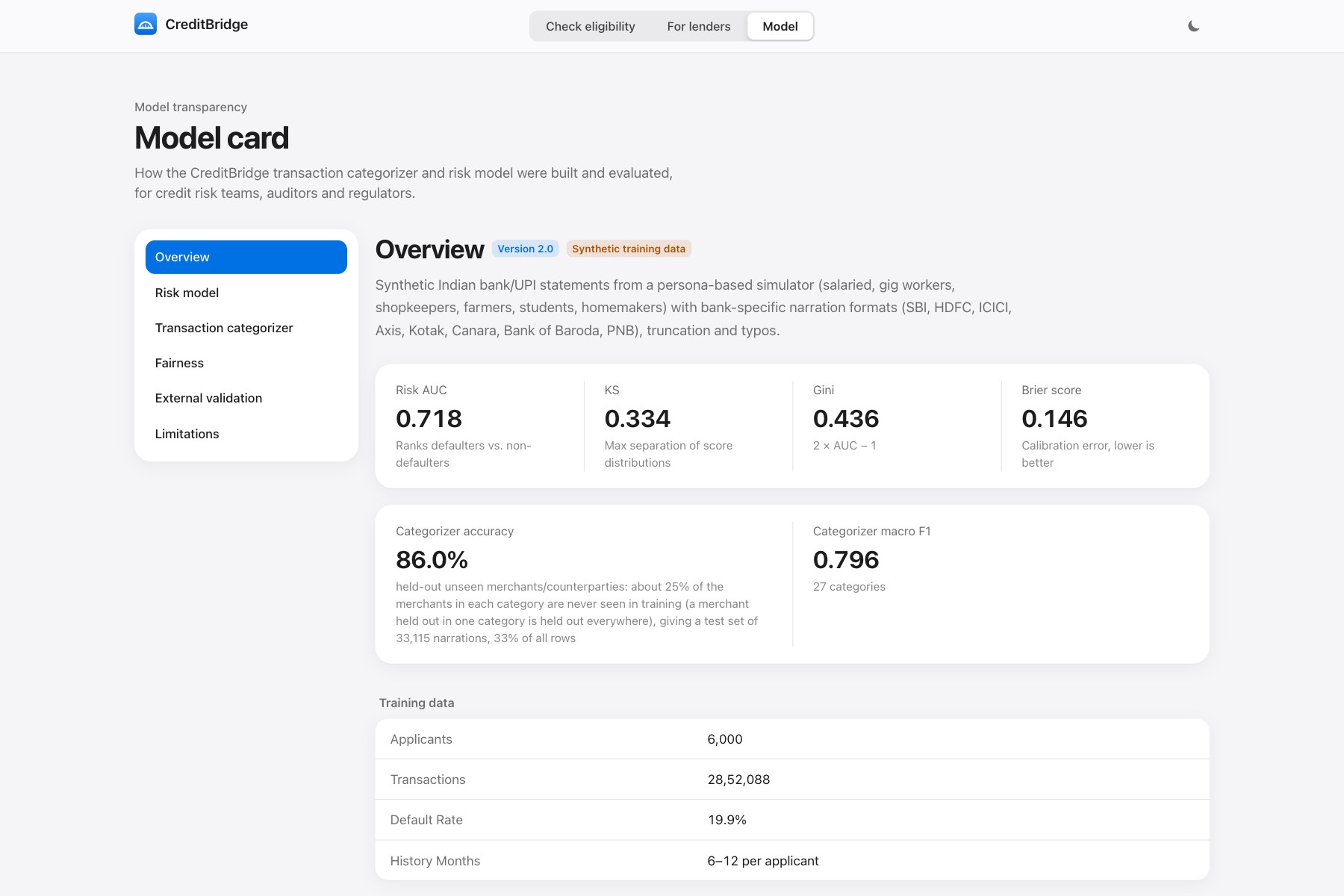
Model card: AUC, KS, Gini, Brier, categorizer accuracy, fairness and limitations
-
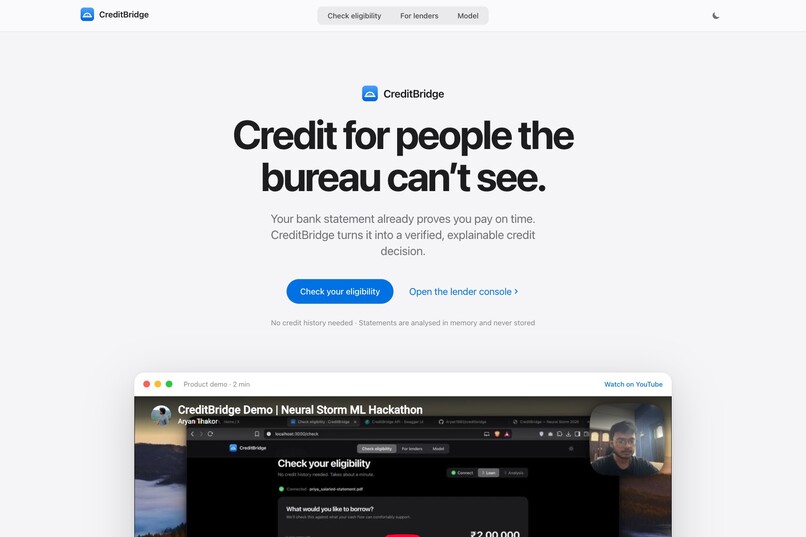
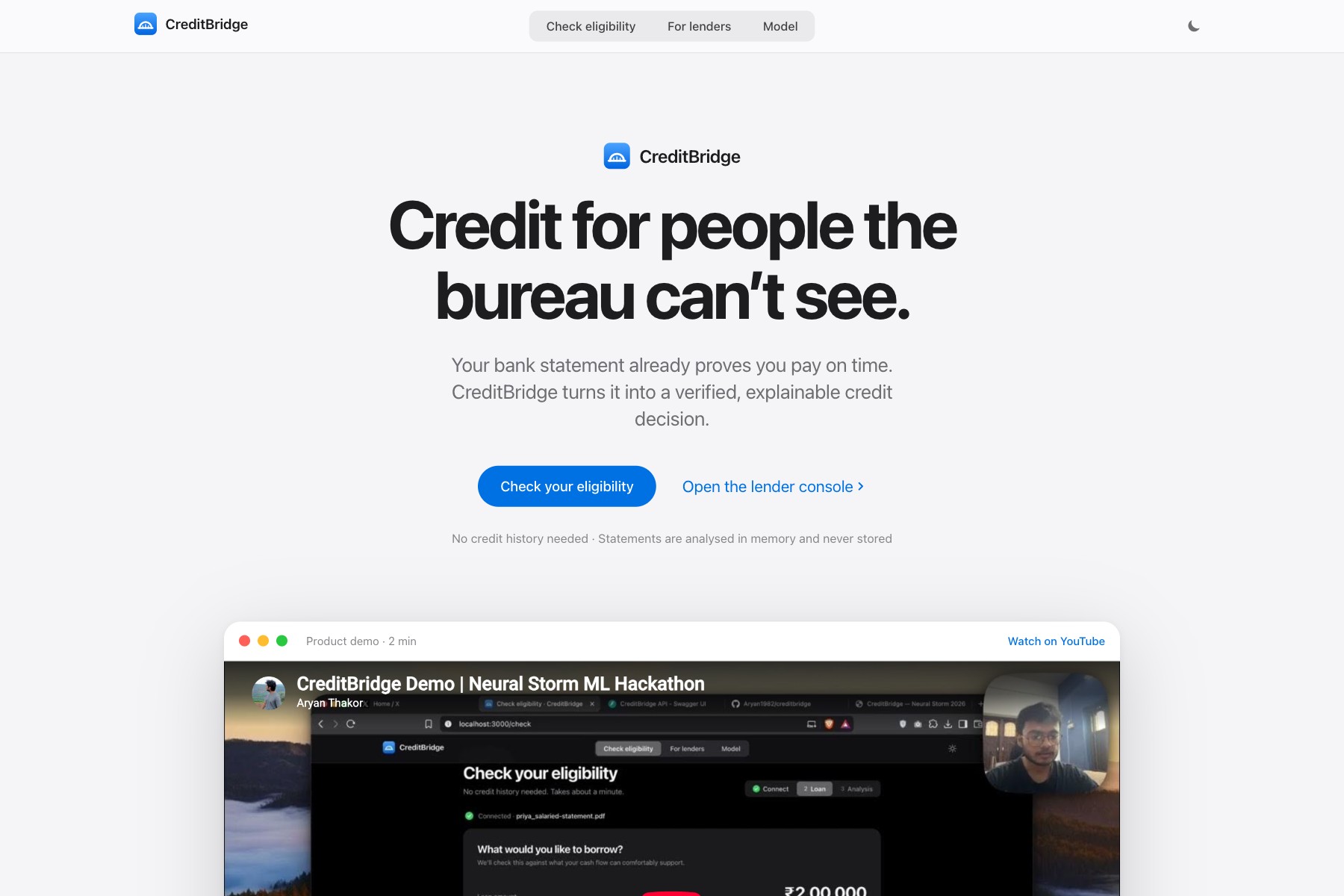
Landing page with embedded product demo
Inspiration
About 190 million Indian adults have no usable credit score. Lenders decide from bureau history, so gig workers, shopkeepers, farmers, students and homemakers are refused or pushed to instant-loan apps, even when their bank account shows steady income and on-time bills. The evidence is already in their bank statements, but lenders can't use it: statements are thousands of cryptic UPI narrations, they are easy to forge, and there is no explainable way to turn cash flow into a decision.
What it does
CreditBridge turns 6-12 months of bank data into an explainable credit decision in seconds.
- Connect data: upload a bank statement (PDF/CSV), connect through an RBI Account Aggregator consent screen, or try a sample profile.
- Authenticity checks: running-balance continuity (catches edited amounts), PDF metadata edits, duplicate transaction IDs, date gaps, salary consistency, and round-tripping (money sent back to the same person within 72 hours is fake income and is excluded). A failed check blocks auto-approval and shows the evidence rows.
- Transaction understanding: an ML categorizer reads every narration into 27 categories.
- Decision: a 300-900 score, A-E band, approve / review / decline, reason codes, FOIR-based affordable EMI vs the requested EMI, and a recommended loan amount.
- How to improve: concrete actions with the projected score after each one.
- For borrowers: summaries in English, Hindi and Telugu, plus a printable decision letter.
- For lenders: a portfolio console with flagged statements, and a model transparency page for risk and compliance teams.
How we built it
- Simulator (Python): no public dataset of Indian bank statements with repayment outcomes exists, so we built a persona-based simulator: salaried, gig workers, shopkeepers, farmers, students and homemakers, with narration formats from 8 banks, truncation and typos. Hidden traits (money discipline, income-shock risk, liquidity stress, loan-app and betting propensity) drive behaviour. Default is simulated over a separate future window with fresh shocks and noise, so it can't be read straight off the statement. 6,000 applicants, 2.85M transactions.
- Model 1, transaction categorizer: char 3-5-gram + word TF-IDF → multinomial logistic regression (scikit-learn), evaluated on merchants never seen in training.
- Model 2, risk scorecard: 17 cash-flow features (bill regularity, savings rate, FOIR, loan-app use, bounces, balance before payday, betting, income variability...) → a sign-constrained L2 logistic regression fit with SciPy L-BFGS-B: every weight is forced in the direction lending logic expects or to zero, so a reason code can never be reversed by collinearity. Selection and scaling are refit inside each of 5 CV folds, and it is benchmarked against a WoE scorecard and gradient boosting on the same features and folds. Every decision splits exactly into per-feature contributions, which become the reason codes and drive the counterfactual search.
- Policy guardrails: statements under 90 days or 30 transactions are never auto-approved; no verifiable income is declined; failed authenticity checks block approval. Approve/review PD cut-offs are fixed policy, not tuned on outcomes.
- No LLM or generative AI anywhere in the product: the multilingual summaries are templates filled with the applicant's numbers.
- Runtime: models exported to JSON and run with numpy only (parity with scikit-learn asserted at training time), served by FastAPI as a Vercel Python function. pdfplumber parses statements. Nothing is stored.
- Frontend: Next.js 16, React 19, TypeScript, Tailwind 4, Recharts.
- Quality: 107 pytest tests (parsers, forgery checks, scoring invariants, API) and GitHub Actions CI on every push.
Results
| Component | Metric |
|---|---|
| Categorizer, unseen merchants | accuracy 0.860, macro-F1 0.797 |
| Risk scorecard (deployed, 5-fold CV) | AUC 0.718, KS 0.334, Gini 0.436, Brier 0.146 |
| Benchmarks (same features and folds) | WoE scorecard 0.726, gradient boosting 0.723 |
| Bureau-like baseline (EMI + any bounce) | AUC 0.609 |
| Default rate by band A → E | 3.7% → 7.1% → 13.1% → 25.5% → 44.1% |
| Auto-approved / declined default rate | 6.6% / 35.4% |
Real-data validation (Statlog German Credit, 1,000 real applicants): alternative features alone reach AUC 0.751 vs 0.625 for bureau features. On the 89 applicants with no or fully-paid prior credit, alternative data reaches 0.682 while bureau features carry no usable signal (0.338); that subset is small and defined by a bureau field, so we treat it as directional.
Fairness: gender is never a model input. Approval rate is 22.8% for women vs 21.0% for men; among people who repaid, 25.7% vs 25.0%.
Challenges we ran into
- No real labelled data: we built a behavioural simulator where default depends on hidden traits, not on observed columns.
- Explainability vs accuracy: the black-box benchmarks were less than 0.01 AUC better, so we shipped the transparent scorecard. A plain logistic model flipped signs on correlated features, so we constrained every coefficient's direction instead of dropping features by hand.
- Fraud: without authenticity checks a cash-flow model is easy to game, so integrity runs before scoring and can block approval, while tolerating genuine quirks (missing balances, PDFs re-saved to remove passwords, small transfers between friends).
- Serverless limits: the runtime uses only numpy, with scikit-learn parity asserted at training time.
Accomplishments that we're proud of
An end-to-end, deployed underwriting pipeline that reads raw statements in three formats, catches forged PDFs and round-tripped income, and explains every decision in three Indian languages.
What we learned
For thin-file borrowers, bureau data carries little signal. Cash-flow behaviour (bill regularity, savings, FOIR, buffers) carries most of it, and authenticity checks are what make cash-flow lending safe.
What's next for CreditBridge
- Re-fit on real repayment outcomes with an NBFC partner, using live Account Aggregator data
- OCR for scanned statements
- Voice explanations for low-literacy users
- Monitoring for drift and fairness on real outcomes
Prototype for research only, not a lending decision. The risk model is trained on simulated statements.
Built With
- fastapi
- github-actions
- next.js
- numpy
- pandas
- pdfplumber
- python
- react
- recharts
- scikit-learn
- scipy
- tailwindcss
- typescript
- vercel
