-
-
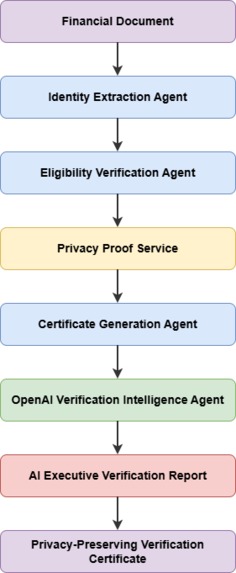
Architecture
-
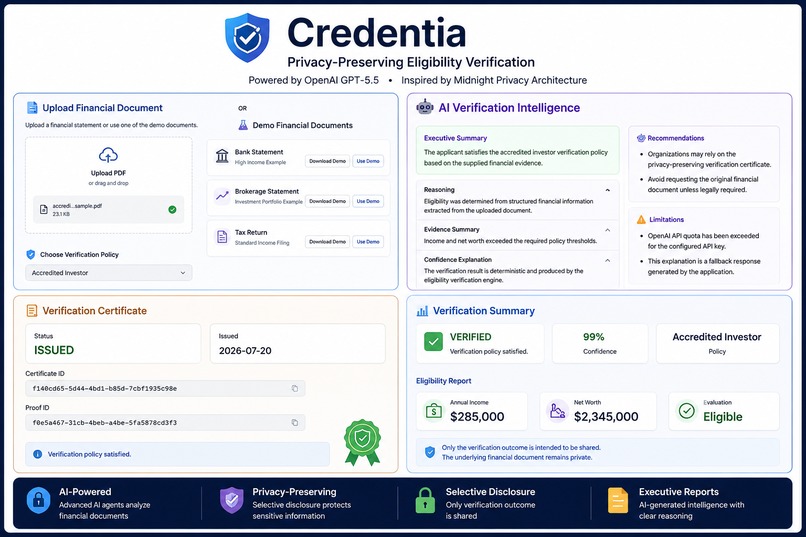
Product Walkthrough
-
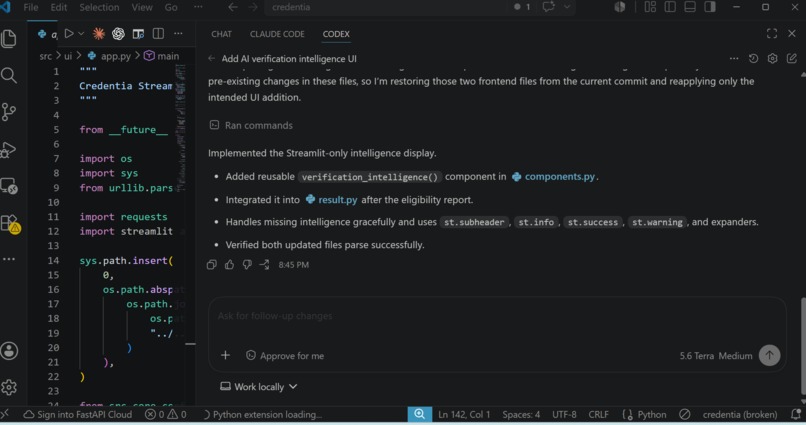
Codex
Inspiration
For many years I've worked on cybersecurity, identity, governance, and enterprise automation platforms where sensitive information is constantly exchanged between organizations. One recurring problem is that verification usually requires people to disclose far more personal information than necessary.
Whether it's proving financial eligibility, employment, or identity, entire documents are often shared even though the verifier only needs a simple yes or no answer.
That inspired Credentia. I wanted to explore how AI could work together with privacy-first principles so people can prove eligibility without unnecessarily exposing their personal financial information.
What it does
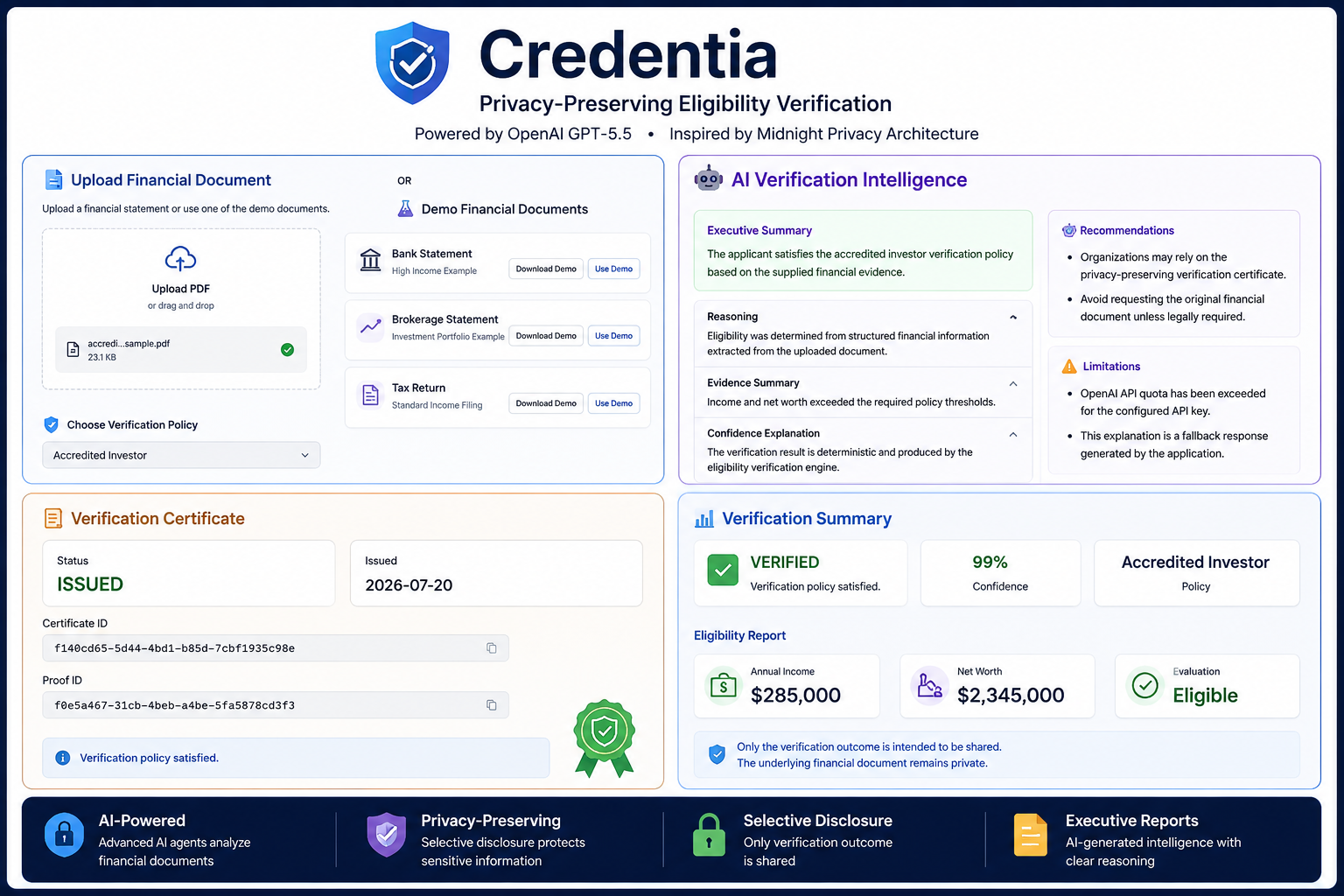
Credentia is a privacy-preserving eligibility verification platform.
Users upload a financial document, such as a bank statement, brokerage statement, or tax return. AI agents extract structured financial information, evaluate eligibility against a verification policy, generate a privacy-preserving verification certificate, and produce an executive verification report powered by OpenAI GPT-5.6.
Instead of sharing the original financial document, organizations receive only the verification outcome together with an explainable AI-generated report and certificate.
How we built it
Credentia is built with FastAPI, Streamlit, and the OpenAI Responses API powered by GPT-5.6.
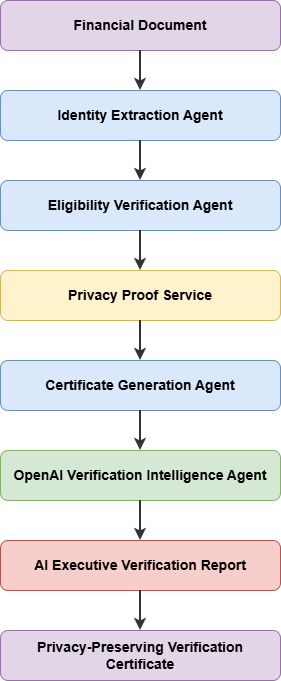
The system follows an agent-based architecture where each AI agent performs a single responsibility. The Identity Agent extracts structured information, the Eligibility Agent evaluates verification policies, the Certificate Agent generates a verification certificate, and the Verification Intelligence Agent uses GPT-5.6 to create an executive verification report that explains the reasoning, supporting evidence, confidence level, recommendations, and limitations.
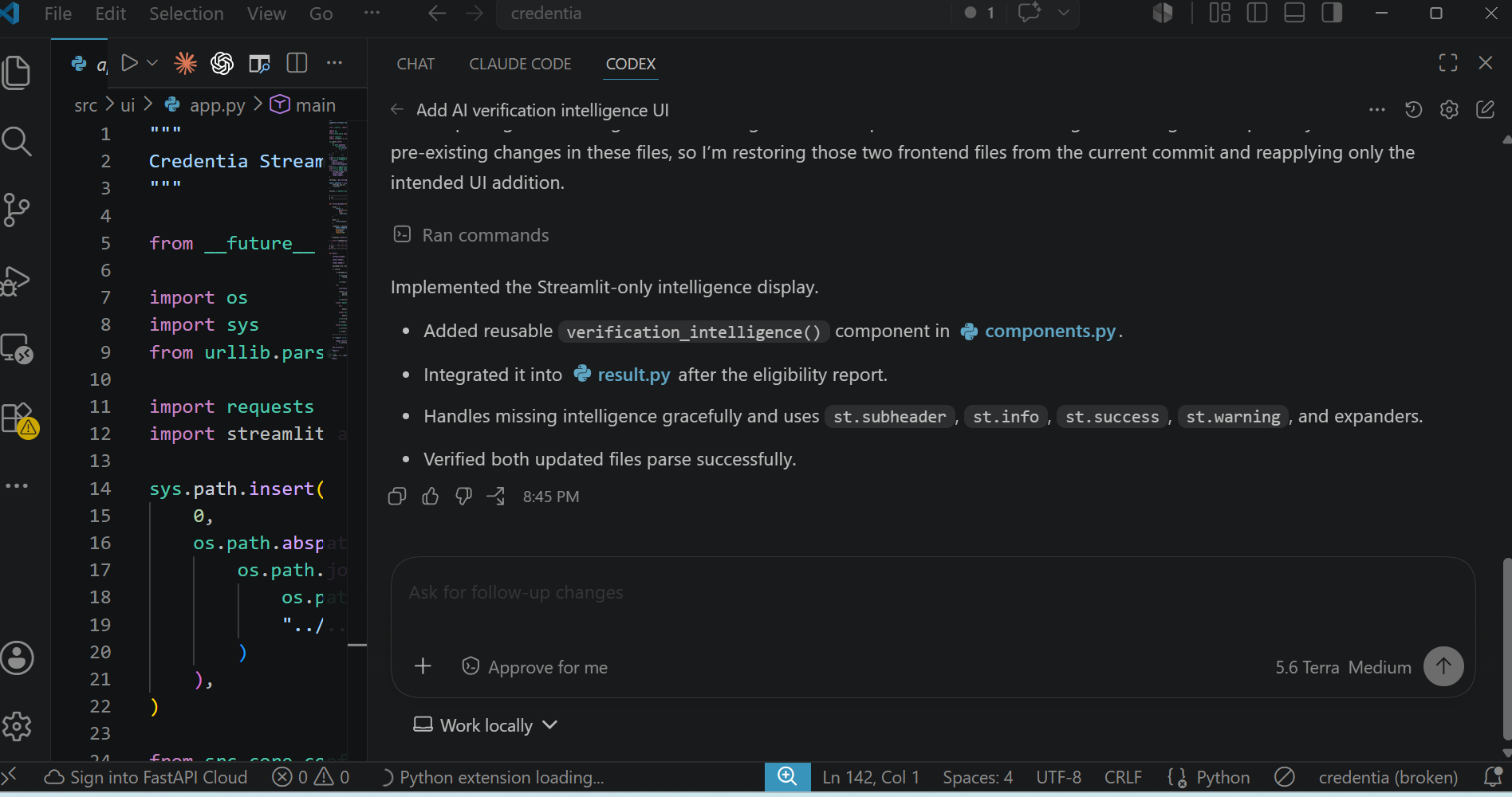
Throughout development, I used Codex within Visual Studio Code to accelerate implementation, debugging, documentation, and refinement while keeping the overall architecture intentionally modular and easy to extend.
Challenges we ran into
One of the biggest challenges was balancing privacy with explainability.
We wanted the system to provide meaningful AI-generated explanations without exposing unnecessary personal information. Designing prompts that generated structured, reliable, and concise executive reports while respecting selective disclosure required several iterations.
Another challenge was integrating the OpenAI Responses API into an agent-based workflow while maintaining consistent structured outputs across every verification.
Accomplishments that we're proud of
We're proud that Credentia demonstrates a practical use of AI beyond conversational interfaces.
The platform successfully combines privacy-first verification with explainable AI, producing both a verification certificate and an executive verification report powered by GPT-5.6.
We're also proud of building a clean multi-agent architecture that can easily support additional verification policies such as employment verification, proof of funds, residency verification, and professional certifications.
What we learned
This project reinforced that AI becomes significantly more valuable when it works alongside well-designed software architecture rather than replacing it.
We also learned how much better user trust becomes when AI decisions are accompanied by transparent reasoning, confidence explanations, and clear limitations instead of a simple pass or fail result.
Working with the OpenAI Responses API and Codex also showed how quickly sophisticated AI-powered applications can be developed while maintaining production-quality engineering practices.
What's next for Credentia
Credentia is designed as a configurable verification platform rather than a single-purpose application.
Next, we'd like to expand beyond accredited investor verification by supporting additional verification policies including employment verification, proof of funds, residency, education, and professional certifications.
We also plan to integrate zero-knowledge proofs and blockchain-backed verification to further strengthen privacy and trust while allowing organizations to verify claims without accessing sensitive underlying documents.
Built With
- codex
- fastapi
- gpt-5.6
- midnight
- openai
- openaisdk
- python
- streamlit

Log in or sign up for Devpost to join the conversation.