-
-
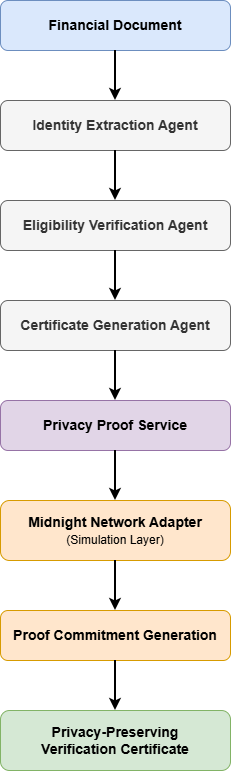
Architecture
-
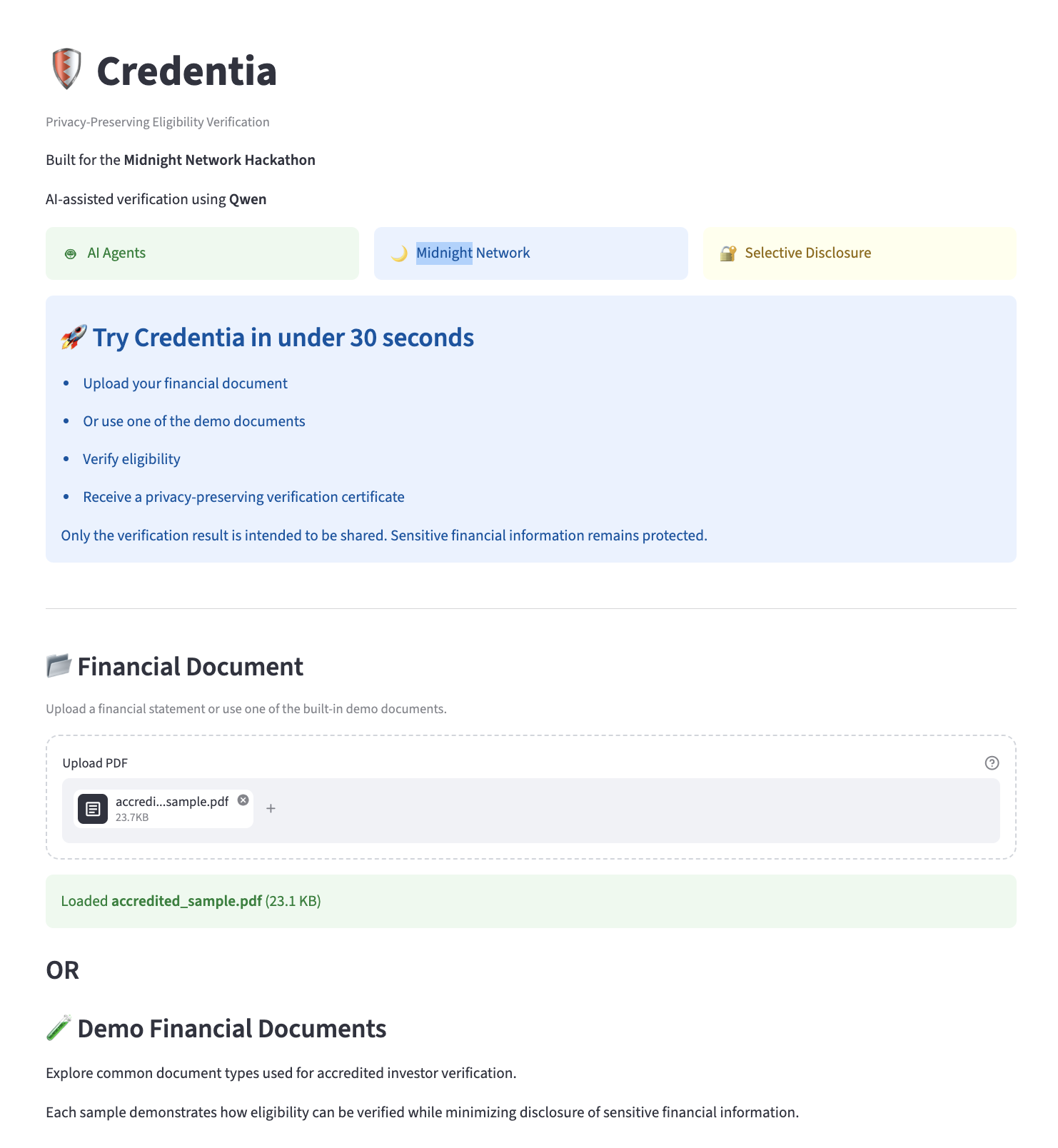
Credentia Console
-
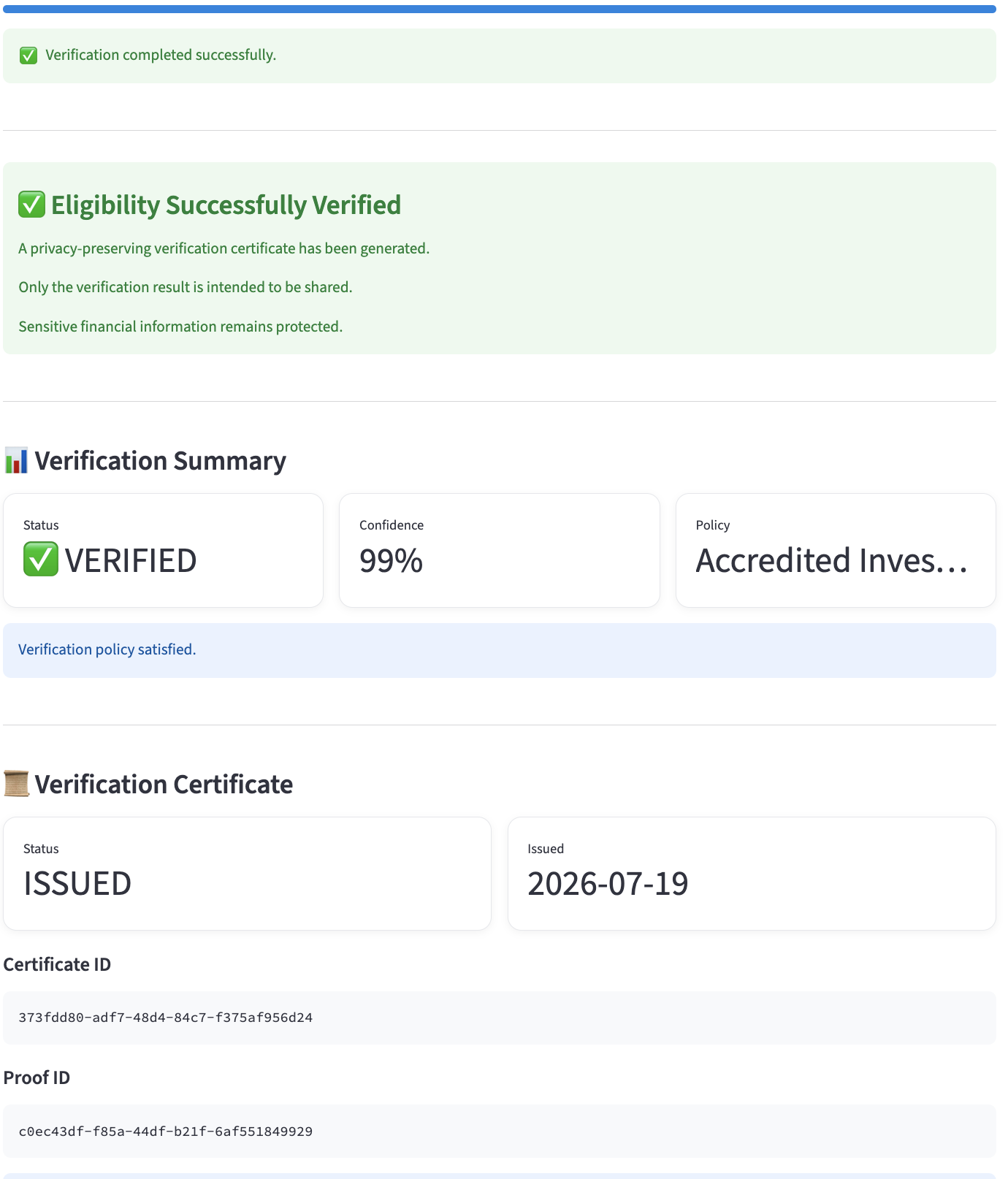
Credentia Console Output
-
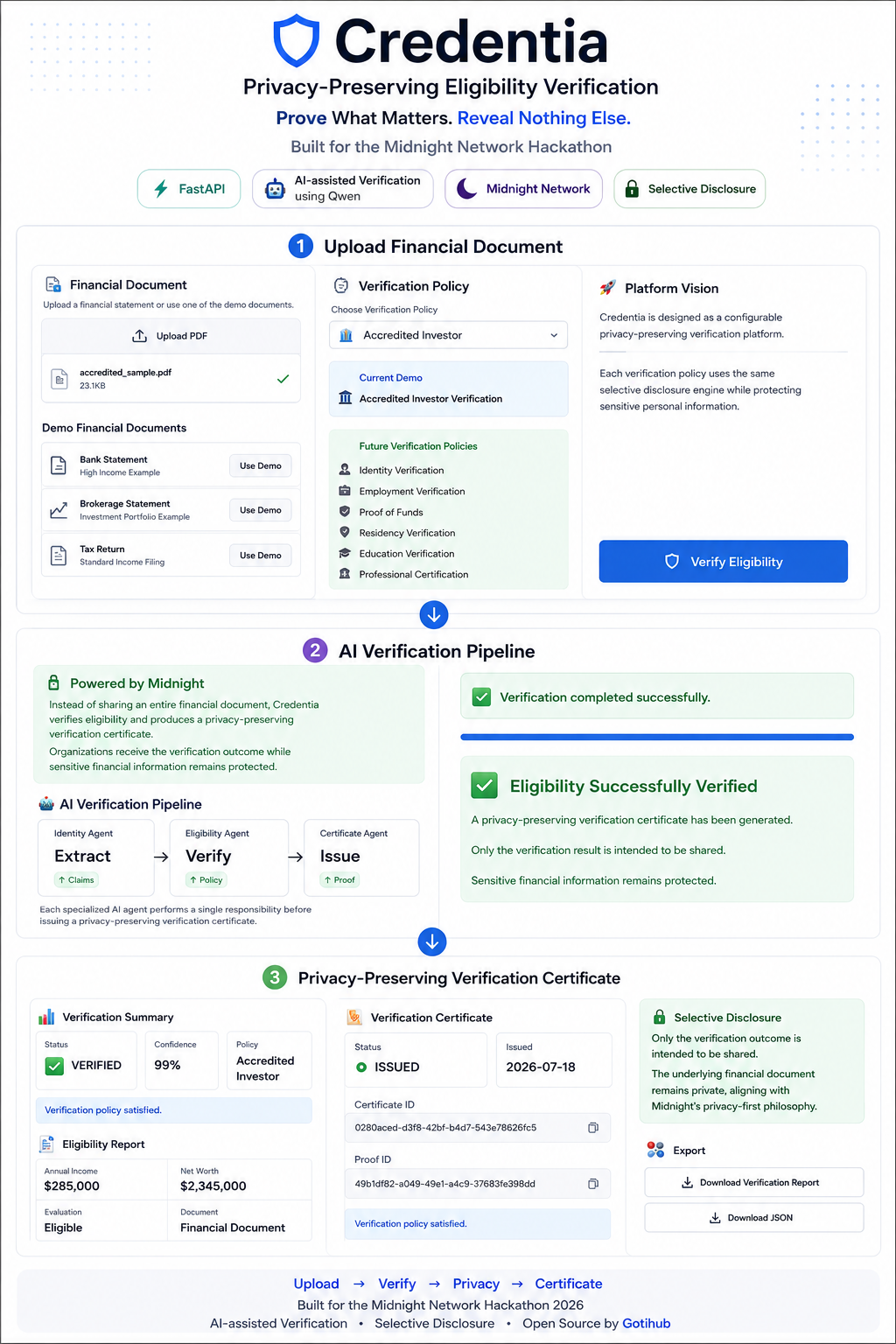
Overview
Inspiration
Traditional financial verification requires people to disclose highly sensitive documents simply to prove a single fact, such as whether they qualify as an accredited investor. This creates unnecessary privacy risks, increases compliance costs, and forces organizations to handle far more personal information than they actually need.
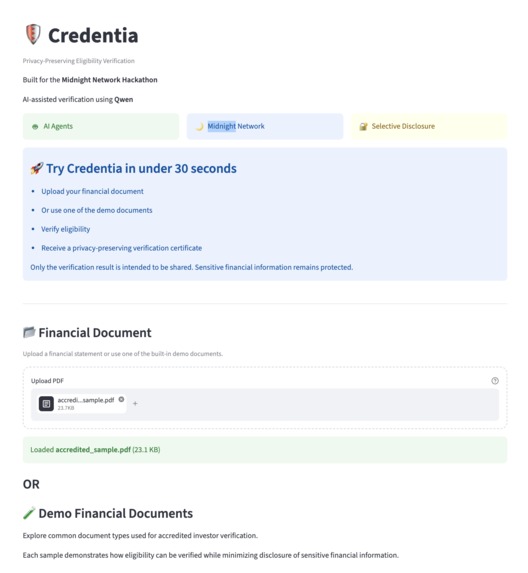
Credentia was inspired by Midnight's privacy-first philosophy. We wanted to demonstrate that AI can verify eligibility while minimizing disclosure of sensitive financial data. Instead of exposing an entire financial statement, users receive a privacy-preserving verification certificate that communicates only the required outcome.
Our goal was to build a practical proof-of-concept showing how intelligent verification and privacy can work together.
What it does
Credentia is an AI-powered privacy-preserving eligibility verification platform.
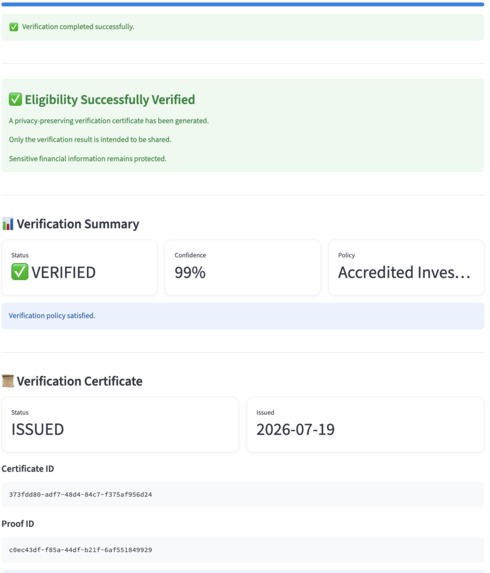
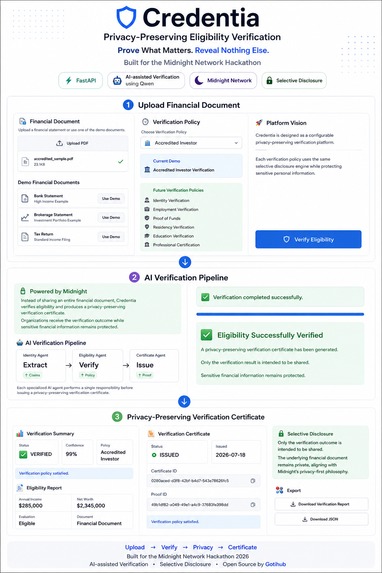
Users upload a financial document such as a bank statement, brokerage statement, or tax return. A multi-agent AI pipeline extracts relevant claims, evaluates them against a configurable verification policy, and generates a privacy-preserving verification certificate.
For this hackathon, Credentia demonstrates Accredited Investor Verification while the platform architecture is designed to support additional verification policies including:
- Identity Verification
- Employment Verification
- Proof of Funds
- Residency Verification
- Education Verification
- Professional Certification
Organizations receive only the verification outcome rather than the user's complete financial information.
How we built it
The project consists of a FastAPI backend and a Streamlit frontend.
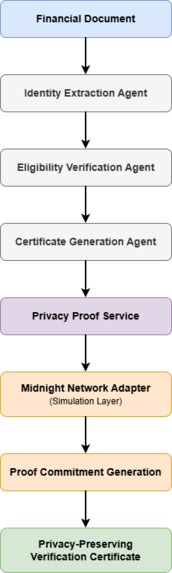
Our AI workflow is composed of specialized agents:
- Identity Extraction Agent
- Eligibility Verification Agent
- Certificate Generation Agent
After verification, a Privacy Proof Service creates deterministic proof commitments through a Midnight Network Adapter abstraction inspired by Midnight's privacy architecture. This separation allows future integration with native privacy-preserving technologies while keeping the verification workflow modular.
Technology stack:
- Python
- FastAPI
- Streamlit
- Qwen AI
- PyMuPDF
- pdfplumber
Challenges we ran into
One of the biggest challenges was balancing explainability with privacy.
We wanted users to understand why a verification succeeded without exposing unnecessary financial details.
Designing an AI workflow that produces meaningful verification results while minimizing disclosure required careful separation between document analysis, policy evaluation, certificate generation, and privacy proof creation.
Another challenge was building an intuitive demonstration within the limited hackathon timeframe while keeping the architecture extensible for future verification policies.
Accomplishments that we're proud of
- Built a complete end-to-end verification workflow
- Designed a modular multi-agent AI architecture
- Created a privacy-first verification certificate
- Developed configurable verification policies
- Delivered a polished interactive demonstration
- Built an architecture inspired by Midnight's privacy-first vision
What we learned
This project reinforced that privacy and AI should complement one another rather than compete.
Large language models can automate complex verification workflows, but preserving user trust requires minimizing data exposure and designing systems around selective disclosure from the beginning.
We also learned the value of modular AI architectures, where each specialized agent has a single responsibility and privacy remains a core design principle throughout the workflow.
What's next for Credentia
Our roadmap includes:
- Native Midnight integration
- Zero-knowledge proof support
- Additional verification policies
- Enterprise compliance dashboards
- API integrations for financial institutions
- Verifier portal for organizations
- Multi-document verification workflows
- Production-ready deployment with secure audit trails
Our vision is to make privacy-preserving verification accessible across finance, employment, education, and digital identity.

Log in or sign up for Devpost to join the conversation.