-
-
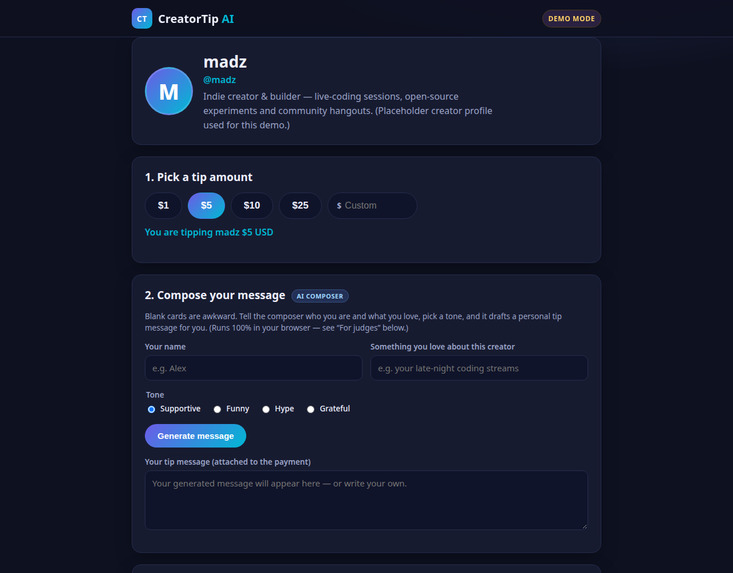
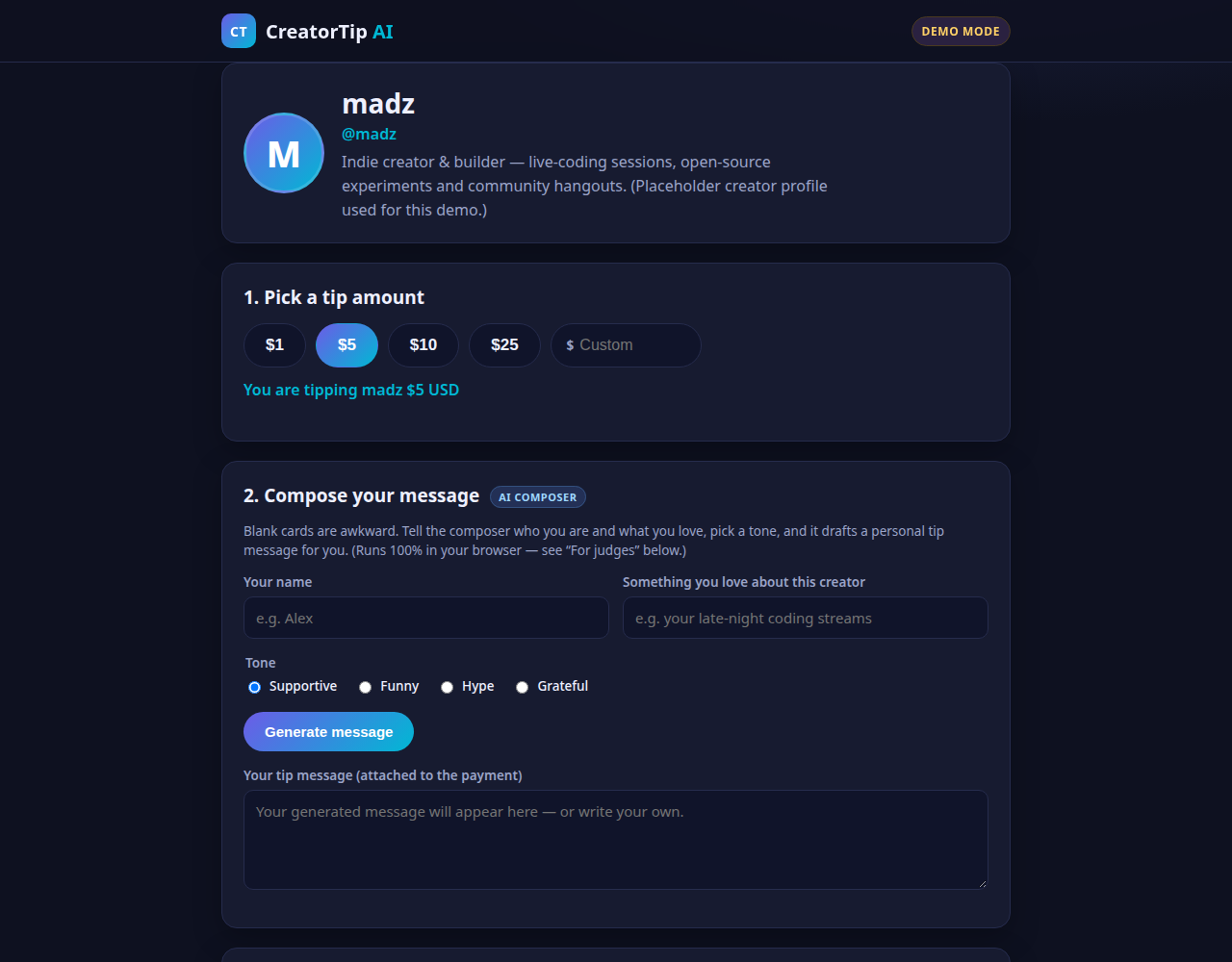
Creator tip page with amount presets
-
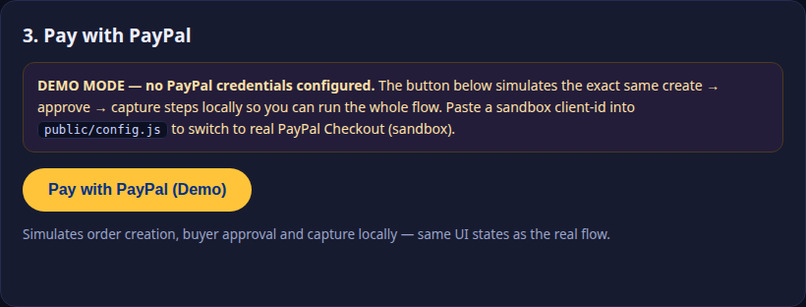
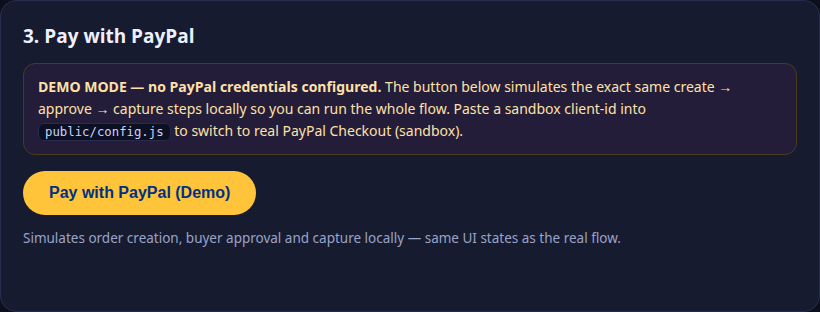
PayPal checkout panel in Demo Mode
-
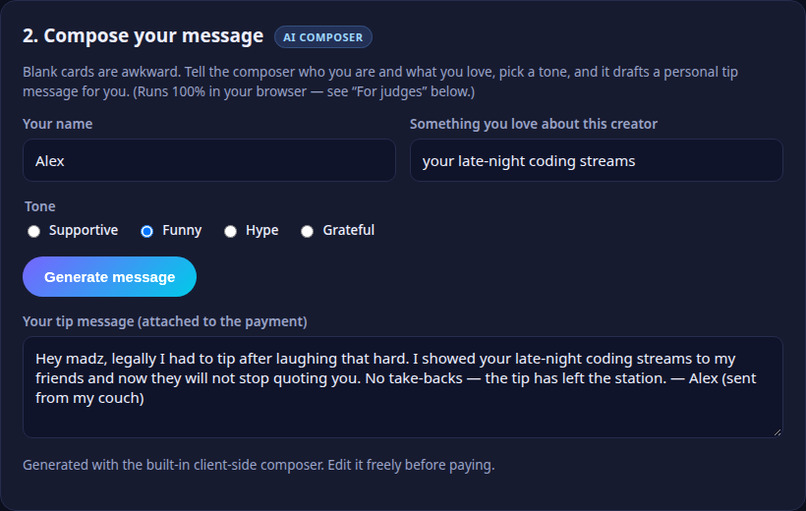
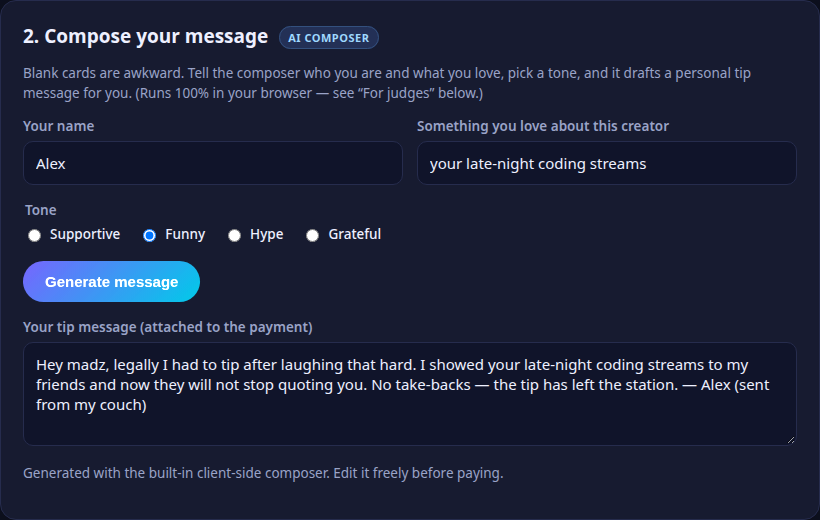
AI composer with a generated message
-
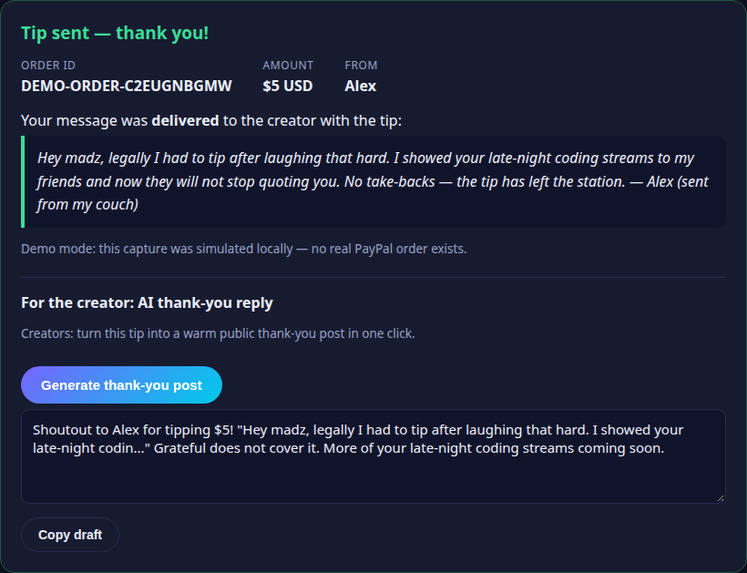
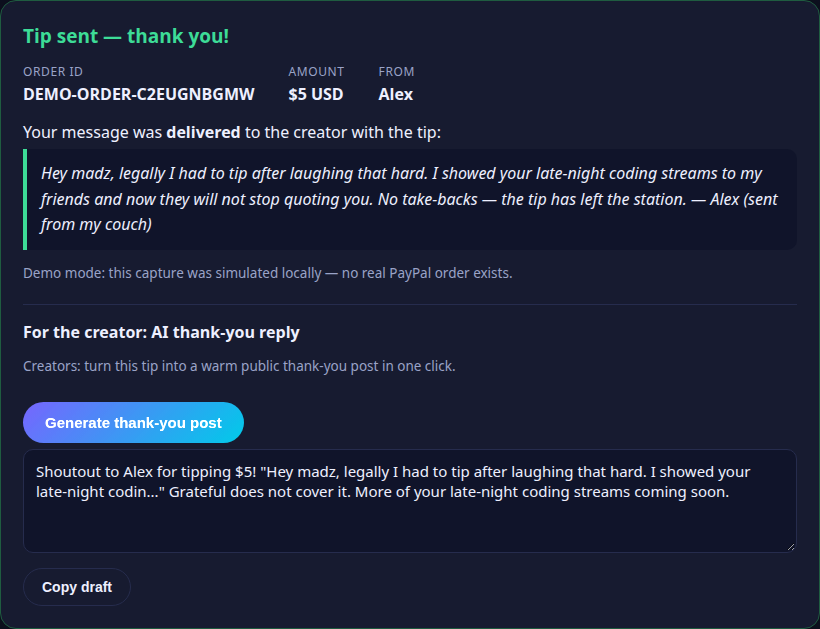
Captured tip, delivered message, thank-you generator
Inspiration
Creator tip pages are usually a bare payment button. Fans hesitate twice: once at the amount, and again at the empty message box — so many never tip at all. And when a tip does arrive, acknowledging it publicly takes effort, so most tips quietly disappear instead of becoming social proof that inspires the next supporter.
What it does
CreatorTip AI turns tipping into a guided, three-step journey on a single page:
- Pick an amount — $1 / $5 / $10 / $25 presets or a custom amount, with strict validation (zero, negative, non-numeric and over-cap amounts are rejected before any payment starts).
- Compose the message with AI — the fan enters their name and one detail they love about the creator, picks a tone (Supportive, Funny, Hype or Grateful), and the AI Tip Message Composer drafts a warm, personal message. It is a client-side smart composer (template + variation engine — 500 combinations per tone with a no-repeat guarantee), so the product runs end-to-end with zero API keys and no external AI service. A real LLM can later be dropped into the single function aiGenerateMessage() without touching the rest of the app.
- Pay with PayPal — checkout runs on the official PayPal JavaScript SDK with the standard Orders flow: createOrder creates an order for the exact tip amount (the fan's message travels with it in the order's custom_id), and onApprove captures it. PayPal is the payment rail end-to-end.
After payment, the success screen shows the order ID, the amount, and the message marked as delivered to the creator. The creator then clicks one button to get an AI Thank-You Reply — a ready-to-post public thank-you draft built from the tip — closing the loop that turns one tip into the next.
Two honest ways to run it. Paste a PayPal sandbox client-id into public/config.js and the real PayPal Checkout (sandbox) renders. Leave it empty and the app runs a clearly-labelled Demo Mode that simulates the same CREATED → APPROVED → CAPTURED states with demo order IDs, so judges can evaluate the complete flow with no credentials at all. The current mode is always visible in the page header and in a banner above the buttons.
How we built it
- PayPal JavaScript SDK (Checkout / Orders v2 API — createOrder + capture)
- Vanilla JavaScript (no frameworks, no build step, zero npm dependencies)
- HTML5 + CSS3 (custom design system, responsive)
- Node.js (zero-dependency static server + automated verification script)
- Client-side AI composer (template + variation engine; LLM-ready single-function integration point)
What we learned
The biggest friction in tipping is not payment — it is knowing what to write. A guided message composer and an automatic public thank-you turn a one-off payment into repeat support, and PayPal's Orders flow makes the payment itself trustworthy and straightforward.
Challenges we ran into
Keeping the whole experience honest in Demo Mode: the simulated flow had to mirror the real PayPal states (CREATED → APPROVED → CAPTURED) exactly, with the mode always clearly labelled, so judges can evaluate the complete journey with no credentials.
Why it matters
Tipping is real income for small creators — streamers, musicians, writers, open-source maintainers. Removing the "what do I even write?" friction and automating the public thank-you directly increases both conversion and repeat support, using PayPal infrastructure creators already trust.
Try it out
Live demo: https://madztipjar.github.io/creatortip-ai/
Code repository: https://github.com/madztipjar/creatortip-ai
Run locally (no install step, no API keys): npm start serves http://localhost:4174, and npm run verify runs automated checks for the server, syntax, composer variety and validation. To test the real PayPal sandbox flow, create a free sandbox app at developer.paypal.com, paste its client-id into public/config.js, reload, and pay with any sandbox buyer account. To test with no credentials, just open the page — Demo Mode is active by default and the full flow (create → approve → capture → success → thank-you draft) works immediately.
Solo project by madz. License: MIT.
