-
-
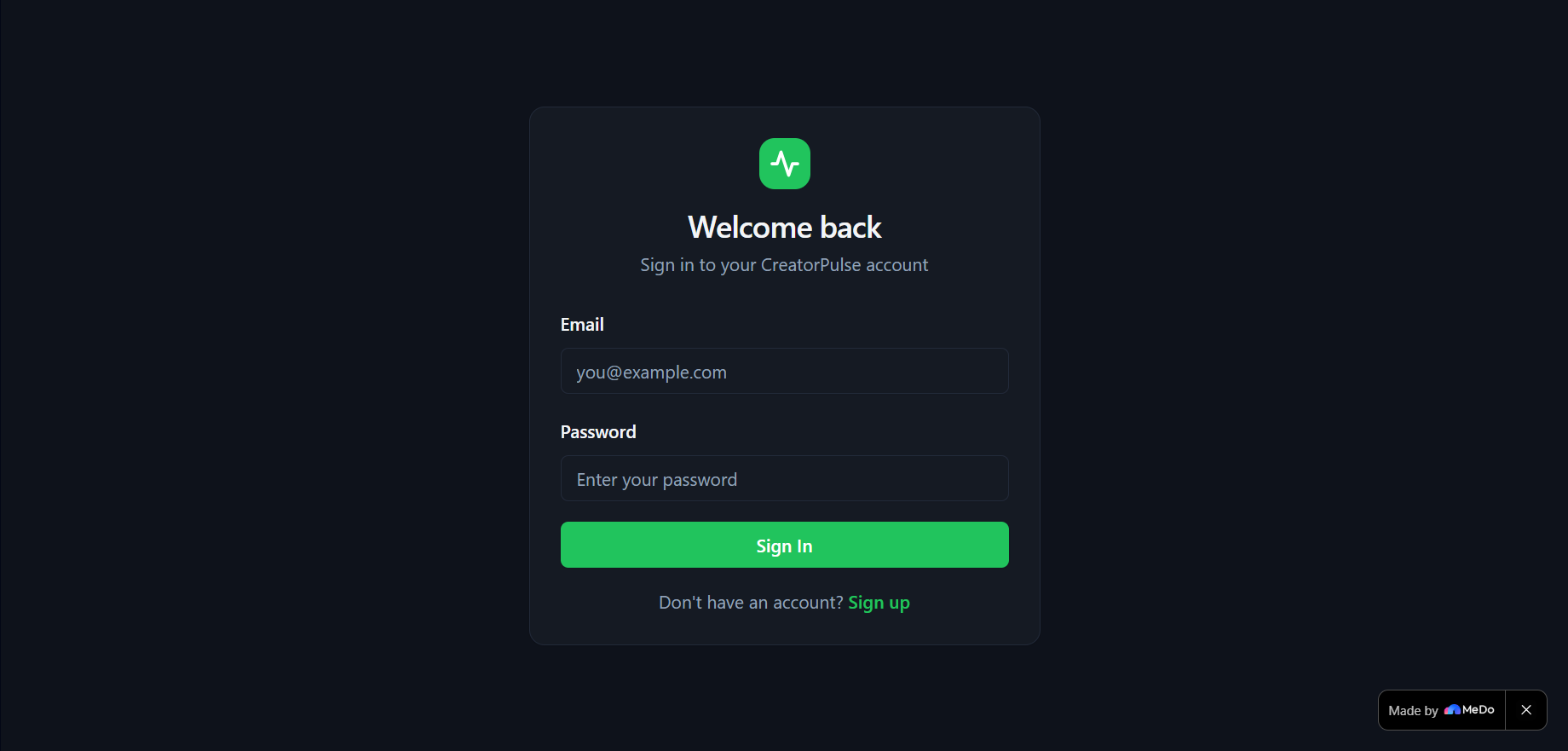
Login/SignUp page
-
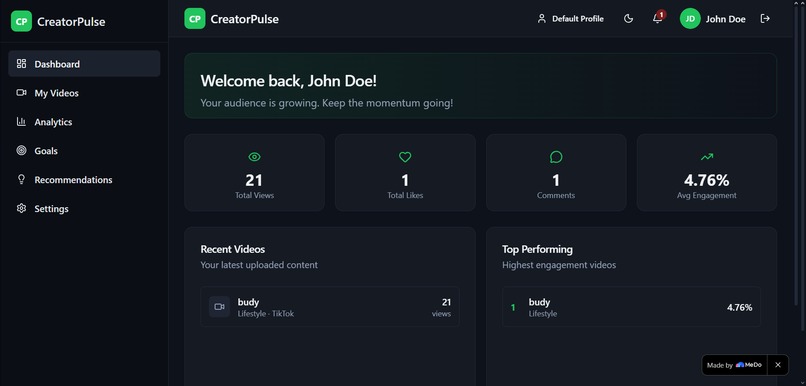
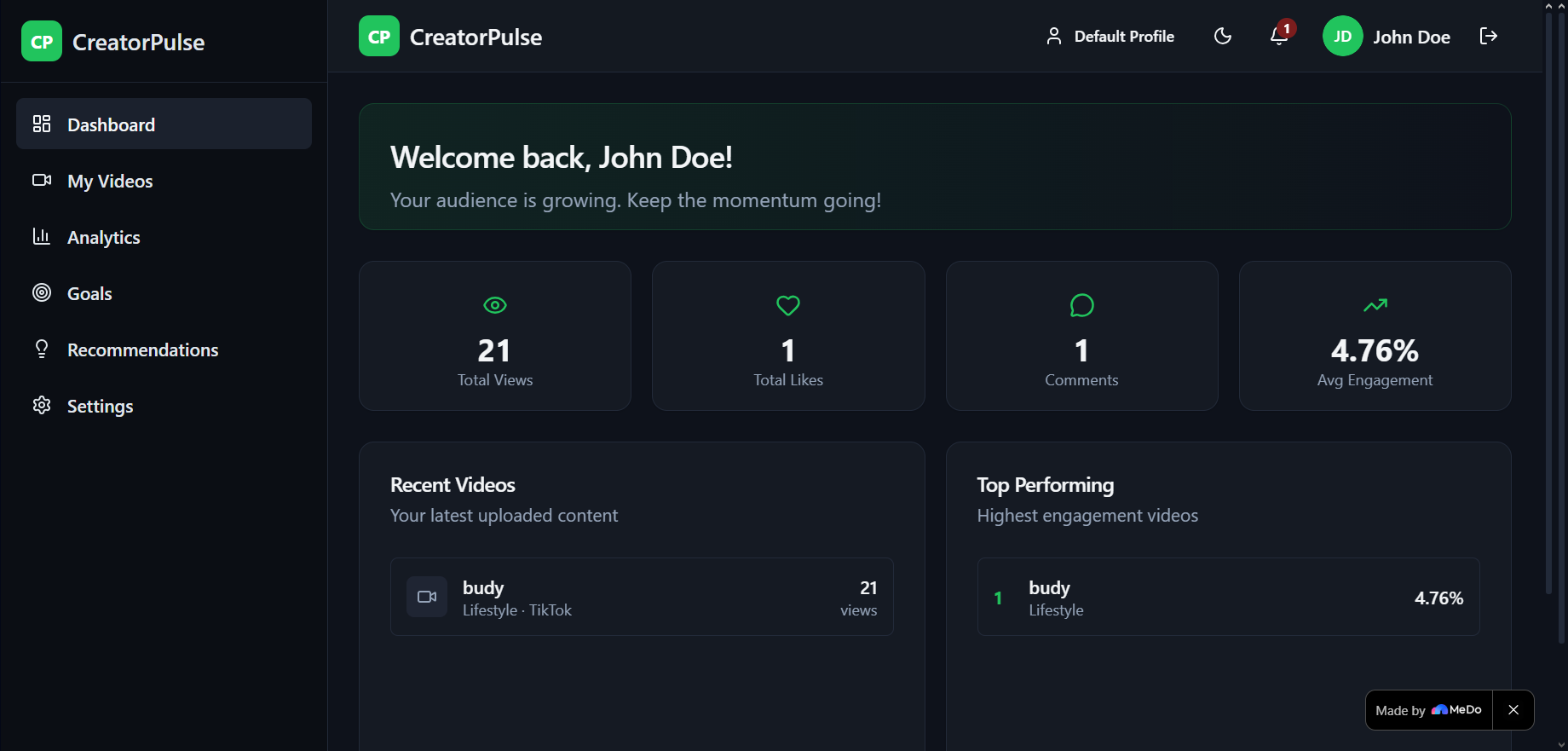
Dashboard
-
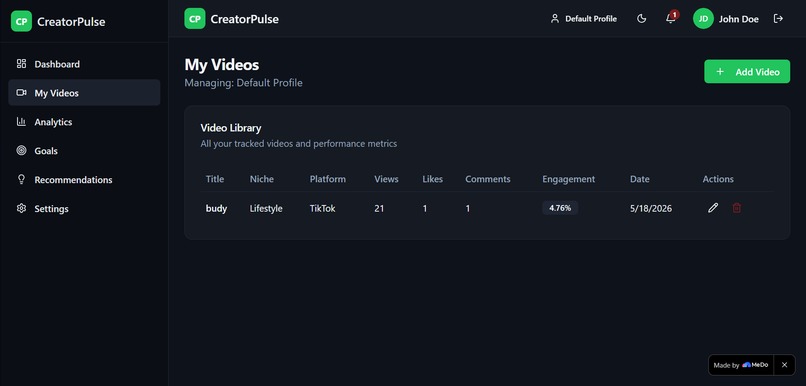
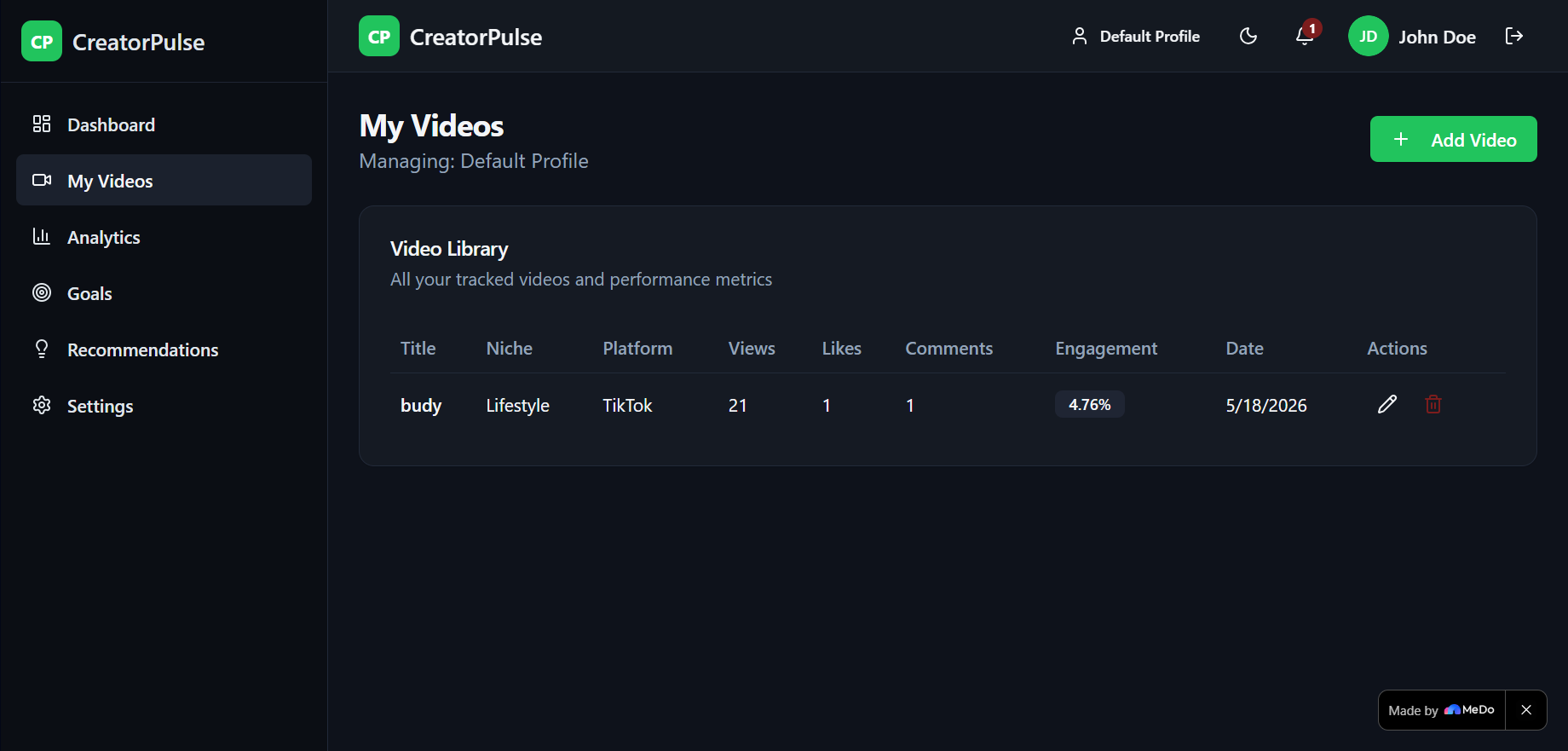
myVideos page
-
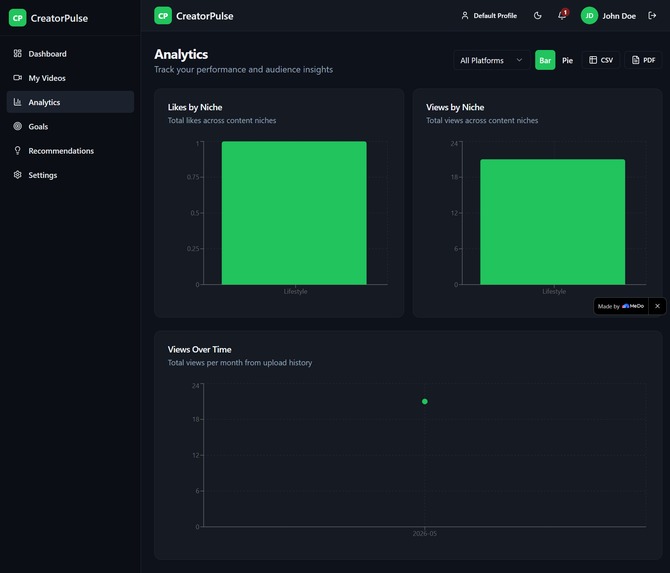
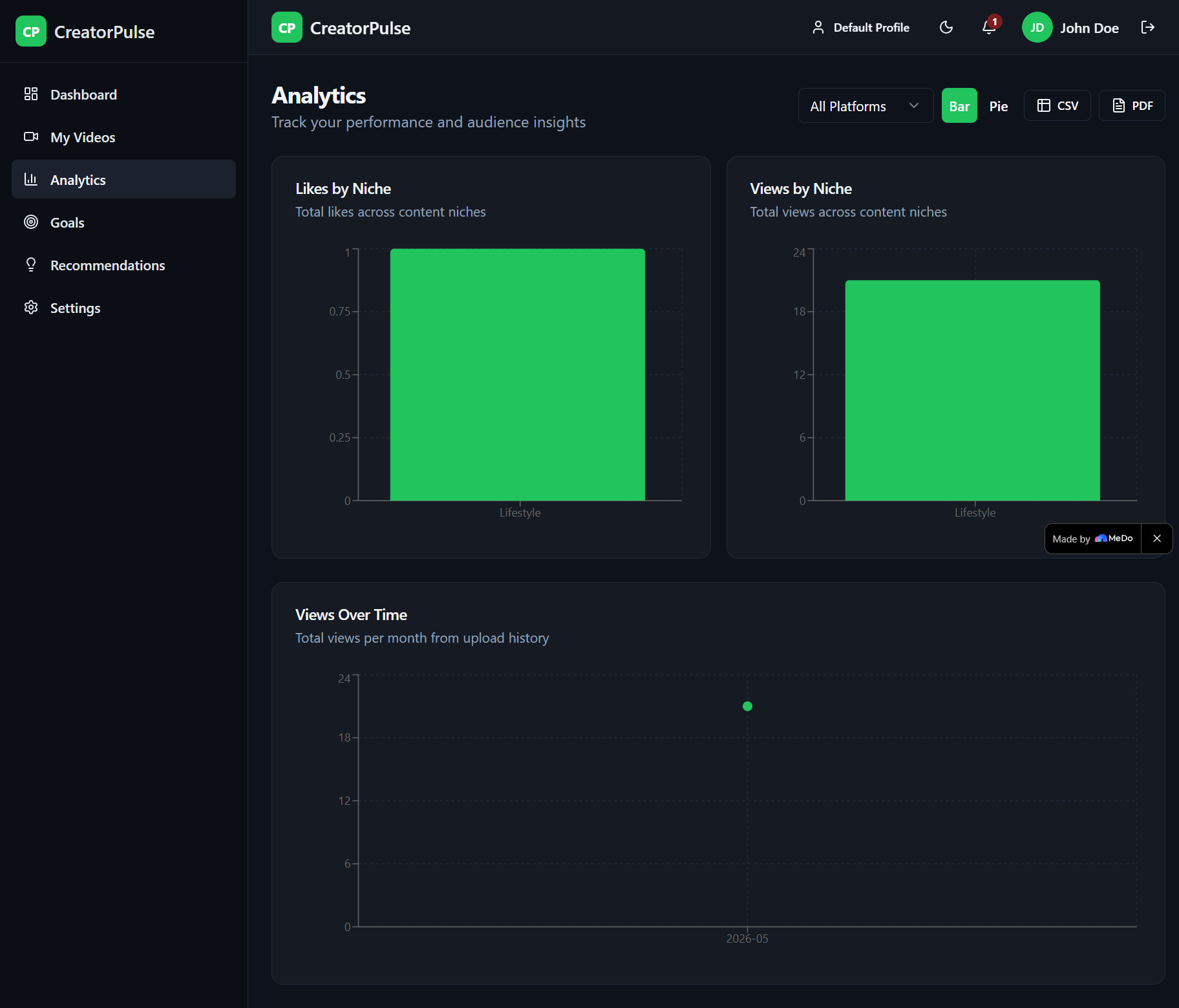
Analytics page
-
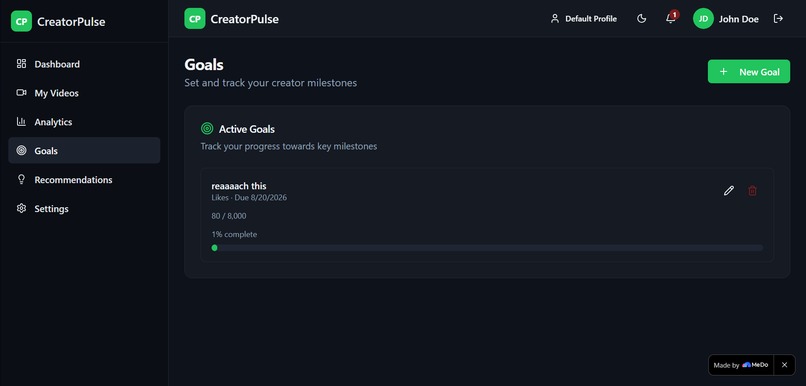
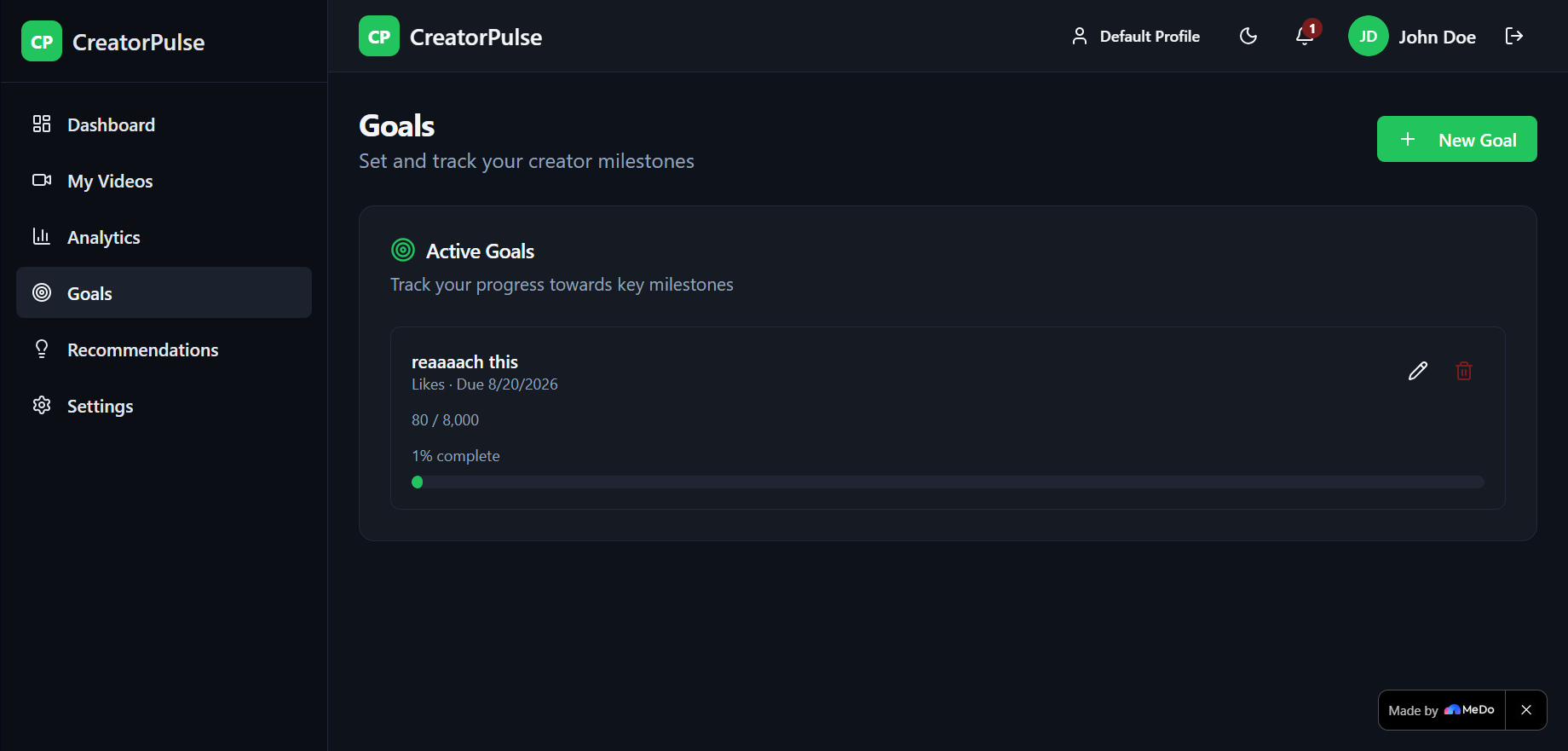
Goals page
-
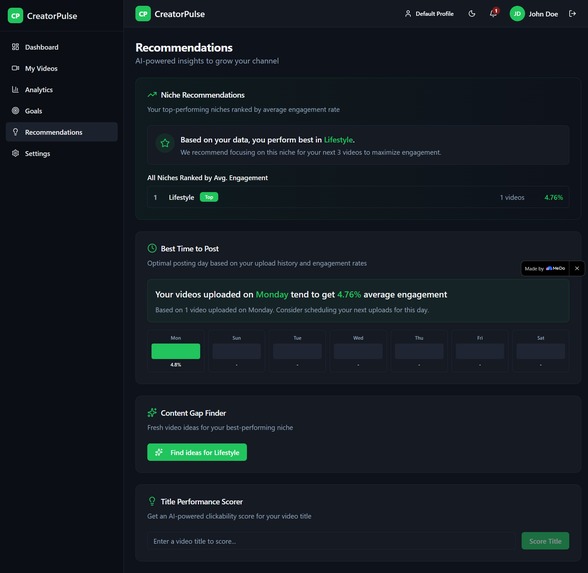
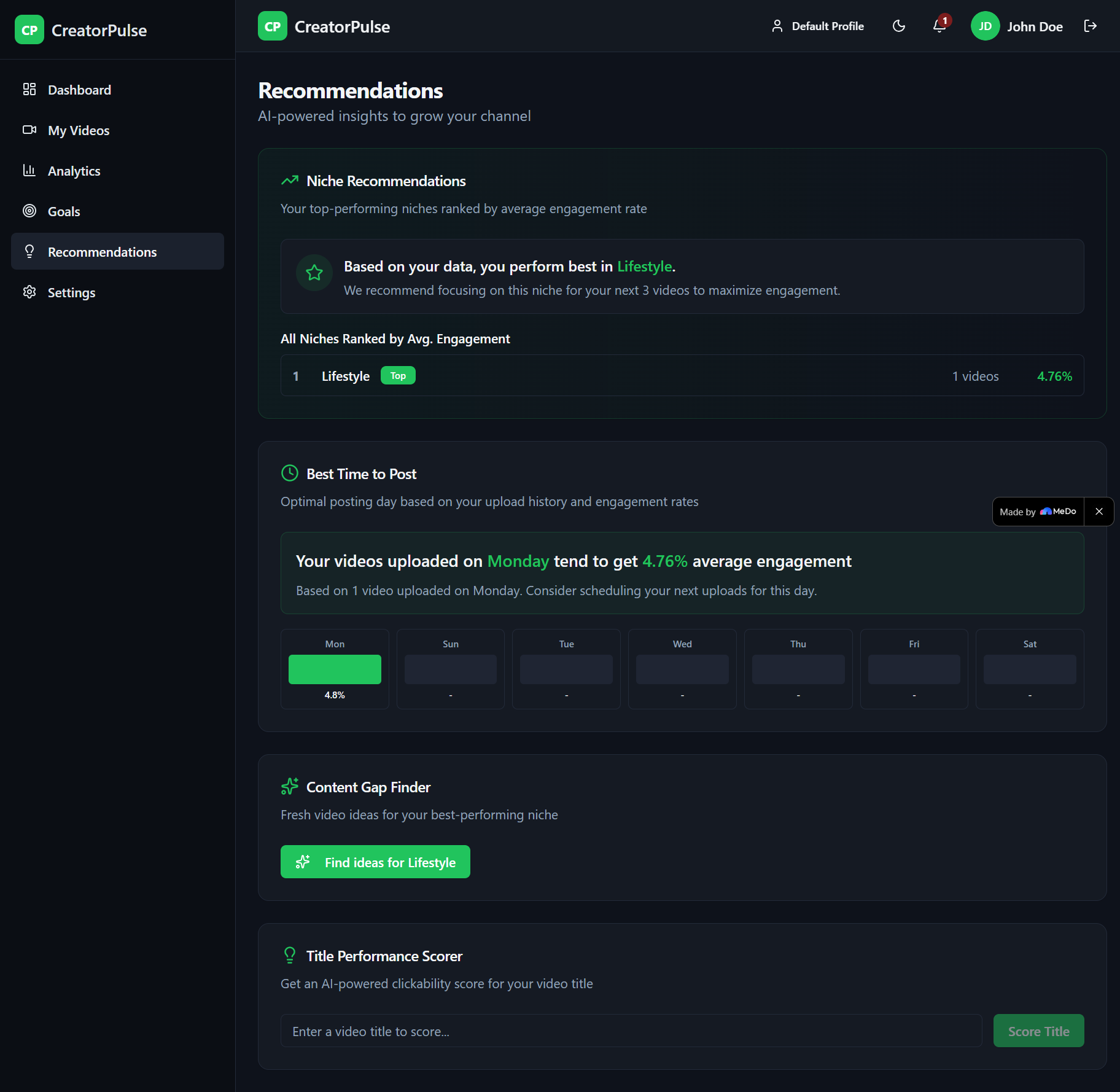
Recommendations page
-
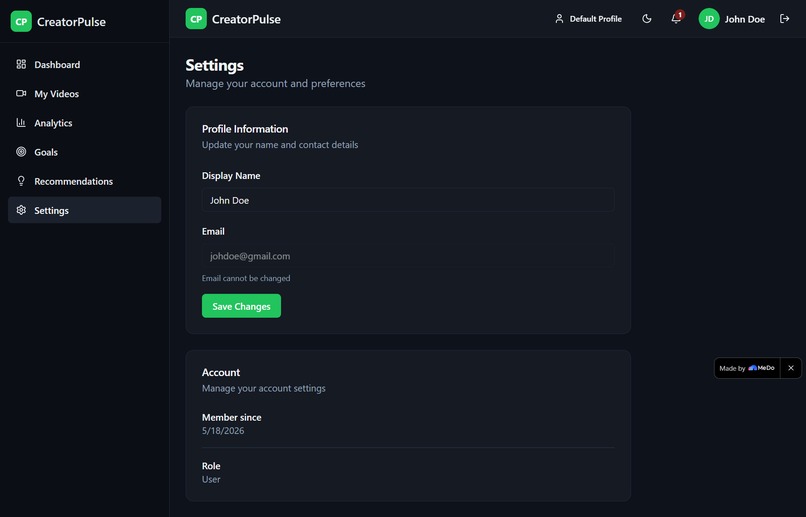
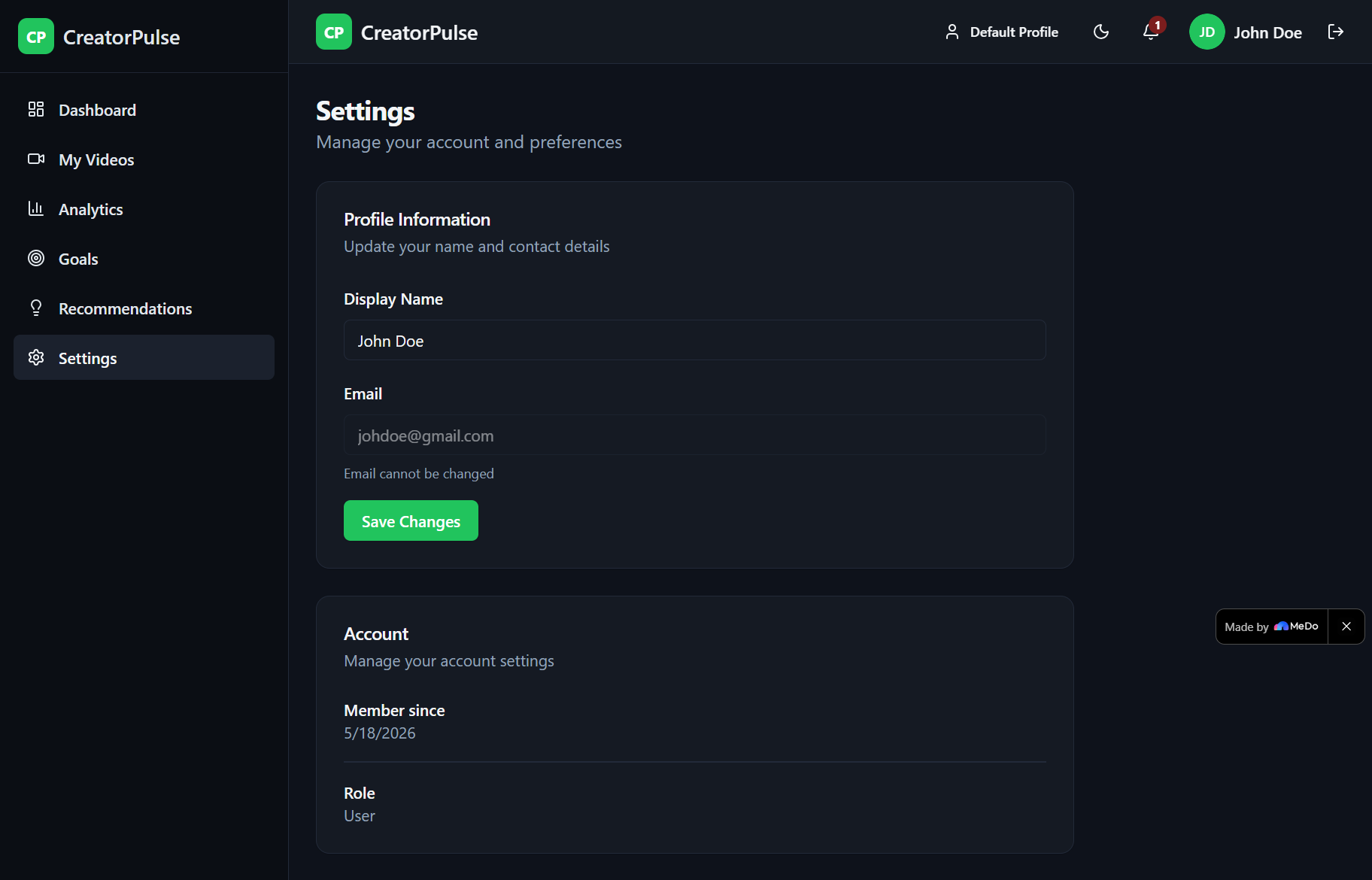
Settings page
Inspiration
I spend a lot of time on YouTube and TikTok. And the one thing I kept noticing was that creators — talented, consistent, hardworking people — had no real idea why some videos took off and others disappeared into silence. They were making decisions based on gut feeling, not data. The analytics tools that exist today are either locked behind expensive subscriptions, built for one platform only, or so overwhelming that the average creator gives up trying to understand them. I wanted to build something different. Something a regular creator could open on any device, understand in under a minute, and actually use to make smarter content decisions. No data science degree required. No switching between five different tabs. That idea became CreatorPulse — one dashboard, all platforms, real AI-powered intelligence.
What it does
-Tracks videos across YouTube, TikTok and Instagram Reels
- Auto-calculates engagement rates with color-coded performance badges
- Visualises niche performance with pie charts, bar charts and growth timelines
- AI-powered niche recommendations based on your actual data
- Content Gap Finder — suggests video ideas you haven't covered yet
- Title & Thumbnail Scorer — rates how clickable your title is out of 10
- Best Time to Post suggestions based on your upload history
- Goal Tracker with progress bars
- Spike and drop notifications when a video over or underperforms
- Export your analytics as PDF or CSV for brand sponsorship pitches -Full dark and light mode
How I built it
I built CreatorPulse entirely using MeDo, submitting the entire project as a series of structured natural language prompts. No manual coding. Just clear, deliberate communication with AI. I designed the build in 4 phases, each submitted as a complete prompt: Phase 1 — Foundation Authentication system with login, signup, and persistent sessions. A full dashboard shell with sidebar navigation, welcome card, and a dark/light mode toggle that works across every page. Phase 2 — Data Engine & Analytics Charts The core tracking system. Users log videos and CreatorPulse automatically calculates the engagement rate using: Engagement Rate (%)=LikesViews×100\text{Engagement Rate (\%)} = \frac{\text{Likes}}{\text{Views}} \times 100Engagement Rate (%)=ViewsLikes×100 Each video gets a color-coded performance badge: Green≥5%∣2%≤Yellow<5%∣Red<2%\text{Green} \geq 5\% \quad | \quad 2\% \leq \text{Yellow} < 5\% \quad | \quad \text{Red} < 2\%Green≥5%∣2%≤Yellow<5%∣Red<2% The Analytics page renders switchable Pie Charts and Bar Charts showing niche performance, plus a Line Chart tracking views growth over weeks and months. A platform filter lets users isolate data by YouTube, TikTok, or Instagram Reels. Phase 3 — AI Intelligence Layer The most powerful part of CreatorPulse. The Recommendations page includes:
Niche Recommendations — ranks all niches by average engagement rate and tells the creator exactly where to focus Content Gap Finder — suggests 5 specific video ideas within the creator's best-performing niche that they haven't covered yet Best Time to Post — analyses upload history and engagement patterns to suggest the optimal day and time to publish Title & Thumbnail Scorer — the creator types a video title and receives a Clickability Score out of 10, a reason, and an improved title suggestion
Phase 4 — Goals, Notifications, Multi-account & Export A Goal Tracker where creators set targets like "Reach 10k subscribers" and track progress with a visual progress bar. A Notification System that fires alerts when a video performs significantly above or below the creator's average. Multi-account support for creators managing more than one channel. And an Export feature that generates a clean, sponsor-ready PDF report or a full CSV data file. API Integration I integrated the YouTube Data API v3 so users can paste a YouTube URL and have views, likes, and comments fetched automatically — no manual entry needed. For TikTok and Instagram, I used third-party scraper APIs via RapidAPI as a practical workaround given the strict OAuth and app review requirements of the official APIs.
Challenges I ran into
Credit management was my hardest constraint. MeDo operates on a credit system, and early in the build I burned through credits quickly by sending small, iterative fix prompts instead of large, comprehensive ones. I had to change my entire approach mid-build — combining fixes with new features into single prompts to conserve credits. A difficult lesson learned the expensive way. The Add Video bug in Phase 2 was a real obstacle. The form was rendering correctly but videos weren't saving to the table. I had to diagnose the issue, write a precise fix prompt, and combine it with the Phase 3 AI features in one generation to avoid wasting a credit on the fix alone. Problem solving under resource constraints. TikTok and Instagram API limitations were more significant than I anticipated. TikTok's official API requires OAuth authentication from the end user, and Instagram's Graph API requires a full Meta app review process that can take weeks. Neither was realistic within a hackathon deadline. I pivoted to third-party scraper APIs via RapidAPI — a practical solution, though one that comes with its own fragility if the platforms change their page structure. Feature prioritisation was a constant tension. My original vision for CreatorPulse had more features than time and credits allowed. I had to make hard decisions about what was core and what was a stretch goal. That discipline — knowing what to cut — is something I'll carry into every project going forward.
Accomplishments that we're proud of
Building a complete, full-stack app from scratch as a student. CreatorPulse is not a toy project or a simple to-do list. It has authentication, a relational data layer, multiple chart types, an AI intelligence layer, goal tracking, notifications, multi-account support, and export functionality. The fact that I conceived, planned, and shipped all of that within a hackathon deadline — as a third year CS student — is something I'm genuinely proud of.
Mastering prompt engineering under pressure. Before this hackathon I had never built an app purely through natural language prompts. Learning to communicate with MeDo precisely enough to produce production-quality features — while managing a limited credit budget — pushed me to think more clearly and deliberately than any coding assignment ever has.
The AI Recommendations page. Of everything CreatorPulse does, the Recommendations page is what I'm most proud of. A niche ranking engine, a content gap finder, a best time to post suggester, and a title clickability scorer — all working together in one place. I described what I wanted in plain English and MeDo brought it to life. Seeing it work for the first time genuinely surprised me.
Integrating a real external API. Getting the YouTube Data API v3 working — registering on Google Cloud Console, enabling the API, generating credentials, and connecting it to CreatorPulse so that a YouTube URL automatically returns views, likes, and comments — was my first real API integration experience. It made the app feel real in a way that manual data entry never could.
Solving problems I had never faced before. The Add Video bug, the credit constraints, the TikTok and Instagram API limitations — none of these had obvious solutions. I had to diagnose, adapt, and keep moving. That ability to problem solve under pressure and uncertainty is the accomplishment I'm most proud of — because it's the one that will serve me longest after this hackathon is over.
Shipping something I would actually use. CreatorPulse solves a problem I genuinely care about. It's not a demo I'll forget about after submission. It's an app I want to keep building — and that feeling of having created something real and meaningful from nothing is the accomplishment that matters most to me.
What we learned
Building CreatorPulse was one of the most educational experiences I've had as a CS student — and not just technically. Prompt engineering is a genuine skill. The quality of what MeDo produced was directly tied to how precisely I described what I wanted. I learned to write prompts that specified not just what to build, but how it should behave, what it should look like, and what should happen when things go wrong. Structured building beats improvisation. Breaking a complex app into four logical phases — foundation, data, intelligence, polish — kept the project manageable and prevented scope creep. Each phase had a clear goal and a clear finish line. APIs are powerful but require real understanding. Integrating YouTube Data API v3 taught me how REST APIs work in practice — how to authenticate, how to structure requests, how to parse JSON responses, and how to handle failures gracefully. Constraints make you creative. Working within MeDo's credit system forced me to think carefully before every generation. I couldn't afford to waste credits on vague prompts. That pressure made me a significantly better communicator and planner. Real problems produce better products. Because I was solving a genuine pain point I had personally observed — not a made-up one — every feature decision felt purposeful. I wasn't adding features to impress judges. I was adding features because creators actually need them.
What's next for CreatorPulse
Full native YouTube, TikTok, and Instagram API integration with live auto-extraction Competitor benchmarking — compare your engagement rate against industry averages per niche AI-generated content calendar based on best posting times and content gaps Mobile version built with React Native Collaboration mode for creator teams and managers


Log in or sign up for Devpost to join the conversation.