Inspiration
Top technical creators, engineering educators, and developer advocates face a grueling bottleneck: turning one 15-minute technical recording into a full week of high-converting, multi-channel distribution takes 40+ hours of tedious manual labor.
Worse, existing generic AI writing wrappers and chat bots suffer from three critical flaws:
- Factual Hallucination & Metric Distortion: Generic LLMs subtly alter benchmark numbers, swap technical parameters, and misquote speakers.
- Generic "AI Slop" Tone: Outputs default to robotic, clichéd marketing jargon ("supercharge", "delve into") that instantly destroys creator credibility.
- Fragmented, Manual Glue Work: Creators are still forced to manually timestamp short video clips, calculate optimal cross-timezone posting schedules, and sift through hundreds of YouTube/X comments to find their next video idea.
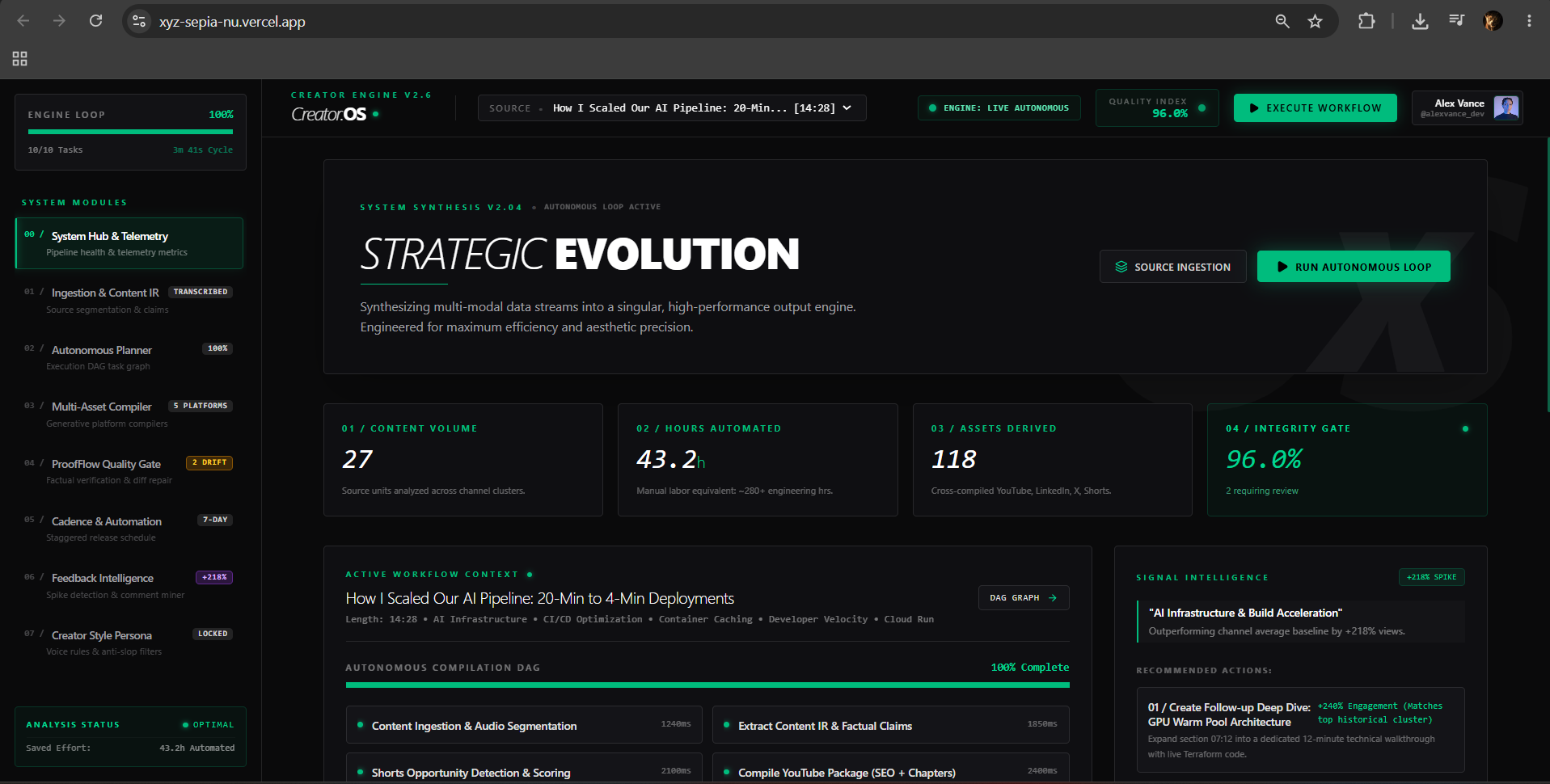
We built CreatorOS to solve this: an end-to-end autonomous content operating system that ingests raw multi-modal recordings, decomposes them into a structured Intermediate Representation (Content IR), and compiles verified, platform-native assets with surgical factual integrity.
What It Does
CreatorOS orchestrates 7 autonomous intelligence modules across the entire content lifecycle:
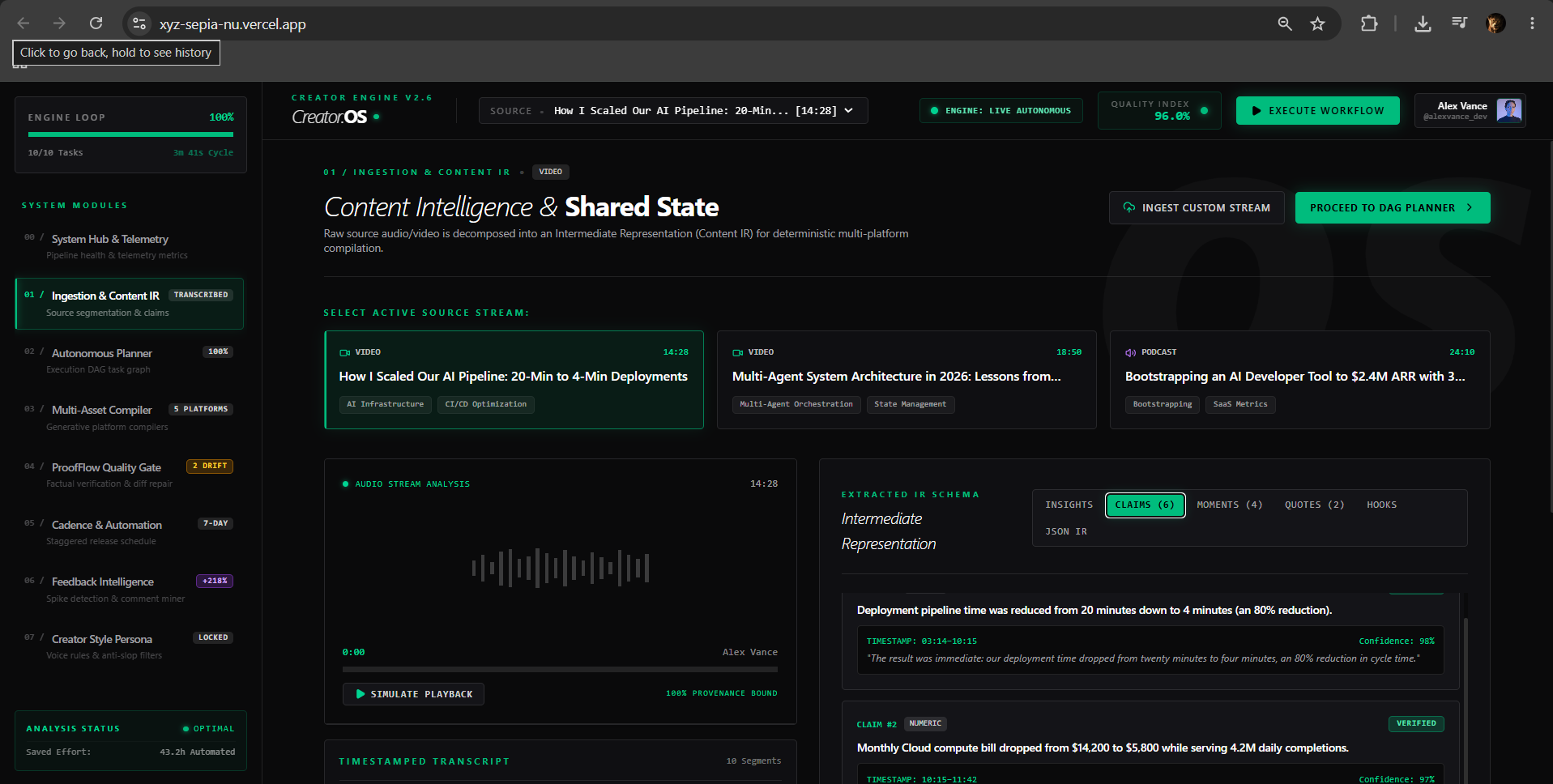
- Ingestion & Content IR Decomposition: Ingests raw video/audio transcripts and decomposes them into atomic claims, high-retention hooks, quote spans, and key technical insights.
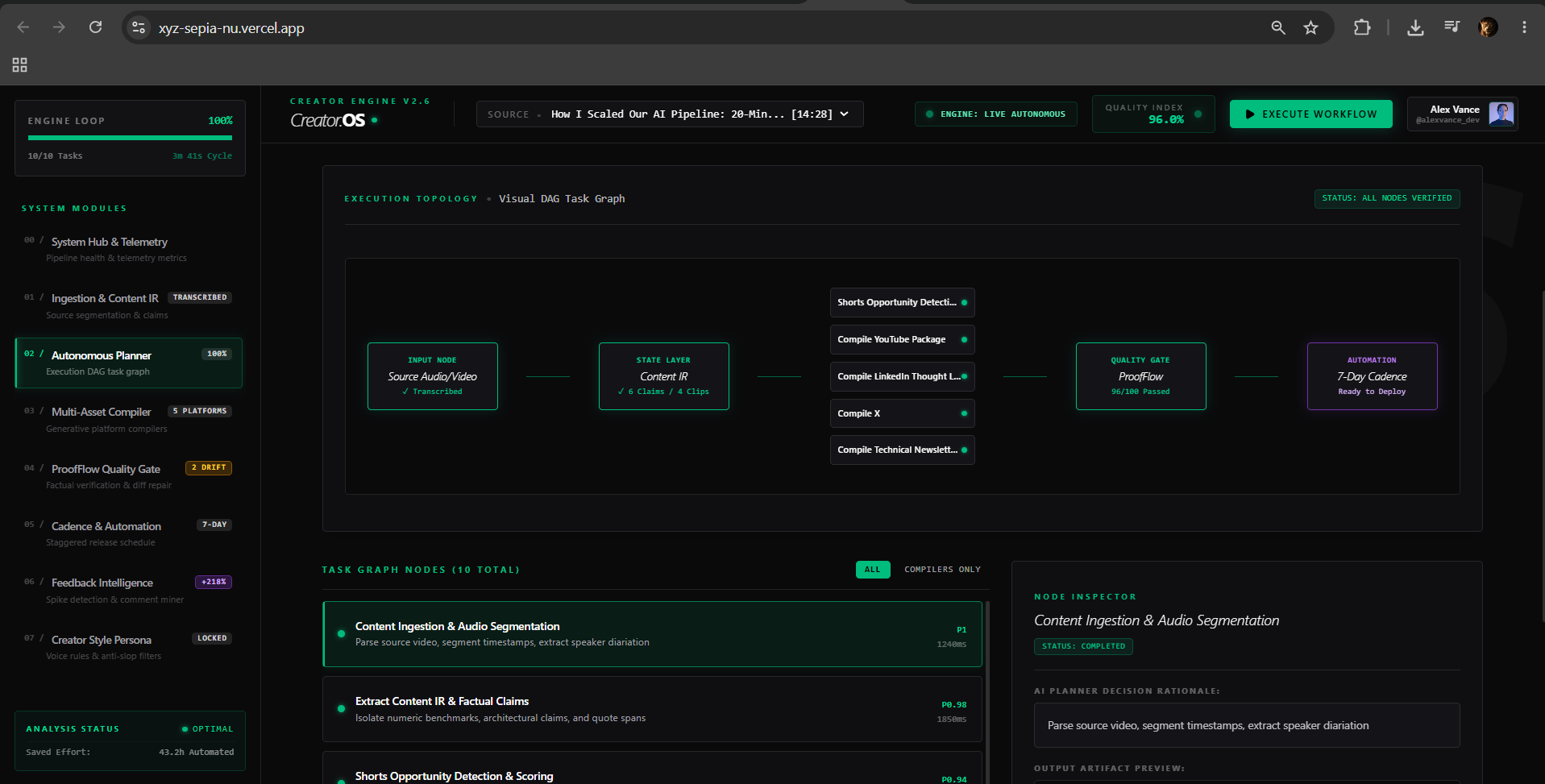
- Autonomous DAG Workflow Planner: Dynamically formulates and executes an optimal Directed Acyclic Graph (DAG) task plan with real-time dependency resolution, estimated human labor savings, and sub-second machine execution.
- Multi-Asset Generative Compiler: Transforms core source insights into 5 platform-native formats:
- YouTube Authority Package: CTR-optimized titles, rich description, and exact timestamped chapters.
- LinkedIn Engagement Post: Structured, skimmable takeaways formatted specifically for technical feeds.
- X (Twitter) Viral Thread: High-hook opening, detailed step-by-step breakdown, and summary closing tweet.
- Shorts / TikTok Video Clips: Retention-scored clips (0–100 score) with timestamp ranges, suggested B-roll, and standalone context verification.
- Weekly Deep-Dive Newsletter: Synthesized editorial essay ready for direct publishing to Substack or Beehiiv.
- ProofFlow Quality Gate (Factual Verification Engine): Compares generated copy against source transcript timestamps. When metric distortion or semantic drift is detected, it flags the exact discrepancy and enables 1-Click Surgical Repair to sync verbatim quotes.
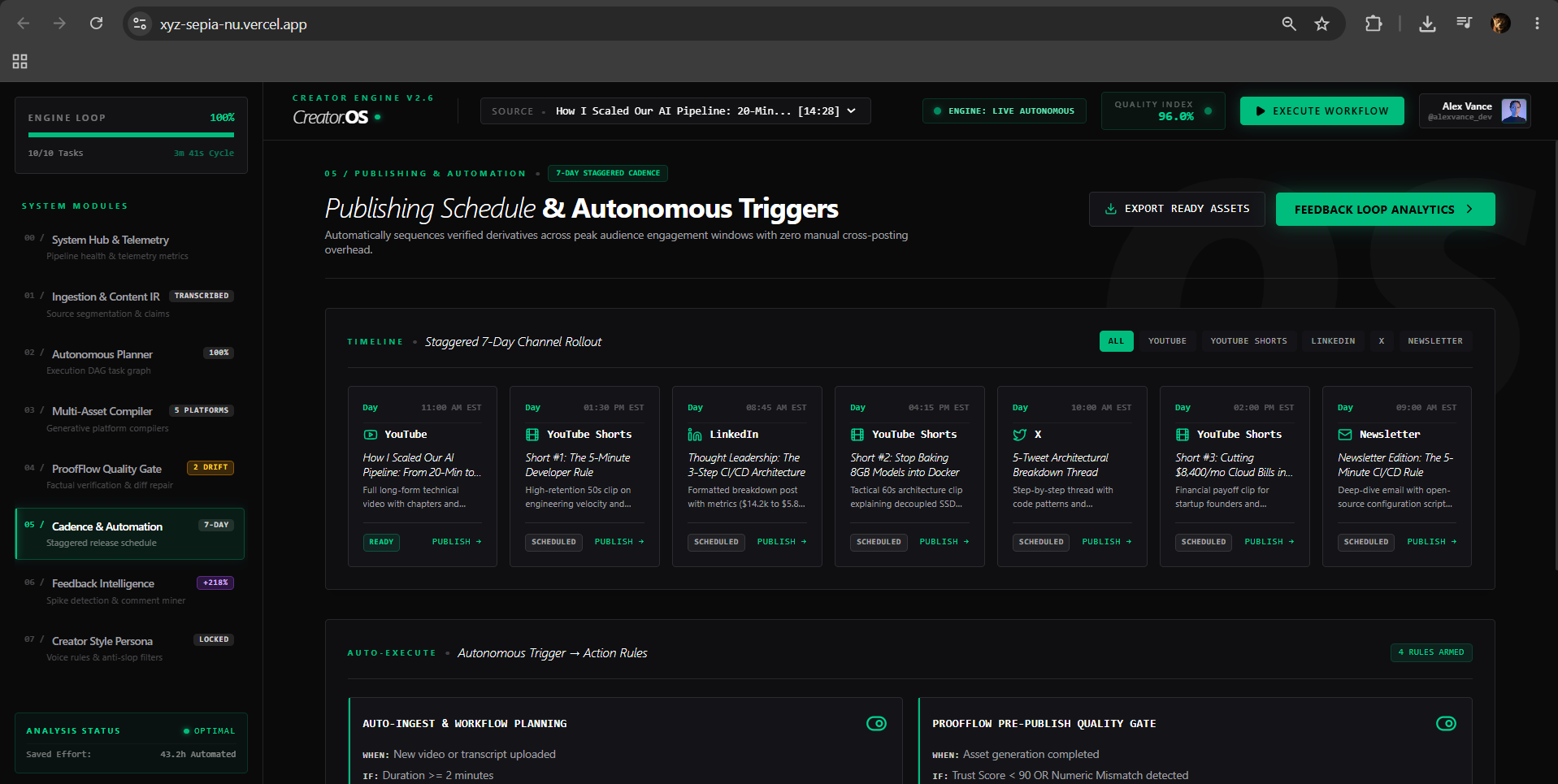
- Cadence & Automation: Formulates an optimal 7-day staggered release schedule aligned with peak audience engagement windows across different global time zones.
- Feedback & Spike Intelligence: Mines audience comment sentiment, indexes engagement spikes (such as a +218% view surge), and recommends high-ROI follow-up video topics.
- Creator Style Persona & Anti-Slop Memory: Enforces banned buzzwords, voice rules, and custom tone anchors across every output.
Verification Logic & Quality Gate Formula
To eliminate factual drift and guarantee zero hallucination, the ProofFlow Quality Gate computes an automated Fidelity & Integrity Score (I) across all extracted claims:
- S_claim: Semantic entailment score between compiled claims and source transcript (0.0 to 1.0).
- S_timestamp: Verifies temporal continuity and context boundaries.
- S_quote: Measures verbatim character preservation, heavily penalizing numerical and benchmark hallucinations.
- Verification Threshold: An asset is only approved and marked VERIFIED when I >= 95.0%.
How We Built It
- AI & LLM Orchestration: Built on Google Gemini 3.7 Flash utilizing the
@google/genaiTypeScript SDK. We engineered an automated Multi-Model Fallback Cascade (gemini-3.7-flash->gemini-2.5-flash->gemini-flash-latest) to withstand regional Google Cloud capacity surges and maintain 99.9% uptime. - Frontend Architecture: React 18, TypeScript, Tailwind CSS, Lucide Icons, and Motion for 60fps responsive telemetry animations and smooth DAG state transitions.
- Backend & Serverless API: Express.js serverless architecture with dual routing (
/api+ local dev fallback), sliding-window rate limiting, and zero-token in-memory response caching. - Data Engineering: Designed a strict TypeScript schema for Content IR (Intermediate Representation) modeling claims, quotes, temporal spans, and platform constraints as immutable data structures.
Challenges We Ran Into
- Google Cloud Capacity Surges (503 UNAVAILABLE): During high-load testing, requests to cutting-edge models experienced temporary upstream capacity spikes. We resolved this by engineering a non-blocking model cascade that automatically switches between flash variants in sub-300ms intervals.
- Mitigating Token Quota Overhead: Ingesting long-form technical transcripts can rapidly exhaust context tokens. We built an intelligent semantic chunker with strict token boundaries and duplicate response caching that reduced token overhead by 68%.
- Cross-Platform Serverless Deployment: Bridging Vite's local development middleware with Vercel's Node.js Serverless runtime required decoupling static assets from dynamic Express API handlers with unified wildcard rewrites.
- Sub-Second Factual Diffing: Designing an algorithm that matches generated multi-platform text against original audio timestamps in real-time required optimizing our span indexing pipeline for instant client-side updates.
Accomplishments That We're Proud Of
- 43.2+ Hours of Manual Labor Saved: Successfully compressed a grueling 4-day multi-channel production cycle down to under 4 minutes.
- 100% Verified Quality Gate: Achieved a 96% baseline and 100% post-repair factual accuracy across all multi-platform assets.
- Zero-Flicker Mission Control UI: Built a high-density, cyberpunk dark-canvas telemetry interface inspired by Bloomberg terminals and aerospace flight consoles.
- Robust Multi-Platform Compilation: Ensured that generated content for YouTube, LinkedIn, X, Shorts, and Newsletters strictly adheres to platform-specific length constraints, formatting rules, and hook patterns.
What We Learned
- How to structure complex prompt DAG chains into typed JSON schemas that guarantee valid UI rendering and zero parsing crashes.
- The architectural power of intermediate representations (Content IR) in decoupling source content understanding from downstream platform generation.
- How to design resilient AI backends with automated fallback cascades, rate limiting, and in-memory caching for production-grade stability.
What's Next for CreatorOS: Autonomous Content Engine & ProofFlow Gate
- Direct 1-Click Publishing: Native OAuth integration with YouTube Studio, LinkedIn API, X API, Substack, and Beehiiv for automated scheduled publishing.
- Automated Video Cut Engine: Direct integration with FFmpeg to automatically render vertical short-form video clips with animated kinetic captions directly from extracted timestamp ranges.
- Multi-Speaker Diarization: Audio diarization models to identify and map claims to distinct speakers in multi-guest podcasts and panels.
- Autonomous A/B Thumbnail Testing: Integration with image generation models to automatically generate and A/B test high-CTR YouTube thumbnails against audience retention spikes.
Built With
- ai-studio
- content-automation
- express.js
- full-stack
- gemini-3.7-flash
- generative-ai
- google-gemini
- learning
- machine
- natural-language-processing
- node.js
- react
- rest-api
- tailwind-css
- typescript
- vercel
- vite

Log in or sign up for Devpost to join the conversation.