-
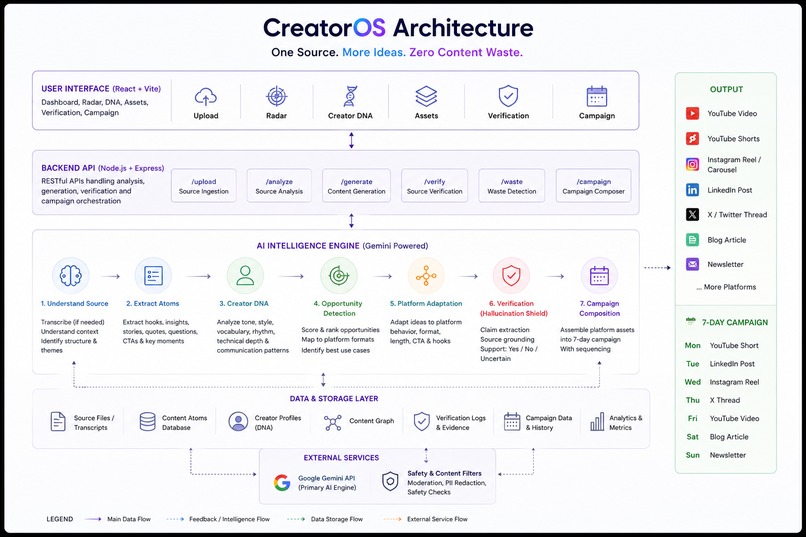
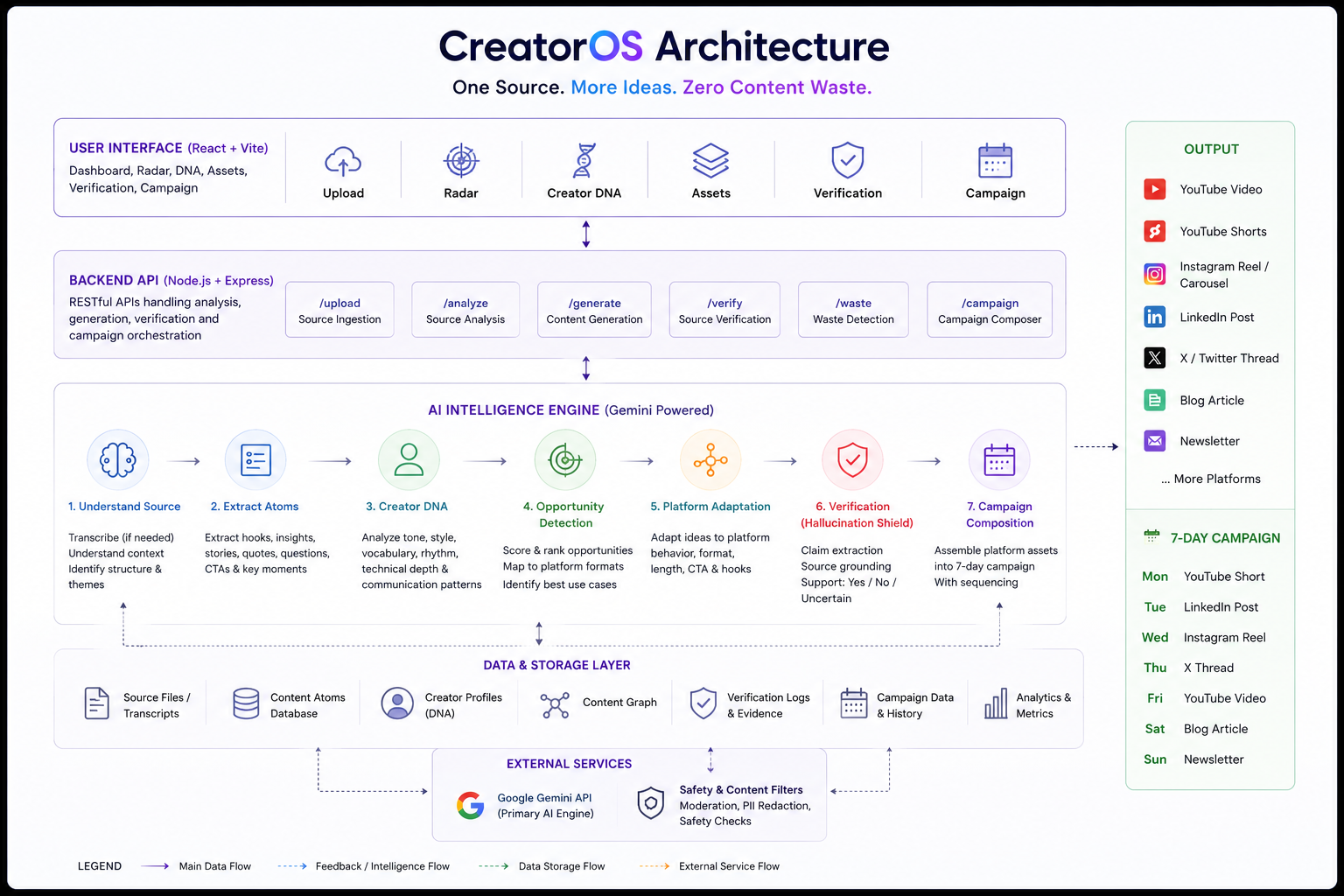
Architecture Diagram
Inspiration
Creators already produce valuable ideas, but much of that value disappears inside the original video, podcast, transcript, or long-form post. We built CreatorOS around one question: What if one source could become an intelligent, traceable content campaign without forcing creators to repeatedly rewrite the same idea?
Unlike a simple AI caption generator, CreatorOS treats repurposing as a compilation problem: understand the source, extract reusable ideas, learn the creator's voice, adapt ideas to each platform, verify generated claims against the source, rescue unused opportunities, and organize the result into a campaign.
The goal is not to create more content. It is to waste less of the content creators already created.
What it does
CreatorOS transforms one creator source into a verified, platform-native campaign.
- Content Radar discovers hooks, insights, stories, opinions, questions, quotes, CTAs, and short-form opportunities.
- Creator DNA profiles tone, cadence, vocabulary, technical depth, storytelling patterns, and communication habits so outputs preserve the creator's voice.
- Content Graph maintains lineage from the original source to content atoms, platform assets, and campaign days.
- Platform Intelligence adapts the same underlying idea differently for YouTube, Shorts, Instagram, LinkedIn, X/Twitter, blogs, and newsletters rather than simply cross-posting.
- Hallucination Shield checks generated claims against the analyzed source and distinguishes supported, unsupported, and uncertain claims. "Source Grounded" means grounded in the supplied source, not internet fact-checking.
- Content Waste Detector finds valuable hooks, insights, FAQs, quotes, and other opportunities left unused after the main campaign is generated.
- 7-Day Campaign Composer sequences native assets into a coordinated release wave, with independent regeneration for individual days.
How we built it
We built CreatorOS as a modular AI pipeline instead of one giant prompt.
Pipeline: Source → Content Understanding → Content Atom Extraction → Creator DNA → Opportunity Detection → Platform Adaptation → Source Verification → Content Waste Detection → Campaign Composition.
The frontend uses React and Vite. A Node.js/Express backend handles API orchestration and secure model access. Google Gemini provides the primary AI intelligence layer.
AI responses are treated as structured application data rather than blindly rendered text. Core concepts include CreatorDNA, ContentAtom, ContentOpportunity, PlatformAsset, Claim, VerificationResult, and CampaignDay.
This separation makes the system easier to debug, validate, extend, and reason about than a single prompt responsible for understanding, generating, verifying, and scheduling everything.
Challenges we ran into
The hardest part was not connecting an AI API. It was controlling what happened around the model.
- Generic output: A single large prompt produced inconsistent results, so we decomposed the workflow into specialized stages.
- Voice preservation: "Write like this creator" was not reliable enough, so Creator DNA became an explicit intermediate representation.
- Platform duplication: Copying the same paragraph across seven platforms is not native content, so we separated the underlying idea from its platform-specific presentation.
- Trust: A fluent model can invent details. The Hallucination Shield compares claims with the canonical source and makes its verification scope explicit.
- Content explosion: More generated assets do not necessarily mean more value. Lineage and waste detection help distinguish useful opportunities from repetitive variations.
- Demo reliability: We designed the experience around a clear pipeline, visible system states, labeled demo content, and independent regeneration so judges can understand the product quickly.
Accomplishments that we're proud of
We are proud of turning a familiar AI content-generation idea into a structured system for content intelligence and reuse.
- One source can drive discovery, voice analysis, platform-native assets, verification, unused opportunities, and a 7-day campaign.
- Content Graph gives generated assets a traceable relationship to their source.
- Creator DNA makes voice preservation an explicit system capability.
- Hallucination Shield adds a trust layer and clearly distinguishes source grounding from external fact-checking.
- Content Waste makes unused source value a first-class product concept.
- Platform Intelligence changes structure, hook strategy, depth, and presentation for each destination.
- The result is a product workflow—not merely a prompt demo: understand → extract → adapt → verify → reuse → schedule.
What we learned
The biggest lesson was that the model is not the entire AI product.
A powerful model can still produce a weak product if the surrounding workflow is poorly designed. The highest-leverage work was deciding what the model should do at each stage, what information must survive between stages, what should be validated, and how uncertainty should be communicated.
We also learned that explicit intermediate representations—Creator DNA, content atoms, claims, verification results, and campaign days—make AI behavior much easier to inspect than one large block of generated text.
Most importantly, we learned to optimize for reliability and usefulness rather than raw generation volume. The goal is not seven versions of the same post; it is a set of distinct, useful assets that remain faithful to the source and native to their destination platforms.
What's next for CreatorOS — AI Content Compiler
The current system establishes the core compilation pipeline. Next, we want to turn it into a long-term content intelligence layer.
Near term: direct YouTube and podcast ingestion, automatic transcription, stronger semantic verification, granular source timestamps, platform-specific evaluation, and repetition detection.
Long term: persistent creator knowledge graphs, audience-performance feedback loops, performance-aware regeneration, brand/team voice profiles, publishing integrations, A/B testing, audience-specific campaigns, and content opportunity forecasting.
The larger vision is not another AI writing assistant. It is a content operating system that understands what a creator has already said, preserves the meaning and voice of that work, finds what remains valuable, and intelligently turns it into a distribution strategy.
One source. More ideas. Zero content waste.

Log in or sign up for Devpost to join the conversation.