-
-
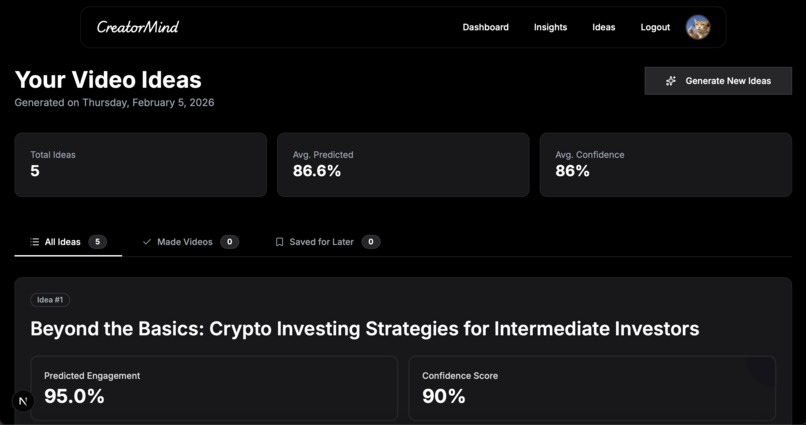
Ideas Page
-
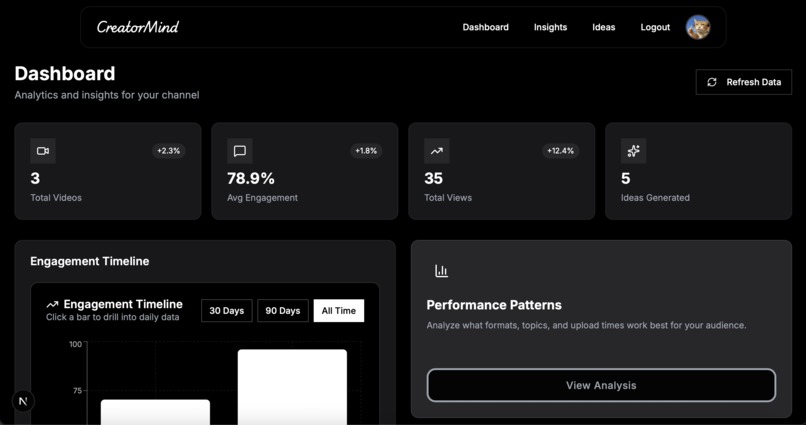
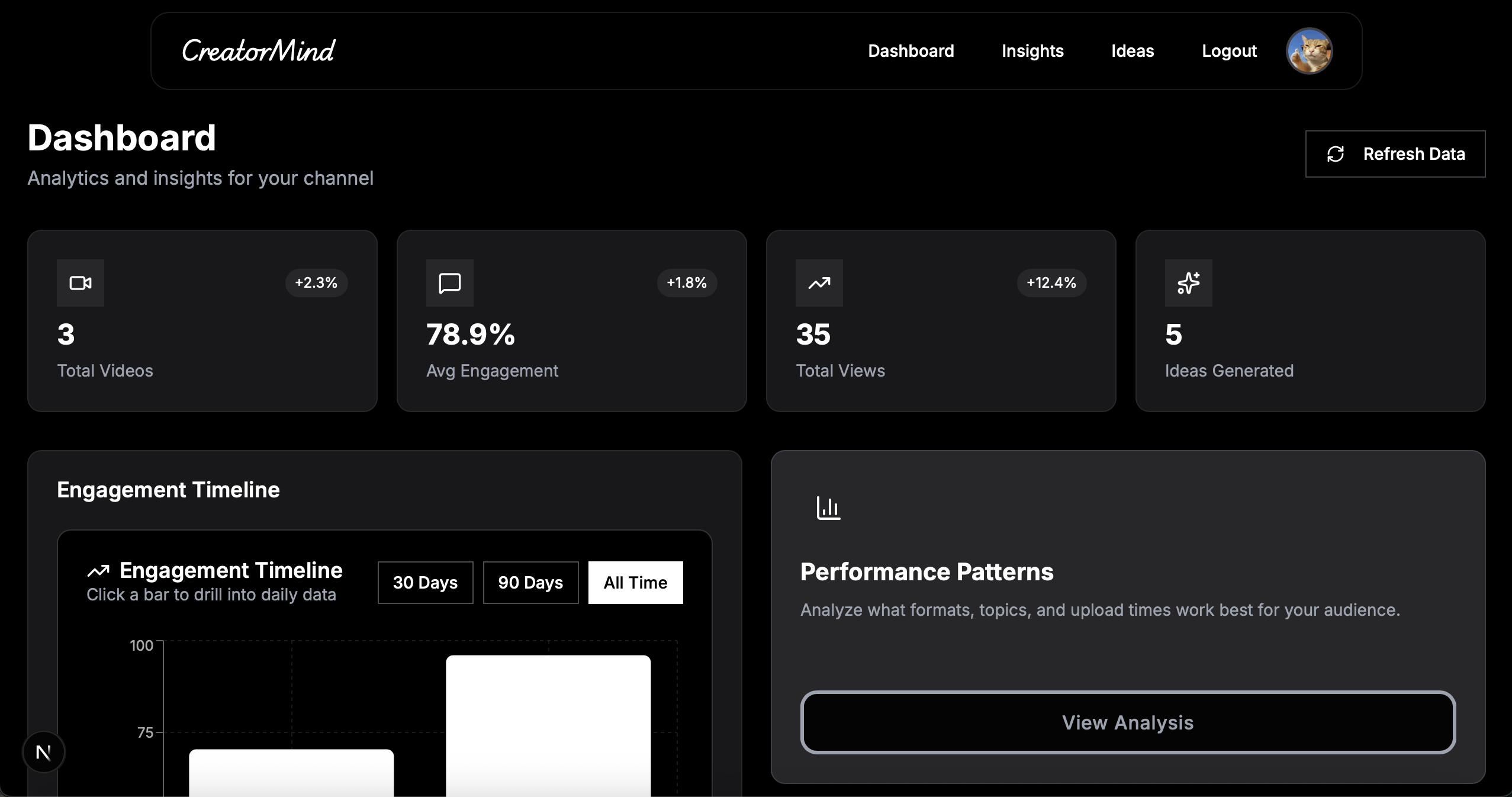
Dashboard Page
-
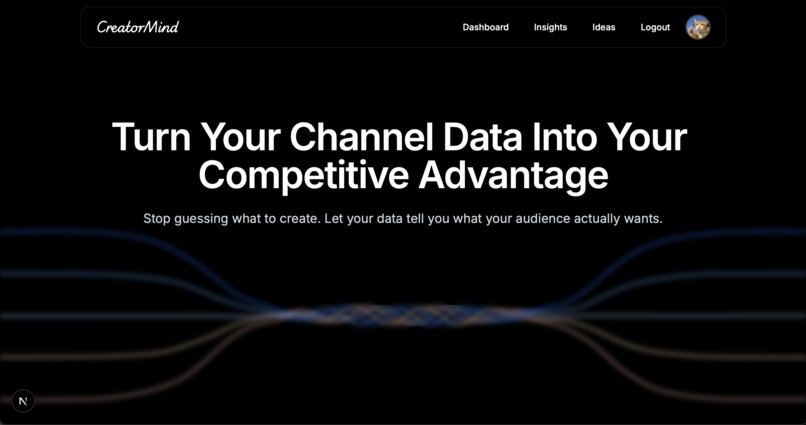
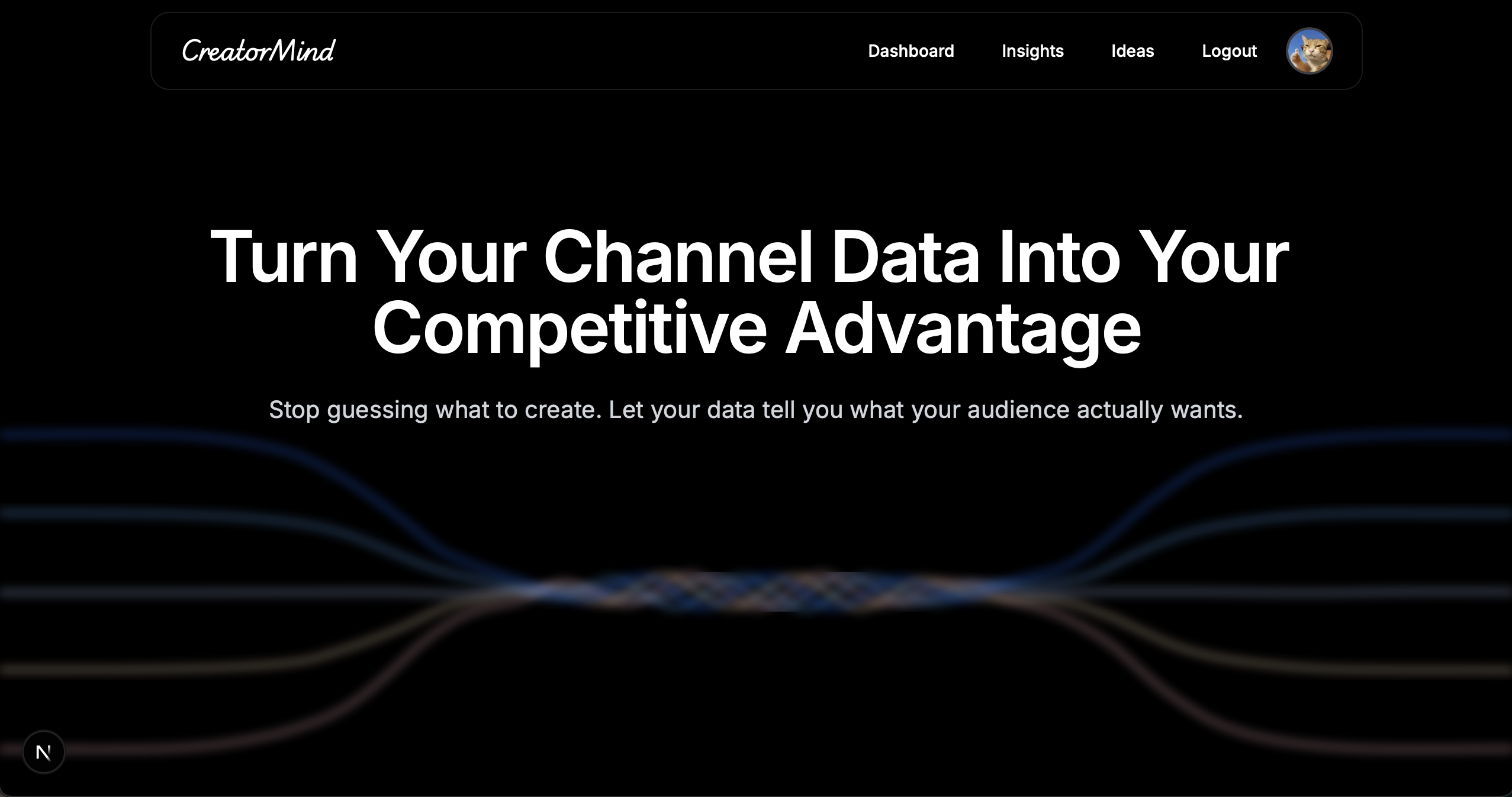
Landing Page
-
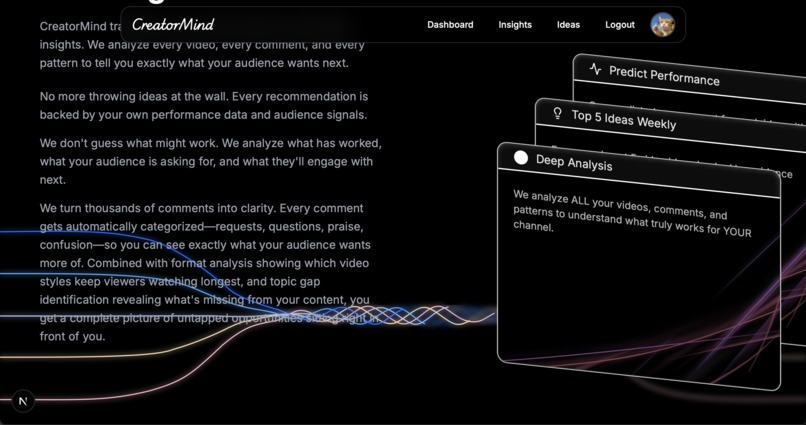
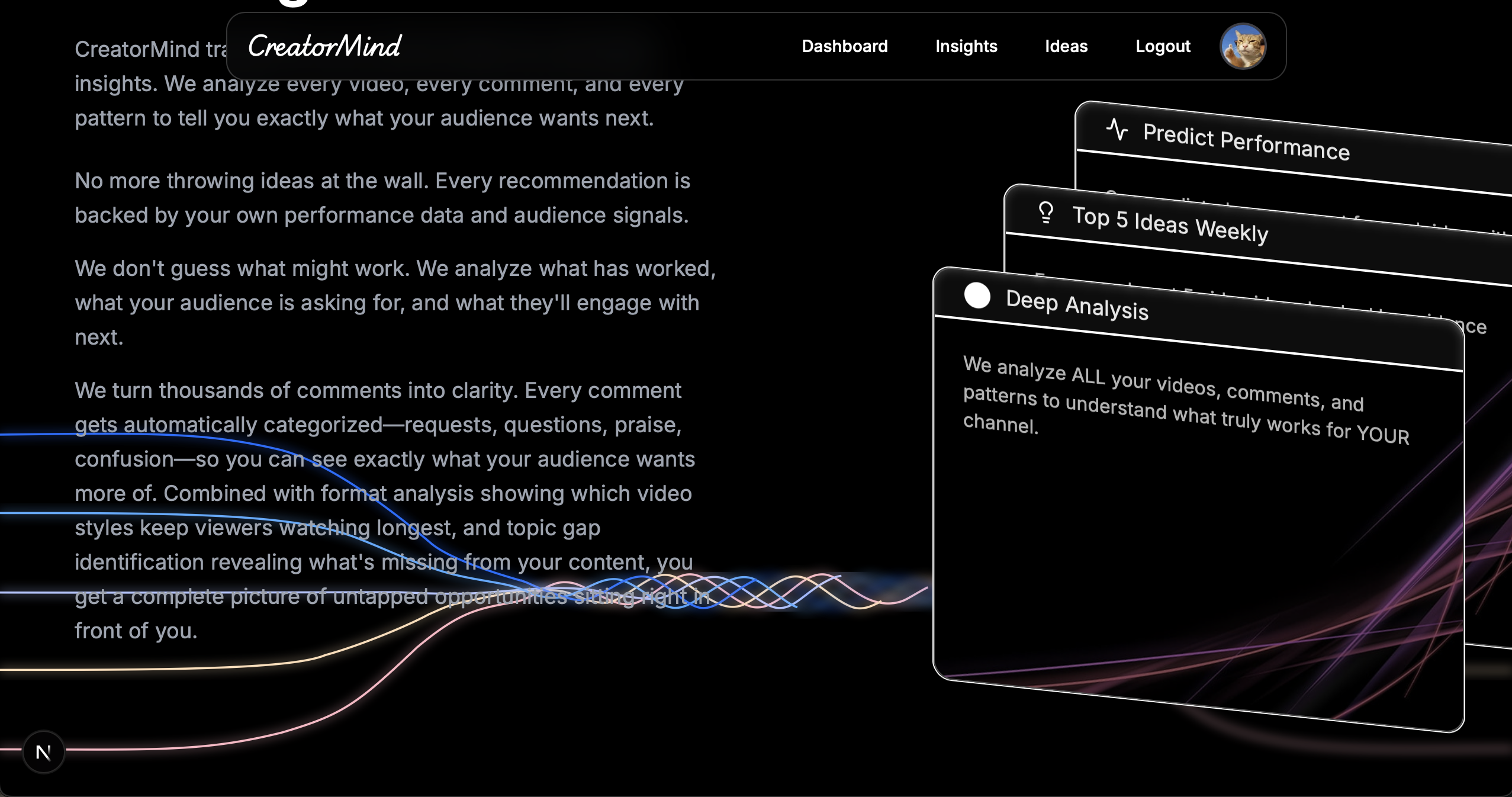
Features section
-
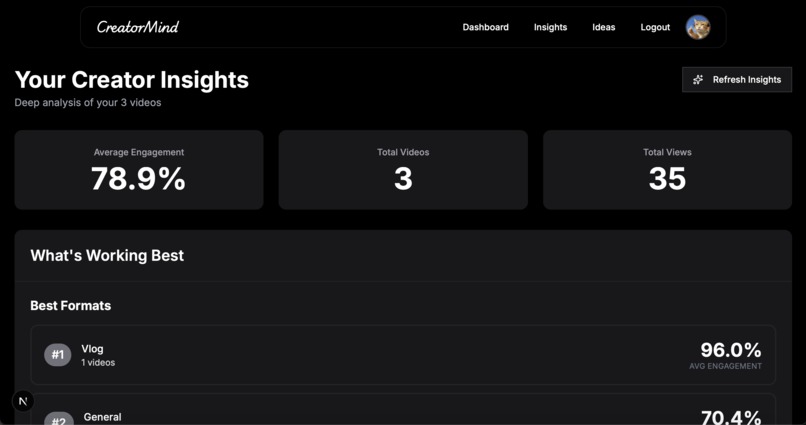
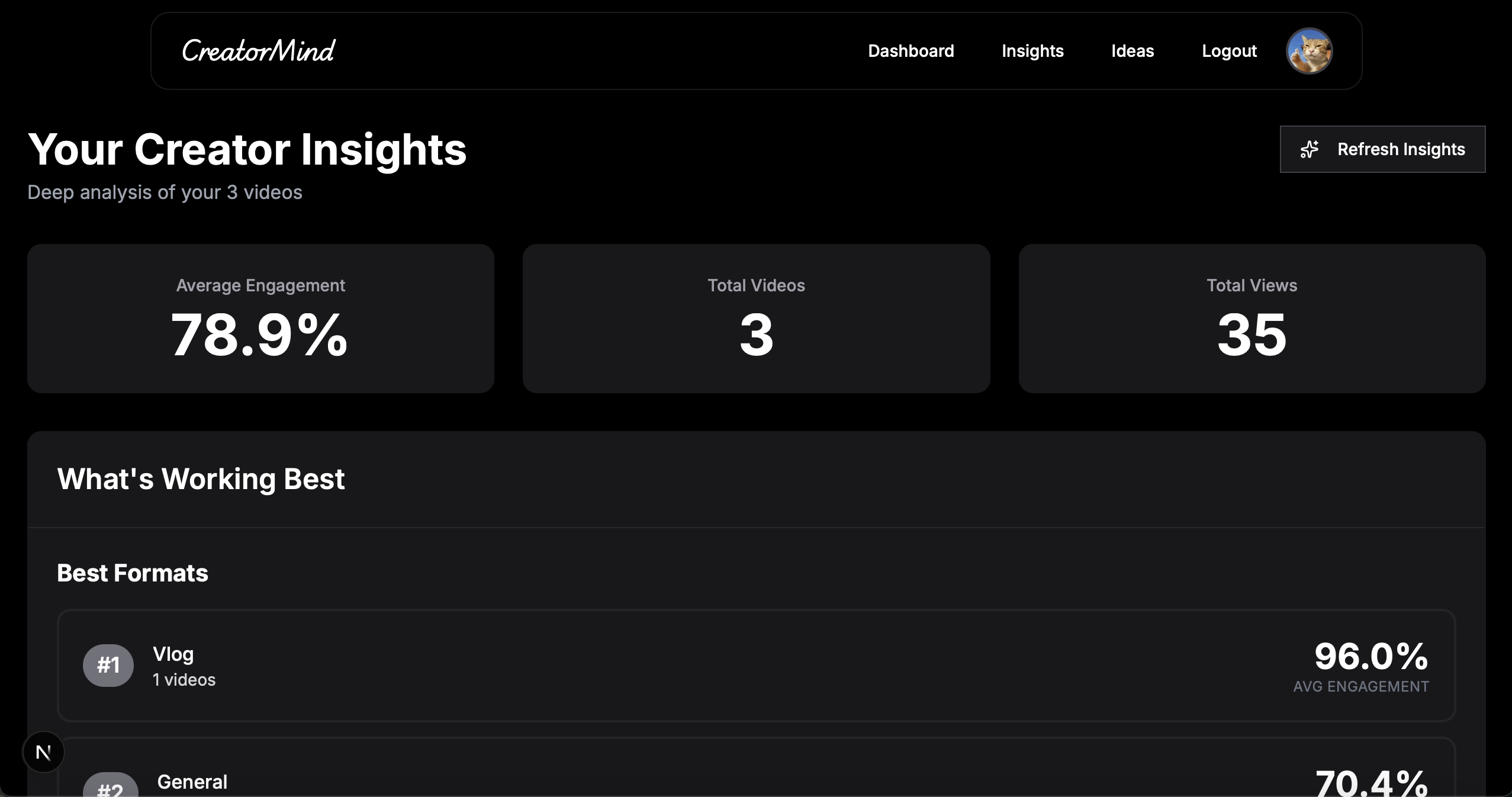
Insights Page
-
Contact Section
-
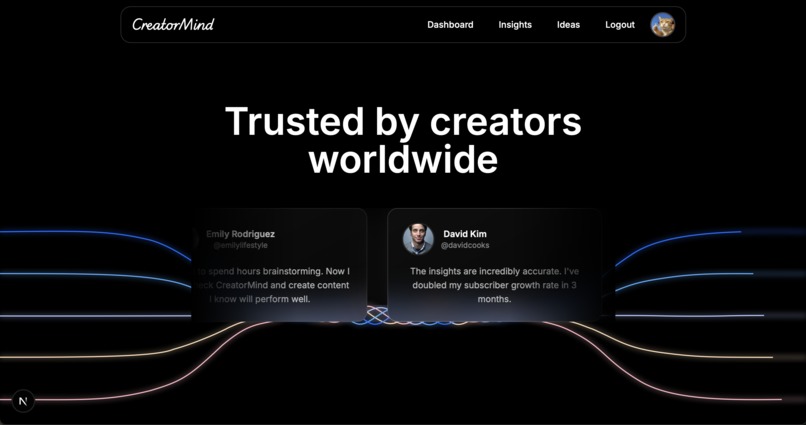
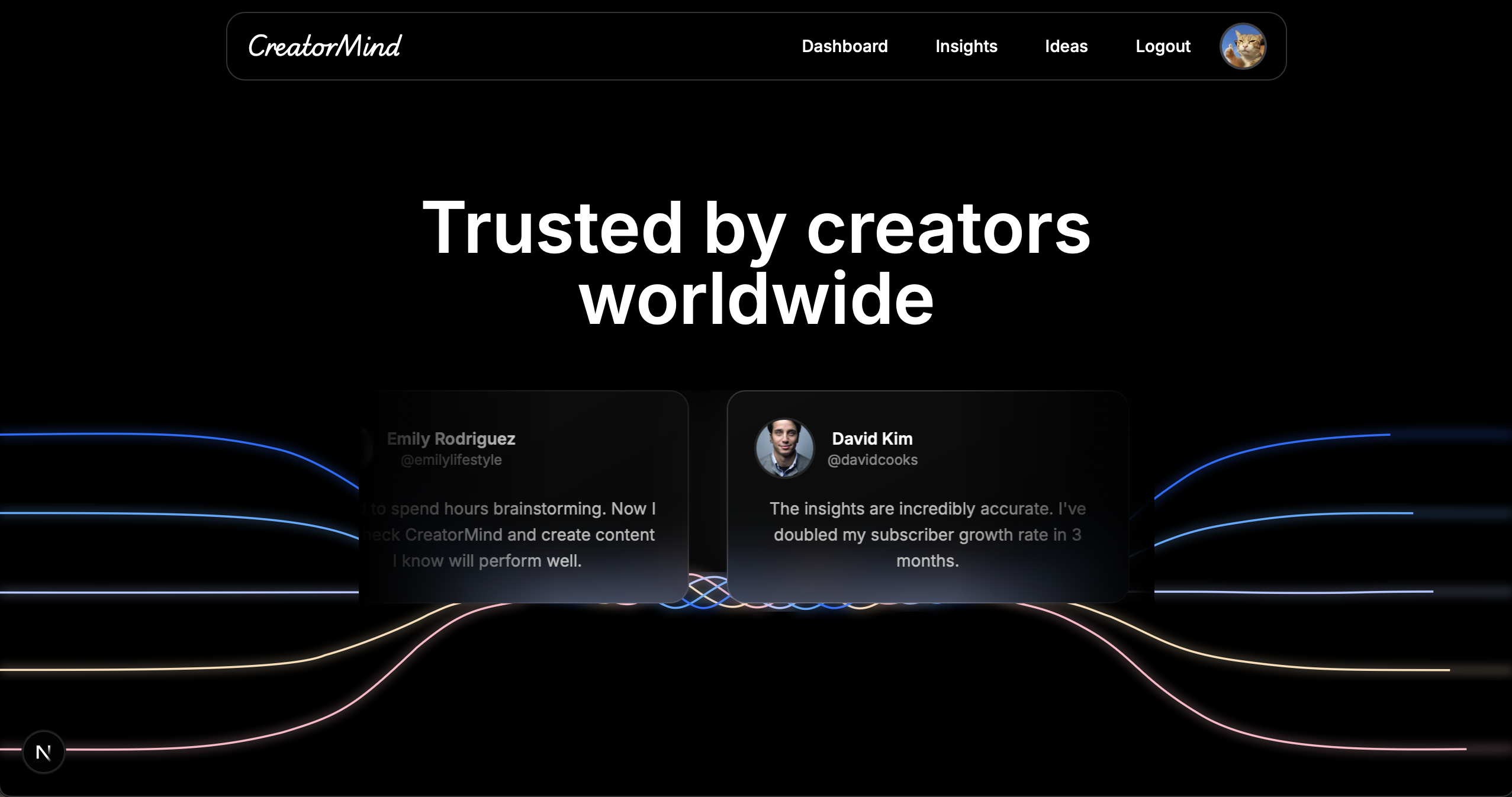
Testimonial Section
Inspiration
YouTube creators face a persistent challenge: understanding what content resonates with their audience. While analytics dashboards provide raw numbers, they fail to answer the fundamental question every creator asks—"What should I create next?"
I observed creators spending hours manually reading comments, tracking trends, and guessing what their audience wants. This inefficiency inspired CreatorMind: a platform that transforms a creator's historical data into actionable intelligence, eliminating guesswork from content planning.
What it does
CreatorMind analyzes a creator's entire YouTube channel—every video, transcript, and comment—to generate data-driven content recommendations. The platform:
- Connects to YouTube channels via OAuth and fetches complete video history
- Extracts metadata (views, likes, comments, transcripts) and stores it permanently
- Uses AI to analyze video characteristics: topics, tone, hooks, format, and complexity
- Performs multilingual sentiment analysis and intent detection on all comments
- Identifies performance patterns across formats, topics, tones, and upload timing
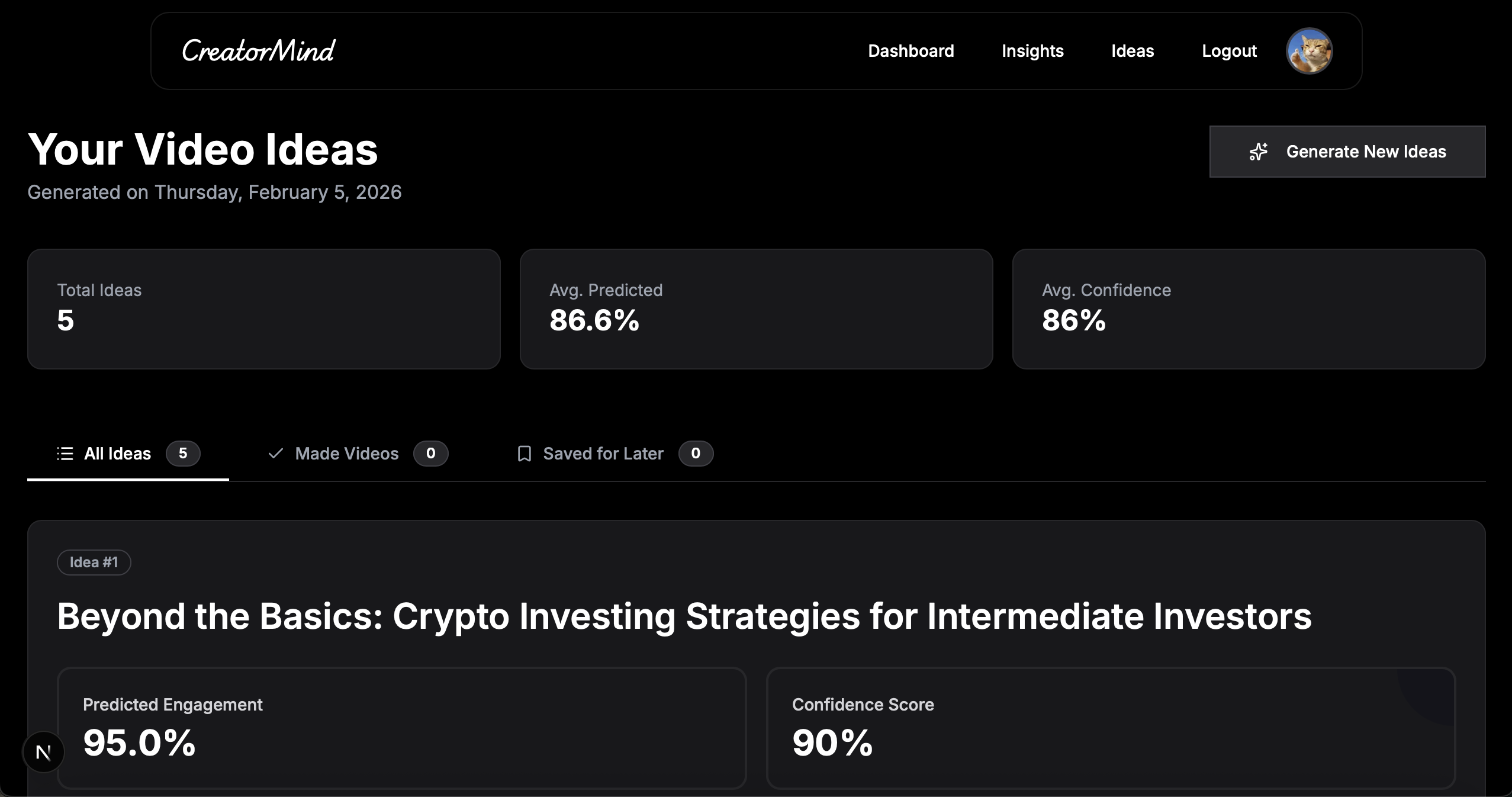
- Generates weekly Top 5 video ideas with evidence-based reasoning and confidence scores
- Delivers insights via interactive dashboard and automated weekly emails
Each video idea includes specific justification such as "42 viewers requested this topic" or "Similar videos achieved 2.1× your average engagement."
How I built it
Technology Stack
- Frontend: React with modern UI components
- Backend: Node.js with Express
- Database: MongoDB for persistent storage
- AI/ML: Google Gemini API for content analysis
- APIs: YouTube Data API v3, OAuth 2.0
- Email: React Email templates with automated scheduling
Architecture
The system follows a three-phase pipeline:
Phase 1: Data Collection
- User authorizes YouTube channel access via Google OAuth
- System fetches all videos with pagination (handles channels with n > 1000 videos)
- For each video v_i, collect: {title, description, views, likes, comments, transcript}
- Display real-time progress: "Processing i of n videos"
Phase 2: AI Analysis
Extract video features using Gemini:
- Topics and subtopics
- Tone classification
- Hook type identification
- Format categorization
- Complexity level (beginner | intermediate | advanced)
Analyze comments across all videos:
- Sentiment: S(c) ∈ {positive, neutral, negative}
- Intent: I(c) ∈ {question, praise, request, criticism, confusion}
- Topic extraction and clustering
Phase 3: Pattern Recognition & Idea Generation
Calculate engagement rate:
E(v) = (likes + comments) / viewsIdentify best-performing characteristics by computing:
Performance(feature) = Σ E(v) / |V_feature|where the sum is over all videos with that feature.
Generate ideas by matching:
- Comment requests (demand signal)
- Historical performance patterns (success indicators)
- Audience profile (relevance filter)
Assign confidence score:
C = w₁ · demand + w₂ · historical + w₃ · relevance
Challenges I ran into
API Rate Limits
YouTube Data API has quota limits (10,000 units/day). Fetching a channel with 500 videos and their comments could exhaust the quota. I implemented:
- Intelligent pagination with exponential backoff
- One-time full sync, then incremental updates
- Prioritized data fetching (metadata first, transcripts second)
Transcript Extraction
Not all videos have auto-generated captions. I built a fallback system:
- Attempt YouTube's auto-caption API
- Fall back to
yt-dlpextraction - Mark videos without transcripts and analyze metadata only
Comment Clustering at Scale
Channels with 100,000+ comments posed computational challenges. I optimized by:
- Batching comments for AI analysis (100 per batch)
- Using embeddings for semantic clustering instead of pairwise comparison
- Reducing complexity from O(n²) to O(n log n)
AI Hallucination Prevention
Gemini occasionally generated ideas without proper evidence. I mitigated this by:
- Requiring explicit evidence linking (specific comment IDs, video titles)
- Implementing verification layer: cross-check AI claims against database
- Rejecting ideas with confidence < 40%
Email Scheduling Across Timezones
Users worldwide need emails at their local time. I implemented:
- Timezone-aware scheduling with cron jobs
- User preference storage (day, time, frequency)
- Beautiful HTML emails using React Email templates
Accomplishments that I'm proud of
I successfully built a complete MVP that:
- Processes unlimited videos from any YouTube channel
- Performs sophisticated AI analysis on video content and audience feedback
- Generates actionable, evidence-backed content ideas
- Delivers insights through both web dashboard and automated emails
- Handles edge cases (missing transcripts, rate limits, large channels)
The platform transforms the content creation workflow from reactive ("what did well?") to proactive ("what will work?").
What I learned
Technical Learnings
- OAuth 2.0 implementation for secure third-party authorization
- Working with large-scale data processing (handling 10,000+ videos × 100+ comments)
- Prompt engineering for structured AI outputs
- MongoDB aggregation pipelines for complex analytics
- Background job processing and queue management
Product Insights
- Users value why over what—showing evidence is crucial
- Real-time progress indicators reduce perceived wait time during sync
- Weekly cadence prevents information overload better than daily updates
- Specificity wins: "42 viewers asked" is more compelling than "popular topic"
What's next for CreatorMind
Future enhancements include:
- Competitor Analysis: Compare performance against similar channels
- Thumbnail Intelligence: Analyze visual elements of high-performing thumbnails
- Trend Detection: Identify emerging topics before they peak
- Collaboration Suggestions: Recommend creators for potential collaborations
- Multi-Platform Support: Extend to TikTok, Instagram, and podcasts
- A/B Testing Framework: Test title/thumbnail variants with predicted outcomes
CreatorMind demonstrates that the future of content creation is not about guessing—it's about knowing. By combining comprehensive data analysis with AI-powered insights, creators can focus on what they do best: creating great content.
Built With
- bullmq
- cron
- gemini-api
- googleoauth
- javascript
- jwt
- mailjet
- mongodb
- next
- nextauth
- react
- react-email
- typescript
- upstash
- vercel
- youtube

Log in or sign up for Devpost to join the conversation.