


Inspiration
User-generated content (UGC) is a form of marketing that allows brands to deliver their messages authentically through trusted creators rather than through explicit advertisements. A key part of the effectiveness of the UGC strategy is authenticity - brands must choose to collaborate with influencers/content creators who align with their image and have an audience who is receptive to their products. Often, brands will search for UGC creators through third-party platforms or by conducting their own market research to find the right fit. We aim to simplify this process, allowing brands and creators to search for one another and connect by leveraging X APIs and X data. Ultimately, we create a better advertising experience for:
- Brands, who can easily find content creators who align with their brand image;
- Content creators, who are promoted and matched to brands that they actually like and use;
- X as a platform, which can leverage their wealth of data to offer an additional service to their advertisers;
- Users of X, who see higher-quality, more genuine content. We believe that the best advertising, measured by high impressions and conversions, comes from quality content; that quality content comes from authentic endorsements.
What it does
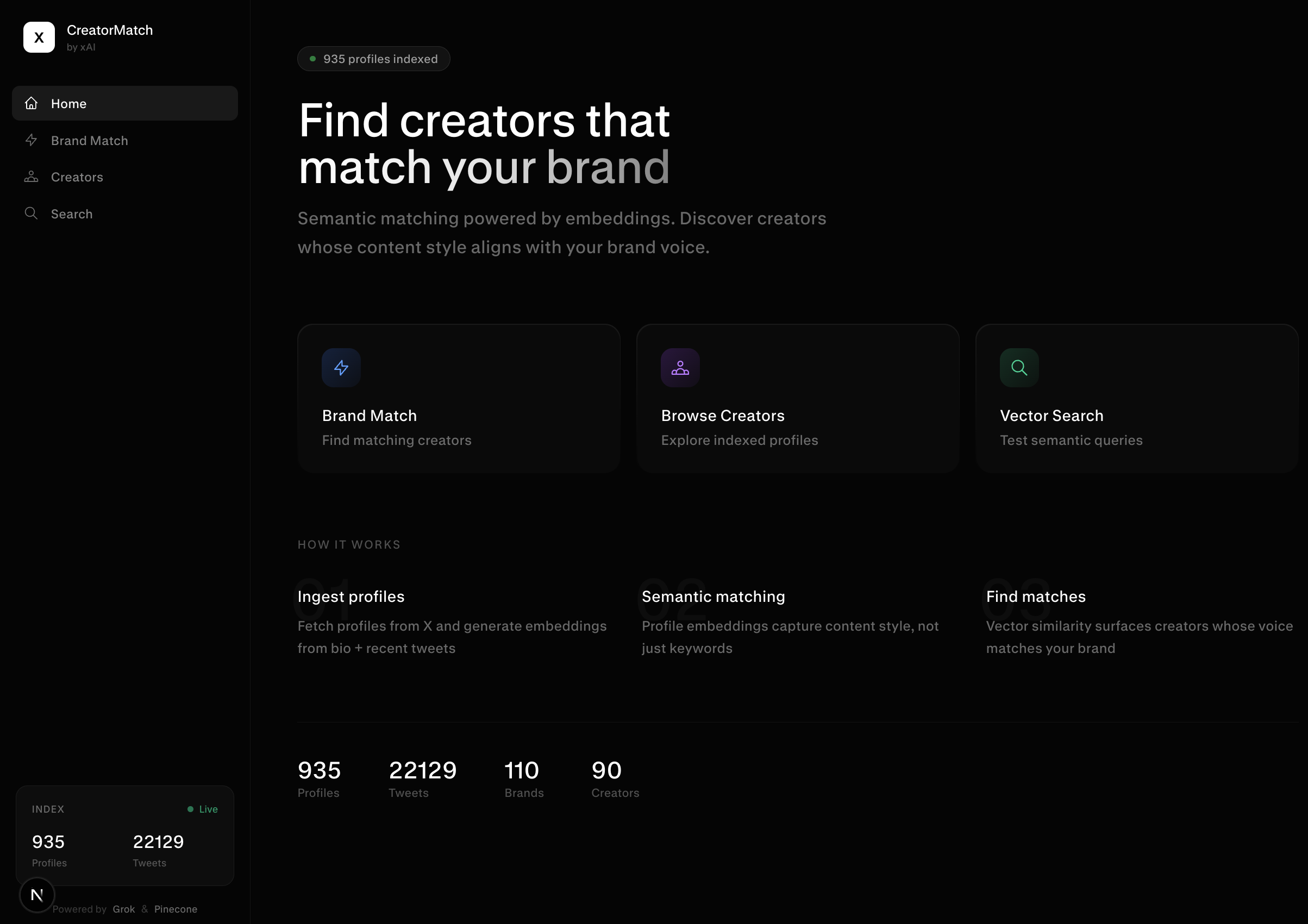
xCreator allows brand managers to find UGC creators who align with their brand. It uses vector embeddings to encode content creators' voice, posting styles, and audience demographics, matching them to brands. Then, social media managers can add their own goals, such as selecting for smaller/larger creators or only verified individuals. They see real creator insights, including their engagement rates and the reason they were recommended. This streamlines both the efficiency in finding appropriate creators, and the quality of the content that is created and advertised.
How we built it
We leveraged X API's data, xAI's Grok 4.1 model, and vector embeddings to build this system to embed and match brands with content creators. First, we create vector embeddings for top content creators among various industries. We extract their tweets and engagement metrics to encode their voice and audience. Then, we project the company's metrics, target audience, and current X presence to the same vector space, comparing their cosine similarity and correcting for overfitting. We use X analytics and Grok to summarize the rationale behind the match, allowing advertisers to make informed, data-driven decisions. Finally, we used Grok 4.1 Fast Reasoning to deliver a personalized call to action to selected creators.
Challenges we ran into
We had to make decisions about how we could normalize and represent unstructured, text-based post data to accurately match sentiment and topics between content creators and brands. We also had to normalize the data, preventing overfitting while still placing higher value on more recent data. Finally, we had to understand and evaluate the quality of our proposed matches, helping advertisers understand their conversions and impressions.
Accomplishments that we're proud of
Indexing and ingesting data at scale was one of our main challenges, and forced us to think about how we could optimize such a costly operation.
What we learned
We learned about the end-to-end UGC pipeline and to understand our target user and the metrics that they care about.
What's next for xCreator
We plan to continue to scale xCreator, embedding a wider variety of brands and content creators.
Built With
- grok
- pinecone
- react-three-fiber


Log in or sign up for Devpost to join the conversation.