-
-
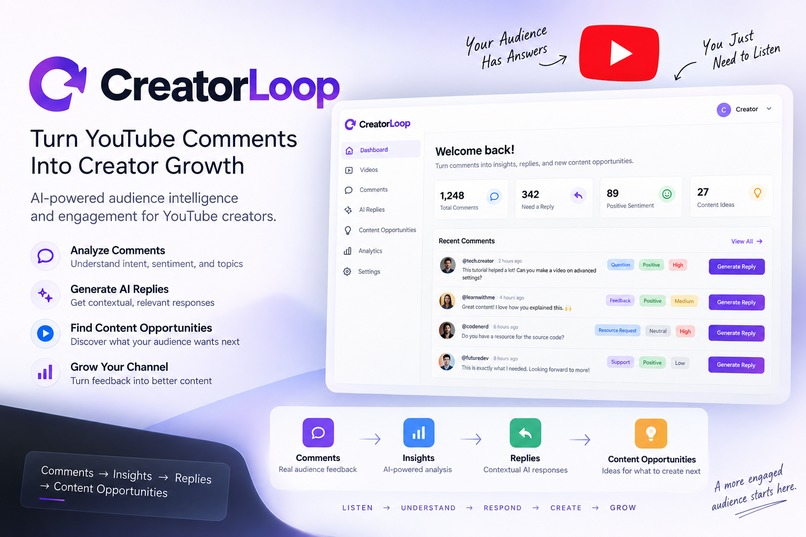
CreatorLoop AI Dashboard
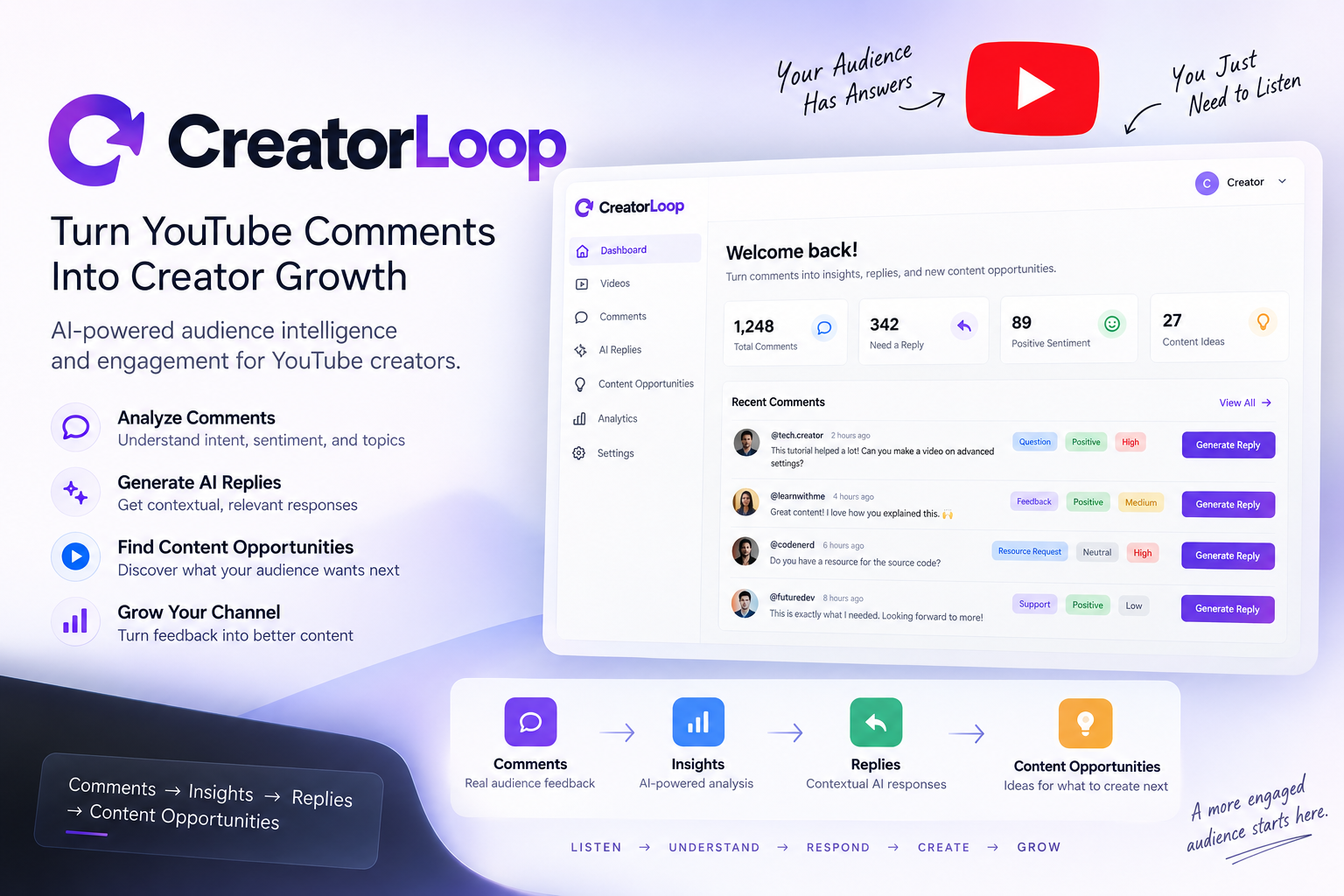
Inspiration
YouTube comments contain much more than engagement. They contain questions, feedback, missing-resource requests, recurring pain points, and ideas for what creators should build next.
As a channel grows, manually reading every comment, deciding which ones matter, replying consistently, and identifying repeated audience requests becomes difficult.
I built CreatorLoop to turn those comments into actionable creator intelligence.
What it does
CreatorLoop is an AI-powered YouTube audience intelligence and engagement platform.
A creator can connect a public YouTube channel, and CreatorLoop:
- Imports recent videos and comments
- Analyzes comment intent, sentiment, topic, confidence, and priority
- Determines whether a comment deserves a reply
- Searches the creator's existing videos using semantic vector search
- Generates contextual AI reply suggestions
- Lets the creator review or edit each reply before publishing
- Publishes approved replies to YouTube
- Identifies unanswered audience requests as future content opportunities
The core idea is simple:
Comments → Insights → Replies → Content Opportunities
Instead of treating comments as isolated messages, CreatorLoop turns them into structured signals that help creators understand their audience and decide what to create next.
How we built it
CreatorLoop uses a Next.js + TypeScript frontend with a FastAPI backend.
YouTube videos and comments are retrieved through n8n workflows and the YouTube Data API v3.
Creator data is stored in PostgreSQL/Neon, while pgvector and AI embeddings enable semantic search across the creator's existing video library.
Google Gemini analyzes comments and generates structured insights, priorities, and contextual reply suggestions.
For publishing, CreatorLoop uses a human-in-the-loop workflow:
CreatorLoop generates a reply → Creator reviews or edits it → Creator approves it → FastAPI calls a protected n8n workflow → YouTube Data API publishes the reply.
The frontend is deployed on Vercel, while the FastAPI backend is deployed on Render.
Challenges we ran into
One of the biggest challenges was separating public YouTube analysis from authenticated YouTube publishing.
CreatorLoop can analyze public channels and comments without requiring creator authentication, but publishing a reply requires OAuth authorization from the YouTube account actually posting the response.
I also had to solve several engineering challenges, including:
- Comment deduplication
- Synchronization between n8n and FastAPI
- API authentication and protected webhooks
- AI failures and malformed outputs
- Vector indexing and semantic search
- Reply state management
- Keeping video and comment synchronization bounded and reliable
- Ensuring AI-generated replies are never published without creator approval
Building these pieces together reliably was much more challenging than simply generating AI responses.
Accomplishments that we're proud of
The biggest accomplishment was getting the complete workflow working end to end.
CreatorLoop can take a real YouTube comment, analyze it, search the creator's existing content for relevant context, generate a suggested response, allow the creator to review or edit it, and then publish the approved reply back to the actual YouTube comment thread.
Seeing an approved CreatorLoop reply appear on a real YouTube video proved that the entire system — from data ingestion to AI analysis to authenticated publishing — worked successfully.
I'm also proud that CreatorLoop goes beyond a typical AI chatbot by combining:
- Real external APIs
- Semantic search
- Structured AI outputs
- Automation workflows
- Human approval
- Production deployment
- Actionable content intelligence
What we learned
CreatorLoop taught me a lot about designing real AI automation systems, rather than simply putting an LLM behind a chat interface.
I gained deeper practical experience with:
- YouTube Data API v3
- OAuth and authenticated publishing
- n8n production workflows
- FastAPI integration patterns
- PostgreSQL and pgvector
- Embeddings and semantic search
- Structured AI outputs
- Human-in-the-loop AI systems
- Secure webhook communication
- Multi-service deployment
- Designing reliable AI workflows around external APIs
The project also reinforced the importance of keeping humans in control when AI systems can perform real-world actions.
What's next for CreatorLoop
The next step is turning CreatorLoop from a single-channel workflow into a more complete audience intelligence platform.
Future improvements include:
- Creator OAuth onboarding
- Multi-channel support
- Continuous comment monitoring
- Audience sentiment trends over time
- Stronger content-demand clustering
- Creator-specific reply styles
- Better analytics dashboards
- Automatic detection of recurring audience questions
- Content opportunity scoring
- Deeper YouTube performance analytics
Ultimately, CreatorLoop could become an AI audience intelligence layer for YouTube creators — helping them understand not only how to respond to their audience, but what they should create next.
Built With
- api
- data
- embeddings
- fastapi
- gemini
- n8n
- neon
- next.js
- pgvector
- postgresql
- python
- react
- typescript
- vector
- youtube

Log in or sign up for Devpost to join the conversation.