-
-
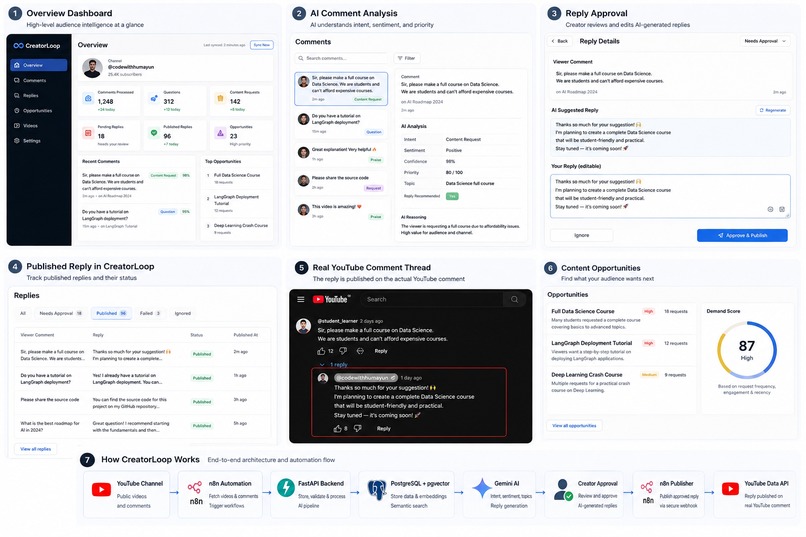
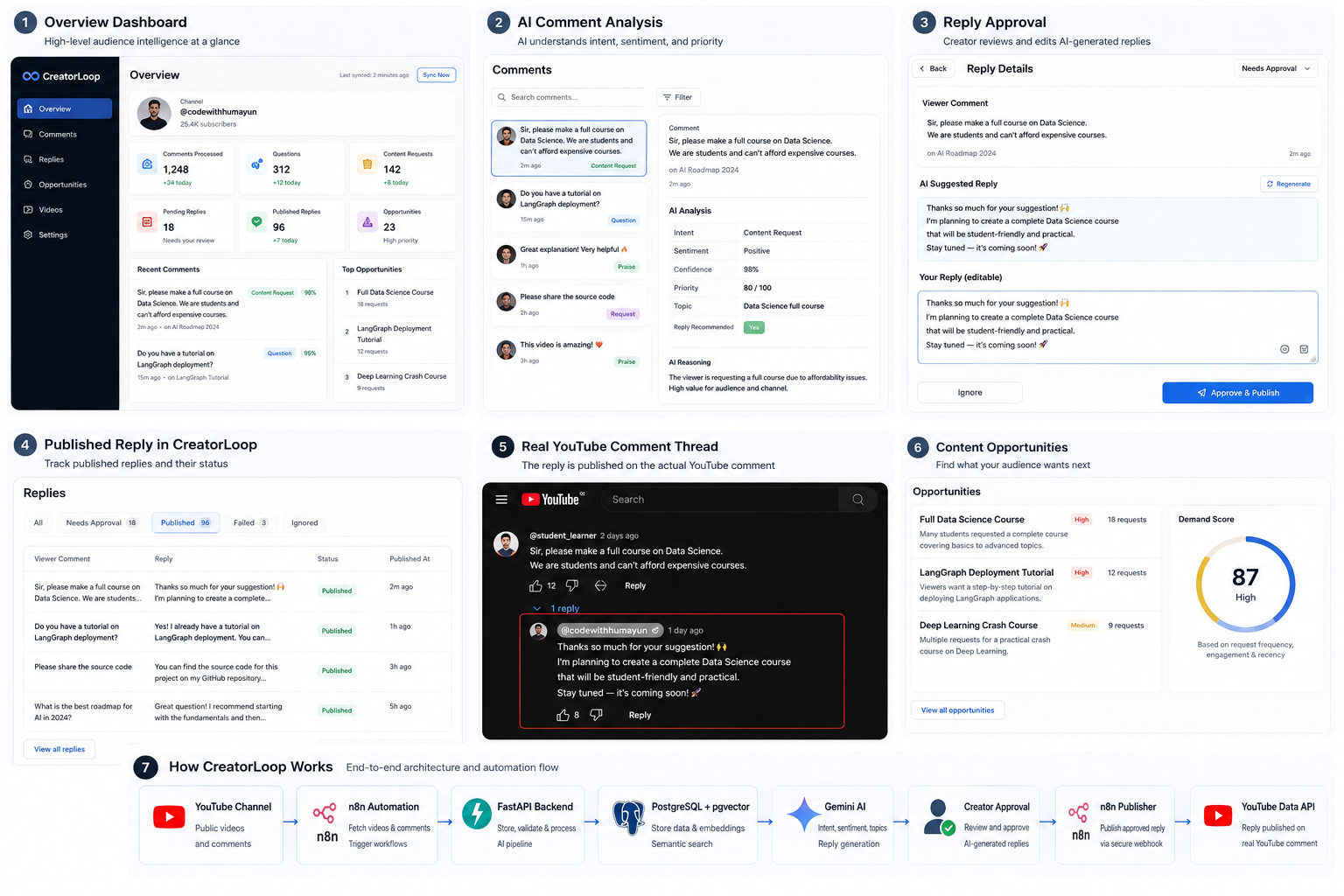
CreatorLoop turns YouTube comments into AI insights, creator-approved replies, real publishing, and content opportunities.
Inspiration
YouTube comments contain much more than engagement. They contain questions, feedback, missing-resource requests, and ideas for what creators should build next.
As a channel grows, manually reading every comment, deciding which ones matter, replying consistently, and identifying repeated audience requests becomes difficult.
I built CreatorLoop to turn those comments into actionable creator intelligence.
What it does
CreatorLoop is an AI-powered YouTube audience intelligence and engagement platform.
A creator can connect a public YouTube channel, and CreatorLoop:
- imports recent videos and comments
- analyzes comment intent, sentiment, topic, confidence, and priority
- decides whether a comment deserves a reply
- searches the creator's existing videos using semantic vector search
- generates contextual AI replies
- lets the creator review or edit each reply before publishing
- publishes approved replies to YouTube
- identifies unanswered audience requests as future content opportunities
The goal is to transform:
Comments → Insights → Replies → Content Opportunities
How I built it
CreatorLoop uses a Next.js + TypeScript frontend with a FastAPI backend.
YouTube videos and comments are retrieved through n8n workflows and the YouTube Data API v3.
The backend stores creator data in PostgreSQL/Neon, while pgvector and AI embeddings enable semantic search across the creator's existing video library.
Google Gemini analyzes comments and generates structured insights and reply suggestions.
For publishing, CreatorLoop uses a human-in-the-loop workflow:
CreatorLoop generates a reply → the creator reviews or edits it → the creator approves it → FastAPI calls a protected n8n workflow → the YouTube Data API publishes the real reply.
The frontend is deployed on Vercel, while the FastAPI backend is deployed on Render.
Challenges I faced
One of the biggest challenges was separating public YouTube analysis from authenticated YouTube publishing.
CreatorLoop can analyze public channels and comments, but publishing a reply requires OAuth authorization from the account actually posting the response.
I also had to handle comment deduplication, synchronization between n8n and FastAPI, API authentication, AI failures, vector indexing, reply states, and ensuring that AI-generated replies are never published without creator approval.
Another challenge was keeping the video/comment synchronization bounded and reliable while still providing enough data for useful audience analysis.
What I learned
This project taught me a lot about designing real AI automation systems rather than just building an AI chat interface.
I gained deeper experience with:
- YouTube Data API and OAuth
- n8n production workflows
- FastAPI integration patterns
- PostgreSQL and pgvector
- semantic search
- structured AI outputs
- human-in-the-loop AI systems
- secure webhook communication
- deploying a multi-service AI application
The most rewarding moment was seeing an approved CreatorLoop reply appear on an actual YouTube comment thread — proving that the complete workflow worked end to end.
What's next
I would like to expand CreatorLoop with creator OAuth onboarding, multi-channel support, continuous comment monitoring, audience sentiment trends, stronger content-demand clustering, creator-specific reply styles, and deeper YouTube analytics.
Ultimately, CreatorLoop could become an AI audience intelligence layer that helps creators decide not only how to respond, but also what to create next.
Built With
- 2.0
- ai
- alembic
- api
- data
- fastapi
- gemini
- generative
- n8n
- neon
- next.js
- oauth
- pgvector
- postgresql
- pydantic
- python
- react
- render
- search
- sqlalchemy
- typescript
- vector
- vercel
- youtube

Log in or sign up for Devpost to join the conversation.