-
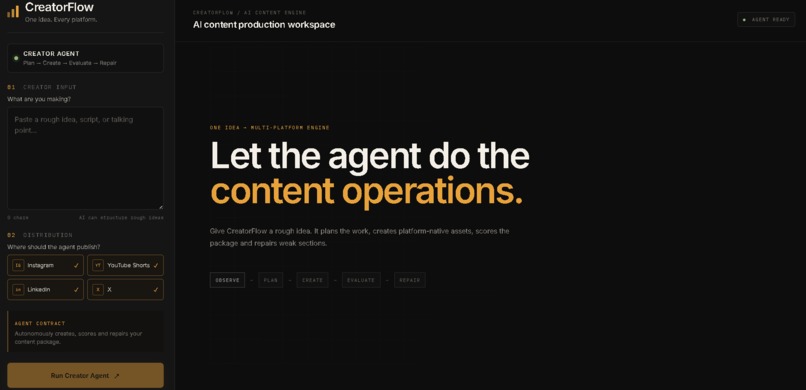
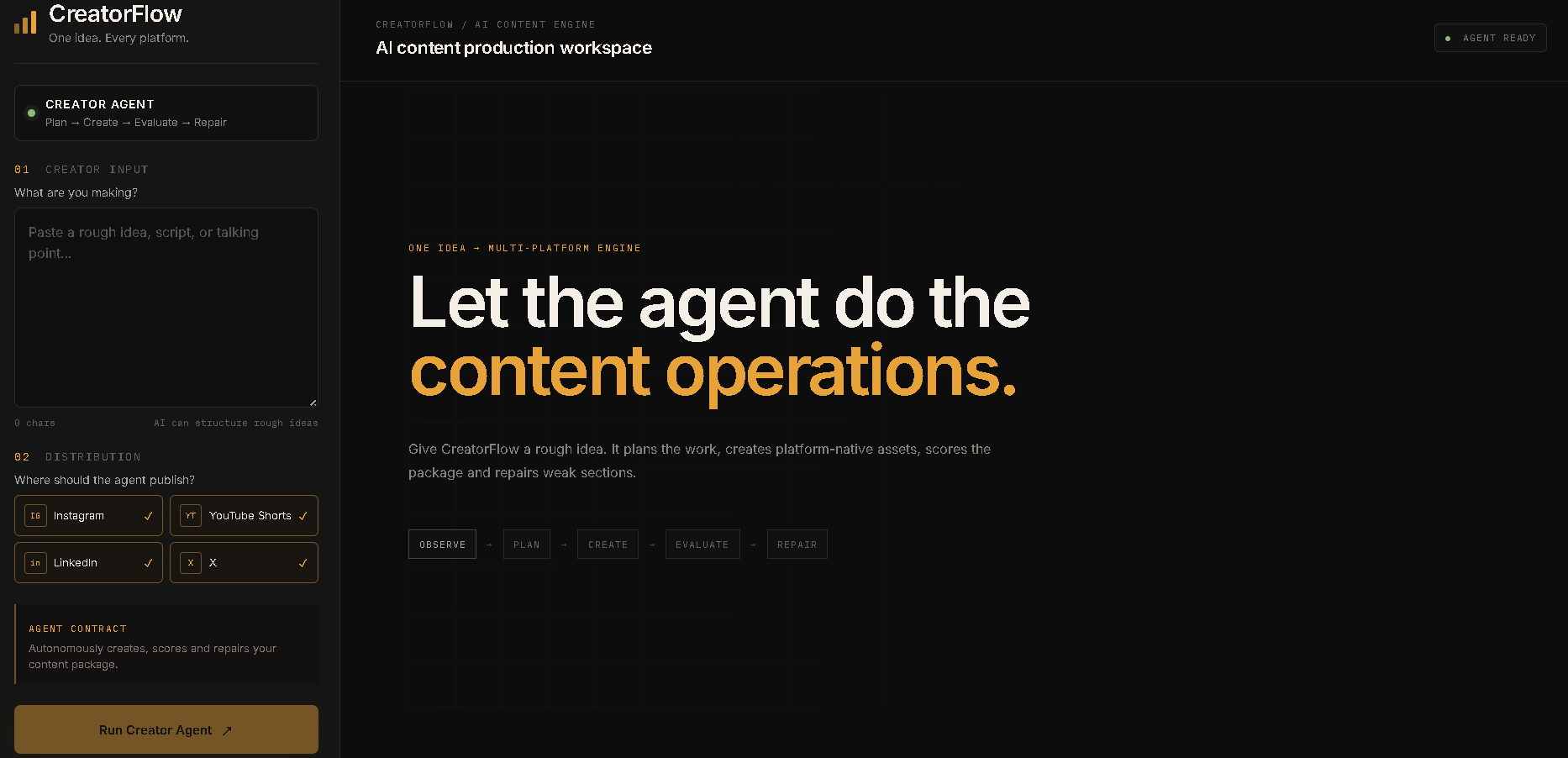
CreatorFlow’s autonomous content workspace: one idea → multi-platform content, with built-in evaluation and repair.
-
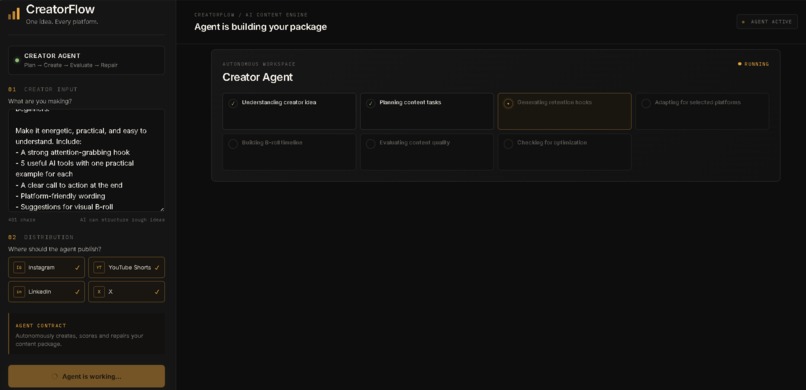
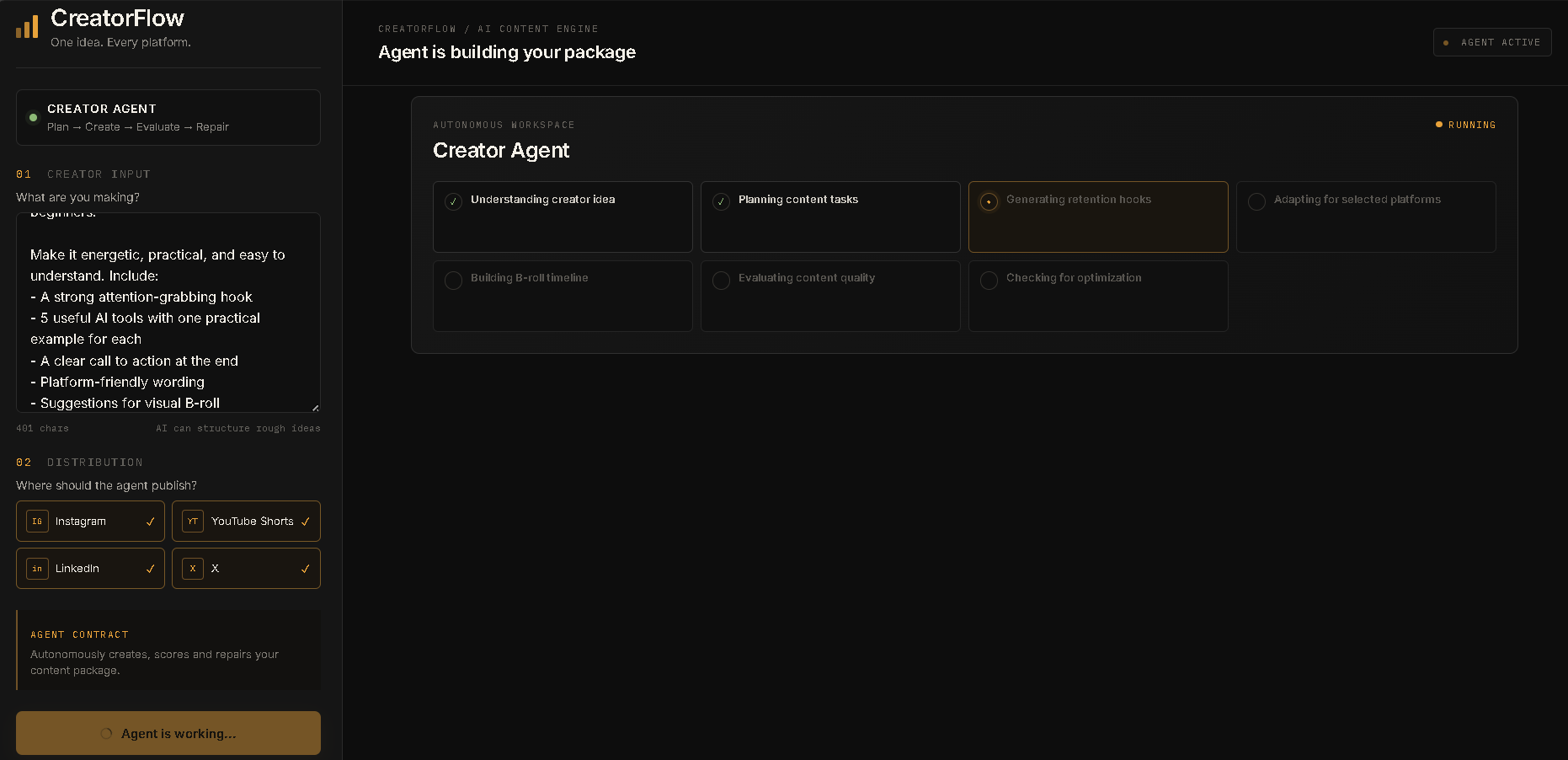
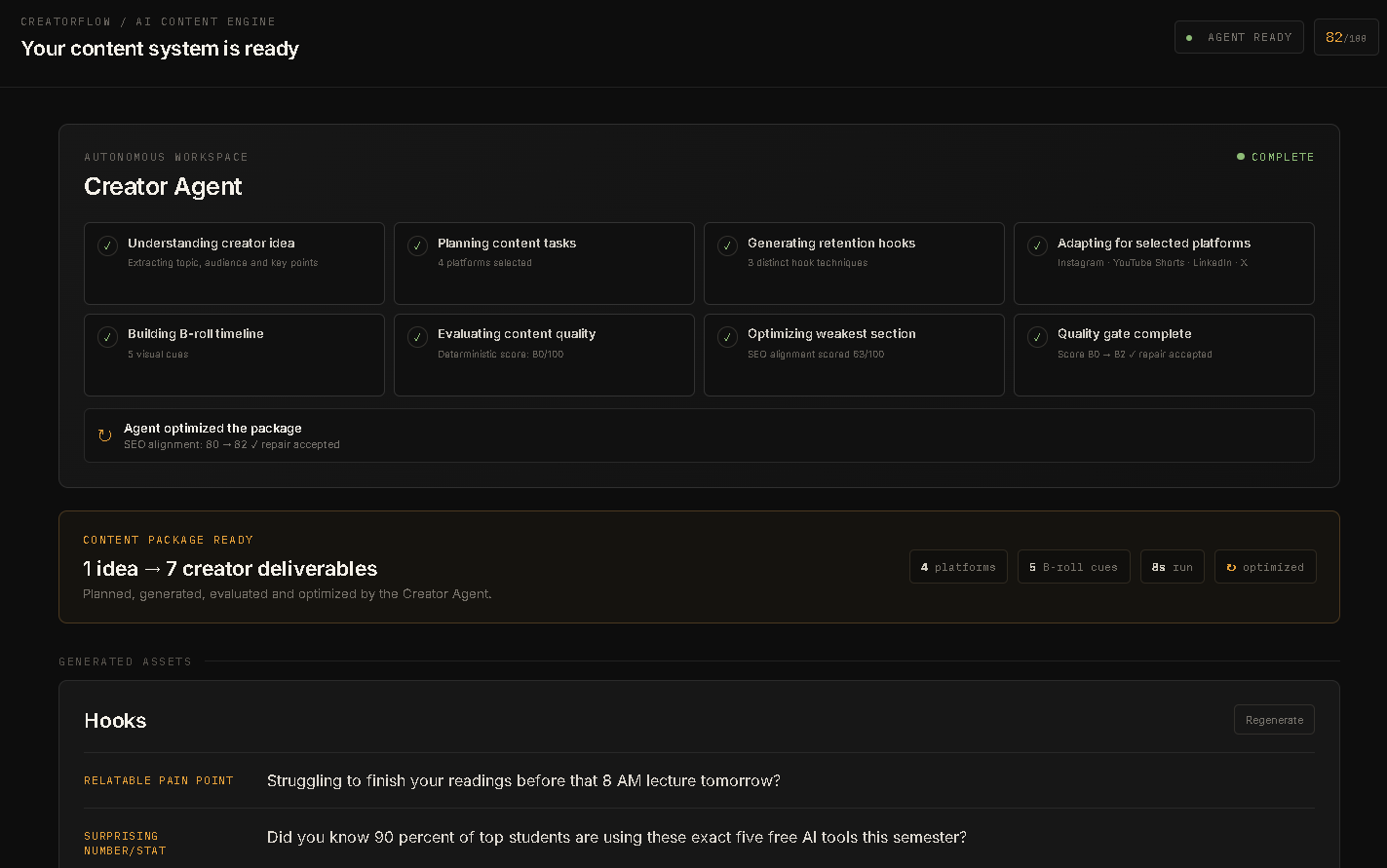
The Creator Agent autonomously executes the content-production workflow from idea to multi-platform assets.
-
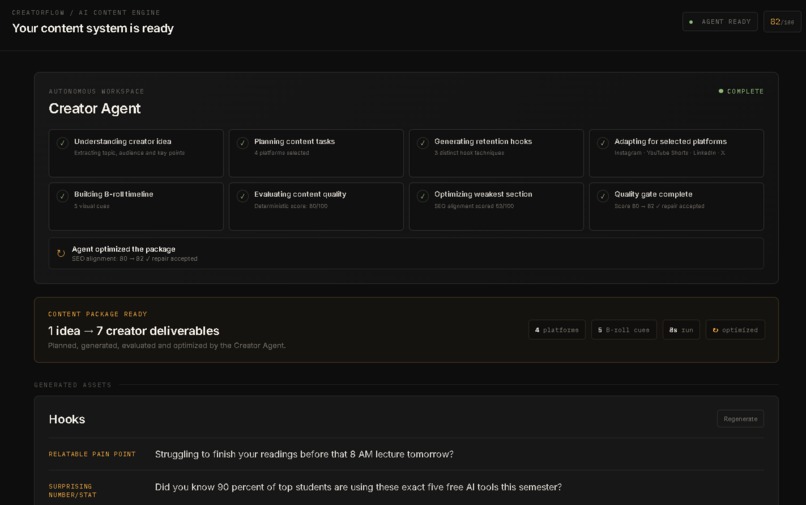
The Creator Agent evaluates content quality and automatically repairs weak sections, improving the score from 80 to 82.
-

-
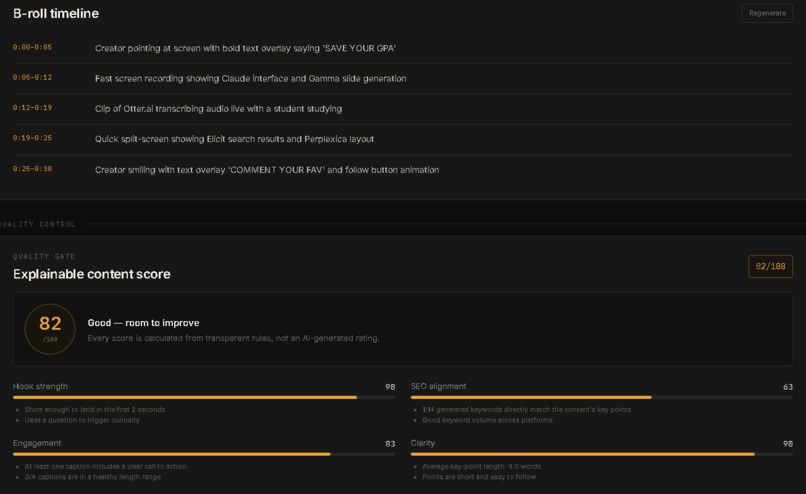

CreatorFlow — AI Content Production Agent
The Problem
Creating content is no longer just about having a good idea.
After writing a script, creators still have to create hooks, plan thumbnails, write platform-specific captions, research SEO keywords, choose hashtags, plan B-roll, and evaluate whether the content is strong enough to publish.
This creates a repetitive workflow where creators constantly switch between different AI tools and manually coordinate the results.
CreatorFlow turns this fragmented process into one automated workflow.
Our Solution
CreatorFlow is an AI-powered content production agent that transforms a single script or rough idea into a complete, platform-ready content package.
Instead of simply generating one response to one prompt, CreatorFlow manages a bounded content-production workflow:
OBSERVE → PLAN → CREATE → EVALUATE → REPAIR → FINALIZE
The creator provides one idea or script and selects the platforms they want to target.
CreatorFlow then:
- Analyzes the topic, audience, and key points
- Generates multiple high-impact hooks
- Creates a thumbnail concept
- Generates platform-specific content
- Produces SEO keywords and hashtags
- Creates a timestamped B-roll plan
- Evaluates the generated package
- Identifies weak areas
- Automatically performs a targeted repair when needed
- Presents the final content package in one workspace
What Makes CreatorFlow Different?
Most AI content tools follow:
Prompt → AI → Output
CreatorFlow instead follows:
Idea → Observe → Plan → Create → Evaluate → Repair → Finalize
This makes CreatorFlow an AI content-production agent, rather than just another text generator.
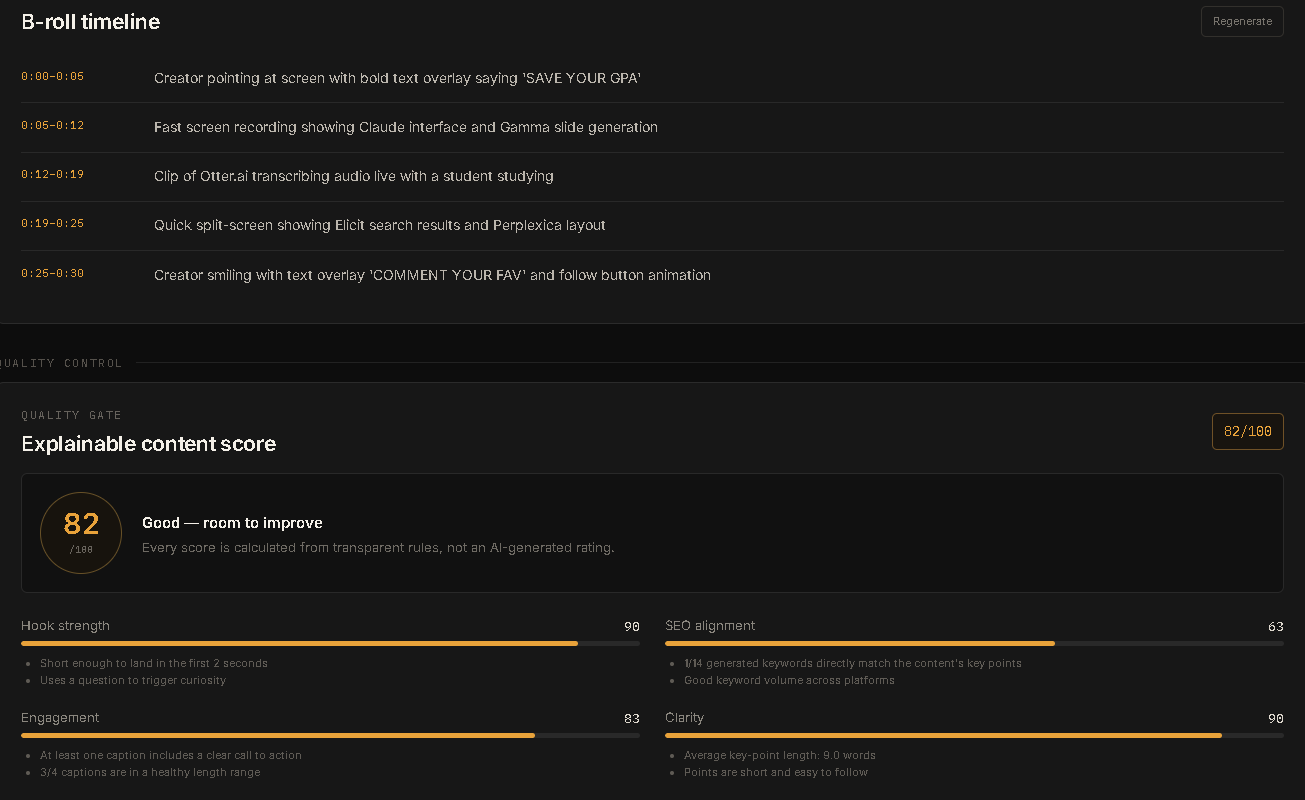
The system also uses an explainable deterministic quality score based on:
- Hook strength
- SEO alignment
- Engagement potential
- Clarity
This allows the system to identify where the generated content needs improvement instead of blindly regenerating everything.
How It Works
1. Observe
The agent analyzes the creator's script or idea to understand its topic, audience, structure, and key points.
2. Plan
It determines the content assets required for the selected distribution platforms.
3. Create
Specialized content operations generate hooks, thumbnail concepts, platform-specific captions, SEO keywords, hashtags, and B-roll suggestions.
4. Evaluate
CreatorFlow evaluates the resulting package using an explainable quality-scoring system.
5. Repair
If a weak area is detected, the agent performs a targeted regeneration instead of restarting the entire workflow.
6. Finalize
The creator receives one organized package containing the assets needed to take the idea toward publication.
Example
A creator can enter:
"5 things every college student should know before starting their first internship."
From that single idea, CreatorFlow can generate:
- 3 different hooks
- A thumbnail concept
- Instagram content
- YouTube Shorts content
- LinkedIn content
- X content
- SEO keywords
- Hashtags
- Posting guidance
- A timestamped B-roll timeline
- An explainable quality score
The creator no longer has to manually coordinate each step.
Technology
CreatorFlow is built with:
- React
- Vite
- Node.js
- Express
- Google Gemini 2.5 Flash
- JavaScript-based deterministic scoring
The frontend communicates with our Node.js backend, which handles the AI orchestration and keeps the Gemini API credential on the server side.
Why It Matters
Creators are under pressure to publish consistently across multiple platforms, but the operational work surrounding content creation can consume as much time as creating the original idea.
CreatorFlow focuses on automating that operational layer.
One idea in. A complete, optimized content package out.
What We Learned
Building CreatorFlow taught us that an effective AI agent is not simply about generating better text.
The important part is designing the workflow around the model:
- Breaking a large task into specialized operations
- Running independent operations efficiently
- Evaluating generated results
- Identifying the weakest component
- Performing targeted repairs
- Giving the user an explainable final result
Our goal was to make AI behave less like a chatbot and more like a production teammate.
Future Improvements
Future versions could include:
- Direct publishing integrations
- Real-time streaming agent activity
- AI-generated thumbnail images
- Automatic video editing
- Creator-specific brand memory
- Performance feedback from published content
- Learning from historical engagement data
- More social platforms
Built With
- 2.5
- agents
- ai
- artificial
- automation
- content
- express.js
- flash
- gemini
- generative
- intelligence
- javascript
- language
- natural
- node.js
- processing
- react
- vite


Log in or sign up for Devpost to join the conversation.