-
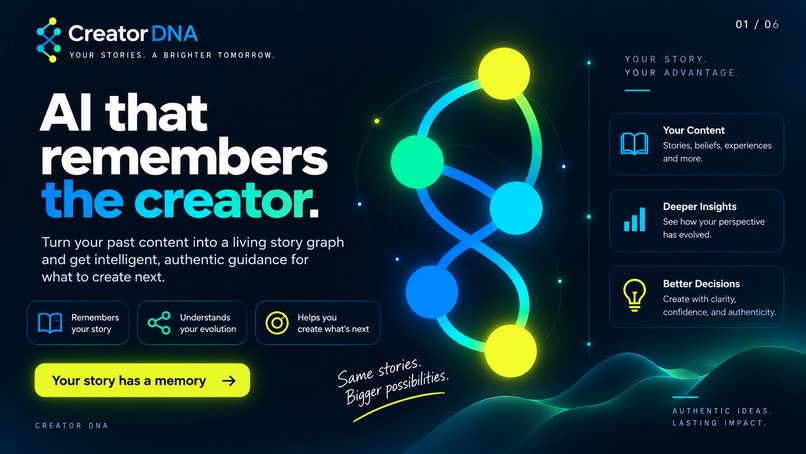
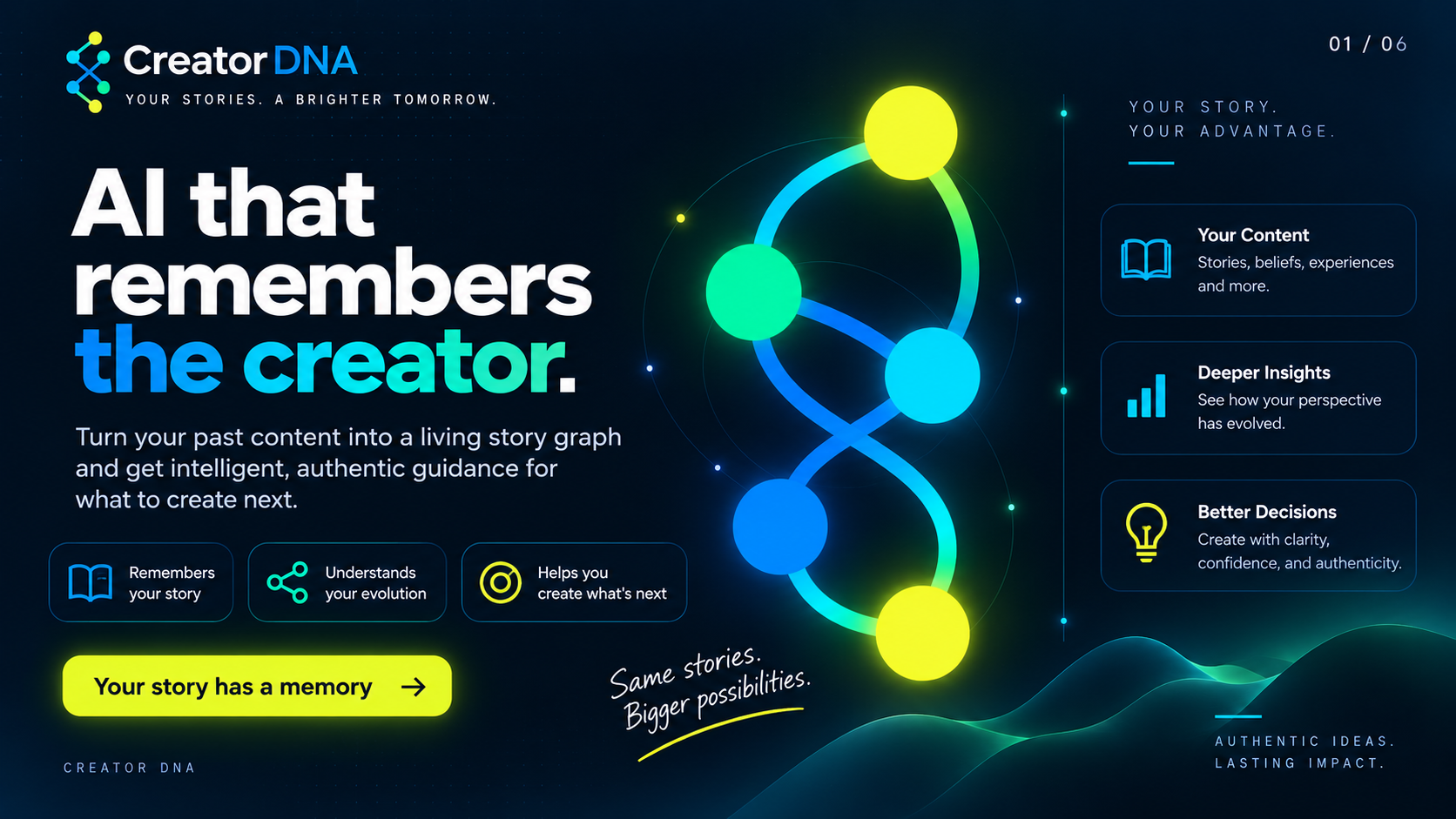
AI That Remembers the Creator
-
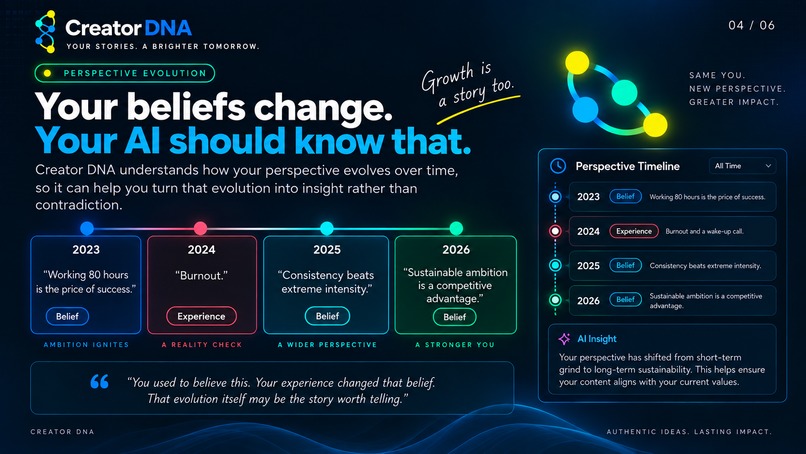
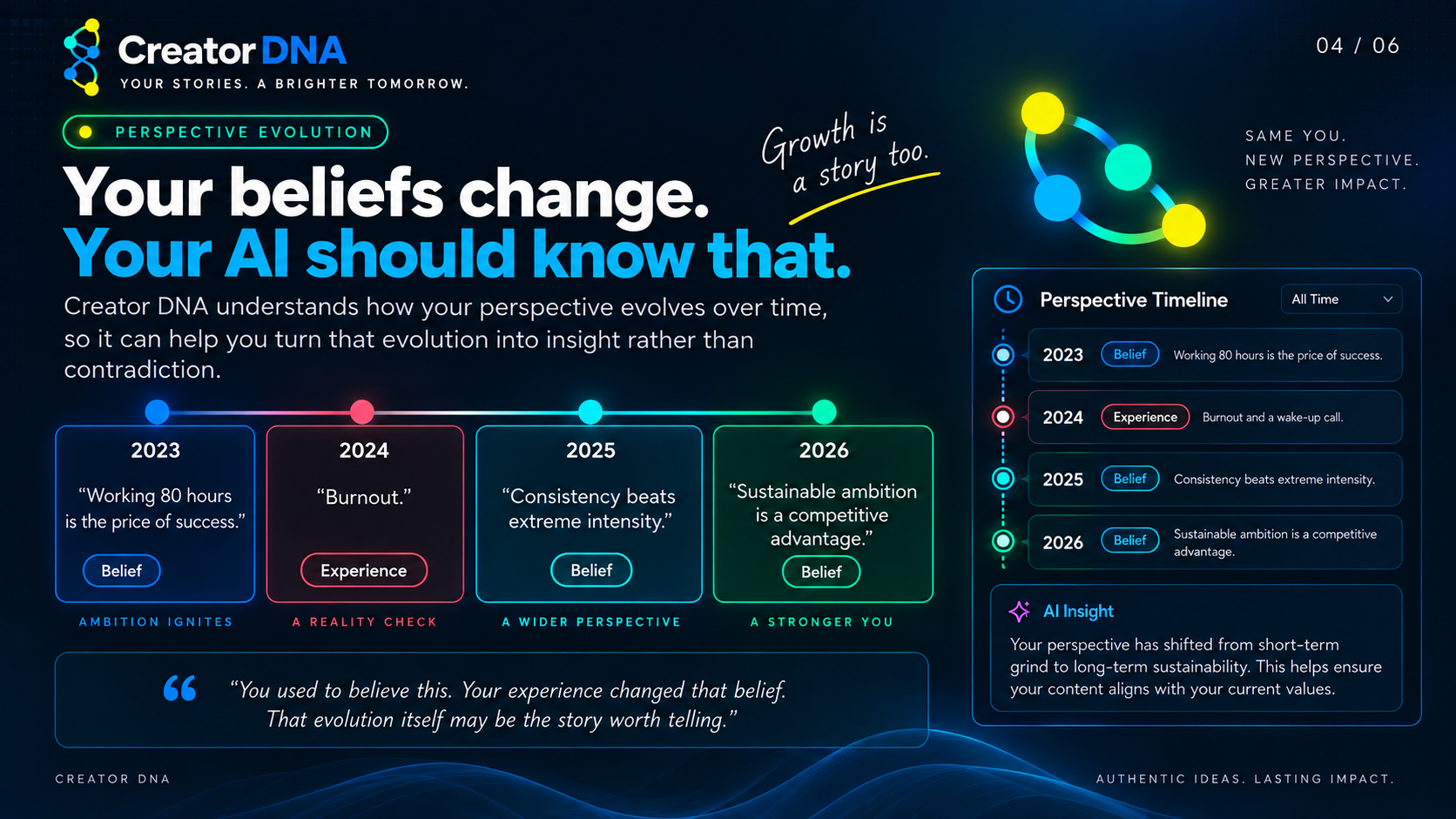
Your Beliefs Change. Your AI Should Know That.
-
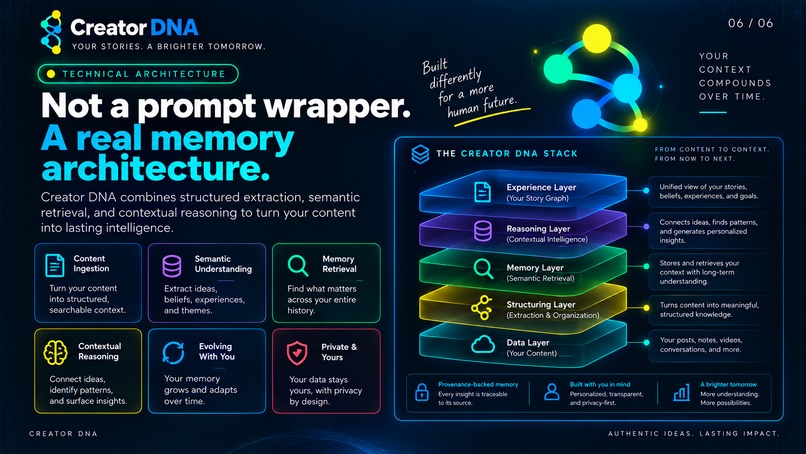
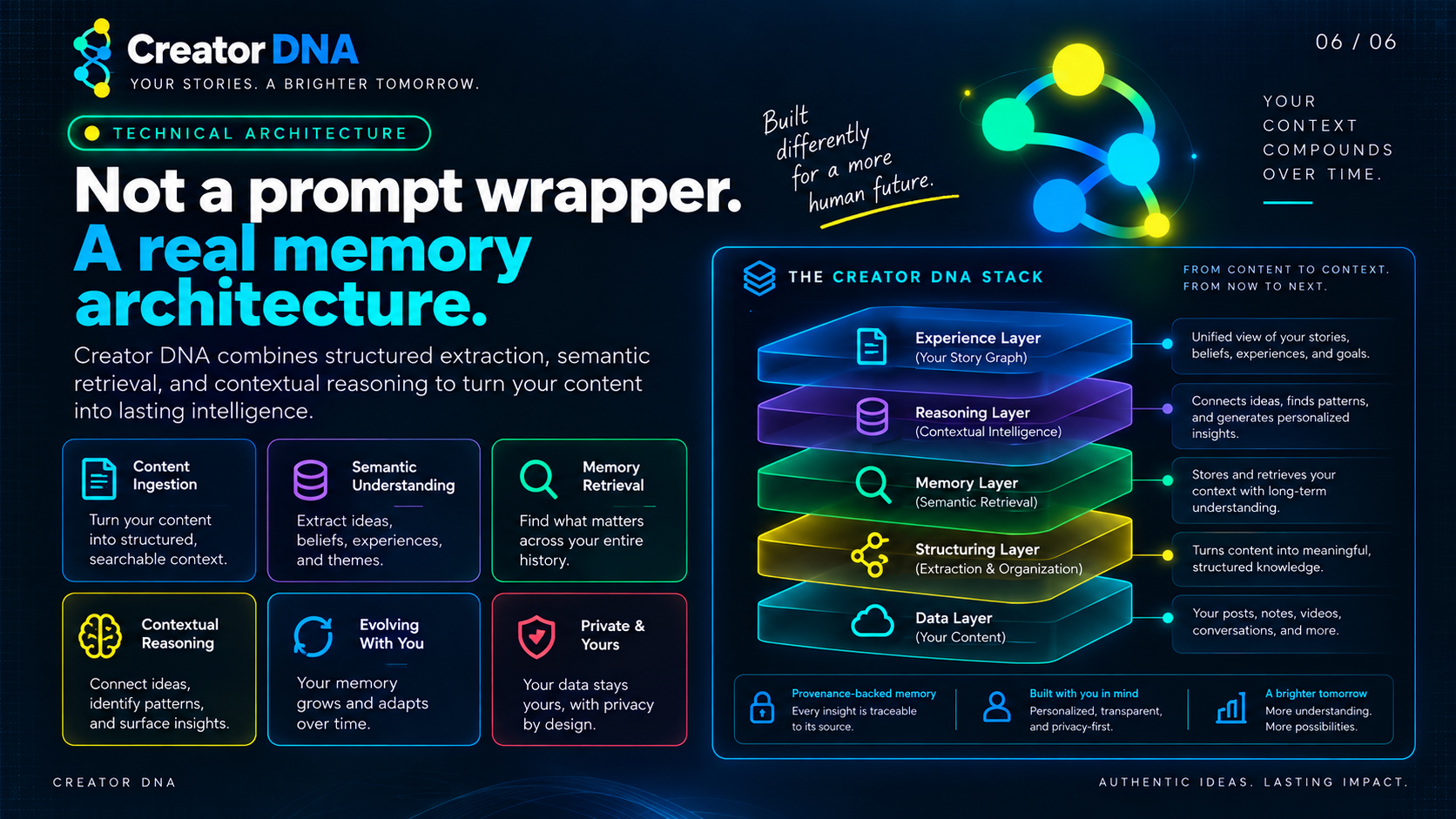
Not a Prompt Wrapper. A Real Memory Architecture.
-
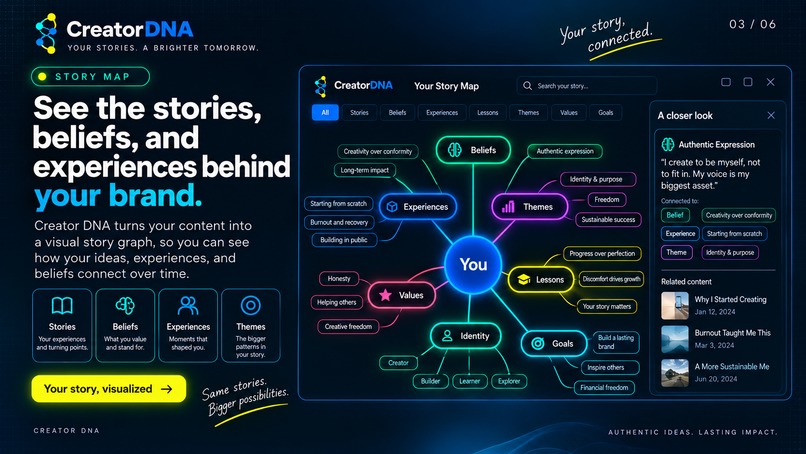
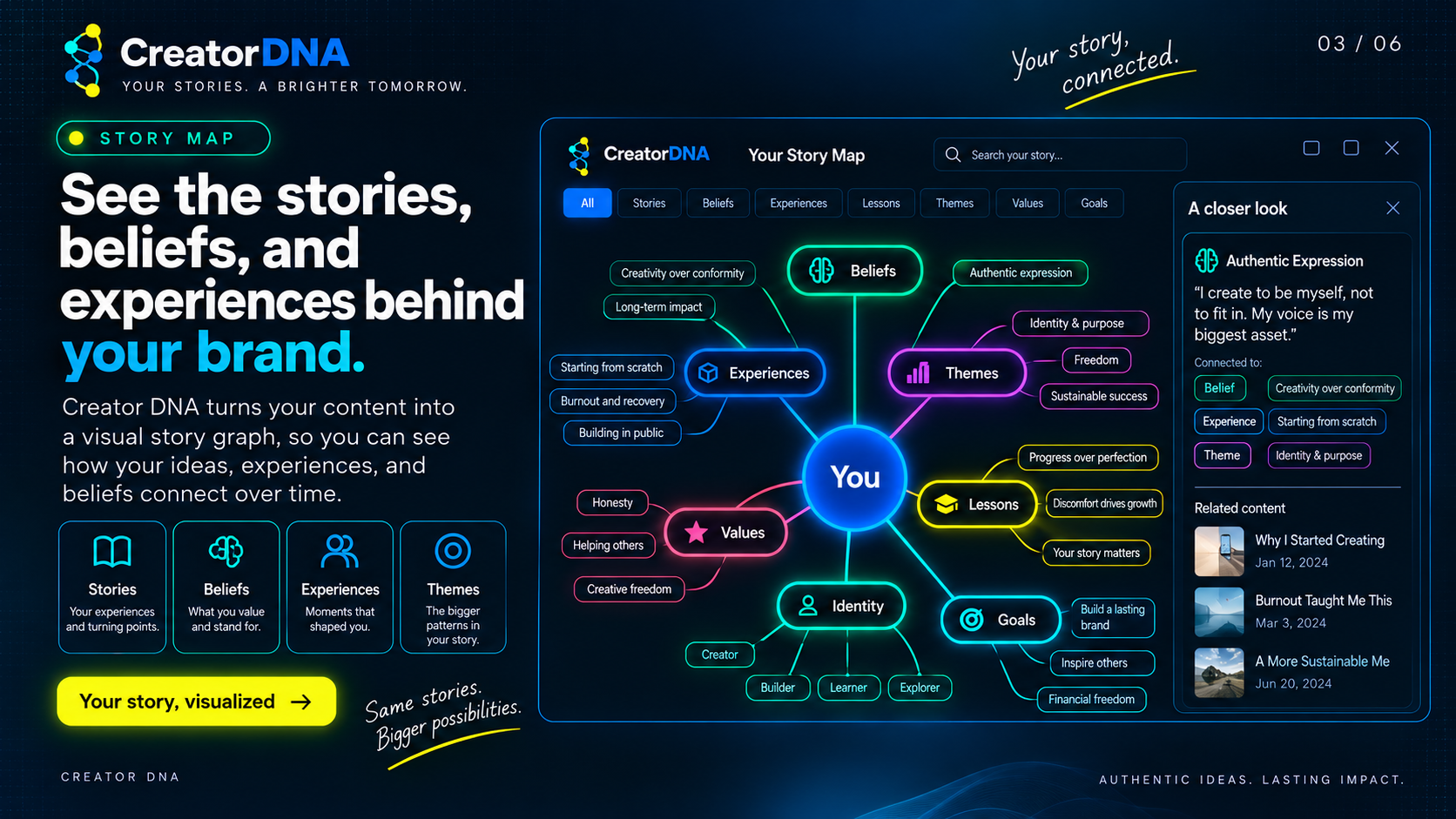
See the Stories Behind Your Brand
-
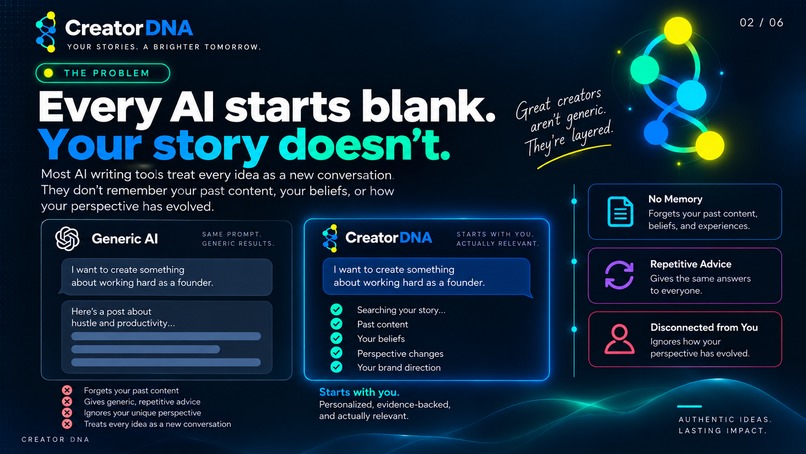
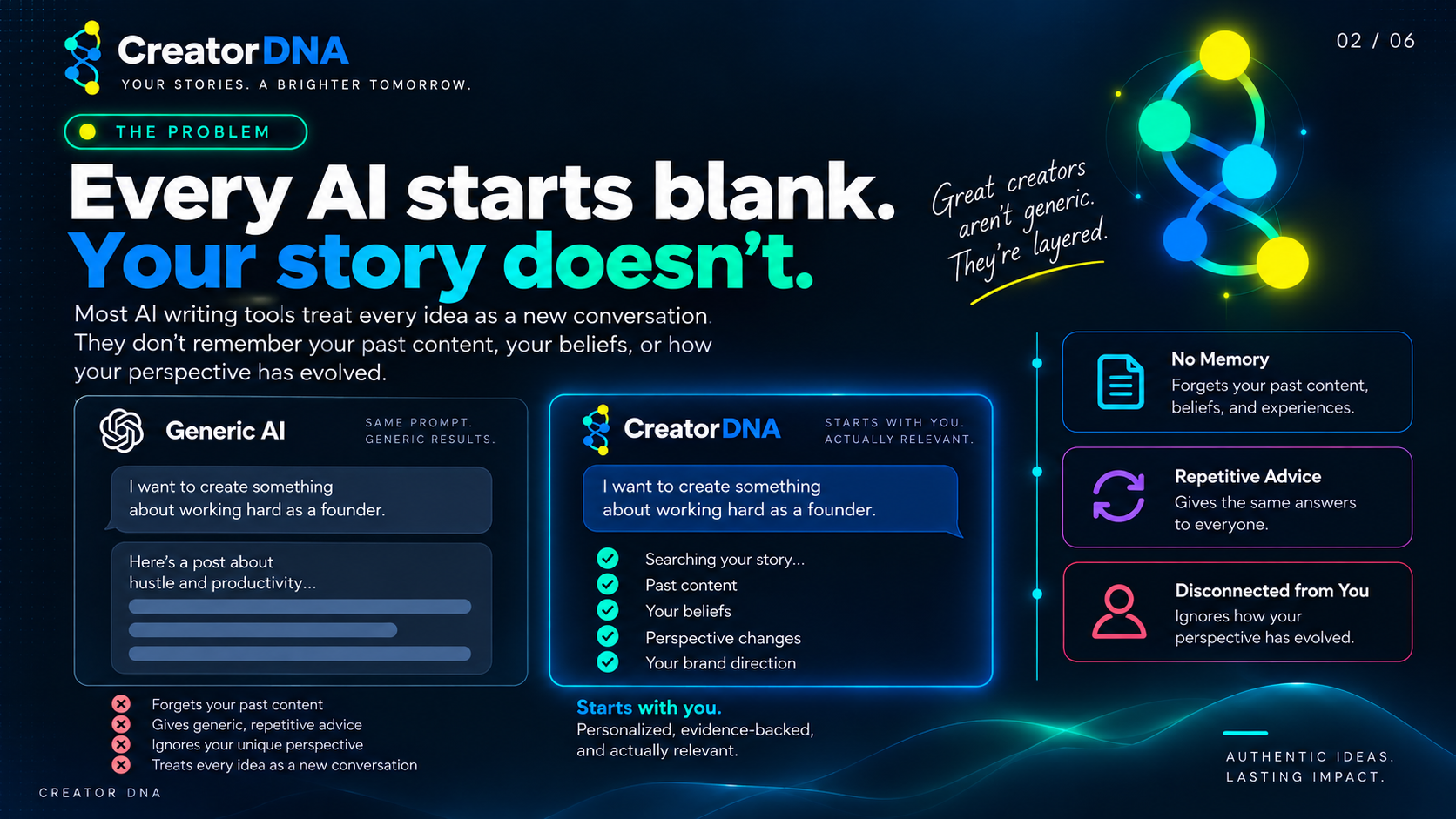
Every AI Starts Blank. Your Story Doesn’t.
-
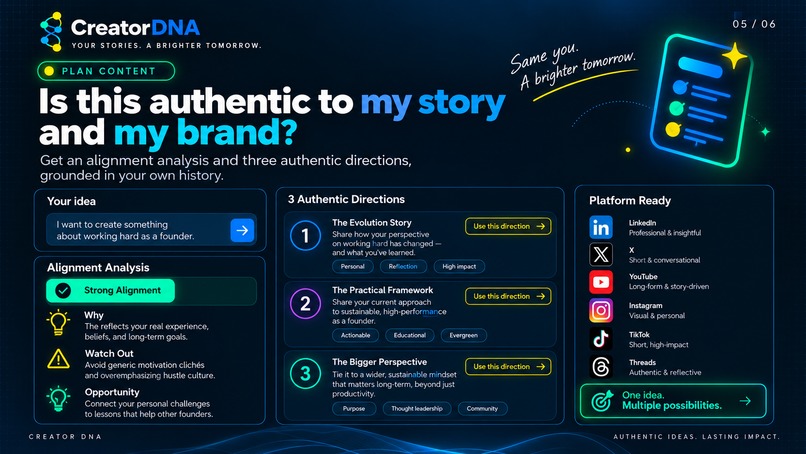
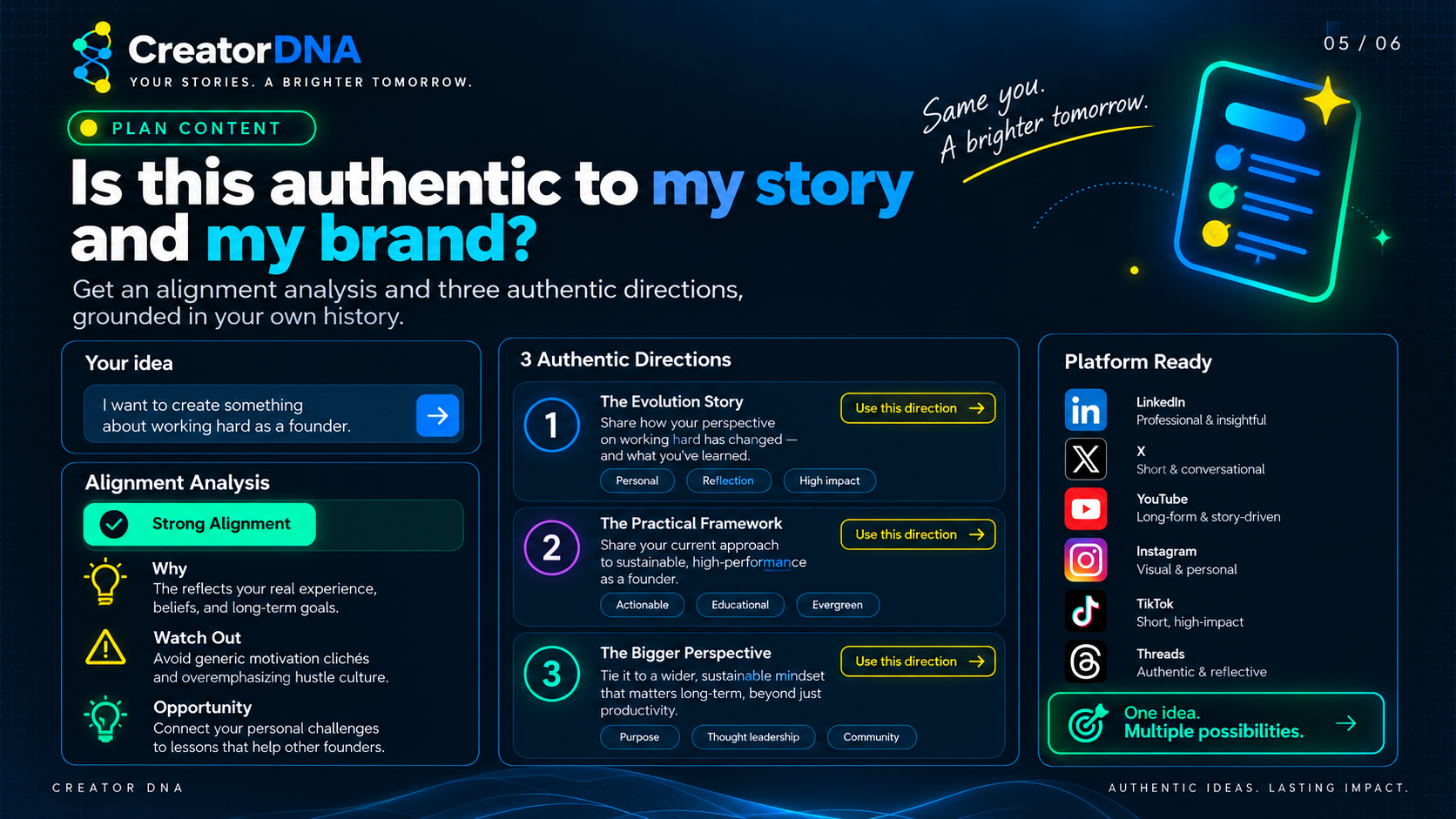
Is This Authentic to My Story and My Brand?
Try Creator DNA
Live Demo: https://creator-dna-pi.vercel.app
GitHub: https://github.com/Aishwaryajakka/CreatorDNA
Built solo by Aishwarya Jakka.
Demo Account
Email: [email protected]
Password: CreatorDNA!Demo26
Best demo prompt
Inside Plan Content, try:
“I want to create something about working hard as a founder.”
Jordan's seeded history evolves from intense hustle culture to burnout, consistency, recovery, and sustainable ambition — so Creator DNA can surface the belief evolution instead of giving generic founder advice.
Inspiration
The idea for Creator DNA came from a problem I had seen from several different angles.
During both my undergraduate and graduate studies, I worked on social media campaigns and spent a lot of time thinking about how brands maintain a consistent identity over time. I have also watched creators grow audiences, shift niches, reinvent themselves, and sometimes drift so far from their original voice that they need to step away and figure out what they actually want to say again.
The more content someone creates, the harder it becomes to remember their own history.
Stories get repeated. Beliefs change. New topics get introduced. Old opinions stay online. Eventually, even the creator can lose sight of the narrative connecting everything they have made.
That felt personal to me because authenticity is something I care deeply about.
Recently, I have also been auditing my own life story: looking at the experiences that shaped me, the things I used to believe, what I believe now, and where I want to go next. At the same time, I was thinking about creating more content myself.
That led to one question:
What if I had a tool that understood my story before helping me create content?
Not another AI that could imitate the way I write.
I wanted something that could remember what I had said, identify the stories and beliefs underneath it, map how those ideas connected, notice where my perspective changed, and help me answer:
“Is this authentic to my story and my brand?”
And then:
“Where should I take this idea next?”
That became Creator DNA.
Don’t build an AI that writes like the creator. Build an AI that remembers the creator.
What it does
Creator DNA turns a creator’s existing body of work into a persistent narrative memory.
Creators bring in past content, and Creator DNA extracts signals such as:
- stories
- beliefs
- themes
- experiences
- lessons
- values
- goals
- identity
- expertise
Those signals become a Creator Story Graph, so the product can understand relationships between ideas over time instead of treating every post as an isolated document.
The creator also defines a Creator Foundation — who they believe they are today — and Brand Territories, the areas they want to become known for.
When a creator enters a new idea, Creator DNA retrieves the most relevant parts of their history and asks questions a generic writing assistant usually cannot:
- Have I talked about this before?
- What personal story could ground this idea?
- Has my opinion changed?
- Would this contradict a newer belief?
- Is this authentic but repetitive?
- Does this fit where I want my brand to go?
Creator DNA then evaluates the idea as:
Strong · Mixed · Weak · Insufficient Evidence
It explains:
- Why
- Watch Out
- Opportunity
Then it returns exactly three authentic directions grounded in the creator’s own history.
Each direction can be reshaped to be:
- Closer to my story
- Stronger point of view
- Fresh angle without repeating myself
Creator DNA also adapts the direction for LinkedIn, X, YouTube, or Threads without confusing platform style with personal authenticity.
The goal is not to automate the creator’s personality.
The goal is to help them create without drifting away from it.
How I built it
Creator DNA is built as a retrieval and reasoning system rather than a traditional AI writing wrapper.
At a high level:
Past Content
     ↓
Structured AI Extraction
     ↓
Creator DNA Nodes
     ↓
Jina Embeddings
     ↓
Supabase + pgvector
     ↓
New Content Idea
     ↓
Semantic Retrieval
     ↓
Creator Foundation + Brand Territories
     ↓
Story Intelligence
     ↓
Alignment + Perspective Evolution + Repetition
     ↓
3 Authentic Directions
I use Groq for structured extraction and narrative reasoning.
Each piece of content is broken into structured Creator DNA nodes such as stories, beliefs, themes, experiences, lessons, values, goals, identity, and expertise.
Those nodes preserve source evidence so Creator DNA can explain where its reasoning came from.
I use Jina AI embeddings as the semantic memory layer. This allows Creator DNA to retrieve relevant beliefs or experiences even when the new idea uses completely different wording from the original content.
The data is stored in Supabase/PostgreSQL with pgvector, with user-scoped retrieval and Row Level Security.
I also built a visual Story Map that turns Creator DNA into a graph of connected stories, beliefs, experiences, lessons, themes, identity, goals, values, and expertise.
For content ingestion:
- YouTube direct import works end-to-end
- LinkedIn OAuth is connected and working
- X OAuth is connected and working
- direct LinkedIn/X content import depends on additional provider API access and approvals
- manual content ingestion is available as a fallback
Once content enters Creator DNA, the same extraction, embedding, retrieval, and reasoning pipeline runs regardless of where it came from.
I also built Research Pulse, which connects current external research back to the creator’s Brand Territories, expertise, beliefs, themes, and goals.
Challenges I ran into
One of the biggest challenges was realizing that semantic similarity alone is not enough.
Finding a related old post is useful, but Creator DNA also has to understand time and evolution.
For example:
2023
“Working 80 hours is the price of success.”

2024
Burnout.

2025
“Consistency beats extreme intensity.”

2026
“Sustainable ambition is a competitive advantage.”
If that creator wants to make a post about working hard, a simple retrieval system might find the 2023 belief and conclude that intense work is still their position.
That would be wrong.
The older belief is relevant, but the creator’s perspective evolved.
That led me to separate three different layers:
- Historical Creator DNA — what the creator has actually said and experienced
- Creator Foundation — what they believe about themselves today
- Brand Territories — where they want their story to go next
Instead of treating contradiction as bad data, Creator DNA can recognize it as perspective evolution.
Another challenge was grounding.
I did not want the model to casually say things like:
“You’ve always believed this.”
just because it generated a convincing sentence.
Creator DNA keeps source evidence attached to its memories, validates retrieved nodes, and separates personal history from declared future direction and external research.
Provider APIs were another real-world challenge. YouTube offers a workable direct-import path, while LinkedIn and X place tighter restrictions around historical content access. I chose to surface those limitations honestly rather than simulate functionality that the providers do not currently allow.
Accomplishments that I'm proud of
I'm especially proud that Creator DNA is more than a prompt wrapper.
It has a real memory architecture behind it.
Some of the pieces I'm proudest of:
- turning raw content into structured Creator DNA nodes
- preserving provenance so the system can explain why something is relevant
- using Jina embeddings and pgvector for semantic memory
- building a visual Story Map instead of hiding everything inside a database
- distinguishing historical identity from current identity and future brand direction
- detecting perspective evolution instead of treating changing opinions as inconsistency
- grounding content planning in actual Creator DNA evidence
- producing exactly three authentic directions instead of generic post generation
- adapting those directions for different platforms
- implementing YouTube import end-to-end
- implementing LinkedIn and X OAuth connections
- building Research Pulse to connect current events back to the creator’s existing story
The part I'm most proud of is that the product can recognize something like:
“You used to believe this. Your experience changed that belief. That evolution itself may be the story worth telling.”
That is the moment where Creator DNA starts to feel meaningfully different from a generic AI writer.
What I learned
The biggest thing I learned is that memory may be more valuable to creators than generation.
There are already many tools that can produce a decent post from a prompt.
The harder problem is helping someone answer:
“Is this authentic to my story and my brand?”
And then:
“What is the strongest direction to take it?”
I also learned that authenticity is not the same thing as consistency.
A creator should be allowed to change their mind.
An older belief and a newer belief do not necessarily mean the creator is inconsistent. The distance between those beliefs may be the most meaningful story they can tell.
That changed how I thought about the product.
Creator DNA should not freeze creators into a historical version of themselves. It should remember where they came from while helping them grow without losing the thread.
On the technical side, I learned a lot about combining:
- structured LLM outputs
- semantic retrieval
- vector databases
- provenance
- user isolation
- OAuth integrations
- graph-like relationships
- external research
into one coherent system.
What's next for Creator DNA
I see Creator DNA becoming a persistent intelligence layer across a creator’s entire body of work.
As direct platform access expands, Creator DNA could continuously maintain a creator’s narrative memory across every place they publish.
The next major layer would be audience memory.
Not just:
“What have I said?”
but eventually:
“What parts of my story actually resonate with the people I’m trying to reach?”
I would want to approach that carefully.
The goal is not to turn authenticity into another optimization score.
The goal is to help creators grow without optimizing away the thing that made their voice theirs in the first place.
The long-term vision is not:
“Write like me.”
It is:
“Understand the story I’m building — and help me decide where it should go next.”
Built With
- generative-ai
- groq
- jina-ai
- jina-embeddings
- knowledge-graph
- large-language-models
- linkedin-api
- oauth-2.0
- perplexity-api
- pgvector
- postgresql
- react
- retrieval-augmented-generation
- row-level-security
- semantic-search
- supabase
- supabase-auth
- tailwind-css
- tanstack-router
- typescript
- vector-search
- vercel
- vite
- x-api
- youtube-data-api


Log in or sign up for Devpost to join the conversation.