Inspiration
What it does
How we built it
Challenges we ran into
Accomplishments that we're proud of
What we learned
What's next for CreatorClash
CreatorClash — Your Community. Your Competition. Your Victory.
- Inspiration: What if Watching Wasn’t Enough?
Live streaming has transformed entertainment. Platforms like Twitch have created massive communities around individual creators, games, and shared interests.
But we noticed an interesting opportunity.
Most viewers still experience streaming primarily as spectators. They watch creators play, send messages in chat, react to moments, and support their favourite streamers. While these interactions are valuable, there is an opportunity to make audiences more involved in what happens during a stream.
What if viewers could become part of the competition instead of simply watching it?
What if they could challenge creators, participate in interactive games, influence competition formats, and compete alongside their favourite communities?
That question inspired us to build CreatorClash.
We envisioned a platform where creators are not just entertainers and viewers are not just spectators. Instead, both become participants in a shared competitive experience.
Our goal is to build a new engagement layer around live streaming — one where communities have meaningful ways to participate, creators have new ways to entertain their audiences, and AI helps make creating competitions easier.
- What Is CreatorClash?
CreatorClash is an AI-powered creator competition and audience-engagement platform designed as a companion experience for Twitch.
Twitch remains the streaming destination, while CreatorClash provides an additional environment where creators and their communities can discover, organize, and participate in competitive experiences.
The platform revolves around three core ideas:
- Creators create the competition.
- Communities participate in the competition.
- AI helps make competitions easier to create and manage.
Rather than building another streaming platform, we wanted to experiment with a different model of audience engagement.
CreatorClash brings two distinct experiences into one ecosystem.
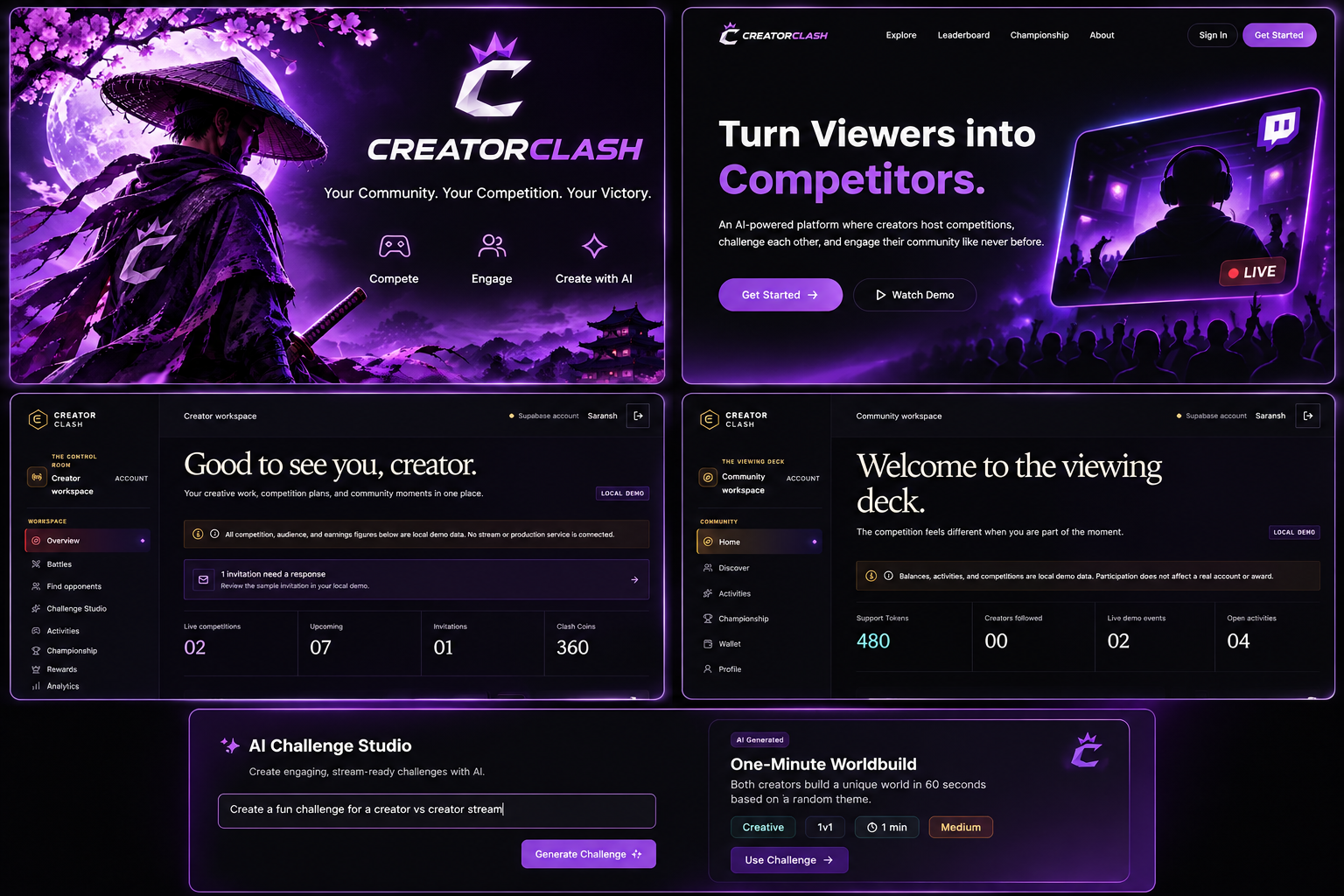
A. Creator Workspace — The Control Room
The Creator Workspace gives creators a dedicated environment to manage their competitive activities.
Its features include:
- Overview Dashboard: A central view of competitions, upcoming events, invitations, and creator activity.
- Battles: A dedicated space for creator competitions.
- Find Opponents: Discover other creators and potential competition partners.
- AI Challenge Director: Generate structured challenge ideas with different formats, rules, and difficulty levels.
- Activities: Explore interactive experiences that can be used to engage audiences.
- Championship: Participate in larger community-driven competitive events.
- Rewards and Analytics: Explore the platform’s reward and performance-oriented interfaces.
We wanted creators to have more than a traditional streaming dashboard. We wanted to give them a place to turn their content into competitive experiences.
B. Community Workspace — The Viewing Deck
A competition is only as exciting as the people participating in it.
The Community Workspace is designed around the viewer’s experience.
It provides:
- Discover: Find creators and explore the platform.
- Activities: Participate in interactive games and challenges.
- Championship: Follow community-driven competitions.
- Support Tokens: A participation-oriented virtual token system.
- Wallet: View the community’s token balance and related activity.
- Profile: Manage the community member’s platform identity.
The intention is to give viewers more reasons to engage beyond watching a stream.
Instead of simply following a creator, viewers can become part of the experiences that creator organizes.
C. AI Challenge Director
One of our central ideas is that creators should not need to invent every competition from scratch.
The AI Challenge Director is designed to help creators generate structured challenge ideas.
It focuses on:
- Challenge concepts.
- Competition formats.
- Difficulty levels.
- Rules and objectives.
- Suggested durations.
This makes it easier to create new competitive experiences without requiring creators to spend significant time planning every detail.
We see AI as a creative assistant that reduces the effort required to organize engaging activities.
D. Interactive Mini-Games
Not every creator plays competitive video games, and not every viewer is an experienced gamer.
We wanted CreatorClash to be accessible to a wider range of communities.
That is why we incorporated lightweight interactive experiences, including:
- Quick Quiz.
- Reaction Rush.
- Guess the Majority.
These experiences explore different forms of participation and make competition possible beyond traditional gaming.
E. Popularity Championship
We also designed the Popularity Championship as a recurring community-driven competition.
The concept revolves around creators competing while their communities rally behind them.
Rather than limiting competition to gameplay performance, it explores another dimension of streaming culture: community participation and creator popularity.
It gives audiences a shared event to follow and a reason to support their favourite creators.
⸻
- How We Built It
We approached CreatorClash as a full-stack web application rather than a static design prototype.
Our development focused on creating a unified platform with separate experiences for creators and community members.
Technology Stack
Technology Purpose React 19 Frontend application TypeScript Type safety and maintainable development Vite Development server and build tooling Tailwind CSS Interface styling Node.js Backend runtime Express Backend API Supabase Database and authentication infrastructure PostgreSQL Relational data storage Twitch API / OAuth Planned creator account integration Codex AI-assisted development and debugging
Frontend Architecture
We used React and TypeScript to develop the user interface.
The application includes separate creator and community workspaces, navigation systems, dashboards, interactive experiences, and supporting pages.
We wanted the interface to feel like a competitive arena rather than a conventional administration dashboard.
This influenced our visual direction:
- Dark cinematic backgrounds.
- Samurai-inspired visual identity.
- Purple and violet highlights.
- Gold accents.
- Strong typography.
- Interactive cards and structured layouts.
The result is a visual identity that connects the competitive theme with a modern creator platform.
Backend Architecture
We used Node.js and Express to develop the backend API.
The backend is responsible for handling application workflows and providing an organized interface between the frontend and supporting services.
We also worked on database structures and backend workflows for the platform’s different features.
Supabase provides the database and authentication infrastructure.
Twitch Integration
An important part of our vision is connecting CreatorClash with Twitch.
We designed an OAuth-based integration workflow intended to associate creator accounts with their CreatorClash identities.
The implementation includes work on:
- OAuth authorization and callback handling.
- State validation.
- Account ownership.
- Token handling and encryption.
- Twitch profile and stream information workflows.
The integration is an important part of the architecture, although live account-linking verification remains incomplete in the current demonstration.
We deliberately distinguish the implemented integration work from a fully verified production connection.
⸻
- How We Used Codex
Codex played a major role in our development workflow.
We used it as an AI-assisted engineering partner throughout the process of designing, implementing, and refining CreatorClash.
Rather than treating AI as a tool that simply generates isolated code snippets, we used Codex to help us work across different parts of the application.
Our workflow included:
- Frontend Development
We used Codex to accelerate the development of React components, application layouts, workspace interfaces, and interactive user experiences.
- Backend Development
Codex helped us implement and refine Express API routes, backend logic, and application workflows.
- Database Workflows
We used Codex to work on Supabase database schemas, SQL migrations, relationships, and backend data operations.
- API Integration
We used Codex while implementing the Twitch integration architecture and associated authentication workflows.
- Debugging and Code Quality
We used it to investigate errors, understand implementation issues, improve code structure, and run checks across the project.
- Iterative Development
One of the biggest advantages was the ability to move between different layers of the application.
We could work on a frontend experience, investigate its backend requirements, refine the database structure, and return to the interface without treating each layer as an entirely separate project.
Codex helped accelerate this process, although we still needed to review implementation decisions, test functionality, and resolve integration issues ourselves.
⸻
- Challenges We Faced
Building CreatorClash involved several challenges that went beyond simply creating an attractive interface.
Challenge 1: Designing Two Different User Experiences
One of our first challenges was figuring out how to serve creators and viewers within the same application.
Creators need tools to organize competitions, discover opponents, and manage activities.
Viewers need simple ways to discover creators, participate in challenges, and follow competitions.
Combining these experiences without making the application confusing required us to think carefully about navigation, permissions, workflows, and information architecture.
Our solution was to create two distinct workspaces:
- Creator Workspace — The Control Room.
- Community Workspace — The Viewing Deck.
Both experiences belong to the same ecosystem but serve different user needs.
Challenge 2: Making Competition Accessible
Initially, it was easy to think of creator competitions as gaming competitions.
However, this would exclude creators who produce content outside traditional gaming categories.
We therefore explored lightweight interactive experiences such as quizzes, reaction challenges, and prediction-based games.
This helped us think beyond gameplay and focus on the broader concept of participation.
Challenge 3: Designing AI-Assisted Challenge Creation
We wanted AI to provide more than generic suggestions.
A useful challenge needs a clear objective, format, difficulty, rules, and duration.
This required us to think about how AI-generated ideas could be structured into something creators could actually use.
The AI Challenge Director represents our approach to making competition creation more accessible.
Challenge 4: Twitch Authentication and Integration
Connecting an external platform introduces challenges that do not exist in a standalone application.
OAuth requires correct redirect configuration, state validation, secure token handling, and account ownership checks.
We worked through the backend architecture and security requirements, but live Twitch account-linking verification remained an unfinished part of our hackathon demonstration.
This taught us that designing an integration and successfully verifying it against a live external service are two different engineering milestones.
Challenge 5: Managing Scope Under Time Constraints
CreatorClash has multiple interconnected components:
- Authentication.
- Creator and community workspaces.
- Competition workflows.
- AI-assisted challenge generation.
- Interactive activities.
- Token systems.
- Championship experiences.
- External platform integration.
Building all these components within a limited hackathon timeline required prioritization.
We had to balance product vision, interface quality, backend implementation, and integration work.
We learned that a large product idea needs to be divided into smaller, independently testable systems.
⸻
- What We Learned
CreatorClash was not just an exercise in building a web application. It was an opportunity to understand how different engineering disciplines come together to create a product.
Some of our biggest learnings were:
Full-Stack Development: We gained experience working across frontend architecture, backend APIs, relational databases, authentication, and external integrations.
AI-Assisted Engineering: We learned how to use Codex as part of an iterative engineering workflow rather than relying on one-shot code generation.
System Design: We learned why separating user experiences, defining data relationships, and organizing backend responsibilities matter as an application grows.
Security: Working on OAuth and token handling helped us appreciate the importance of authentication state, account ownership, encryption, and server-side validation.
Product Thinking: We learned that building a feature is not enough. It must solve a genuine user problem and fit into a coherent experience.
Scope Management: Perhaps our most important lesson was learning to distinguish between a feature that looks complete, one that works locally, and one that has been verified against a real external service.
⸻
- What’s Next?
CreatorClash is an early step toward a broader vision of interactive creator communities.
There are several directions we would like to explore next:
- Complete and verify the live Twitch OAuth integration.
- Connect competition workflows to real-time streaming events.
- Develop more interactive community-driven challenges.
- Expand the AI Challenge Director with more advanced challenge generation and management.
- Develop stronger real-time audience participation and voting.
- Improve competition matchmaking and creator discovery.
- Introduce more sophisticated community rewards and progression systems.
- Test the platform with real creators and their communities.
Our long-term goal is to make CreatorClash a place where communities do not simply follow creators — they actively shape the experiences around them.
⸻
- The Vision
We believe the future of live streaming can be more interactive.
Creators bring the entertainment. Communities bring the energy. Technology creates new ways for them to participate together.
CreatorClash is our attempt to bring those elements into one competitive ecosystem.
We didn’t want to build another platform where people simply watch.
We wanted to build an arena where everyone has a reason to participate.
CreatorClash
Your Community. Your Competition. Your Victory.
Built With
- api
- artificial
- codex
- creator
- css
- economy
- express.js
- html
- javascript
- node.js
- oauth
- openai
- postgresql
- react
- rest
- supabase
- tailwind
- twitch
- typescript
- vite
